Walter Arrives Quietly
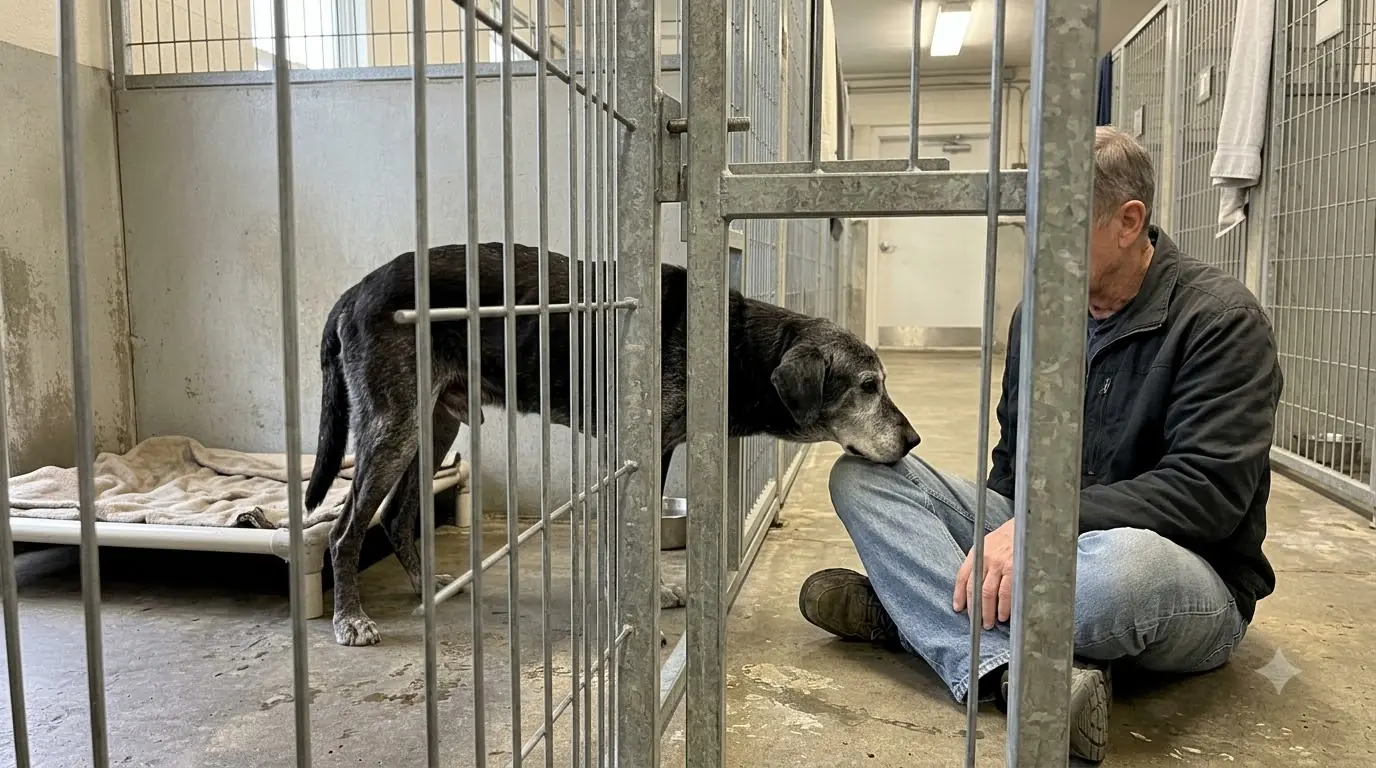
Walter did not make a dramatic entrance when he arrived at the shelter.
There was no barking.
No pulling at the leash.
No frantic pacing.
The 11-year-old Labrador Retriever mix simply moved slowly.
His body condition immediately concerned staff.
Walter was significantly underweight.
His ribs were easy to feel.
Muscle loss was especially obvious over his hips and hindquarters.
His coat had thinned with age, and his gray muzzle made him look every bit like the senior dog he was.
His eyes were cloudy.
His joints were stiff.
When he stood for too long, he shifted his weight repeatedly as though trying to find a position that hurt less.
Staff quickly realized that Walter did not need to be encouraged to “perk up.”
He needed rest.
A thick orthopedic bed was placed in his kennel.
Food and water were kept nearby.
He was given time to settle before anyone asked more of him.
What We Could See Right Away
Several problems were obvious even before a full veterinary examination.
Walter was thin.
He moved with stiffness.
His eyes were cloudy.
He tired easily.
But none of those findings should be dismissed as simply “old age.”
Senior dogs can develop treatable medical problems that look like normal aging from a distance.
Weight loss may come from poor nutrition, dental disease, chronic pain, digestive problems, kidney disease, endocrine disease, cancer, or other illnesses.
Cloudy eyes can result from several age-related or disease-related changes.
Arthritis can be managed even if it cannot be cured.
The rescue did not want to assume.
Walter deserved a complete workup.
His First Veterinary Examination
Walter’s physical examination was performed carefully because standing for long periods made him uncomfortable.
His temperature was normal.
His heart and lungs sounded stable.
His gums were pink but slightly dry.
He was mildly dehydrated.
His abdomen did not reveal a large obvious mass or severe pain during gentle palpation.
His body-condition score confirmed significant weight loss.
There was also generalized muscle wasting.
The orthopedic portion of the exam showed decreased range of motion in several joints, especially the hips and elbows.
Walter did not cry out.
Instead, he became tense and tried to shift away.
That was enough to tell the veterinarian that manipulation was uncomfortable.
The exam was paused whenever needed.
Investigating the Arthritis
Radiographs were obtained once Walter was comfortable enough for imaging.
They confirmed chronic degenerative joint disease consistent with osteoarthritis.
The hips showed the most notable changes, though the elbows were also affected.
There was no acute fracture.
There was no single orthopedic lesion that could be corrected with an emergency procedure.
Walter’s mobility problem was chronic.
That meant management would focus on reducing pain, preserving function, and rebuilding enough muscle to support his joints.
A cure was not the goal.
Comfort was.
The Cloudy Eyes
Walter’s cloudy eyes also needed evaluation.
The veterinarian examined his pupils, corneas, lenses, and responses to light.
The cloudiness appeared to be largely related to age-associated lens changes.
One eye also showed a more advanced cataract.
Walter still retained some useful vision.
He was not completely blind.
However, his vision was reduced, especially in lower light.
That helped explain why he sometimes hesitated before stepping through doorways or navigating unfamiliar spaces.
The team began approaching him more predictably.
They spoke before touching him.
They avoided rearranging his kennel unnecessarily.
Small environmental changes helped Walter feel more secure.
Bloodwork for a Senior Dog
Because Walter had severe weight loss, bloodwork was especially important.
A complete blood count and chemistry panel were performed.
His results did not show catastrophic organ failure.
That was encouraging.
There were, however, mild changes suggesting chronic inflammation and nutritional depletion.
His kidney values were slightly higher than ideal but not at a level that immediately confirmed advanced kidney disease.
A urinalysis was added to help interpret those findings.
His urine concentration was adequate, which reduced concern for severe kidney dysfunction at that time.
Follow-up monitoring would still be important because Walter was a senior dog.
The major question remained why he had lost so much weight.
His Mouth Offered Another Clue
Walter’s dental examination showed significant periodontal disease.
Several teeth had heavy tartar.
His gums were inflamed.
One molar appeared painful.
That could absolutely affect appetite.
Older dogs often continue eating despite dental discomfort, but they may eat less, chew more slowly, or avoid harder food.
Walter’s mouth was likely contributing to the problem.
The veterinary team discussed dental treatment once he was more medically stable.
Feeding Him Without Overwhelming Him
Walter was interested in food.
That was one of the best early signs.
Still, the rescue did not simply give him unlimited meals.
His intake was increased carefully.
A complete and balanced diet was offered in measured portions, divided throughout the day.
Because chewing appeared uncomfortable, softer food was initially easier for him.
Walter ate slowly.
Sometimes he paused.
Then he returned to the bowl.
His water intake remained normal.
The shelter staff documented how much he ate because gradual improvement in appetite would be one of the clearest indicators of progress.
The Bed Became His Safe Place
During his first days, Walter spent most of his time on his bed.
He did not seem interested in the noise of the kennel room.
Young dogs barked.
Some jumped against their gates.
Visitors stopped to watch the most energetic dogs.
Walter remained curled beneath a blanket.
Sometimes he lifted his head.
Often he did not.
That did not mean he was indifferent.
He was conserving energy.
Pain, muscle loss, unfamiliar surroundings, and reduced vision all made movement more difficult.
Staff began spending time near him without expecting interaction.
Walter seemed to prefer that.
Most Visitors Passed Him
The shelter was full of dogs who were easier to notice.
Young dogs rushed forward.
Puppies climbed over each other.
Walter simply did not compete.
Visitors often looked at him briefly and continued walking.
It is common for senior dogs to be overlooked in busy shelters.
Their needs are quieter.
Their personalities may take longer to appear.
Walter did not present himself like a dog demanding to be chosen.
Then one man stopped.
Twenty Minutes Beside the Kennel
The visitor was an older man.
He stood outside Walter’s kennel for several moments.
Walter remained on the bed.
The man did not leave.
He lowered himself into a chair outside the gate.
Then he began talking quietly.
Nobody knew exactly what he was saying.
It did not matter.
He stayed.
Five minutes passed.
Walter looked up.
The man kept talking.
Ten minutes.
Walter shifted.
Fifteen minutes.
Then Walter pushed himself to his feet.
His first steps were stiff.
He paused once.
The man did not call him forward.
Walter continued.
He crossed the kennel slowly.
When he reached the gate, he lowered his head.
His gray muzzle came to rest against the man’s knee.
The man placed one hand gently against the side of Walter’s face.
Walter stayed there.
What That Moment Meant
Staff were moved by the interaction.
But it was important not to turn it into something it was not.
Walter had not suddenly become healthy.
His arthritis remained.
His weight loss remained.
His vision remained limited.
What had changed was his willingness to engage.
Walter had made a choice.
He had gotten up despite discomfort because someone had given him enough time.
That moment told staff that there was more personality waiting beneath the fatigue.
Starting Pain Management
Walter began a veterinarian-directed arthritis management plan.
Medication was selected based on his bloodwork and overall health.
His response was monitored carefully.
Within several days, staff noticed subtle improvements.
He stood with less hesitation.
He changed sleeping positions more easily.
He walked to his water bowl instead of waiting for it to be moved closer.
His gait remained stiff.
But he appeared more comfortable.
That was the goal.
Dental Treatment
Once Walter was stable enough, the veterinary team scheduled a dental procedure.
Pre-anesthetic bloodwork was reviewed again.
Under anesthesia, dental radiographs revealed several teeth with advanced periodontal disease.
Those teeth were extracted.
The remaining teeth were professionally cleaned.
Walter recovered without major complications.
He was kept comfortable with appropriate pain control.
Soft food was offered during healing.
Within several days, staff noticed that eating had become easier.
He finished meals more consistently.
That mattered.
The Scale Begins to Move
Walter was weighed regularly.
At first, progress was slow.
Then the numbers began increasing.
Not dramatically.
But steadily.
His ribs became slightly less prominent.
His hip bones were still visible, but no longer as sharply.
His coat began to look healthier.
His energy improved enough that he sometimes stood when staff entered.
The rescue deliberately avoided overfeeding.
Rapid weight gain would have placed additional stress on his arthritic joints.
The goal was a lean, stronger body.
Rebuilding Muscle
Weight alone would not restore Walter’s mobility.
He also needed muscle.
That required movement.
But too much exercise could worsen arthritis.
So Walter began with very short walks.
Sometimes only a few minutes.
Flat surfaces were chosen.
He was allowed to stop.
He was allowed to sniff.
If he became tired, the walk ended.
Over time, he tolerated slightly longer outings.
His hind legs grew stronger.
He stood more steadily.
Bathroom Habits
Walter was able to urinate independently.
Early on, he sometimes needed extra time to position himself comfortably.
His bowel movements were regular once his diet stabilized.
There were no persistent gastrointestinal problems.
That was important because diarrhea or vomiting could have quickly worsened his hydration and weight.
As he gained strength, bathroom outings became easier.
He no longer needed as much time to stand up after squatting.
His Vision in Daily Life
Walter adapted well to his limited vision.
He learned his kennel layout.
He learned the route outside.
He responded strongly to voices.
Staff announced themselves before reaching toward him.
He sometimes turned his head to locate a person by sound before walking forward.
In bright conditions, he navigated reasonably well.
Dim areas remained more difficult.
Future placement would need to account for that.
The Older Man Returns
The older man came back.
Walter recognized his voice.
This time, it did not take twenty minutes.
Walter lifted his head.
Then he stood.
He crossed the kennel more quickly than before.
His steps were still careful.
But there was less hesitation.
When he reached the gate, he pressed his muzzle against the man’s knee again.
That interaction became part of Walter’s routine.
A Quiet Bond Develops
The visitor began spending time with Walter regularly.
Sometimes they sat together.
Sometimes Walter remained on his bed while the man talked.
There was no expectation.
That seemed to suit Walter.
He enjoyed affection.
But he did not need constant attention.
He simply liked knowing someone was there.
Follow-Up Bloodwork
Because of Walter’s age and earlier laboratory changes, repeat testing was performed.
His values remained stable.
The mild kidney changes had not progressed significantly.
His red and white blood cell counts were acceptable.
There was no new evidence of severe systemic disease.
That was good news.
His weight loss now appeared most consistent with multiple chronic factors rather than one catastrophic illness.
Dental pain.
Poor nutritional condition.
Chronic joint discomfort.
Age-related muscle loss.
The treatment plan continued addressing all of them.
A Small Setback
Several weeks into recovery, Walter had a day when his mobility worsened.
The weather had turned colder.
He was slow getting up.
His hips appeared more painful.
The team reassessed him.
There was no sign of a new injury.
His arthritis had likely flared.
His pain-management plan was adjusted.
His activity was temporarily reduced.
Within a few days, he returned to baseline.
The episode was a reminder that chronic arthritis does not improve in a straight line.
Moving Into Foster Care
Once Walter was medically stable, the rescue placed him in a quiet foster home.
The house had few stairs.
Rugs covered slippery flooring.
His bed was placed near a window where he could rest in warm light.
Food and water were easy to reach.
The foster caregiver moved slowly around him.
Walter adapted quickly.
He slept deeply.
He ate well.
He began following the caregiver from room to room.
Not always.
But often.
His First Week in a Home
Walter learned the daily rhythm.
Breakfast.
Bathroom break.
Medication when needed.
Rest.
Short walk.
More rest.
Dinner.
Evening outside.
Sleep.
He seemed to love routine.
He also liked lying near people.
Not necessarily touching.
Just close.
If the foster caregiver moved to another room, Walter sometimes waited a few minutes before following.
Then he would settle again.
His Weight Improves
Walter continued gaining weight gradually.
His body condition became healthier.
His ribs were no longer sharply visible.
Muscle remained limited, but there was improvement.
His food intake stayed consistent.
He drank normally.
The rescue adjusted portions to maintain progress without pushing him toward excess weight.
For an arthritic Labrador mix, lean was better.
Comfortable Movement
Walter would never move like a young dog.
That was not realistic.
But he became more functional.
He could stand without struggling for long periods.
He could walk across the house.
He could go outside.
He could enjoy short walks.
He could change direction without losing balance.
He still moved slowly.
That was fine.
His Eyes Remain Cloudy
Walter’s cataract and age-related lens changes did not disappear.
His vision remained reduced.
There was no immediate medical indication for surgery.
The rescue focused on adaptation.
Consistent furniture placement helped.
Night lights were used in darker areas.
Verbal cues helped Walter know where people were.
He did very well with those adjustments.
Visitors Begin Seeing Him Differently
As Walter’s strength improved, he became more visible to people.
He sometimes stood when visitors arrived.
He sometimes wagged.
His gray face had not changed.
His age had not changed.
But his body language did.
People began seeing the dog beneath the exhaustion.
Adoption Planning
The rescue began considering Walter’s permanent-home needs.
He required a family comfortable with senior-dog care.
His arthritis would require lifelong management.
His vision would need monitoring.
His weight needed to remain lean.
Routine bloodwork would be important.
Future dental care would also matter.
His home should be easy to navigate.
Too many stairs could become difficult.
Slippery floors would need traction.
Walter did not need a high-energy lifestyle.
He needed comfort.
The Older Man’s Role
The older man who had first stopped at the kennel continued visiting.
By now, Walter clearly recognized him.
Staff began wondering whether the bond might become something more.
There was no rush.
A good adoption should not happen because of one emotional moment.
The rescue wanted to understand Walter’s medical needs fully.
The man continued learning about his care.
He asked about arthritis.
He asked about vision.
He asked about medication.
He asked what Walter could realistically do.
Those were the questions the rescue wanted to hear.
A Trial Home Visit
Once Walter was medically stable, a controlled trial visit was arranged.
The man’s home was quiet.
There were only a few steps at the entrance.
Rugs covered the main walking areas.
A large orthopedic bed had been prepared.
Walter entered slowly.
He sniffed.
He looked around.
Then he found the man.
He rested his muzzle against his knee.
That was familiar.
Adjusting to the New Space
Walter spent the first hours exploring only small areas.
His limited vision meant he needed time to map the environment.
Nobody moved furniture once he settled.
Food and water stayed in consistent locations.
The backyard was flat.
That helped.
Walter navigated well.
His Sleep Changes
At the shelter, Walter often slept curled tightly.
In the home, he began stretching out.
He slept on his side.
Sometimes his paws moved as he dreamed.
He stopped waking at every sound.
Security had become routine.
Another Veterinary Recheck
Walter returned for another examination.
His weight was healthier.
His coat had improved.
His dental extraction sites had healed.
His joints remained arthritic but manageable.
His vision was stable.
His bloodwork remained acceptable for his age.
The veterinarian was pleased with his overall condition.
Walter was not cured of being old.
He was comfortable.
That was enough.
What We Still Don’t Know
We still do not know everything about Walter’s past.
We do not know exactly how long he had been losing weight.
We do not know whether his previous circumstances contributed to his condition.
We do not know why he arrived so thin.
The rescue cannot assign blame without evidence.
What we can document is what happened after he entered care.
He was examined.
His pain was treated.
His dental disease was addressed.
His nutrition improved.
His mobility improved.
His vision was accommodated.
And someone stopped long enough to notice him.
Walter Today
Walter is still an 11-year-old dog.
He still has arthritis.
He still has cloudy eyes.
He still moves slowly.
But he is no longer painfully thin.
He eats well.
He drinks normally.
He walks comfortably for short distances.
He goes outside independently.
His bathroom habits are regular.
He sleeps deeply.
His pain is managed.
His weight is healthy.
His future will continue requiring veterinary care.
That will not change.
The Moment Everyone Remembers
People often focus on Walter’s medical improvement.
The weight gain.
The dental treatment.
The better movement.
But the moment staff remember most happened before any of that was complete.
An older man sat outside his kennel.
Walter stayed on his bed.
The man waited.
Then Walter stood.
He crossed the kennel.
He rested his gray muzzle against the man’s knee.
Nothing dramatic happened after that.
The man simply stayed.
Sometimes rescue is exactly that.
Not rushing.
Not demanding.
Not overlooking the dog who cannot compete for attention.
Just staying long enough for him to come forward.
A Different Kind of Strength
Walter will never be the dog jumping against the kennel door.
He does not need to be.
His strength looks different now.
He stands.
He walks.
He eats.
He follows familiar voices.
He chooses people.
He rests when he needs to.
He lives at the pace his body can manage.
That is not a lesser life.
It is simply an older one.
Where His Story Is Going
Walter’s long-term plan centers on comfort.
Arthritis management.
Healthy weight.
Routine senior exams.
Monitoring his remaining vision.
A safe home environment.
Regular dental care.
Short, appropriate exercise.
And people who understand that some dogs need more time to reach the gate.
Walter once watched younger dogs get noticed while he stayed on his bed.
Then one person stopped.
He did not ask Walter to perform.
He did not call him repeatedly.
He sat down.
Walter made the rest of the decision.
One careful step at a time, he crossed the kennel.
And when his gray muzzle reached that waiting knee, Walter finally showed everyone that he had never stopped wanting connection.
He had simply needed someone patient enough to meet him at his speed.