Severely Underweight Senior Dog Rescued After Becoming Too Weak to Stand
Reader Theme:
Font Size:
24px
Murphy Arrives at the Shelter
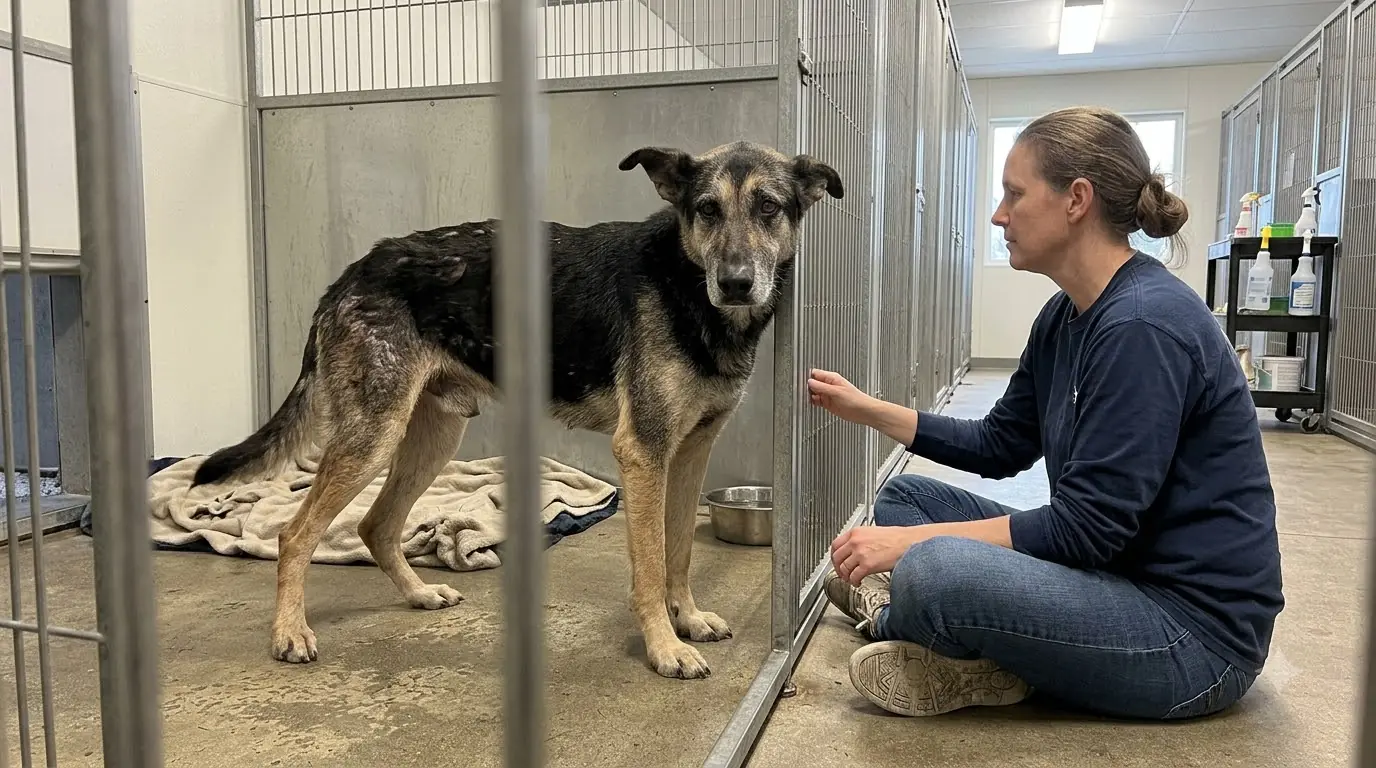
When Murphy arrived, nobody needed a scale to know he was dangerously thin.
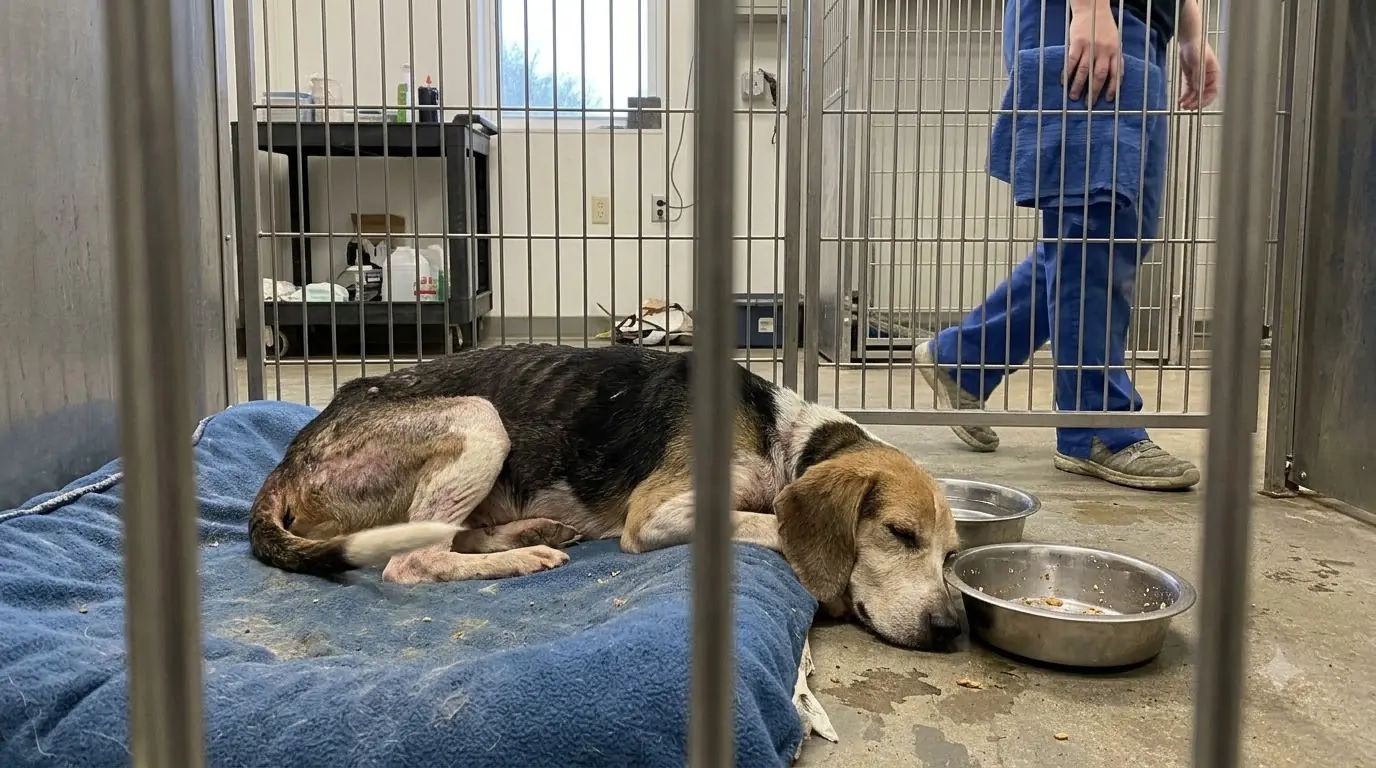
The 9-year-old German Shepherd mix had lost substantial body condition. His ribs, spine, and hip bones were prominent beneath his coat, and the large muscle groups around his shoulders and hindquarters had visibly wasted.
Several areas of his coat were missing.
The exposed skin underneath was irritated and inflamed in places, although there were no large open wounds.
Most concerning was the way Murphy moved.
He could stand.
But not for long.
When encouraged to take several steps, his legs began trembling beneath him. He moved slowly and deliberately, as though every step required concentration.
After a short distance, he wanted to lie down again.
Staff immediately adjusted their expectations.
Murphy did not need to prove that he could walk.
He needed to conserve his strength.
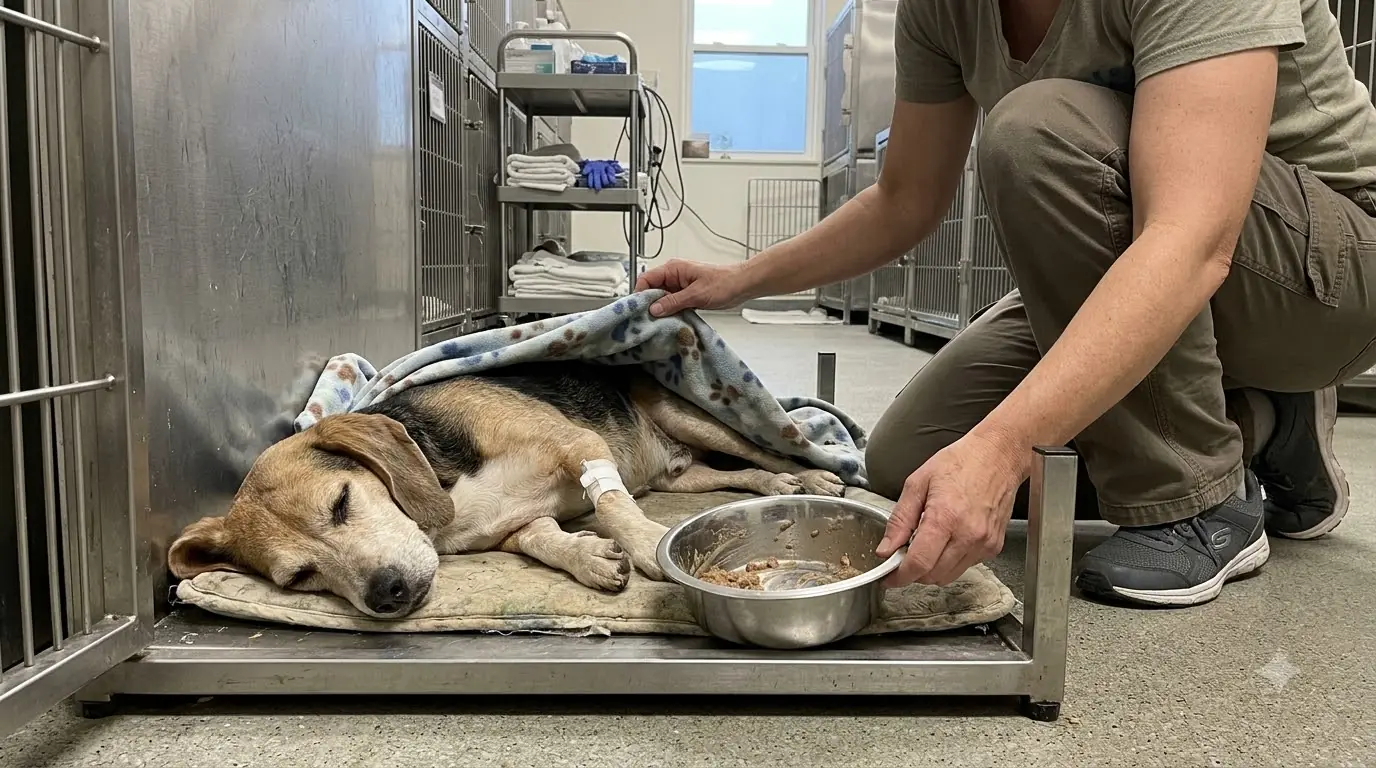
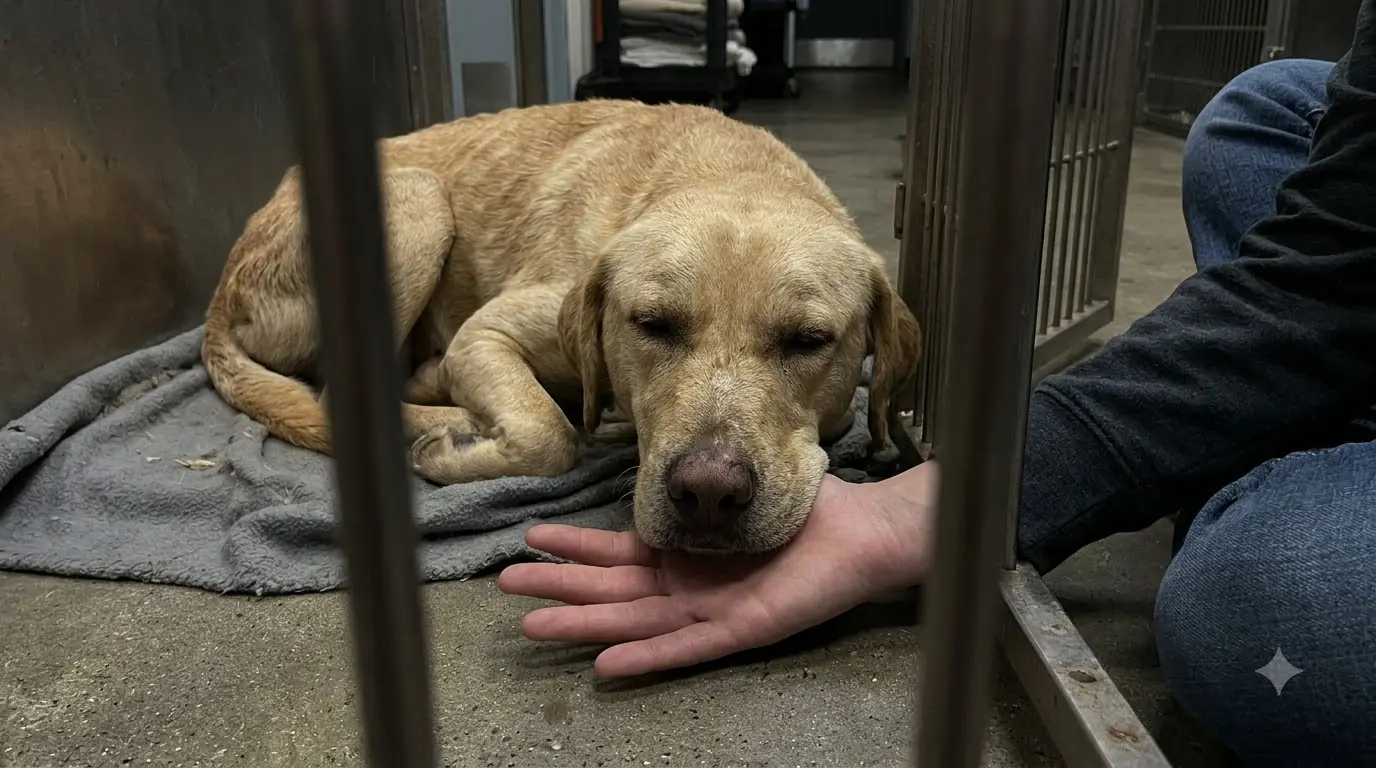
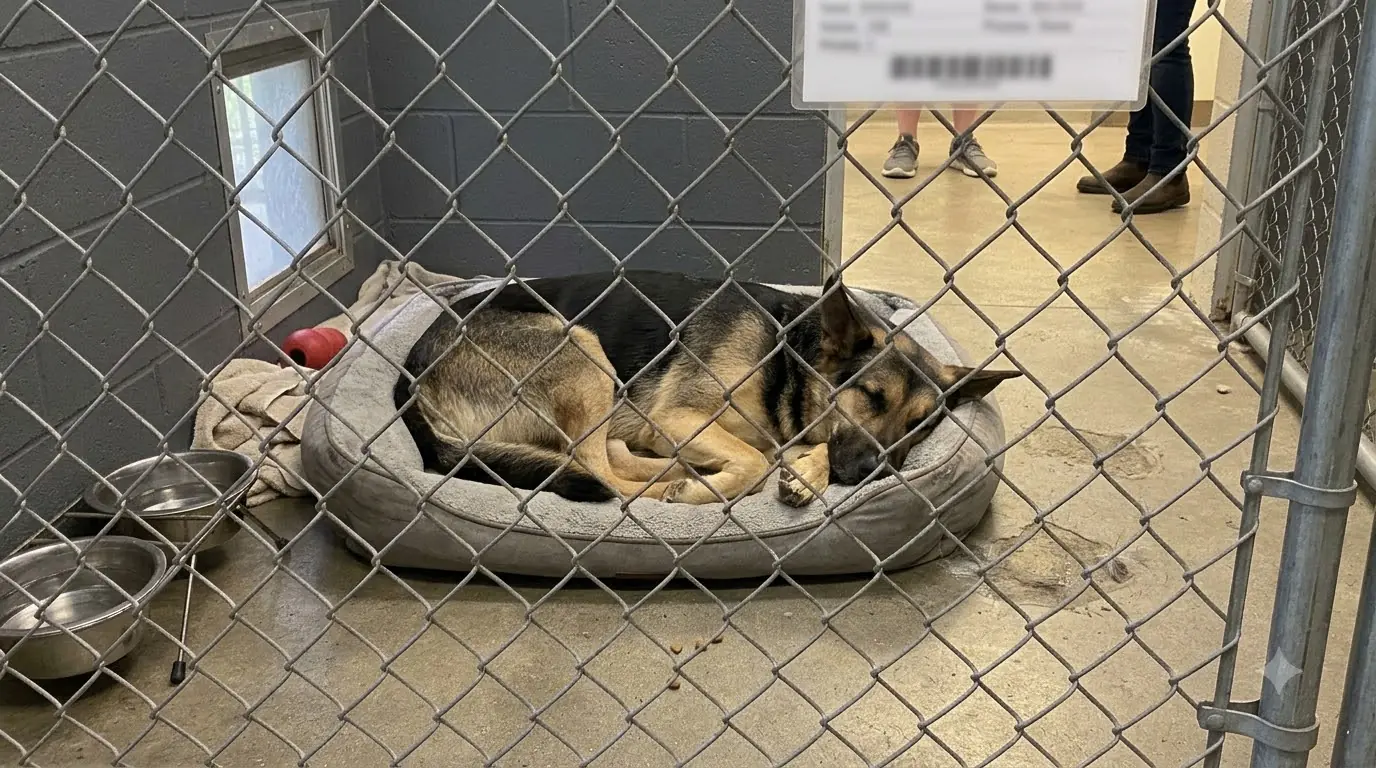
A thick bed was prepared in a quiet kennel, and a lightweight blanket was placed over him once he settled.
Food and water were brought directly to him.
During those first days, Murphy's world became deliberately small.
A bed.
A blanket.
A bowl.
A few trusted people.
And a veterinary team trying to determine exactly what his body needed.
What We Know—and What We Don't
Murphy's condition was serious.
It was also important not to turn his appearance into assumptions about his past.
A severely underweight dog can reach that condition for many reasons.
Insufficient nutrition is one possibility.
Chronic disease is another.
Digestive disorders, parasites, dental pain, cancer, kidney disease, liver disease, endocrine disorders, and other medical problems can contribute to weight and muscle loss.
Sometimes multiple factors are involved.
Murphy could not tell us what had happened before he entered our care.
We therefore could not responsibly claim that someone had deliberately starved, neglected, or abandoned him unless evidence established that history.
Our first responsibility was medical.
Why was Murphy so thin?
Why was he weak?
And what was causing the condition of his skin?
His First Examination
Murphy's initial veterinary examination was performed with him lying comfortably whenever possible.
Repeatedly asking him to stand would have provided little useful information and unnecessarily exhausted him.
His body-condition score was significantly below ideal.
Muscle wasting was particularly obvious over his spine, hips, and thighs.
He was mildly dehydrated.
His gums were paler than expected, raising concern for anemia.
His heart rate was mildly elevated, but his heart rhythm was regular on examination.
His lungs sounded clear.
His abdomen did not reveal an obvious large mass or severe pain during gentle palpation.
His temperature was monitored.
The veterinarian then examined Murphy's skin.
Hair loss affected several areas rather than forming one single bald patch.
Some exposed skin was flaky and irritated.
Other areas showed redness consistent with inflammation.
Samples were collected because appearance alone could not determine the cause.
Investigating His Hair Loss
Skin problems in dogs can have many causes.
Parasites are possible.
Allergies can contribute.
Bacterial or yeast infections can develop secondarily when the normal skin barrier is damaged.
Hormonal disorders can alter the coat.
Poor nutrition can also affect skin and hair quality.
Murphy's veterinary team performed skin scrapings and cytology.
The samples showed a substantial bacterial component consistent with secondary pyoderma, a bacterial skin infection.
Additional testing did not initially identify a severe generalized mite infestation as the primary explanation.
That was useful information, but it did not completely answer the question.
The infection could be treated.
The reason Murphy's skin had become vulnerable still required consideration alongside his overall medical condition.
The Bloodwork
A complete blood count confirmed that Murphy was anemic.
His anemia was moderate rather than immediately life-threatening, but it was significant enough to contribute to fatigue and weakness.
The laboratory pattern did not suggest that Murphy was rapidly losing a massive amount of blood at that moment.
His chemistry panel also showed changes consistent with poor nutritional status and chronic physical stress.
His protein levels required monitoring.
Fortunately, his kidney and liver values did not indicate advanced organ failure.
That was encouraging.
But bloodwork alone could not explain his severe loss of body condition.
The veterinary team continued investigating.
Parasite Testing
Because Murphy's previous preventive-care history was unknown, parasite screening was important.
A fecal examination identified intestinal parasites that could have contributed to poor nutrition and gastrointestinal inefficiency.
He was started on veterinarian-selected deworming treatment.
Additional screening for common vector-borne diseases was also performed based on his unknown history and clinical condition.
One test returned positive for a tick-borne infection consistent with ehrlichiosis.
That finding helped connect several pieces of Murphy's medical picture.
Ehrlichiosis can affect blood cells and, in some dogs, contribute to anemia, lethargy, appetite changes, and other systemic signs.
The veterinary team evaluated Murphy's laboratory results and clinical presentation together rather than assuming that one positive test explained every problem.
Still, the infection was considered medically relevant and required treatment.
More Than One Problem
Murphy did not have one simple diagnosis.
He had several problems interacting with one another.
He was severely underweight.
He had substantial muscle loss.
He was anemic.
He had intestinal parasites.
He had a bacterial skin infection.
Testing supported a tick-borne infection that could be contributing to his systemic illness.
His age also made chronic orthopedic disease a consideration when evaluating his weak, stiff movement.
The treatment plan therefore had to address Murphy as a whole dog.
Giving him unlimited food would not solve everything.
Treating his skin alone would not restore his strength.
And asking him to exercise heavily because his muscles were weak could actually make him worse.
Recovery needed to happen in stages.
Feeding Murphy Carefully
The temptation with an extremely thin dog is to give a very large meal.
That is not always the safest approach.
Murphy's veterinary team established a controlled nutritional plan designed to increase calories gradually while monitoring his tolerance.
He received a complete, highly digestible diet divided into several smaller meals.
During the first days, the portions looked modest compared with what people imagined a hungry German Shepherd should eat.
There was a reason.
His digestive system needed time to adjust.
Staff monitored him for vomiting, diarrhea, abdominal discomfort, and other signs that feeding needed modification.
Murphy's appetite was encouraging.
He ate.
Slowly at first.
Then with increasing interest.
Bringing the Bowl to Him
During those early days, Murphy did not have to walk across the kennel to eat.
A staff member brought his bowl to his bed.
Water was positioned within easy reach.
Murphy sometimes lifted his head as soon as he smelled food.
Other times, he needed several minutes before beginning.
Staff did not rush him.
If he wanted to eat lying down in a safe position, the setup was adjusted accordingly.
Hydration improved steadily.
His urination remained normal in volume and appearance based on routine observation.
His bowel movements were initially inconsistent as his diet changed and parasite treatment began.
Over time, they became more predictable and formed.
Treating the Infection
Murphy began appropriate antimicrobial treatment for his bacterial skin infection based on the veterinary findings.
His skin was kept clean and dry.
Medicated bathing was introduced only when he was physically strong enough to tolerate it without becoming chilled or exhausted.
Early in recovery, extensive bathing would have created unnecessary stress.
Treatment for the tick-borne infection was also started using veterinarian-prescribed medication.
His response would be assessed not only by how he looked but through repeat bloodwork.
The anemia needed to improve.
His overall energy needed to increase.
His Legs
Murphy's weakness was initially generalized.
He had lost a significant amount of muscle, particularly in his hindquarters.
However, as he became slightly stronger, veterinarians could assess his movement more accurately.
Orthopedic examination suggested chronic discomfort in his hips.
Radiographs later showed degenerative changes consistent with osteoarthritis.
There was no acute fracture.
There was no finding suggesting that emergency orthopedic surgery would restore his ability to walk.
Instead, Murphy's mobility problems appeared to result from a combination of severe deconditioning, muscle loss, systemic illness, and chronic joint disease.
That meant rehabilitation was possible.
It also meant it would be slow.
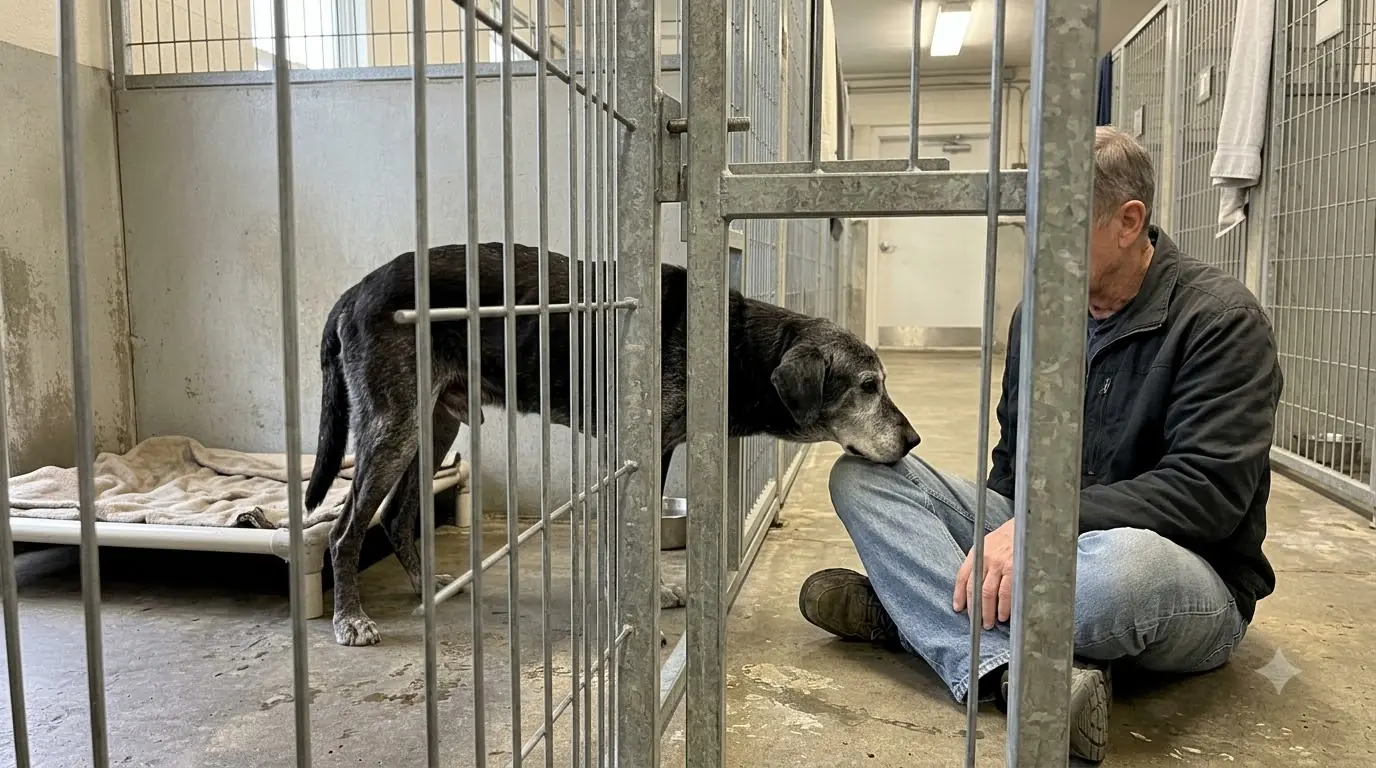
The Morning He Heard Her
One volunteer had begun spending quiet time with Murphy almost every day.
She did not ask him to stand.
Sometimes she sat beside the kennel and talked softly.
Sometimes Murphy slept through the entire visit.
Other times he lifted his head when she arrived.
Then came the morning everyone remembered.
The volunteer entered the kennel room.
Murphy heard her.
His head lifted from beneath the blanket.
He looked toward the gate.
Then he began pushing himself upward.
A staff member nearby was prepared to support him if necessary, but Murphy found his footing.
His legs trembled.
He took one step.
Then another.
Then a third.
His tail started moving.
The volunteer immediately lowered herself onto the floor.
She did not encourage Murphy to walk farther.
She moved to him instead.
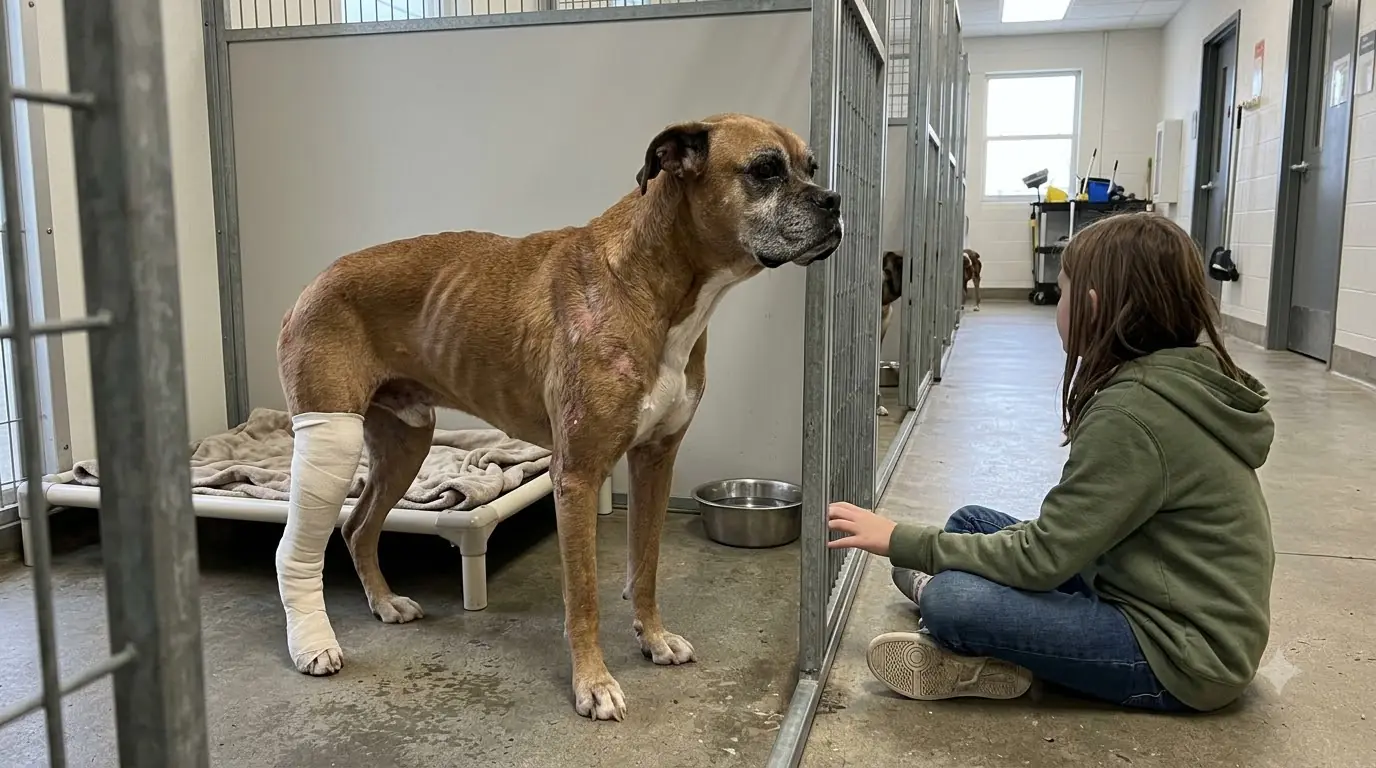
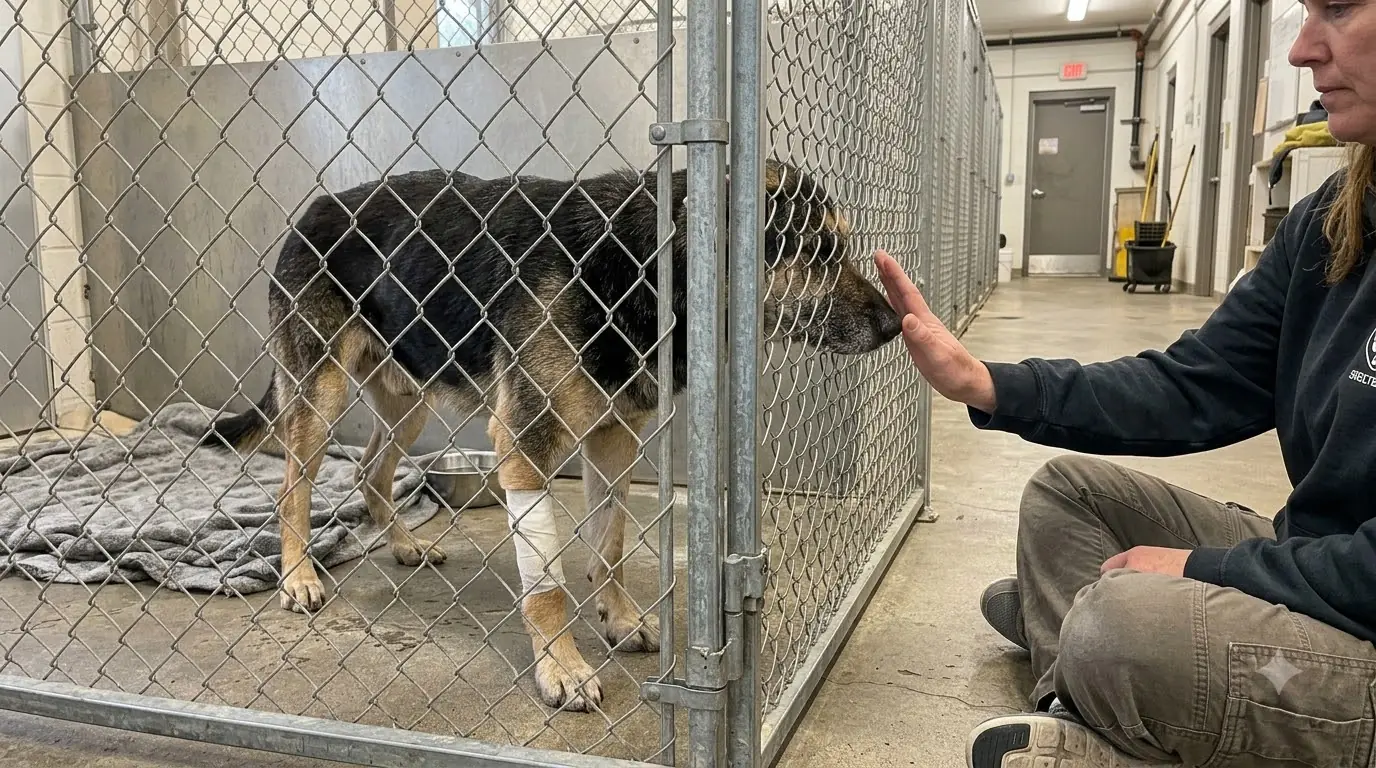
Murphy reached the kennel gate and leaned against the bars.
The volunteer rested beside him.
For several moments, Murphy remained standing.
Then his muscles began tiring.
He slowly lowered himself.
Nobody considered those three steps a medical recovery.
They were something different.
They showed that Murphy was beginning to engage with the world around him.
Rest Was Still Treatment
After that morning, staff did not suddenly begin asking Murphy to walk farther.
Three steps did not mean his body was ready for thirty.
Rest remained an important part of treatment.
Murphy slept frequently.
His body was processing nutrition, fighting infection, rebuilding blood cells, and adapting to medication.
His caregivers continued bringing meals close to him.
Bathroom trips were supported.
A sling was available when he needed assistance maintaining balance.
Non-slip surfaces reduced the chance of his feet sliding apart.
His bedding was kept thick and dry.
Bathroom Care
Murphy could urinate independently, but early in recovery he sometimes needed help getting into a stable position.
Staff supported him without lifting unnecessarily.
He was given enough time.
His bowel movements gradually normalized after deworming and dietary stabilization.
There were occasional soft stools, which were monitored closely.
Because Murphy was weak, even a routine gastrointestinal problem could have caused dehydration more quickly than in a healthy adult dog.
Fortunately, persistent diarrhea did not develop.
As his strength improved, Murphy needed progressively less physical assistance outside.
That was one of the first objective signs that rehabilitation was working.
The Scale Begins Moving
Murphy was weighed regularly.
Nobody expected dramatic changes overnight.
The first goal was simply to stop further loss.
Then the scale began moving upward.
A small gain.
Then another.
His ribs remained visible for weeks.
Muscle did not return simply because body weight increased.
But his overall condition slowly changed.
His shoulders looked less hollow.
The sharp contours around his hips softened.
His appetite remained strong.
His food portions were adjusted gradually as his body adapted.
Repeat Bloodwork
Several weeks into treatment, Murphy returned for repeat laboratory testing.
His anemia had begun improving.
The change was not instantaneous, but his red blood cell measurements were moving in the correct direction.
Other laboratory abnormalities associated with his poor condition were also stabilizing.
The veterinary team continued his prescribed treatment and scheduled additional monitoring.
This was important.
A dog looking brighter does not replace laboratory follow-up when a significant blood abnormality has been identified.
Murphy's tail could tell us he felt better.
The bloodwork helped tell us whether his body was recovering too.
His Skin Begins to Heal
Murphy's skin improved gradually.
The redness decreased.
Flaking became less pronounced.
The secondary bacterial infection responded to treatment.
Hair did not instantly fill the bald areas.
Coat regrowth takes time, particularly in an older dog recovering from systemic illness and nutritional depletion.
Small areas of new hair eventually became visible.
The foster and medical teams continued watching for renewed itching, redness, odor, or other signs that infection might be returning.
His skin improvement was encouraging, but the team remained aware that future recurrence would warrant another evaluation rather than automatically repeating medication.
Beginning Rehabilitation
Once Murphy was medically stable enough, controlled rehabilitation began.
The earliest exercises were extremely simple.
Standing for several seconds.
Taking a few supported steps.
Resting.
Later, short walks across a room.
Then brief outdoor trips on level ground.
The goal was not distance.
It was quality of movement.
Murphy needed to rebuild the muscles that supported his joints.
Too much exercise would exhaust him and potentially aggravate his arthritis.
Too little movement over the long term would make rebuilding strength harder.
The rehabilitation plan lived between those extremes.
A Small Setback
Recovery did not move perfectly upward.
One morning, Murphy seemed unusually tired.
He ate breakfast but did not attempt to stand when his volunteer arrived.
Given his medical history, staff did not dismiss the change.
His temperature and vital signs were checked.
The veterinarian examined him.
Repeat testing did not show an acute crisis.
The team believed Murphy had simply been pushed close to his physical limit by the previous day's increased activity.
His rehabilitation schedule was reduced temporarily.
Within two days, his energy returned to baseline.
That setback changed how his team measured progress.
More was not always better.
Moving Into Foster Care
Eventually, Murphy became stable enough to continue recovery in a foster home.
The foster environment was chosen carefully.
There were few stairs.
Area rugs covered slippery flooring.
Murphy had an orthopedic bed in a quiet part of the living room.
His food and water remained nearby.
The foster caregiver understood that Murphy was not ready for normal senior-dog activity.
During his first evening, Murphy explored only a small portion of the room.
Then he lay down.
His favorite shelter volunteer visited several days later.
Murphy recognized her almost immediately.
This time, he did not need to struggle three steps toward a kennel gate.
He walked slowly across the rug.
His tail wagged the entire way.
Learning Household Life
Murphy adjusted well to the quieter environment.
He slept deeply.
He showed little interest in furniture and preferred his bed.
He learned the sound of the refrigerator opening.
He learned where meals were prepared.
He learned that the back door meant a bathroom trip.
Most importantly, he began standing before someone brought the food bowl directly to him.
Eventually, he walked to his feeding area himself.
That simple act became another milestone.
His Appetite and Weight
Murphy continued eating several measured meals before gradually transitioning toward a more typical schedule.
His weight increased steadily.
The veterinary team monitored his body condition because the long-term goal was not to make him heavy.
Excess body weight would place unnecessary stress on arthritic joints.
Instead, the goal was a healthy lean weight accompanied by improved muscle.
That second part took longer.
Calories could add body mass relatively quickly.
Muscle required movement, adequate protein, medical stability, and time.
Walking Farther
Murphy's first meaningful walks were measured in minutes.
He moved slowly.
He sniffed.
He occasionally stopped.
His foster caregiver watched for trembling, dragging of the feet, excessive panting, or increased limping.
If Murphy appeared tired, the walk ended.
Over several weeks, his endurance increased.
He could walk from the house into the yard without support.
Then around a small portion of the yard.
Later, he could manage short neighborhood walks.
His gait was never transformed into that of a young German Shepherd.
Murphy remained a 9-year-old dog with arthritis.
The goal was comfortable independence, not athletic performance.
Managing His Joints
Murphy's osteoarthritis required a long-term plan.
His veterinarian selected pain-management options based on his overall health and laboratory monitoring.
A lean body condition remained essential.
Regular controlled movement helped preserve strength.
Non-slip flooring reduced strain.
His thick bed gave him a comfortable place to rest.
Cold mornings sometimes made him noticeably stiffer.
On those days, his foster caregiver gave him extra time before asking him to walk.
If his mobility changed significantly, the plan was to reassess rather than assuming every new problem was simply age.
His Favorite Person
Murphy continued having a special relationship with the volunteer who had sat beside his kennel.
He liked other people too.
But he recognized her voice.
When she visited the foster home, Murphy often lifted his head before she entered the room.
Eventually, he began meeting her at the doorway.
Not quickly.
Not dramatically.
He stood.
He walked.
His tail moved.
That was enough.
The volunteer always lowered herself so Murphy did not need to remain standing longer than was comfortable.
Sometimes he leaned his shoulder against her.
The kennel bars were gone.
The habit remained.
Trust Without Pressure
Murphy became increasingly affectionate, but his caregivers never used affection as evidence that he was completely comfortable with every situation.
He disliked having his feet handled for long periods.
He occasionally became tense during medical procedures.
He preferred unfamiliar visitors to move slowly.
Those preferences were respected.
A dog can love people and still have boundaries.
Murphy's care was built around listening to those boundaries rather than testing them.
Another Veterinary Recheck
At a later recheck, Murphy's weight had improved substantially from intake.
His anemia had continued to resolve.
His skin infection was no longer active on examination.
Hair was returning across several previously thin areas.
His muscle condition remained below ideal but was clearly improved.
Most importantly, Murphy could stand through the examination without his legs immediately trembling.
He still needed breaks.
He was still a senior dog recovering from a profound period of physical weakness.
But the difference was measurable.
What His Recovery Did Not Prove
As Murphy became healthier, people naturally wanted to know what had happened to him.
How did a dog become so thin?
Why had his skin deteriorated?
How had he gone so long with untreated medical problems?
We did not have verified answers.
His medical findings established what was wrong when he arrived.
They did not establish who was responsible or what events had preceded them.
We could say Murphy had been severely underweight.
We could say he had parasites, anemia, a tick-borne infection, secondary skin disease, muscle wasting, and chronic arthritis.
We could document his treatment.
We could not reconstruct an unknown past as fact.
Adoption Planning Begins
Murphy eventually became healthy enough for the rescue to consider his permanent-home needs.
He would not be appropriate for every household.
He remained an older German Shepherd mix with chronic arthritis.
A home with minimal stairs would be preferable.
Slippery floors would need rugs or runners.
His adopter would need to maintain a healthy weight and continue appropriate exercise.
Routine senior bloodwork would be important.
His history of tick-borne disease and anemia would remain in his medical record.
His skin would need monitoring.
His joints would need lifelong attention.
None of that made Murphy unadoptable.
It simply meant his future family needed to understand what responsible senior care looked like.
The Difference Between Surviving and Recovering
Murphy's first days were about stabilization.
Food.
Water.
Medication.
Warmth.
Sleep.
Later, recovery became more complicated.
Rebuilding muscle.
Managing arthritis.
Completing treatment.
Monitoring bloodwork.
Restoring healthy body condition.
Helping him move independently.
Giving him a predictable home environment.
These were not dramatic interventions.
Together, they changed his daily life.
Murphy No Longer Eats in Bed
One morning in foster care, Murphy's caregiver prepared breakfast.
For months, someone had either brought his food directly to him or kept it extremely close.
This time, Murphy heard the bowl.
He stood.
He walked across the room.
He stopped beside his feeding spot.
Then he looked at his caregiver as though the next step should have been obvious.
She put the bowl down.
Murphy ate standing.
His legs did not shake.
Afterward, he walked back to his bed and fell asleep.
There was no applause.
There did not need to be.
Where Murphy Is Now
Murphy is no longer the dog who can remain upright for only a few moments.
His weight has moved into a healthier range.
His anemia has substantially improved with treatment and recovery.
The tick-borne infection was treated according to his veterinary plan.
His intestinal parasites were addressed, with follow-up testing performed as recommended.
His secondary skin infection resolved, and his coat continues filling in.
His arthritis remains.
That is expected.
It is a chronic condition, and his future care will continue focusing on comfort and function rather than pretending it can be cured.
Murphy eats normally.
He drinks appropriately.
He urinates without assistance.
His bowel habits are regular.
He sleeps comfortably.
He can get up from his bed independently on most days.
He walks outside for bathroom breaks and takes short controlled walks appropriate for his age and joints.
Still a Senior Dog
Murphy's improvement can look dramatic when compared with his intake photographs.
But his caregivers are careful about what that means.
He has not become a young dog.
He still tires.
He still needs more sleep than an energetic adolescent dog.
Some mornings his joints need time to loosen.
Long hikes are not part of his future plan.
Neither are repeated jumps or intense exercise.
Murphy's success is measured differently.
Can he stand comfortably?
Can he walk to his bowl?
Can he go outside?
Can he sniff the grass?
Can he choose where to sleep?
Can he walk toward someone he loves?
The answer to those questions is increasingly yes.
Three Steps
Of all Murphy's milestones, his favorite volunteer still remembers the smallest one.
Three steps.
That was all.
Murphy heard her enter the kennel room.
He could have remained beneath his blanket.
Nobody would have blamed him.
Instead, he struggled upright.
His legs trembled.
He walked toward the gate.
One step.
Two.
Three.
Then his tail began moving.
She sat immediately.
Murphy leaned against the bars until his legs became tired.
At the time, those three steps represented nearly everything his body could give.
Today, he can walk considerably farther.
But those later walks have never made the first three less important.
A Different Life
Murphy now spends most of his days in a warm home environment.
He has a supportive bed.
His meals arrive consistently.
His medication and veterinary care are managed.
His activity is adjusted according to how his body feels.
He has people who know that a slower day does not mean he has failed.
He has people who notice when he is uncomfortable.
He has people who celebrate progress without demanding more of him than he can safely give.
And he still has his blanket.
He no longer spends the entire day beneath it.
Sometimes Murphy pushes it aside and walks toward the kitchen.
Sometimes he follows his foster caregiver outside.
Sometimes he hears a familiar volunteer arriving and gets up before she reaches the room.
His legs are stronger now.
His body is healthier.
His future will still require medical care, arthritis management, good nutrition, and realistic expectations for an older dog.
But Murphy no longer needs someone to carry every bowl to his bed.
He can go looking for the people he trusts.
The morning he took those three shaky steps, Murphy's body was still profoundly weak.
His tail wagged anyway.
Months later, that same tail still starts moving when his favorite people arrive.
The difference is that now, Murphy can usually walk all the way to meet them.