The old repair shop had one mechanic left besides its owner, three overdue supplier accounts, a furnace that rattled every time it started, and a bank manager who privately doubted the business would survive until Christmas.
Then Adeline Monroe walked through the front door asking for work.
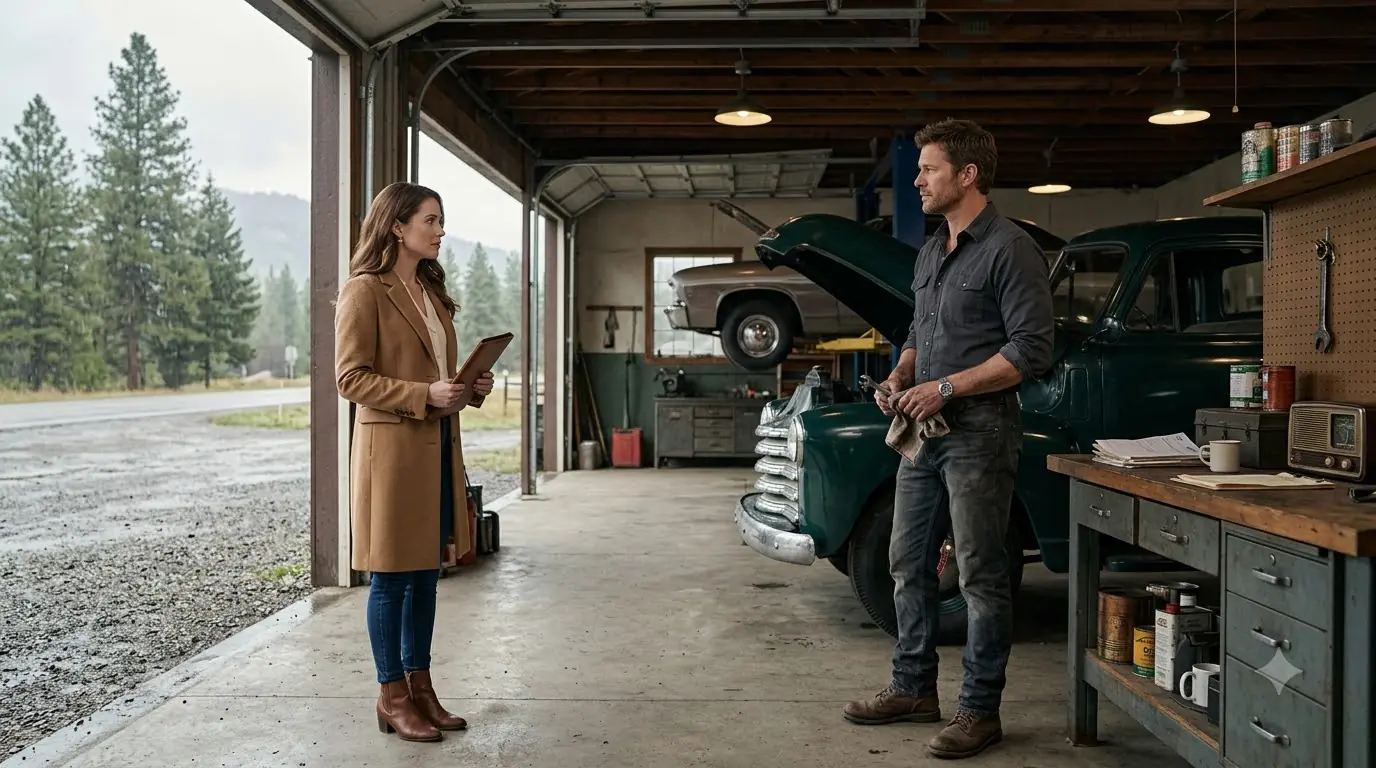
Coulter Briggs barely looked up from the engine in front of him.
“I don’t need another employee,” he muttered.
Adeline had already started turning toward the door when he added, with the exhausted bitterness of a man talking mostly to himself, “What I need is a wife.”
The wrench in the hands of the younger mechanic across the garage stopped moving.
Adeline stopped too.
For one uncomfortable second, the only sound in Briggs Auto Repair was an old country song crackling through a radio with a damaged speaker.
She slowly turned around.
If Coulter had been smiling, she would have walked out immediately.
He wasn’t.
There was no flirtation in his face. No crude joke. No challenge.
Only exhaustion.
Then Adeline noticed the wrench hanging on the wall behind him.
It was older than most of the other tools and polished smooth by years of use. Looped over its handle was a narrow gold wedding ring dulled by dust, grease, and time.
Coulter’s eyes moved toward it for half a second.
That was enough.
Adeline understood that whatever he had meant, it was not what the words sounded like.
She left anyway.
But she came back the next morning.
And neither of them understood yet that the decision would save more than a dying auto shop.
Adeline had arrived in the small Montana town two months earlier with everything she still owned packed into an aging sedan.
Three boxes of clothes.
Two boxes of books.
A kitchen set missing one plate.
A laptop that needed to be plugged in constantly because the battery no longer held a charge.
And a framed photograph she kept wrapped in a sweater because she did not yet know whether she wanted to look at it.
She had the address of a cousin who had offered her a couch.
That was about all.
The town had not been part of some carefully imagined second act.
She had not searched for scenic mountain towns or small communities where people knew one another by name.
She had searched for distance.
Distance from Detroit.
Distance from the automotive industry.
Distance from the people who had stopped returning her calls.
Distance from the offices where she had spent thirteen years building a career only to discover that thirteen years of loyalty could disappear the moment loyalty required telling an inconvenient truth.
The town offered anonymity.
That was enough.
It sat between ranch country and a stretch of highway that truckers used when weather farther north became unreliable.
Main Street was six blocks long.
There was a hardware store with a bell above the door, a diner that closed at eight, one bank, two churches, a pharmacy, a feed store, a laundromat, and a tavern whose neon beer sign buzzed even in daylight.
At the far end of town stood the remains of a mill that had once employed hundreds.
The mill had closed nearly a decade earlier.
People still talked about it as though it might reopen if everyone remained patient enough.
It never did.
Families left.
Storefronts emptied.
Ranches consolidated.
Young people moved to Billings, Bozeman, Spokane, Denver, anywhere that offered work.
Briggs Auto Repair remained.
Barely.
Rain had fallen for eleven consecutive days when Adeline first stopped there.
Not dramatic rain.
Just a steady gray drizzle that soaked everything and made the entire town smell of wet dirt, pine, and old wood.
She had driven past the shop twice that week.
The first time she noticed the HELP WANTED sign.
The second time her sedan made a metallic sound near the courthouse that convinced her she might soon require the shop whether it hired her or not.
On the third pass, she pulled in.
The sign above the building read BRIGGS AUTO REPAIR, though the word REPAIR had faded enough that from the road it looked more like BRIGGS AUTO REP.
The gravel lot was full of potholes holding brown rainwater.
One bay door was open.
Two others were closed and looked as though they had not moved in years.
Adeline sat in the car with both hands around the steering wheel.
She had applied for nineteen jobs since coming to Montana.
Nineteen.
Receptionist at the clinic.
Bookkeeper at the feed store.
Administrative assistant at a ranch equipment dealer.
Front-desk clerk at a motel.
Inventory clerk at a hardware distributor thirty miles away.
Nothing.
Some employers told her she was overqualified.
Others told her she lacked local references.
Several simply never called.
Her savings were disappearing with mathematical certainty.
Her cousin had never pressured her to leave the couch, but Adeline had begun feeling like every extra day there cost something dignity could not repay.
She looked at the HELP WANTED sign.
Then at her reflection in the rearview mirror.
“You know nothing about fixing cars,” she whispered.
The woman in the mirror looked unimpressed.
“You know something about running businesses.”
That was technically true.
Adeline stepped into the rain.
Inside the garage, the smell hit first.
Motor oil.
Rubber.
Cold metal.
Brake cleaner.
Coffee that had been sitting too long.
And beneath everything, the faint smoky scent of a wood stove that was not yet burning because Coulter Briggs refused to acknowledge winter until snow physically entered the building.
Coulter was bent over an engine.
He wore an old dark work shirt with his name embroidered over one pocket.
His sleeves were rolled to the elbows.