She brought her own tools.
That was the first thing everyone remembered later.
Not the rain dripping from the ends of her short dark hair. Not the canvas jacket faded nearly gray at the elbows.
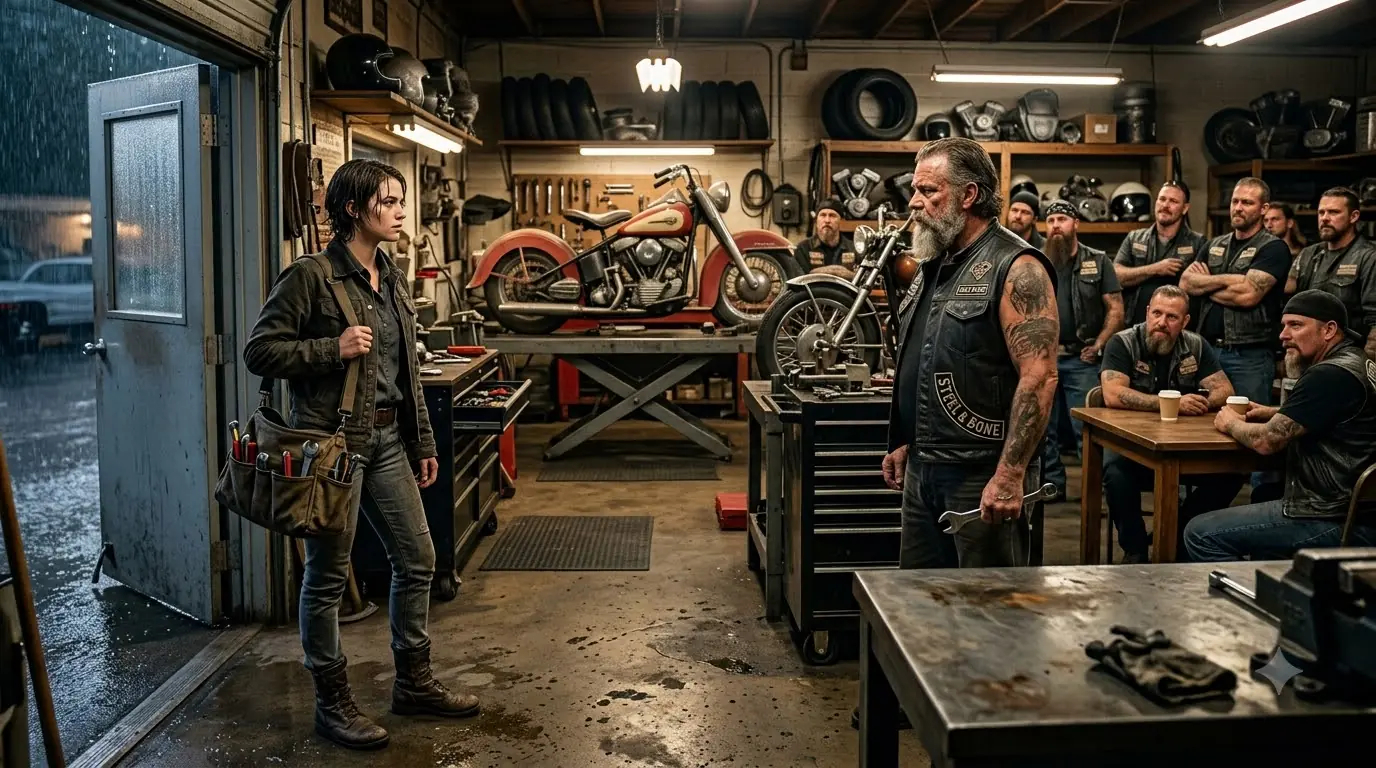
Not the fact that she was a twenty-four-year-old woman walking alone through the side door of the Iron Pines Motorcycle Club garage on a wet Tuesday evening in early November.
It was the tool bag.
A real mechanic’s roll, dark brown canvas with leather reinforcement at the handles, heavy enough to pull one shoulder slightly lower than the other. The fabric had black stains that no amount of washing would ever remove, and the buckles were polished not by care but by years of hands opening and closing them.
Nobody carried tools like that as decoration.
Nate McKenzie noticed.
Nate had been a member of Iron Pines for twenty-two years. He had spent enough of those years in the club garage to know when a sound, smell, machine, or person did not belong where it had appeared.
He was sitting at a side bench sorting bolts into coffee cans when the door opened.
Cold air pushed inside.
Rain tapped the metal awning.
The young woman stood just beyond the threshold for a second, allowing her eyes to adjust to the fluorescent lights.
Iron Pines’ garage was larger than it looked from the road. Three main bays. Two smaller service bays. Parts shelves lining the rear wall. A narrow office built into one corner. Toolboxes accumulated over decades and mismatched workbenches scarred by welding heat, oil, dropped engines, and arguments.
There were six motorcycles inside that evening.
One on each main lift.
Two waiting near the wall.
And one old Harley tucked into the corner bay beneath a canvas cover.
Nate put down the bolts.
“Help you?”
The woman looked past him.
Not rudely.
Professionally.
Her eyes moved across the lifts, the workbench, the compressor line, the tire rack, the parts shelves.
Then toward the rear corner.
“I heard you’ve got a Panhead nobody can sort out.”
Nate leaned back.
“Did you?”
“Sixty-three. Two-tone red and cream. Been sitting in the corner since September.”
That got his attention.
The motorcycle had not been advertised.
No social media post.
No public request for help.
The Iron Pines garage handled mostly club members’ machines and a limited number of jobs from people they knew.
“You know a lot for somebody who just walked in.”
“Wes Okafor mentioned it.”
Nate’s expression changed slightly.
Wes mattered.
He had been bringing motorcycles to Iron Pines for eleven years and had the irritating habit of being correct about people.
“You know Wes?”
“He knows my father.”
“Who’s your father?”
“Gerald Baxter.”
Nate looked at her again.
Baxter’s Garage.
Kier Street.
Everybody in the older mechanical trades around Sudbury knew the name.
Gerald Baxter had repaired motorcycles, snow machines, generators, old cars, farm equipment, and just about anything else that could be made to run through controlled explosions. The garage had been on the corner of Kier Street and Second Avenue longer than most of the condos now surrounding it.
“Gerald’s your dad?”
“Yes.”
“How is he?”
The question landed differently than the others.
Her jaw tightened almost invisibly.
“He had a stroke eight months ago.”
Nate sat straighter.
“I heard something happened. Didn’t know what.”
“He’s in rehabilitation.”
“And you?”
“I’ve been running the shop.”
“How long?”
“Since the week after.”
Nate looked toward the office.
Then called one word across the garage.
“Stone.”
The office door opened.
Calvin Mercer stepped out.
Almost everyone in Iron Pines called him Stone, though nobody could agree anymore on exactly when the nickname had become permanent. He had been president of the Iron Pines Motorcycle Club for nineteen years, and he had spent enough of that time managing men, machines, conflict, money, road problems, family emergencies, bad judgment, and occasional police attention that genuine surprise had become rare.
He was fifty-eight.
Large without being heavy.
Gray threaded through a dark beard.
His forearms carried burns, scars, and the kind of strength that did not come from a gym.
He walked across the floor without hurry.
Calvin believed people who rushed toward uncertainty usually brought more of it with them.
He stopped two metres from the woman.
Took in the wet jacket.
The boots.
The tool bag.
Her stance.
Then something else.
Her right hand hung slightly looser than the left.
Not injured enough to be useless.
But recently hurt.
The yellow-green edge of an older bruise showed near the wrist when she shifted the bag.
Calvin did not ask about it.
“Which Panhead?”
“The sixty-three.”
“Colour?”
“Red and cream.”
“What’s wrong with it?”
“If I knew without looking, I’d charge more.”
Nate almost smiled.
Calvin did not.
But something changed around his eyes.
“How’d you hear about it?”
“Wes Okafor.”
“That makes two good answers.”
She waited.
Calvin said:
“Name?”
“Jory Baxter.”
“Experience?”
“My father put me on shop cleanup when I was ten. Started paying me for basic service work at sixteen. I’ve been doing engine and driveline work full-time since nineteen.”
“Certification?”
“Working toward final provincial sign-off. My apprenticeship hours are complete. Dad was my supervising mechanic until the stroke.”
Calvin’s eyes stayed on her.
“You looking for work?”
“I’m looking for money.”
That answer was honest enough to quiet the room.
Jory continued:
“Baxter’s Garage isn’t bringing in what it did when Dad was there. I can keep the doors open. I can’t do that and cover rehabilitation costs forever.”
Calvin nodded.
“And the Panhead?”
“I heard nobody’s fixed it.”
“Nobody said nobody can.”
“Fair.”
“How long do you need?”