The pepper spray struck Governor Noah Bradley before he had time to finish the word complying. A burning orange cloud filled his eyes, nose, and throat. He staggered backward into the side of his Ford Bronco. One hand still raised and the other pressed uselessly against his chest as every nerve in his face seemed to ignite at once. Rain hammered the roof of the deserted gas station, but not even the cold November water could cut through the chemical fire spreading across his skin.
"On the ground!" Officer Thomas Cleary shouted. Noah could barely see. He heard boots splash through a puddle, felt a forearm drive between his shoulder blades, and hit the concrete hard enough to knock the air from his lungs. His cheek landed in oily rainwater beneath the fluorescent lights. A knee settled against the base of his neck.
"Both hands behind your back. Now." "They were visible," Noah forced out between coughs. "My hands were visible." Cleary caught his right wrist and twisted until pain shot through his shoulder. The first steel cuff snapped shut. The second closed a moment later, two clicks tighter than necessary.
Noah lay face down beside Pump 6, soaked, blinded, and handcuffed while the officer above him breathed hard with triumph. Across the forecourt, Arthur Penhallagan, the 67-year-old night attendant, stood frozen behind the store window with his phone held at chest level. He had seen the entire encounter. He had seen the black driver step away from his truck with open palms. He had seen Cleary advance, spraying before the man made any threatening move.
Arthur did not yet know the stranger's name, but he knew what he had witnessed was wrong. Cleary hauled Noah to his knees by the back of his faded Georgetown sweatshirt. "You should have followed instructions the first time." Noah drew one careful breath, then another. His training as a civil rights lawyer returned before his vision did. Identify the officer.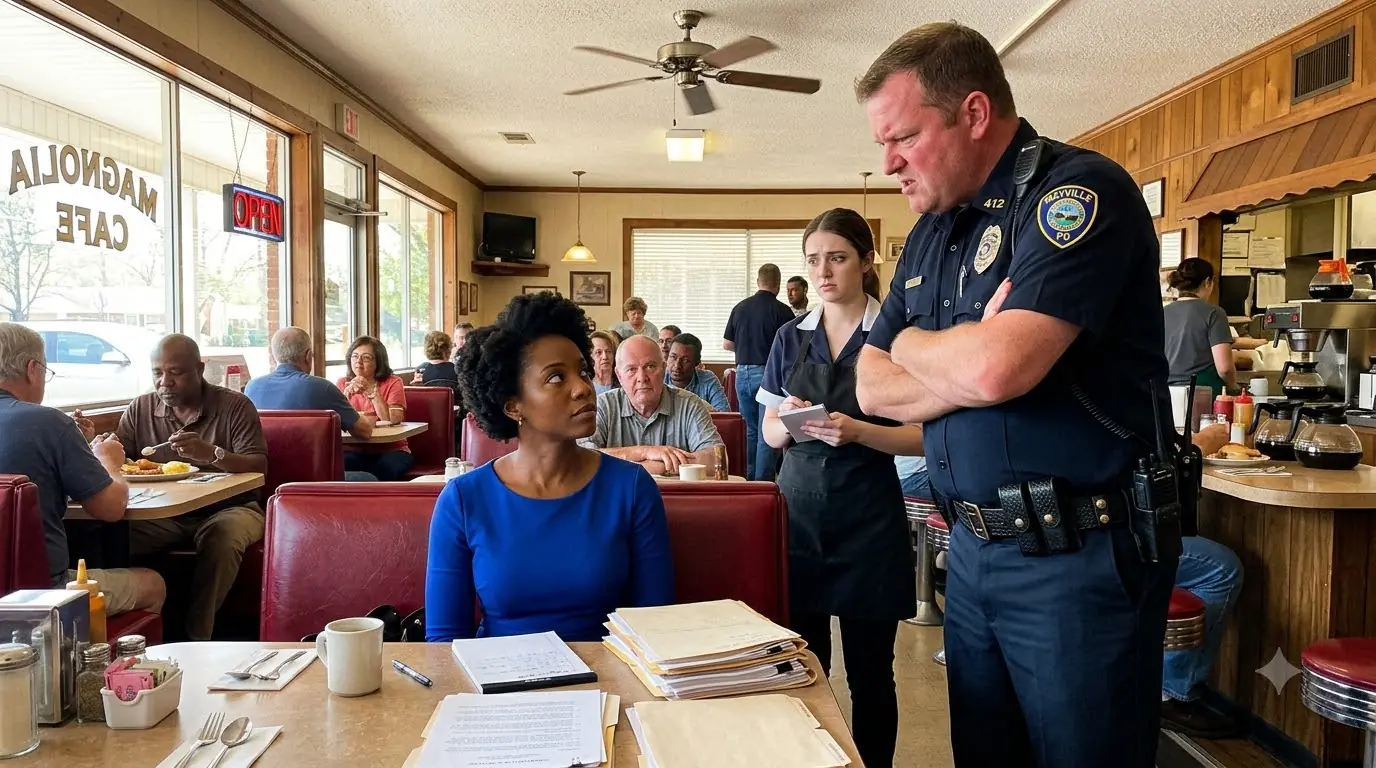
State the facts. Create a record. Do not give fear permission to choose your next movement. Officer Thomas Cleary, he said, reading the silver name plate through streaming tears. Badge number 4492.
"I did follow your instructions. Your dash camera and the station cameras will confirm that." Cleary's grip tightened. "You people always think a camera is going to save you." The words landed more cleanly than the spray. Noah raised his face toward the officer's voice. He was 48 years old, the first black governor in the state's history, and the former attorney who had once spent 14 hours cross-examining a sheriff without raising his voice.
He had negotiated budgets, stared down bomb threats, and stood beside families after shootings. Yet, none of that was visible beneath the wet sweatshirt, old jeans, and dark knit cap. To Cleary, he was simply a black man alone after midnight in a town that believed outsiders should pass through without stopping. "My name is Noah Bradley," he said. "I am the governor of this state.
My identification is in the inside pocket of my jacket. My protection detail is nearby. Verify me before this goes any further." For half a second, Cleary said nothing. Then he laughed. "Of course you are, and I'm the president." He pulled Noah upright and marched him toward the patrol car.
Noah stumbled because his eyes were clamped shut and his balance was gone. Cleary did not slow down. He pushed Noah's head beneath the door frame and forced him into the molded plastic back seat. The door slammed, sealing him inside a cage that smelled of sweat, disinfectant, and old fear. Only 11 minutes had passed since Noah pulled into the station.
It was enough time for a quiet drive to become the most dangerous political crisis of his life. He had left the governor's mansion shortly after 10 that Sunday evening following a day of ceremonial duties and difficult phone calls. The legislature was due to reconvene in the morning for a budget session already poisoned by weeks of partisan threats. His chief of staff wanted him rested. His security commander wanted him inside the mansion.
Noah wanted one hour in which nobody asked him to decide the fate of a hospital, a school district, a prison, or a family. The Bronco had belonged to his father, Ellis Bradley, a high school history teacher who believed an old vehicle could be repaired more easily than a damaged promise. Ellis had taught Noah to change the oil beneath their apartment building, to listen before speaking, and to never confuse an office with the person trusted to hold it. After Ellis died, Noah restored the truck but refused to replace its cracked leather steering wheel. Driving it was the closest he came to having a conversation with his father.
That night, he had asked his executive protection unit for distance, not absence, just distance. Commander Dylan Cole had objected until Noah agreed to keep the encrypted state phone in his pocket and allow two unmarked vehicles to trail him by no more than 3 miles. Rain and poor cellular coverage in the northern counties had stretched that gap slightly. Noah had welcomed the temporary loneliness. He crossed into Oak Haven County at 12:41 in the morning.
The fuel gauge was low, and the old shell sign glowing through the rain seemed harmless. He pulled beneath the canopy, removed the nozzle, and began filling the tank. Cleary's cruiser arrived less than 2 minutes later. There had been no traffic violation. Noah had not been followed from the road.
The officer drove directly into the station and stopped diagonally across the Bronco's front bumper, trapping it beside the pump. Cleary emerged with one hand on his pistol and ordered Noah away from the vehicle. Noah complied. When he asked why he was being detained, Cleary said there had been burglaries in a gated neighborhood 5 miles away and that Noah matched the description of a suspicious male in dark clothing. Noah asked for the suspect's height, age, vehicle, or any other identifying detail.
Cleary told him questions were evidence of agitation. Noah offered to retrieve his wallet. Cleary ordered him not to move. Noah stopped immediately and raised both hands again. Cleary told him to turn around.
Noah began to turn. The spray came before he completed the movement. Now in the patrol car, Noah leaned forward because the cuffs forced his shoulders into an unnatural angle. His eyes flooded uncontrollably. Each breath scraped his throat.
He listened as Cleary searched the Bronco without asking permission. The officer opened the driver's door, then the center console. He found Noah's leather wallet exactly where Noah had said it would be. He also found a slim government credential case bearing the state seal. Through the rain streaked window, Noah watched Cleary open it.
The officer went still. Noah Bradley, Governor. The photograph was unmistakable. So were the holographic security strip, the executive seal, and the emergency verification number printed beneath it. Cleary looked toward the patrol car, then back at the credential.
His face did not soften. Fear appeared there, but it hardened almost instantly into calculation. He slipped the credential into his uniform pocket. Noah saw him do it. Cleary returned to the cruiser and opened the rear door.
Cleary stared at him. The officer's confidence had changed. It no longer came from believing Noah was powerless. It came from believing he might still control the record. "You reached toward the vehicle after I ordered you not to move," he said.
"No." "You became aggressive." "No." "I feared you were reaching for a weapon." "My hands were above my shoulders when you sprayed me." Cleary leaned closer. "That's not what my report will say." Noah blinked through the pain until the officer's face came into focus. "Then your report will be a confession." Cleary slammed the door. At the store window, Arthur lowered his phone just enough to check that the recording was still running. The officer had parked at an angle that blocked the store's main camera, but Arthur's phone had a clear view of the pumps.
His hands shook so badly that the image wandered across the ceiling and floor. Still, the crucial seconds were there, the stranger's open palms, the unprovoked spray, the knee, the cuffs. Arthur considered calling the local police station, then realized the man committing the assault wore its uniform. He called 911 instead. The dispatcher identified herself as Brenda Pike.
Oak Haven Emergency Services. What is your location? Shell station on Route 9. One of your officers just sprayed a man who had his hands up. There was a pause.
Is the officer in danger? No. The other man never touched him. He's handcuffed in the patrol car. Do you know the officer's name?
Cleary. Thomas Cleary. The line went quiet again, longer this time. Sir, remain inside and do not interfere with law enforcement activity. Are you sending a supervisor?
The situation is under control. She disconnected. Arthur stared at the phone. He had lived in Oak Haven for 39 years. He understood what silence meant in a small town.
Silence could be caution. It could be cowardice. Sometimes it was cooperation. He saved the video, attached it to a message addressed to his daughter, and typed, "If anything happens to this phone, keep this safe." In the cruiser, Cleary removed Noah's encrypted device from the pocket of his jacket. It was heavier than an ordinary phone, protected by a rubberized black shell without a commercial logo.
"What is this?" "A secure state communications device. Press the red side button and you will reach the executive command center." Cleary turned it over. "A burner. That doesn't help your story." The device is transmitting my location and biometric status. My team already knows something is wrong.
Your team, right? Cleary tossed it onto the passenger seat, then keyed his shoulder radio. Dispatch, unit 4. One male detained at the Route 9 shell. Possible burglary suspect.
Combative presenting false government identification. Run plate 7 David King 214. Static filled the car. Copy. Unit four, Brenda answered.
Her voice had lost its earlier boredom. Standby. Noah closed his eyes. He could hear his own pulse, the rain, and the faint electronic chirp of the encrypted phone as it attempted to reconnect with the protection convoy. He thought of the clients he had represented before entering politics.
A 19-year-old mechanic forced onto hot asphalt for driving his employer's luxury sedan. A black mother arrested after questioning why officers searched her son's backpack. A grandfather whose complaint disappeared because the officer's body camera had supposedly failed. He had built a career from their testimony. Yet some private part of him had begun to believe that power had lifted him beyond their vulnerability.
The belief shamed him now. The office had protected Governor Bradley. It had never changed what Officer Cleary saw when he looked at Noah. The encrypted phone emitted a harsh two-tone alarm. Cleary frowned.
The screen glowed red with the words, "Executive command. Priority override." The phone answered automatically on speaker. "Eagle 1, this is Vanguard. We have a biometric distress alert and loss of vehicle telemetry. Confirm status." Dylan Cole's voice was controlled, but no one knew him well enough to hear the alarm beneath it.
Cleary lifted the device. This is officer Thomas Cleary, Oak Haven Police Department. The owner of this phone is detained. Identify yourself. Silence held for 2 seconds.
Officer Cleary, Dylan said, step away from the detainee and place the device where he can hear me. You don't give orders in my jurisdiction. I am Commander Dylan Cole of the Executive Protection Division. You are holding Governor Noah Bradley. My team is approaching your location.
Keep your hands visible. Do not remove or alter any evidence and request a supervisor immediately. Cleary's eyes moved to the rearview mirror. Noah met them through the wire partition. Anybody can say that over a phone, Cleary replied, but his voice had thinned.
Your unit number is 4. Your badge number is 4492. You at the Shell station at mile marker 87. State Police Troop C is now on your radio channel and your dispatch center has received the governor's identity verification. You will not touch him again.
Brenda's voice exploded from Cleary's shoulder radio before he could answer. Unit 4, respond immediately. The plate is a class, a protected executive registration. State command confirms the subject is Governor Bradley. Thomas, tell me he is safe.
The station canopy seemed to grow very quiet despite the rain. Cleary looked down at the pepper spray canister on his belt, then at the credential protruding from his pocket. For the first time, he appeared to understand not just who Noah was, but what the evidence would show. He opened the rear door and reached for his handcuff key. "Governor, there has been a misunderstanding.
Let me get those off." Noah shifted away from his hand. "Do not touch the cuffs until a state police supervisor photographs them and documents their position." They're too tight. "They were too tight when you believed I was nobody." Cleary's face twitched. I was responding to a burglary call. There was no call.
You drove into the station after seeing me at the pump. You resisted. There are at least three cameras here. "Which lie would you like preserved first?" Cleary stepped back. The small metal key trembled between his fingers.
Headlights appeared through the rain at the end of the road. They multiplied as they approached. two black sport-utility vehicles, three state police cruisers, and an ambulance. The vehicles entered the forecourt in a disciplined arc surrounding but not striking the Oak Haven cruiser. Doors opened. Agents and troopers emerged with weapons holstered, hands ready, voices clear.
Officer Cleary, move away from the vehicle. Keep both hands visible. Cleary obeyed. The same man who had treated questions as defiance now followed each instruction with desperate precision. Dylan Cole crossed the pavement first.
He was tall, broad- shouldered, and usually impossible to read. When he looked into the back seat and saw Noah's swollen eyes, wet clothes, and cuffed wrists, anger tightened every line of his face. "Governor, can you breathe?" "Yes, the spray is wearing off. My right hand is going numb." Dylan signaled to the paramedics. A state police captain named Lena Ortiz approached with a body camera recording and an evidence photographer beside her.
"Sir, we need less than 30 seconds to document the cuffs, then they come off," Ortiz said. "Your circulation takes priority." Noah nodded. He had no intention of sacrificing nerve function for a political image. The photographer captured the position of the restraints, the double lock that had never been engaged, and the red grooves already forming beneath the steel. Ortiz read the cuff serial number aloud.
A paramedic checked Noah's fingertips and told them to remove the restraints immediately. Dylan used Cleary's key. The cuffs opened with two small clicks. Pain surged through Noah's arms as he brought them forward. His fingers tingled violently, then began to shake.
The paramedics guided him to the ambulance and flushed his eyes with saline. One examined the abrasion on his cheek. Another wrapped cold gauze around his wrists. Noah accepted treatment without argument, though his gaze never left the station forecourt. Captain Ortiz separated Cleary from the other officers and read him a formal notice that he was being detained pending investigation of excessive force, unlawful restraint, and possible evidence tampering.
She did not tear off his badge or throw him into the mud. She took his weapon, radio, body camera, spray canister, and credential case, one item at a time, recording each transfer. The contrast was deliberate. Accountability would not imitate humiliation. "My body camera malfunctioned," Cleary said when Ortiz requested the device password.
"It appears to be powered on now," Ortiz replied. "It wasn't recording during the stop." "Then the activation log will tell us when it was disabled." Cleary glanced toward Noah. Governor, I swear I didn't know. Noah wiped saline from his face. That is the problem, Officer Cleary.
You believe knowing my job would have changed what I deserved. Arthur finally stepped outside, clutching his phone beneath a plastic grocery bag to protect it from the rain. "Captain," he called. "I recorded it. I got the whole thing." Cleary turned so quickly that two troopers moved between him and the attendant.
Ortiz approached Arthur. Do not delete, edit, or send the original file anywhere else. We will make a forensic copy while you retain your phone. Did you witness the entire encounter? From when the police car pulled in, the man had his hands up.
That officer sprayed him anyway. Noah watched clearly absorbed the words. The officer's remaining hope had rested on controlling the story. Arthur had taken that from him with a trembling hand and an ordinary phone. The ambulance doors stood open behind Noah.
Dylan lowered his voice. We can take you directly to the mansion. Captain Ortiz will handle the scene. First, secure every recording lawfully. Station video, dispatch audio, cruiser data, the officer's camera, Arthur's file.
No shortcuts. Call Attorney General Hayes and the independent inspector general. I want preservation orders before anyone enters that department's servers. Already moving. And Dylan, no one acts in anger.
Not for me. If we break procedure now, Cleary becomes the victim in his own story. Dylan looked toward the officer who had sprayed and cuffed the man he was sworn to protect. Understood. Noah turned to Captain Ortiz.
He said they had been looking for people who matched my description because of burglaries across the ridge. Determine whether there was an actual alert. Pull every stop initiated by Oak Haven officers on Route 9 for the past 2 years. Compare race, search rates, arrests, citations, and property seizures. Ortiz held his gaze.
You think this was policy? He behaved like a man following a policy he trusted. From the back of Ortiz's cruiser, Cleary began to speak urgently to the trooper beside him. I need to call Chief Carter. He'll explain the burglary detail.
Noah heard the name and felt an old memory move through him. William Carter. Six years earlier, when Noah was attorney general, Oak Haven's police chief had resisted a statewide body camera standard, calling independent review an insult to local officers. Carter's department had produced unusually high civil asset forfeiture revenue and unusually few sustained misconduct complaints. The numbers had bothered Noah then, but jurisdictional limits and a lack of cooperating witnesses had kept the inquiry narrow.
Now a door had opened. Do not let him contact Carter until investigators preserve the evidence," Noah said. Captain Ortiz was already reaching for her phone. The attorney general is seeking an emergency order now. 40 miles away, Chief William Carter was asleep in the small apartment he kept above Oak Haven's municipal courthouse when his private line began to ring.
He answered on the fifth chime. "Chief, it's Brenda," the dispatcher said. Her breathing came fast and shallow. Something happened with Cleary. Something always happens with Cleary.
Put it in the morning log. He detained Governor Bradley at the Route 9 station. Pepper sprayed him. Handcuffed him. State police have Cleary now.
Carter sat upright. Say that again. The governor. It was really him. His protection team is at the station.
State command took over the channel. For several seconds, Carter heard nothing except blood pounding in his ears. Then he asked the only question that mattered to him. Did Cleary's camera upload? Brenda hesitated.
I don't know. Did you log the original call? There wasn't one. Cleary self-initiated. Listen carefully.
Mark it as a response to the Ridge burglary bulletin. Use incident code B17. Chief, that bulletin expired last month. Then reopen it. The state police are requesting our dispatch archive.
Carter swung his feet to the floor and reached for his trousers. Do nothing until I get there. Don't answer questions. Don't let anyone into the records room. He ended the call and opened a secure messaging application on his personal phone.
The group was labeled night maintenance. It contained Carter Cleary, two patrol sergeants, and Oak Haven's town manager, Paul Dempsey. Delete tonight's messages. State is coming. Use B17.
He pressed send. A red exclamation point appeared beside the message. Delivery failed. Carter tried again. The same symbol appeared at the gas station.
A digital forensic specialist had already placed Cleary's phone in an isolation pouch. The state had not seen the group message yet, but Carter's attempt was recorded on the service provider's server. Panic had produced the very evidence he hoped to destroy. Attorney General Robert Hayes was at his kitchen table when Dylan's call reached him. By 1:38 in the morning, he had awakened a duty judge, notified the independent inspector general, and assigned two career prosecutors who had never worked on Noah's political campaigns.
He knew the danger of appearing to use state power for personal revenge. Every step would require written authority, independent custody, and a wall between the governor and prosecutorial decisions. At 1:56, the judge signed a temporary preservation order covering Oak Haven's dispatch logs, vehicle recordings, body camera systems, departmental messaging accounts, and property records. The order prohibited deletion or alteration, but did not authorize a search. Hayes sent it electronically to Captain Ortiz and to Oak Haven's municipal council.
At 2:07, a second judge approved a narrowly tailored emergency warrant after reviewing Arthur's video. the dispatch audio and the attempted alteration of the incident code. State investigators were authorized to secure the department's digital systems and make forensic images while a special prosecutor prepared the broader application. Chief Carter reached headquarters at 2:12. The squat concrete building was lit from end to end. Brenda stood behind the dispatch desk, pale and rigid.
Two night officers watched him enter without speaking. Server room, Carter snapped. Now, chief, the municipal attorney called. There's a preservation order. Preservation means nobody outside this department touches our files.
That isn't what he said. Carter pushed through the security door and hurried down the corridor. The server room was cold enough to sting his lungs. He entered his administrative password and opened the retention console. Hundreds of folders appeared.
Traffic stops, arrests, dispatch recordings, evidence photographs. One directory sat behind a second layer of encryption, NW archive. Operation Nightwatch had begun as a private promise to wealthy residents after three homes near Oak Ridge were burglarized. Carter told midnight officers to stop unfamiliar vehicles and make outsiders uncomfortable. Then the town discovered how much money could be taken through civil forfeiture from drivers who lacked the resources to fight.
Cash became new cruisers. Cruisers became political praise. Praise became quotas no one wrote down in official policy. But unofficial records existed. Carter kept them because he trusted numbers more than people.
The archive contained spreadsheets tracking stops by vehicle value, neighborhood, and amount seized. It contained message threads in which officers called black motorists travelers and Hispanic motorists packages. It contained complaint videos that had never reached the county review board. Carter selected the directory and moved the cursor toward delete. Step away from the terminal, chief.
Captain Lena Ortiz stood in the doorway with two investigators behind her. Her warrant was displayed on a tablet, its digital seal glowing beneath the text. Carter kept one hand beside the mouse. This is a municipal facility. You have no authority to seize our entire system.
The warrant identifies specific databases and date ranges. You were served with the preservation order 6 minutes ago. Any deletion now would be a separate felony. You don't understand what you're looking at. Then step away and let the forensic team determine that.
Carter glanced at the screen. If he clicked once, the directory would move to a recovery queue. A second command could overwrite it. He might destroy enough before they stopped him. Ortiz seemed to read the calculation in his face.
Chief Carter, put both hands on top of your head and take three steps backward. He did not move. Do it now. The authority in her voice left no space for negotiation. Carter raised his hands and stepped away.
An investigator took his place at the console, photographed the screen, and disconnected the keyboard before beginning the forensic image. When Carter saw the folder name reflected in the investigator's protective glasses, he knew the truth was no longer under his control. Noah arrived at the executive mansion at 2:34 in the morning with both eyes swollen and his wrists bandaged. The rain had stopped, but water still dripped from the old trees lining the drive. Sarah Jenkins waited beneath the portico with a physician and two members of the legal staff.
Sarah crossed the stone steps before the vehicle fully stopped. She was 52. Silver threaded through her dark hair and so disciplined that most reporters mistook restraint for coldness. At the sight of Noah's face, restraint abandoned her. My god, I'm all right.
You are very clearly not all right. The physician led him inside and examined him in a ground floor sitting room that had been converted into a medical workspace. The chemical irritation would pass. The abrasion on his cheek needed cleaning. His wrists were badly bruised, but showed no fracture or lasting nerve damage.
Noah listened, answered questions, and allowed photographs for the medical record. On a nearby table, Cleary's handcuffs rested inside a clear evidence bag. Sarah noticed him looking at them. National media already has the scanner traffic. We can confirm the detention and say the investigation is independent.
Nothing more until morning. Agreed. She blinked, surprised. I expected you to demand a live address at 3:00. At 3:00, Anger would be speaking.
I want evidence to speak. Attorney General Hayes entered carrying a thick folder. For the record, Governor, you are the victim and a material witness. You are not directing charging decisions. I have appointed Deputy Attorney General Elena Ruiz as special prosecutor.
She will report to the courts and the inspector general, not to your office. Good. The department is secured under warrant. Carter attempted to access a concealed archive after receiving the preservation order. We don't know what is inside yet.
I know the name of the program, Noah said. Nightwatch. Hayes stopped. How? Cleary told me they were looking for people like me.
Carter opposed statewide camera retention 6 years ago, and his forfeite numbers have never made sense. Pull the files from the old attorney general inquiry. Sarah folded her arms. If this is bigger than one officer, tomorrow's budget session becomes a constitutional crisis. Half the rural caucus will say you are using the state police to occupy a town that voted against you.
Then we show the warrant. We show the independent prosecutor. We show every link in the chain of custody and the video. Noah looked toward the evidence bag. Not until Arthur consents to release his copy and Elena determines it will not damage the case.
Sarah studied him. You could win the news cycle in 10 minutes. I am not interested in winning 10 minutes. I want the truth to survive 10 years. By 4 in the morning, the mansion's west conference room had become a quiet command center.
No one raised a voice. Phones vibrated against the long table. Printers released warm pages, and rainwater ticked from the copper roof outside. On the wall, a map of Oak Haven County glowed beside a timeline of the night's events. Deputy Attorney General Elena Ruiz arrived wearing a navy suit beneath an unbuttoned raincoat.
She had prosecuted public corruption cases for 19 years and possessed a talent for making powerful people feel that lying was a waste of time. She greeted Noah as formally as she would any other witness. Governor, before we speak, I need you to understand the boundaries. I control the criminal investigation. You control your office and your policy response.
If those lines cross, I will document it and tell the court. That is why Robert chose you. He chose me because I once subpoenaed his campaign treasurer. Hayes gave a tired smile. She enjoyed it.
Elena placed a recorder on the table. For the next 73 milesnutes, she took Noah through the encounter without allowing political interpretation. Where exactly had his hands been? Which instruction had heard? Had he moved toward the Bronco?
When did Cleary search the vehicle? What words had the officer used? Noah answered slowly and admitted when the spray made his memory uncertain. He did not call Cleary racist. He repeated Cleary's words.
He did not claim the officer intended to kill him. He described the pressure of the knee and the difficulty breathing. He did not demand a charge. He identified the evidence. When the interview ended, Elena turned off the recorder.
Your account matches the station video and Arthur Penhallagan's recording in every material respect. Cleary's body camera log shows he manually disabled recording 31 seconds before leaving his cruiser. It reactivated automatically when the priority alert reached his radio and the dash camera. It buffered continuously. He did not realize the system retained 2 minutes before activation.
We have him blocking your vehicle, ordering you away from the pump and spraying you while both hands are visible. audio captured the rest. Sarah let out a breath she had been holding for hours. Elena continued, "Arthur has consented to public release after we make the forensic copy. I recommend releasing one unedited angle with a written timeline. If you release selected clips, the defense will claim manipulation.
Release the full encounter," Noah said. Blur Arthur's private information and the license plates of uninvolved customers. There were no other customers. The emptiness of the station returned to him. Black woods, hard rain, one witness behind glass.
If Arthur had looked away, Cleary might have owned the only narrative. Is Arthur safe? A trooper is with him. He is more worried about missing the morning delivery than about himself. At 5:22, the forensic team opened the first night watch spreadsheet.
Elena received the call in the conference room and listened without interrupting. Her expression changed gradually. not toward surprise, but toward the grim recognition of a theory becoming fact. How many? She asked. Send me the verified totals only.
Do not speculate in writing. And preserve the formulas as well as the values, she ended the call. The archive covers 26 months, she said. At least 612 vehicle stops appear to have been tracked outside the official reporting system. Drivers were categorized by race, estimated income, and likelihood of contesting a seizure.
There is a column labeled resistance potential. Another is labeled yield. Hayes looked down at the table. Property taken? Cash, cars, tools, jewelry.
More than $2 million in recorded value. Fewer than one in five drivers were charged with a crime. Complaints? Noah asked. 43 in the hidden archive.
The public database lists four. Sarah walked to the window. Dawn was beginning to gray the horizon beyond the mansion lawn. By breakfast, she said, "Everyone will ask why the governor is receiving attention that 600 ordinary people never received." "And they will be right," Noah replied. The sentence silenced the room.
He thought of the credential in Cleary's pocket the moment fear replaced contempt on the officer's face. "The system had awakened because a governor was harmed. That awakening would mean nothing if it returned to sleep after protecting him. Find every person in that archive, he said. Not for my speech, for counsel and restitution.
Create an independent contact team. No campaign staff, no press, no demand that anyone tell their story publicly. We go to them because the state failed them. Elena nodded. That belongs with the inspector general and victim services.
I will arrange it. At 6:15, Police Benevolent Association President Michael Donnelly appeared on a local morning program from a studio two blocks from the Capitol. Sarah placed the broadcast on the conference room screen. Donnelly was a polished man with a square jaw and the solemn manner of someone accustomed to being introduced as the voice of law enforcement. He had spoken with Chief Carter before the warrant team confiscated Carter's phone.
He had not seen any video. What occurred last night appears to be an unfortunate case of mistaken identity, he told the host. Officer Cleary was responding to active burglary concerns and severe weather. The driver wore concealing clothing, operated a vehicle with protected registration, and refused to provide ordinary identification. The officer used a standard defensive spray after perceiving a sudden movement.
The host asked whether race played a role. There is no evidence of that. We should resist judging an officer from the comfort of a television studio when he had seconds to make a decision. Nobody is above a lawful investigation, not even a governor. Noah watched without visible anger.
He has the incident code, Elena said. B17, Carter gave him the cover story. Can you prove the call? Hayes asked. Not yet.
Sarah muted the screen. We release at 7. full video, dispatch log, warrant, medical summary, and a statement confirming Elena's independence. At 9, Noah addresses the joint session. No charges announced from the podium, Elena said. No names beyond facts already public.
Agreed, Noah replied. The video went online at exactly 7 in the morning. For the first 40 seconds, nothing dramatic happened. A man filled an old truck beneath a leaking canopy. Rain crossed the camera in silver lines.
Then Cleary's cruiser entered too fast, blocking the Bronco. The country watched Noah step back with his hands raised. They heard him ask why he was being detained. They heard Cleary say that people matching his description had been prowling around wealthy homes. They saw Noah begin to turn.
They saw Cleary spray him in the face. There was no sudden reach, no aggressive lunge, no ambiguous angle. Arthur's closer recording showed Noah falling, Cleary's knee against his neck and the handcuffs closing while the governor coughed into a puddle. The final minutes captured Cleary finding the credential, hiding it in his pocket and rehearsing a false version of events. By 7:06, every major network had interrupted its programming.
By 7:12, Donnelly's studio interview was being replayed beside the video that disproved him. By 7:20, Oak Haven's municipal website had crashed under the traffic. But the image that spread fastest was not the pepper spray or the cuffs. It was Noah sitting in the patrol car after Cleary discovered his identity. His eyes were swollen, nearly shut, yet his voice remained level as he said, ""Then your report will be a confession."" Commentators called it courage.
Noah knew it had been discipline born of terror. There was no shame in that distinction. At 8:05, Elena received confirmation that Cleary's false burglary narrative had been constructed after the detention. The B17 bulletin referred to two teenagers seen near an abandoned property 32 days earlier. The suspects were described as white, both under 20, driving a red compact car.
Nothing in the bulletin resembled Noah or the Bronco. At 8:18, forensic analysts recovered the night maintenance group messages. Cleary had received instructions during previous stops to build cause, check for travel cash, and make the corridor uncomfortable. Carter's failed deletion order appeared at the end of the thread. At 8:32, a judge approved arrest warrants for Carter and Cleary on state charges that included official misconduct, unlawful imprisonment, assault under color of authority, falsification of records, evidence tampering, and conspiracy.
Federal prosecutors announced that they were reviewing potential civil rights violations, but made no promise of immediate indictments. Noah learned of the warrants while a makeup artist gently covered the abrasion on his cheek for the legislative cameras. He stopped her. Leave it visible. The lights will make it look worse, she warned.
It looked worse in the dark. He changed into a charcoal suit, but kept the white medical wraps around his wrists. Sarah had suggested carrying Cleary's handcuffs to the podium. Noah refused. They were criminal evidence, not a prop.
Instead, the legislature's sergeant-at-arms placed a certified evidence photograph on an easel beside the rostrum. The House chamber was full before 9. Legislators occupied every desk. Judges, county officials, civil rights lawyers, police chiefs, clergy, and reporters crowded the galleries. Outside, thousands gathered behind metal barriers, some holding signs with Noah's final words from the patrol car.
Others held photographs of relatives whose complaints against Oak Haven had gone nowhere. The speaker struck the gavel. Members of the general assembly, the governor of the state. Noah entered through the central doors with Attorney General Hayes on one side and Inspector General Margaret Sloan on the other. Dylan followed several paces behind.
The room rose, but Noah lifted a hand before the applause could build. "Please sit," he said. "They did." He reached the rostrum and placed both bandaged hands on its edges. The chamber became so quiet that the small movement of camera lenses was audible. Last night, at 12:48 in the morning, an Oak Haven police officer sprayed me in the face, forced me onto wet concrete, and locked my hands behind my back.
At the time, I was committing no crime. I had broken no traffic law. I was buying gasoline. He paused. Many people have called what happened to me shocking.
To hundreds of families in this state, it was familiar. That difference should shame every person entrusted with public power, including me. Several legislators lowered their eyes. The machinery of justice moved for me with extraordinary speed. My protection detail found me.
State police preserved the scene. Judges answered their phones. Prosecutors obtained warrants. Cameras ensured that my account was believed. By sunrise, the public knew my name and saw my injuries.
Noah looked toward the gallery where Arthur sat beside his daughter. I am grateful for every professional who acted lawfully. I am especially grateful to Arthur Penhallagan, a citizen who understood that witnessing injustice creates a responsibility. But gratitude is not enough. We must ask why that machinery did not move for the people stopped on Route 9 before me.
The screens beside the rostrum displayed no image of Noah. Instead, six names appeared. Marcus Green, Leah Watkins, Rafael Santos, Denise Carter, Jamal Price, Tanya Brooks. These names come from complaints found overnight in a concealed police archive. Their allegations were marked resolved without interviews, hearings, or notice.
They represent only the beginning. We will not show their photographs or tell their stories without consent. Their pain does not belong to the state to display, but their names belong in this chamber because their government failed to hear them. Noah explained Operation Nightwatch in careful terms, limiting himself to facts Elena had cleared for release. He described the unauthorized tracking system, the missing complaints, the racial categories, and the property seizures unconnected to criminal charges.
He did not declare anyone guilty. He repeated that Carter and Cleary were entitled to counsel and a fair trial. Then his tone changed. Due process is not mercy reserved for people we like. It is the discipline that separates justice from revenge.
The men accused in this investigation will receive more fairness than their records suggest they offered others. That is not weakness. That is the law proving it is better than the conduct it condemns. He introduced a package of emergency measures not as a finished bill but as principles for public debate. An independent statewide office to investigate serious uses of force.
Automatic external storage for body camera footage. A ban on civil forfeiture without a criminal conviction except in narrowly defined emergencies reviewed by a judge. A public database of sustained misconduct findings. Protection for officers who reported illegal orders. And a fund to provide counsel for people seeking the return of seized property.
A badge carries immense authority. Noah said most officers understand that authority as a duty. Some mistake it for ownership. Our laws must protect the public from that mistake without treating every honorable officer as an enemy. Accountability and safety are not rivals.
Trust is what makes both possible. He raised his bandaged wrists. These marks will fade. The record we create now must not. Noah ended without a slogan.
For one breath, the chamber remained silent. Then the applause began in the public gallery. It moved slowly across the floor, not unanimous and not theatrical. Some legislators stood. Some stayed seated, already reading the proposed measures.
Noah preferred the honest division to automatic praise. Reform built on emotion alone would collapse when emotion moved elsewhere. Outside the chamber, reporters shouted questions. Noah answered only three. Was he afraid during the arrest?
Yes. Courage is not the absence of fear. and public office does not erase the body. Did he want Cleary imprisoned? I want the evidence tested in court and the law applied without favor. Would he resign if the investigation found that his administration had ignored earlier warnings?
Noah stopped. If my office buried credible evidence, responsibility will not end at Oak Haven. It will reach us, too. That answer created a second crisis. At noon, Elena's investigators found a memorandum written 18 months earlier by a junior analyst in the Department of Public Safety.
The analyst, Priya Desai, had noticed that Oak Haven reported forfeiture revenue nearly six times the state average while filing unusually few arrest reports. She recommended an audit. Her supervisor forwarded the memo to a deputy commissioner who marked it local matter, no action after receiving a call from an Oak Haven senator. The deputy commissioner had been appointed by Noah. Sarah brought the document to the governor's private office.
It never reached us, she said. There is no evidence anyone on your staff saw it. That is a legal defense, not a moral one. You cannot personally read every memo in state government. No, but I appointed the person who made silence easier than inquiry.
Noah called Priya into the office. She arrived expecting punishment for embarrassing the administration. Instead, he asked her to explain the analysis as though he knew nothing about it. Priya was 29, precise and visibly angry beneath her nervousness. She described the ratios, the missing disposition codes, and the way complaints disappeared after transfer to Oak Haven.
Her supervisor had warned her that pushing further would be career-limiting. "Why did you stay?" Noah asked. because leaving would have made it easier for them to say no one noticed. He placed the memo between them. Will you testify publicly? If I have whistleblower protection, you will.
That afternoon, Noah accepted the deputy commissioner's resignation and ordered the inspector general to examine why Priya's warning had been ignored. Critics called the resignation an admission of administrative failure. Noah agreed with them. government could not demand accountability from a small town chief while protecting senior officials at the capital. The first person from the hidden complaint list to contact investigators was Marcus Green. Marcus was a 22-year-old refrigeration technician who drove Route 9 twice a week to service restaurant equipment.
8 months earlier, Cleary and another officer stopped him for a broken license plate light that photographs later showed was working. They searched his van and seized $4,800 he had collected from customers for equipment parts. Marcus was never charged. When he asked for the money back, the department told him to hire an attorney and prove the cash was innocent. The cost of doing so exceeded what they had taken.
Without the money, Marcus missed a supplier payment and lost his job. His complaint was marked withdrawn. He had never withdrawn it. He agreed to meet Noah privately but refused cameras. They sat in a small conference room with Marcus' lawyer and Elena present.
"They listened to you because you're the governor," Marcus said. "That's the whole story." "It is part of the story," Noah replied. "It's the part that matters. You got sprayed and judges woke up. I lost everything and they sent me a form letter." Noah did not defend the speed of the response or list the reforms he had proposed.
"You're right." Marcus seemed almost irritated by the answer. That's it. No, but anything I say after it has to begin there. You were right. The state failed you and my title opened doors that stayed closed for you.
I cannot change that fact. I can help return what was taken and build a system that does not require a governor to be harmed before anyone pays attention. And when the cameras leave, then you should judge us by what remains. Marcus never became a public symbol. He testified under his own name at a committee hearing, recovered his money with interest, and returned to refrigeration work.
When reporters asked for interviews, he usually declined. He wanted his life restored, not transformed into content. Other stories followed. Leah Watkins, a night shift nurse, had been detained for 40 minutes while driving home in scrubs. An officer searched her car and opened sealed medication she was transporting for her diabetic mother.
Raphael Santos lost the landscaping truck that supported four employees because a cousin riding with him possessed a small amount of marijuana. Tanya Brooks was handcuffed in front of her children after asking why police demanded proof that her leased car belonged to her. Each account matched a row in Carter's spreadsheets. The yield column measured money. The resistance potential column estimated whether a driver had education, legal help, or community influence.
Cleary had marked Noah as low resistance before approaching him. The notation became central to the case. Cleary's attorney argued that it referred to the likelihood of physical aggression, not the ability to challenge a seizure. Prosecutors recovered a training audio file in which Carter explained the category himself. Low resistance means no lawyer, no local family, no one making calls.
The chief said, "Those are clean stops." The recording had been made by Sergeant Elaine Foster, an Oak Haven officer who spent 14 years trying to survive inside Carter's department. She had copied messages and meetings onto a private drive, but never trusted an outside agency enough to deliver them. When she saw Noah's arrest on television and learned that Elena controlled the investigation, she drove to the attorney general's office with the drive hidden beneath her spare tire. "Why didn't you come forward sooner?" Elena asked during her recorded interview. Elaine stared at her hands.
I watched what happened to officers who complained. Bad shifts, failed evaluations, rumors that made other departments afraid to hire them. I kept telling myself I was collecting enough evidence. Then every week I stayed became another week I was part of it. Her files connected Carter's program to town manager Dempsey and two members of the municipal finance committee. seized cash, paid for tactical equipment, a renovated police gym, and a public safety banquet at a resort.
Dempsey approved altered accounting entries. The committee members asked no questions as long as local taxes stayed low. Elaine's evidence also complicated the public appetite for simple villains. Several officers had objected. One refused to make quota stops and was transferred to school crossing duty.
Another documented a search he believed unlawful, only to see the report rewritten under his electronic signature. Corruption had not infected every person equally, but fear and ambition had allowed it to become ordinary. Noah insisted that the state distinguish among them. Officers who committed crimes would face investigation. Those who knowingly lied would face discipline.
Those who resisted or cooperated would receive protection. Collective punishment might satisfy anger, but it would teach honest officers that truth offered no refuge. Michael Donnelly did not adopt the same restraint. For 3 days, he repeated that the investigation was an anti- police purge. He called Arthur's video emotionally misleading and suggested Noah had arranged a confrontation to justify statewide control of local departments.
Then Elena obtained Donnelly's messages with Carter. one sent 11 months earlier read, "Keep Nightwatch official email and I can defend anything else." Donnelly resigned as union president that evening. He was later charged with obstruction for helping conceal complaints and coaching Carter to use the expired burglary bulletin. The union's executive board elected an interim president, a 26-year patrol veteran named Grace Holloway, who opened her first press conference with words no one expected. A union exists to protect due process, not to protect proven misconduct. We failed to understand the difference.
The statement cost her members. It also began rebuilding something slogans had damaged. The investigation lasted 9 months. During that time, Noah's proposed public trust and accountability act moved through 11 committee hearings. Its first draft was too broad.
Rural departments could not afford the required technology. Civil rights advocates argued that the misconduct database excluded unresolved complaints. Police organizations warned that eliminating all forfeite would prevent them from seizing weapons or trafficking proceeds during active investigations. Noah refused to force the original language through while public anger was highest. He asked opponents to produce alternatives in public sessions.
The final bill created regional independent investigation teams funded by the state, required automatic off-site camera uploads, established penalties for deliberate deactivation, provided emergency seizure authority followed by a hearing within 72 hours, and required a criminal conviction before permanently transferring property to law enforcement. Sustained findings and descertifications would be public. raw unproven accusations would remain protected but available to authorized investigators who could detect patterns across jurisdictions. The bill also created an office of first notice, an independent portal through which residents and officers could report misconduct without sending the complaint back to the department accused. Priya Desai became its first data director after confirmation by the Senate. The narrowest vote occurred in the House.
Two members who had applauded Noah's speech opposed the bill. Three who had remained seated supported it after county sheriffs helped revise the funding formula. It passed by seven votes. Noah signed it at a plain wooden desk in the capital rotunda. He invited no celebrities.
Behind him stood Arthur, Marcus, Leah, Rafael, Tanya, Sergeant Foster, Captain Ortiz, and families whose cases were still under review. Grace Holloway represented the officers who had supported the final version. Before signing, Noah held up the pen. This law will not make every officer fair or every citizen safe. Laws do not perform moral work by themselves.
They create doors, duties, records, and consequences. People must still choose to use them. He signed his name. The law returned $1.6 million to people whose property had been taken without charges. Another $700,000 remained disputed and moved through judicial review.
Oak Haven's insurance carrier funded settlements for unlawful stops, but Noah required the town to hold public budget hearings so residents could see the cost of Carter's program. Accountability would not be hidden in a premium increase. Carter refused every plea offer and went to trial. The prosecution lasted 6 weeks. Elena presented spreadsheets, messages, altered complaints, financial records, and Sergeant Foster's recordings.
Defense attorneys argued that Nightwatch was an aggressive but lawful crime-prevention effort distorted by political enemies. They showed that burglaries had declined during the program and that some seized property was connected to criminal activity. Elena did not deny either fact. A program does not become lawful because some guilty people are caught in an illegal net, she told the jury. The constitution is most necessary when violating it seems efficient.
Brenda Pike testified that Carter ordered her to change the incident code after learning Noah's identity. She admitted she had redirected earlier complaints and received immunity for truthful cooperation. Arthur authenticated his video. Priya explained the statistical warning the state ignored. Marcus described the money taken from his van.
Finally, Cleary testified he had accepted a plea agreement that required a complete account, descertification for life, restitution, and a prison sentence whose length would depend partly on his cooperation. He entered the courtroom without the uniform that once seemed fused to his identity. Under Elena's questioning, he admitted that no burglary call led him to the gas station. He had seen the Broncos protected plate return no owner information through his mobile terminal. Carter had taught officers that hidden registrations often belong to people with something worth taking.
Cleary followed the truck until Noah stopped. "Why did you spray him?" Elena asked. Cleary looked toward the jury. He questioned me. "Did he threaten you?" "No." "Did he reach for a weapon?" "No." "Were his hands visible?" "Yes." "Then why?" For a long moment, Cleary seemed unable to speak because I thought he would complain and I wanted the video to start with him on the ground.
The courtroom remained absolutely still. Why did you hide his credential? I knew the stop was over if dispatch verified him. Would you have removed the cuffs if he had not been governor? Cleary swallowed.
No. Noah watched from the second row on the day of that testimony. He felt no triumph. Cleary's admissions were too small and human for the monstrous figure public anger had created. He had not been possessed by some mysterious evil.
He had made a series of choices because he believed a uniform, a chief, a union, and a silent town would absorb the consequences. That ordinariness was more frightening than hatred performed for cameras. The jury convicted Carter of conspiracy, evidence tampering, official misconduct, theft, and multiple civil rights offenses under state law. Federal charges proceeded separately. Dempsey and Donnelly entered guilty pleas.
Cleary received 7 years in state prison followed by 3 years of supervised release after the judge credited his cooperation but emphasized the deliberate use of force and false reporting. At sentencing, Cleary asked to address Noah. I am sorry I didn't recognize you," he began. Noah's expression changed. Clear he saw it and stopped.
He looked down at the prepared page in his hands, then folded it. "No," he said. "That's what I've been saying since that night, and it's still wrong. I should be sorry for what I did before I knew who you were. I should be sorry for every person whose name I never learned because I didn't think I needed to." He turned toward Marcus, Leah, and the others seated behind the prosecution table.
I cannot ask you to forgive me. I only want the record to say that the governor was not my first victim. He was the first victim I could not erase. The judge allowed the statement to stand without response. Noah never wrote to Cleary in prison.
Forgiveness was not a public duty, and he would not perform it to make the ending comfortable. He supported educational and restorative justice programs for incarcerated officers as he did for other prisoners. But he did not confuse rehabilitation with escape from consequence. One year after the night at pump 6, Noah returned to the route 9 shell station. This time the sky was clear.
The old canopy had been repainted and new cameras covered every angle of the forecourt. Arthur had retired 3 months earlier, but came back for the visit wearing a red flannel shirt and carrying the same phone now protected by a cracked blue case. I kept meaning to replace it, Arthur said. Then it started feeling like evidence. Elena says, "Your original file is preserved in three places.
You are allowed to buy a new phone." Arthur smiled. Maybe Christmas. There were no television crews. Noah had asked Sarah to keep the visit private, though his security team remained close enough to satisfy Dylan. The Bronco stood beside the same pump.
Its cracked steering wheel and faded paint had survived their sudden fame. Noah filled the tank while Arthur leaned against a concrete post. "You know," Arthur said. "People keep telling me I was brave. I was behind glass.
You were the one on the ground." Bravery isn't measured by distance from danger. You saw an officer, a stranger, and a town you had lived in for decades. You could have decided it was none of your business. Almost did, but you didn't. Arthur looked across the road toward the dark line of pines.
I knew Carter. Played cards with him years ago. I knew things happened out here. Not the details, but enough. I told myself it was young officers being rude, drivers exaggerating, outsiders not understanding the town.
Your video made me look at all the times I had chosen the easier explanation. It wasn't my video. It was yours. That's what I mean. I had to point the camera before I could stop looking away.
Noah returned the nozzle to the pump. For months, strangers had told him that his suffering transformed the state. He never accepted that version. Pain did not transform anything by itself. Pain could be denied, exploited, repeated, or forgotten.
Change came from the decisions made after people could no longer claim they had not seen it. A sedan pulled into the station. The driver, a young black woman in hospital scrubs, recognized Noah and lowered her window. "Governor Bradley," he walked over. "My brother got his truck back because of the new review board," she said.
"I just wanted you to know." What is his name? Devon Cole. No relation to your security man. Tell Devon the state should never have taken it without giving him a fair hearing. Getting it back is correction, not a favor.
She nodded, surprised, then smiled and drove to another pump. Dylan approached from the edge of the forecourt. Sir, we should leave in 5 milesnutes. You said 10. That was before three people posted your location.
Arthur, apparently I remain unpopular with the protection division. They have a point. Arthur said, "Last time you came alone, you changed state law. They probably don't want to risk what you'll do next." Noah laughed. It was the first time he had laughed at that station.
Before leaving, he walked to the patch of concrete where he had fallen. The stains were gone. Cars had crossed it, rain had washed it, and winter had given way to spring and summer before returning to cold. Nothing in the ground marked what happened there. For years, Oak Haven had depended on that kind of disappearance.
A stop ended. A driver left. A complaint went into a drawer. Money entered an account. Each event vanished from public view, leaving only the private memory of the person forced onto the roadside.
Now the records remained. Every serious use of force in the state generated an external notice. Camera files uploaded beyond local control. Seizures required prompt hearings. Complaints could be compared across county lines.
The system was imperfect and new failures had already revealed gaps in the law. Some departments resisted. Some officers found subtler ways to misuse discretion. Reform had not delivered innocence. It had delivered visibility, and visibility created the possibility of consequence.
Noah touched the fading scar near his right wrist. The pepper spray had stopped burning within hours. The bruises disappeared in 2 weeks. For longer than he expected, however, the smell of peppermint gum made his chest tighten. Rain striking metal could wake him before dawn.
He had begun speaking with a trauma counselor despite advisers who feared the disclosure might make him appear weak. When a reporter eventually asked about counseling, Noah answered plainly, "Public strength that depends on private denial is not strength." The statement brought letters from police officers, veterans, assault survivors, and teenagers who had never heard a governor admit fear without apology. Noah kept several in the bottom drawer of his desk beside the photograph of his father and a copy of the Public Trust and Accountability Act. Arthur followed him back to the Bronco. "Your father would have been proud," he said, glancing at the old truck.
Noah rested one hand on the driver's door. He would have asked why it took me getting arrested to notice what the numbers had been saying. Then he would have made me check the oil. Smart man. The smartest.
Noah opened the door, then looked once more at the station. The place no longer seemed like the sight of his humiliation. It was a crossroads where several ordinary decisions had collided. Cleary chose force. Arthur chose to record.
Brenda eventually chose to testify. Elaine chose to surrender her files. Priya chose to stay after being ignored. Judges chose to answer. Investigators chose procedure over vengeance.
Legislators chose a difficult compromise over a perfect speech. No single choice had been enough. Together, they broke a pattern powerful people had taught themselves not to see. Noah climbed into the Bronco. Dylan's vehicles took position at a respectful distance, closer than they had been one year earlier.
He turned the key and the old engine caught with a familiar rumble. As he pulled onto Route 9, the station receded in the mirror. He did not look away from it immediately. He watched until the yellow sign became a point of light between the trees, then disappeared around the bend. The road ahead was dark, but it was no longer unrecorded.
END