She Framed the Black Chef for a $4 Million Necklace — Then Slapped Him Where No Guest Could See
Chapter 1
Reader Theme:
Font Size:
24px
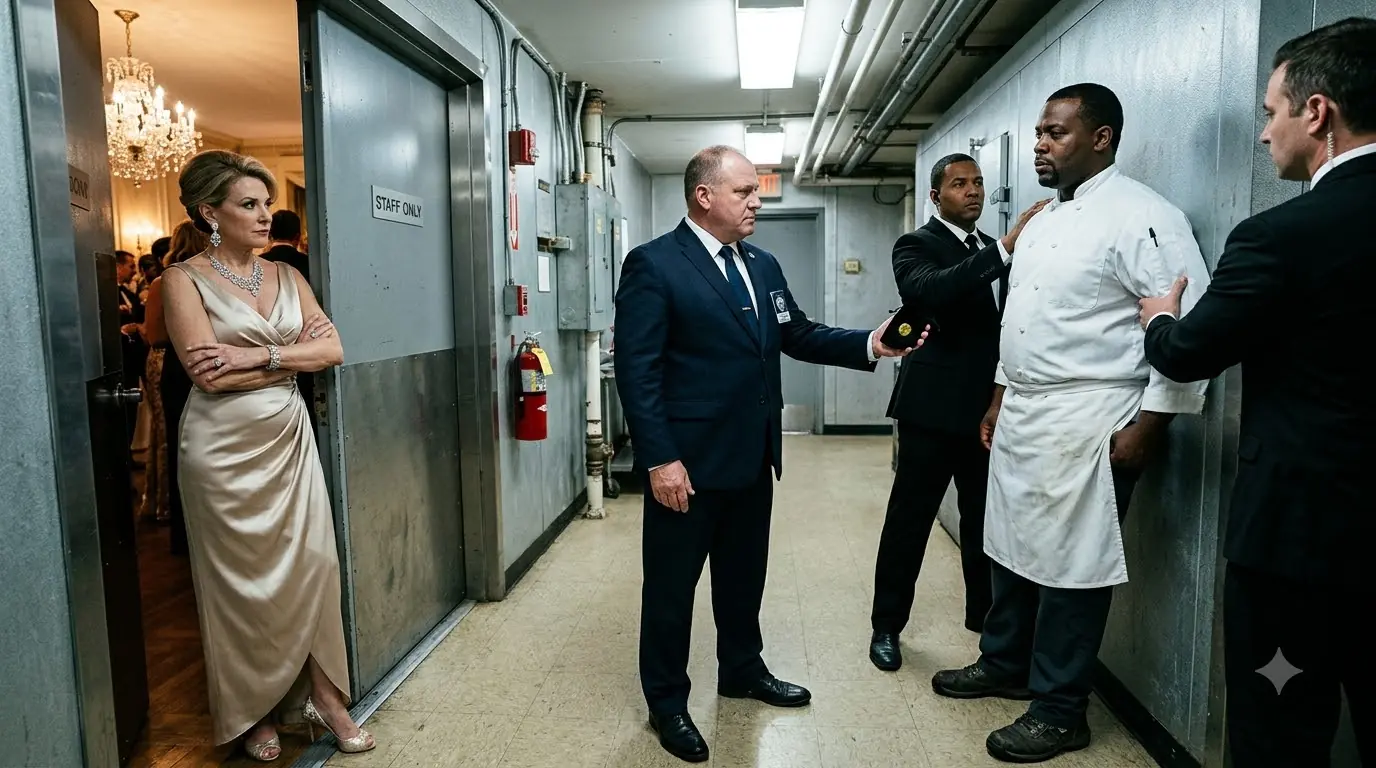
Filthy thief. Where did you hide it? Vivian Anderson glared at him, her eyes blazing with anger, her champagne glass trembling in her hand. Madam, I never touched that necklace. Four million dollars worth of diamonds gone.
And you think I don't know who took them? She stepped closer, her voice rising to a scream. Dahoum, I knew it from the moment my husband hired you. You disgusting thief. I was in the kitchen all night, madam.
She laughed, a sharp, maniacal Officer, arrest this beast before he hides my diamonds. The sound of handcuffs clicked. The sound echoed on the marble floor like a gunshot. The black chef in the white coat didn't flinch. He just looked at her.
She picked the wrong man to call a thief. Because once upon a time, he was the one putting jewel thieves in handcuffs. Eight weeks earlier, Stamford, Connecticut. 4:45 a.m. The espresso machine hissed in a small two-bedroom apartment on the third floor of a quiet brick building.
Franklin Davis stood at the counter in a worn leather apron, pulling a shot of coffee with the same steady focus most men reserved for surgery. He was 42 years old, broad-shouldered with the kind of calm in his hands that came from doing difficult work for a long time. He sipped his coffee, then started his mise en place. Fresh pasta dough rested under a damp towel. A whole turbot lay on butcher paper, glistening under the kitchen light.
He plated a single breakfast for himself, soft scrambled eggs, sourdough toast, a half orange, the way he plated everything else, precisely, beautifully, as if someone important were about to eat it. On the wall above his small dining table, three things hung side by side. A diploma from the Cordon Bleu, Paris, a photograph of the younger Franklin in a dark suit shaking hands with the director of the FBI, and a folded American flag inside a triangular glass case. Before he left, he stopped in front of a small framed photo on the bookshelf. A woman with kind eyes and a navy FBI windbreaker holding a coffee cup laughing at something off camera.
He pressed two fingers to the glass. "See you tonight, baby." he whispered. Then he picked up his knife roll and walked out the door. By 6:00 a.m. he was driving through the wrought iron gates of the Anderson estate in Greenwich. 22 acres of manicured lawn, hedge trimmed in geometric perfection with a four-story Georgian mansion sitting at the center like something out of a magazine.
The kind of place where old money lived behind even older walls. Senators came here. Museum chairs came here. Hedge fund kings came here. Franklin parked in the service lot, walked past the rose garden, and entered through the kitchen door.
He had been hired 3 months ago through a top-tier agency after a glowing referral from a chef in Manhattan. His resume mentioned a career change from public service. Vivian Anderson had skimmed it once and tossed it aside. The kitchen was twice the size of his apartment. Copper pots hung from a wrought iron rack.
The marble island gleamed under pendant lights. Outside the window, the autumn morning was rolling pink and gold across the lawn. He inhaled fresh thyme from the herb garden, the faint sweetness of yesterday's lemon tart, and got to work. His duties were simple on paper. Three meals for the family, sourcing ingredients from Union Square Green Market twice a week, catering for the Andersons' famous parties, including the upcoming Founders Gala in 2 months.
In practice, Franklin ran the household kitchen like a federal operation. He knew every staff member's name. He learned the housekeeper's coffee orders, the groundskeeper's kids' birthdays, the butler's bad shoulder. Within 2 weeks, every staff member in the house quietly loved him. Vivian Anderson, however, did not.
She entered the kitchen that morning in a cream silk robe, sunglasses indoors, holding a phone to her ear. She walked past Franklin as if he were a piece of furniture. Then, mid-conversation with a friend, loud enough for him to hear, "Edward keeps hiring diversity hires from the city. I told him you can't trust them, but he gets these ideas every couple of years." She laughed. "I'll just count the silver tonight." Franklin kept slicing shallots.
He didn't look up. He didn't react. A faint, knowing smile touched the corner of his mouth, the way a man smiles when he's seen this exact movie before. 2 weeks in, Vivian hosted an intimate dinner for eight. Wives of financiers, a Vogue editor, a Met board member.
Franklin served pan-seared sea bass with beurre blanc, a dish he'd perfected in Paris. The table went silent at the first bite. Caroline Brown leaned toward Vivian. "Where on earth did you find a chef this talented?" Vivian smiled tightly, not looking at Franklin as he refilled wine. "Oh, you know Edward.
He has this whole giving back phase. We got him through one of those programs. The kind that hires people with colorful pasts." The table went very quiet. Caroline lowered her eyes to her plate. The Vogue editor coughed.
Franklin tilted the bottle, voice warm as honey. "May I refill your glass, ma'am?" He turned back toward the kitchen. Only one person at the table noticed his jaw tighten for a single second. Edward's 19-year-old daughter Maggie, half hidden at the corner reading a book. What Vivian didn't realize was that the small enamel pin on Franklin's chef coat, the one shaped like a tiny olive branch, wasn't decoration.
It had been recording her word for word since the soup course. Three weeks before the gala, the Cartier necklace arrived. Vivian had announced it at breakfast like she was unveiling a royal jewel, which, in a way, she was. 92 carats of yellow and white diamonds, a piece her grandmother had won at a Sotheby's auction in the 1960s, appraised at $4 million. A registered Cartier archive piece.
The kind of necklace that traveled with its own paperwork, its own armored courier, and its own insurance binder thick as a phone book. What Franklin noticed wasn't the necklace. It was the safe. Vivian had insisted the piece be stored not in the master bedroom vault, not in the home office, but in the small butler's pantry safe, the one tucked into the wall just off the kitchen, the chef's territory. The one room where a black man on the staff could be reliably placed at any hour of any day.
Franklin watched from the prep station as Gregory Wilson, the head of estate security, personally installed it. Wilson was a stocky man in his 50s with cold eyes and the swagger of someone who had badged his way through life. He changed the safe's combination without informing the agency, against household protocol. Franklin slid a sheet pan into the oven, looked away, and made a quiet mental file. Then, a written one that night in the Moleskine notebook he kept locked in his car.
Two mornings later, Vivian stormed into the kitchen mid-service. A sauté pan hissed on the burner. Six staff members froze in place. Vivian was holding a single black pearl earring up between two manicured fingers, her face flushed crimson. Where's the other one?
Franklin looked up calmly from the cutting board. Ma'am? My pearls, from Mikimoto. Don't play stupid with me. She marched toward him, heels clicking like gunshots on the marble.
Two estate security guards stood in the doorway behind her, arms crossed. Empty your pockets, right now, in front of everyone. Franklin set down his knife. He wiped his hands on his apron. His voice was even.
Of course, Mrs. Anderson. He emptied his pockets onto the marble island, one item at a time. A moleskin notebook, a chef's tasting spoon, a single car key on a plain metal ring. Nothing else.
No earring, no pearl, not even loose change. Vivian stared at the small collection like it had personally insulted her. The housekeepers in the doorway watched, lips parted. The sous chef behind Franklin held very still. Somebody's hand shook so hard a ladle rattled against a pot.
"Strange," Vivian said finally. Her voice had dropped half a register. I could have sworn I saw you near my room this morning. Franklin's apron smelled faintly of charred butter. The sauté pan behind him was burning.
He didn't move to save it. I haven't been upstairs all week, ma'am. Mhm. She turned on her heel and walked out without another word. The earring was found in her own jewelry box exactly 1 hour later.
There was no apology, no retraction, no mention of it Ever. That night Franklin drove home and unlocked the travel case he kept under his bed. Inside were three items most chefs do not own. A discreet lapel pin with a hidden audio recorder, legal under Connecticut's one-party consent law. A small high-resolution dashcam he installed inside his SUV that very night, angled at the estate's service entrance.
And a backup smartphone running a continuous encrypted upload to a secure cloud server he hadn't touched in 6 years. He didn't tell anyone. He didn't file a complaint. He didn't even tell his agency. He just started documenting.
Every entry, every exit, every comment, every direct order from Vivian, timestamped, backed up, triple redundant. Then he picked up a burner phone and dialed a 202 area code. Howard, it's Franklin. Probably nothing, but keep your phone on this month. He hung up before the voicemail beep finished.
One week before the gala, the second test came. Vivian announced that a $12,000 Hermes scarf had vanished from the laundry room. This time she did not call the agency. She did not call the housekeeping supervisor. She picked up the phone and dialed the Greenwich Police Department directly.
News in the same category

Twin Black Belt Brothers Humiliated a Single Dad at the Gym — They Never Saw His Elite Training Coming

A Rich BJJ Prodigy Challenged a Quiet Delivery Guy — Never Knowing He Was an Elite Fighter

Cops Target a Black Man and His Family During a Traffic Stop — Then Freeze After Seeing His Identification
Smiling Agent Rips a Black Woman’s Passport at the Counter — What She Pulls Out Makes Everyone Step Back
Cops Pull Over a Black Man’s Family for “Looking Suspicious” — Then Go Pale When They See His ID
The Boss’s Son Waited for Him in the Empty Parking Garage — Then Forced Him to Fight

The Cop Cornered Her in a Parking Garage — Then Mocked Her Like She Had No Power
She Cut the Maid’s Hair to Humiliate Her — Then Her Husband Walked In

Walter Finds a Family After Being Abandoned in His Senior Years

The Dojo Bully Choked the Quiet New Guy After He Tapped — Then Tried to Break Him in Front of the Whole Class

Mason Finally Finds a Home After Waiting So Long for Someone to Choose Him

FULL: Karen Called the Police Because I Was Sitting on My Own Property — So I Revealed What She Never Wanted Anyone to Know
Karen Reported Me to the Police for Relaxing on My Own Porch — Then I Uncovered Her Biggest Secret
FULL: Karen Called the Cops on Me for Sitting on My Own Porch — So I Exposed the Secret She’d Been Hiding
Mason Finally Goes Home After Waiting for Someone to Choose Him

FULL: A Cocky Black Belt Called a Black Girl “Too Small” in Front of a Crowd of 800 — Then She Removed Her Jacket and Everything Changed
A Black Belt Ridiculed a Black Girl’s Small Size in Front of 800 Spectators — Then She Took Off Her Jacket, and His Hand Started Shaking

The Prison Bully Slapped the Quiet New Guy in Front of 300 Men — Then Kept Pushing Him for a Reaction
News Post
Twin Black Belts Mocked a Quiet Single Dad at the Gym — Unaware of His Hidden Training Past

At 72, I Thought My Best Years Were Behind Me—Then I Changed These 8 Ordinary Habits
Twin Black Belt Brothers Humiliated a Single Dad at the Gym — They Never Saw His Elite Training Coming

Most Men Over 50 Don’t Need 20 Exercises to Build Muscle—Focus on These 5 Things Instead

No Ozempic. No Starving Myself—7 “Boring” Things I Do to Keep 48 Pounds Off After Retirement

At 72, I Thought My Best Days Were Behind Me—These 10 Habits Changed How I Think About Aging
A Rich BJJ Prodigy Challenged a Quiet Delivery Guy — Never Knowing He Was an Elite Fighter
Cops Target a Black Man and His Family During a Traffic Stop — Then Freeze After Seeing His Identification
Smiling Agent Rips a Black Woman’s Passport at the Counter — What She Pulls Out Makes Everyone Step Back
Cops Pull Over a Black Man’s Family for “Looking Suspicious” — Then Go Pale When They See His ID

Injured Pit Bull Mix Rescued With a Tennis Ball He Refused to Leave Behind

Rescued Beagle Mix Was Too Weak to Finish Meals Until One Morning Changed Everything

Senior Golden Retriever Mix Rescued After Months of Waiting Beside His Shelter Gate

Oliver's Recovery After Being Found Beside Discarded Furniture

# Luna's Recovery After Being Found Living in an Abandoned Shopping Cart

# Murphy's Recovery After Being Found Beneath a Burned Porch
The Boss’s Son Waited for Him in the Empty Parking Garage — Then Forced Him to Fight

Injured Boxer Mix Rescued With a Painful Leg After He Could No Longer Greet Shelter Visitors

Sick Beagle Mix Rescued After Becoming Too Weak to Finish Her Meals
She Framed the Black Chef for a $4 Million Necklace — Then Slapped Him Where No Guest Could See
5 Part