The sheriff believed he was opening the trunk of an ordinary woman’s SUV.
That assumption was the first mistake.
The second was believing he had enough authority to make the first mistake disappear.
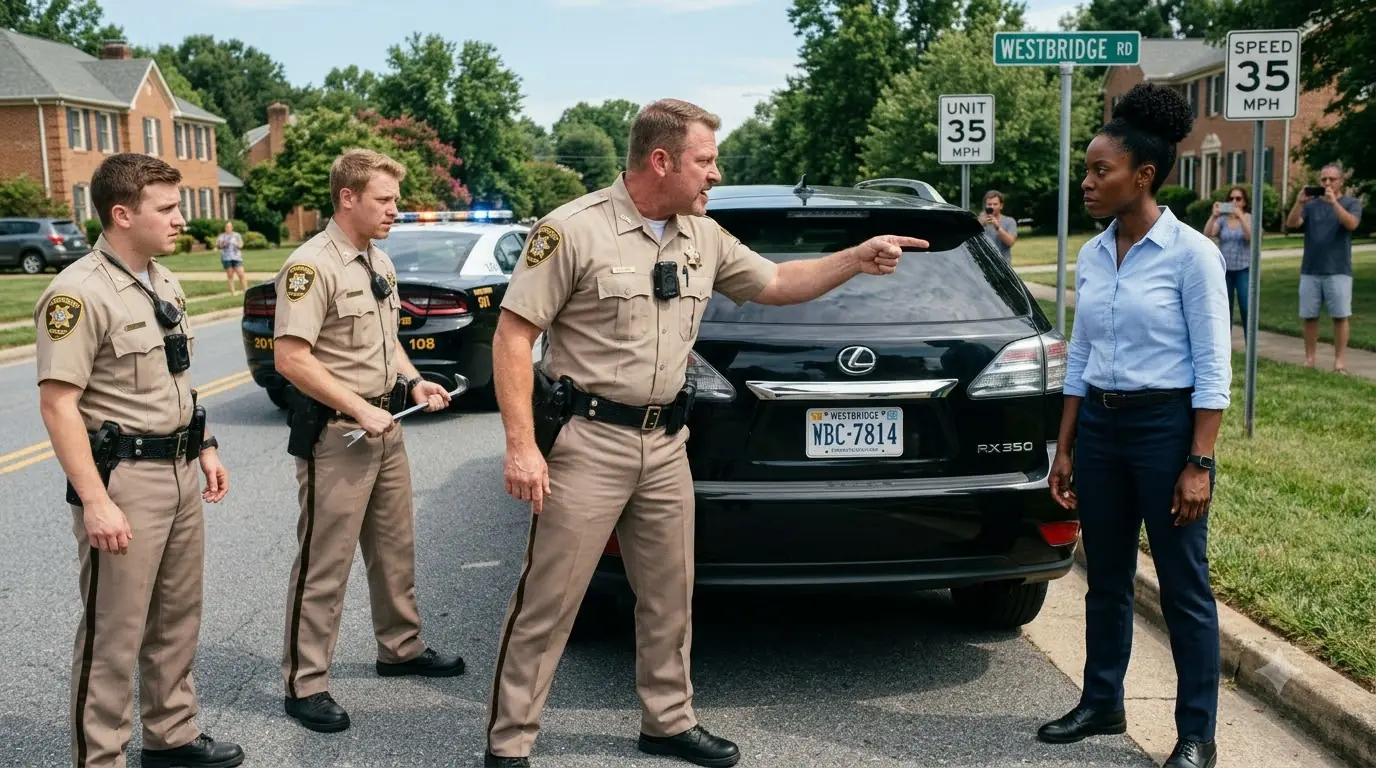
Sheriff Cole Mercer stood behind the black Chevrolet Tahoe with one hand gripping the edge of the rear liftgate. Beside him, Deputy Ryan Keller still held the forced-entry tool they had used to defeat the lock after the driver repeatedly refused permission to search the vehicle.
The liftgate rose slowly.
Afternoon sunlight spilled across the cargo compartment.
Mercer leaned forward.
Then stopped breathing.
The first thing he saw was the black tactical field coat hanging from a secured equipment rail.
Across the back were three enormous yellow letters.
FBI.
Below it sat several matte-black equipment cases marked with federal inventory labels. A compact surveillance drone rested inside a fitted hard-shell case. There were encrypted storage devices, sealed evidence packages, photographic equipment, a portable communications unit, and a credential wallet lying beside an evidence transport manifest.
Mercer’s face lost its color.
Deputy Keller lowered the entry tool.
Twenty feet away, Deputy Daniel Price whispered something beneath his breath that sounded very much like, “Oh, no.”
The woman standing beside the SUV did not panic.
She did not rush toward the trunk.
She did not attempt to explain herself.
Special Agent Simone Carter simply folded her arms.
She had been calm from the moment Mercer stopped her.
She remained calm now.
“You really should have waited for that warrant.”
Mercer stared at her.
Then at the FBI coat.
Then back at her.
“You’re federal?”
Simone did not answer immediately.
Mercer took one uncertain step closer to the open cargo area.
His hand moved toward the credential wallet.
“Don’t.”
Her voice changed.
Until then she had spoken to Mercer like a civilian who understood the law better than the man insisting on searching her vehicle. Now the softness disappeared from her tone.
The authority did not come from volume.
It came from certainty.
Mercer pulled his hand back.
Simone stepped toward him.
“Special Agent Simone Carter. Federal Bureau of Investigation.”
Keller’s eyes widened.
Price looked from Simone to Mercer and then toward the body camera mounted on his own vest as though suddenly grateful it existed.
Mercer’s mouth opened.
“Why didn’t you identify yourself?”
Simone’s expression barely moved.
“Why did you force open a locked vehicle after I explicitly denied consent?”
“I had probable cause.”
“Based on what?”
Mercer hesitated.
“Your behavior.”
“My behavior was asking whether you had a warrant.”
“You were evasive.”
“I answered every lawful question you asked.”
“You refused access to the vehicle.”
“Yes.”
Simone held his gaze.
“That is called exercising a constitutional right.”
Mercer looked toward the open trunk again.
Something inside had changed his concern into fear.
Simone noticed exactly when it happened.
His eyes had moved past the FBI equipment.
Past the surveillance cases.
Past the drone.
They had landed on a transparent evidence sleeve resting inside a secured tray.
Inside was a photograph.
Nighttime.
A county warehouse.
An unmarked box truck parked against a loading dock.
Two men beside it.
One was Westbridge County Procurement Director Frank Talbot.
The other was Deputy Ryan Keller.
Keller saw the photograph almost simultaneously.
His face went white.
Mercer moved immediately.
He stepped sideways between Keller and the cargo compartment.
The motion lasted less than a second.
But Simone had spent fifteen years building cases from moments people thought were too small to matter.
That one mattered.
She looked at Mercer.
Then Keller.
Then Price.
Nobody spoke.
Finally Simone said:
“No one touches anything.”
Mercer’s voice became sharper.
“You need to explain why you have surveillance photographs of one of my deputies.”
“No.”
“What?”
“I don’t need to explain that to you.”
“This is my county.”
Simone reached into the front pocket of her trousers and removed her phone.
Mercer’s expression changed again.