She Smashed My Car Window — Not Knowing the File Inside Could Cost Her Everything
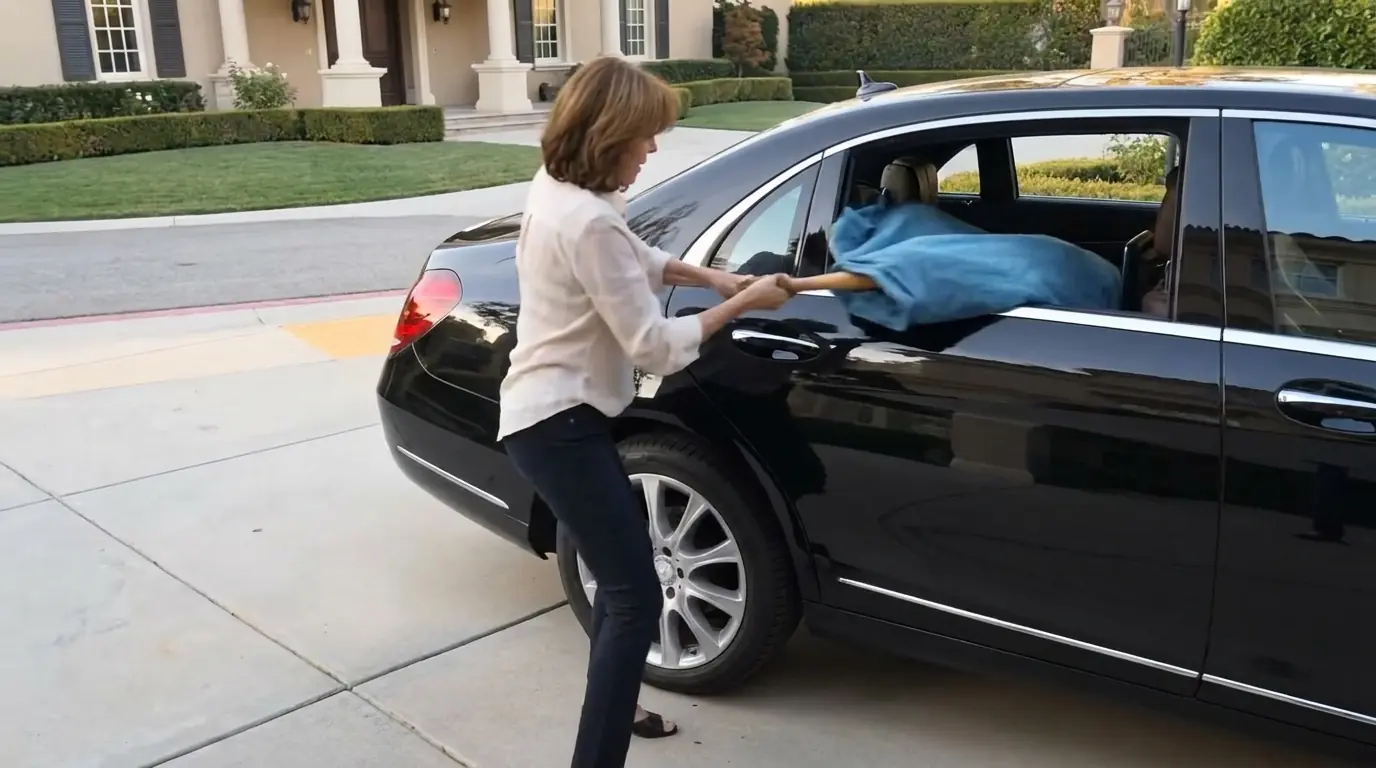
The sound of breaking glass came from my driveway at 4:16 on a Tuesday afternoon.
Not a crack.
Not a car door slamming.
An explosion.
I was standing in my kitchen rinsing a coffee mug when the sharp crash made me drop it into the sink.
I ran toward the front window.
My neighbor, Denise Carter, was standing beside my SUV.
A heavy metal flashlight hung from her right hand.
The driver-side window was gone.
Glass glittered across the seat, the pavement, and the black rubber floor mat.
For a second, I could not understand what I was seeing.
Then Denise reached through the broken window.
That was when I noticed what she was trying to grab.
A blue accordion folder lay on the passenger seat.
My folder.
The one I had spent nearly six weeks building.
I opened the front door.
“What the hell are you doing?”
Denise jerked backward.
She turned toward me.
Her face was red.
Not embarrassed.
Angry.
“You have no right keeping documents about me.”
I stopped halfway down the front steps.
That sentence was more disturbing than the shattered window.
Because I had never told Denise what was inside the folder.
I had never shown it to her.
Never mentioned it.
I had not even told most neighbors I was collecting records.
So how did she know?
I walked toward the driveway.
“Get away from my car.”
Denise pointed through the broken window.
“That file belongs to the association.”
“No, it doesn’t.”
“You stole confidential records.”
“They’re copies.”
“You had no authority to obtain them.”
“Then how do you know what they are?”
She hesitated.
Only for half a second.
Enough.
I took another step.
“Move away from the vehicle.”
Instead, Denise shoved her hand through the broken opening again.
The remaining glass scraped against the sleeve of her blouse.
She reached for the folder.
Then a voice shouted from across the lawn.
“Denise, don’t touch that file.”
She froze.
Michael Grant was running toward us with his phone held out in front of him.
Recording.
Michael lived two houses down.
Sixty years old.
Retired federal accountant.
The kind of man who wore cargo shorts in February and could explain property-tax assessments for fun.
He had been helping me organize the records.
Denise saw him.
Her entire expression changed.
Not anger now.
Fear.
“Michael.”
He stopped ten feet away.
“Step away from the SUV.”
“This is none of your business.”
“It became my business when you broke a window trying to take evidence.”
“Evidence?”
She laughed too quickly.
“That’s dramatic.”
Michael kept filming.
“Then stop reaching for it.”
Denise looked at me.
Then the folder.
Then Michael’s phone.
Her breathing changed.
She lowered the flashlight.
For the first time since I had known Denise Carter, she seemed unsure which version of herself to use.
The aggressive HOA officer.
The offended neighbor.
The frightened woman.
She chose frightened.
“Daniel.”
My name is Daniel Brooks.
I was forty-four years old, worked as a project manager for a commercial glazing company, and had lived on Laurel Ridge Drive in Frederick County, Maryland, for eleven years.
Denise had lived next door for five.
For most of those five, she had treated our quiet street like a private territory she had been appointed to defend.
She chaired the Laurel Ridge Homeowners Association’s Compliance Committee.
Not the full HOA board.
That distinction never seemed important to her.
She photographed driveways.
Reported work vans.
Counted days trash cans remained visible.
Questioned guests.
Sent violation notices about basketball hoops, lawn furniture, children's bicycles, and once, famously, an “unauthorized seasonal flag.”
The flag had been an American flag with pumpkins printed around the border.
Denise claimed it exceeded decorative-size guidelines.
The HOA board dismissed the complaint.
She filed another one.
That was Denise.
Persistent enough to make bad authority feel official.
My problems with her started after my sister stayed with me for three weeks following surgery.
Her car remained in my driveway.
Denise photographed it every morning.
On the fourth day, I received an email.
UNREGISTERED LONG-TERM VEHICLE
I responded that my sister was a guest.
Denise requested “documentation of temporary residency.”
I refused.
She threatened a fine.
The board rejected it.
Then my friend Marcus parked his plumbing van outside one evening.
Another complaint.
Then my nephew left a basketball near the porch.
Complaint.
Then I installed a new mailbox matching the old one almost exactly.
Denise claimed the finish was “too reflective.”
That was when I stopped believing the issue was neighborhood standards.
It was control.
I challenged her during an HOA meeting.
Publicly.
Politely.
I asked why her committee had issued forty-seven fines in six months when the previous year’s committee had issued twelve.
I asked where the fine revenue went.
The treasurer answered:
“General association operations.”
I asked for a breakdown.
Denise interrupted.
“We’re not here to audit the HOA because one homeowner dislikes enforcement.”
I looked at her.
“I’m asking where the money goes.”
She smiled.
“You should worry more about complying.”
That sentence bothered me.
So did another one she said afterward in the parking lot.
“You’re going to make yourself very unpopular here.”
“I can live with that.”
She stepped closer.
“I can make you regret challenging me.”
I thought it was a threat made in anger.
Then my fines started.
Driveway discoloration.
Fence appearance.
Unauthorized contractor parking.
Improper waste-bin positioning.
Four hundred and seventy-five dollars in eight weeks.
Most were eventually dismissed.
But only after I appealed.
I began keeping records.
At first, to defend myself.
Then I noticed something.
The HOA charged fines through an outside company called Ridgeway Community Compliance Services.
I had never heard of Ridgeway before Denise joined the committee.
Every violation included:
Administrative processing fee: $45
Even if the underlying fine was dismissed, the processing fee often remained.
Residents paid.
Forty-five dollars seemed small.
Until Michael Grant asked how many notices were issued.
We counted.
More than three hundred in two years.
Then we found something stranger.
Ridgeway’s mailing address was a private mailbox in Rockville.
Its registered agent was a man named Christopher Carter.
Denise’s brother.
That was the first page in the blue folder.
Now Denise stood beside my shattered SUV saying:
“Daniel, we need to talk.”
I stared at the flashlight in her hand.
“You broke my window.”
“I panicked.”
“About a folder you supposedly know nothing about?”
She swallowed.
Michael’s phone remained raised.
“I shouldn’t have done that.”
“No.”
“I’ll pay for the glass.”
“That’s not the main problem anymore.”
Her eyes moved toward the folder.
“Please.”
That word surprised me.
Denise did not use “please” often.
“What?”
“Give me the file.”
Michael said quietly:
“No.”
Denise snapped:
“I wasn’t talking to you.”
Michael stepped closer.
“You’re being recorded.”
She looked around.
Curtains moved in nearby houses.
A garage door had opened.
People were watching.
Denise lowered her voice.
“You don’t understand what’s in those documents.”
I almost laughed.
“I collected them.”
“You don’t understand what they could do.”
“That sounds like your problem.”
Her face collapsed for a second.
Then she whispered:
“They’ll destroy everything.”
Before I could ask who “they” were, a black sedan turned onto Laurel Ridge Drive.
It slowed.
Stopped behind Michael’s pickup.
A man in a dark suit stepped out.
Mid-fifties.
Gray hair.
Leather folder under one arm.
He looked at the broken SUV window.