The first spray struck Dr. Zora Pembroke across the hands. The second hit her face. A sharp mist of hospital-grade sanitizer caught her along the cheek and right eye. Zora recoiled, one hand rising instinctively as the sting spread beneath her eyelid. The bottle clicked again in Mallory Keswick's manicured fingers ready for a third pull.
"Don't touch my counter," Mallory said. The bright lobby of Northgate Meridian Medical Center went quiet. A volunteer stopped pushing a wheelchair and two visitors near the coffee kiosk turned. Behind the curved reception desk, employees stared at their screens as if they had seen nothing. Zora blinked through the burning.
Her charcoal coat was wrinkled at the knees and a dark stain ran along one sleeve. 10 minutes earlier, she had been kneeling on wet pavement beside an elderly man who collapsed outside the east entrance. She had kept him conscious until the emergency team arrived, then followed the gurney inside long enough to make sure his airway was stable. That delay had cost her the welcome escort the board had arranged. It should not have cost her dignity.
A young nurse hurried from the adjoining corridor with a box of tissues. "Ma'am, are you all right?" "I'm fine," Zora said, though her eye was watering. "Thank you." The nurse's badge read Paloma Ibarra, RN. Mallory planted the sanitizer bottle on the counter. She was the director of executive guest services dressed in a cream suit that matched the stone walls and polished floors. Her expression carried the cool impatience of someone accustomed to deciding who belonged in expensive spaces.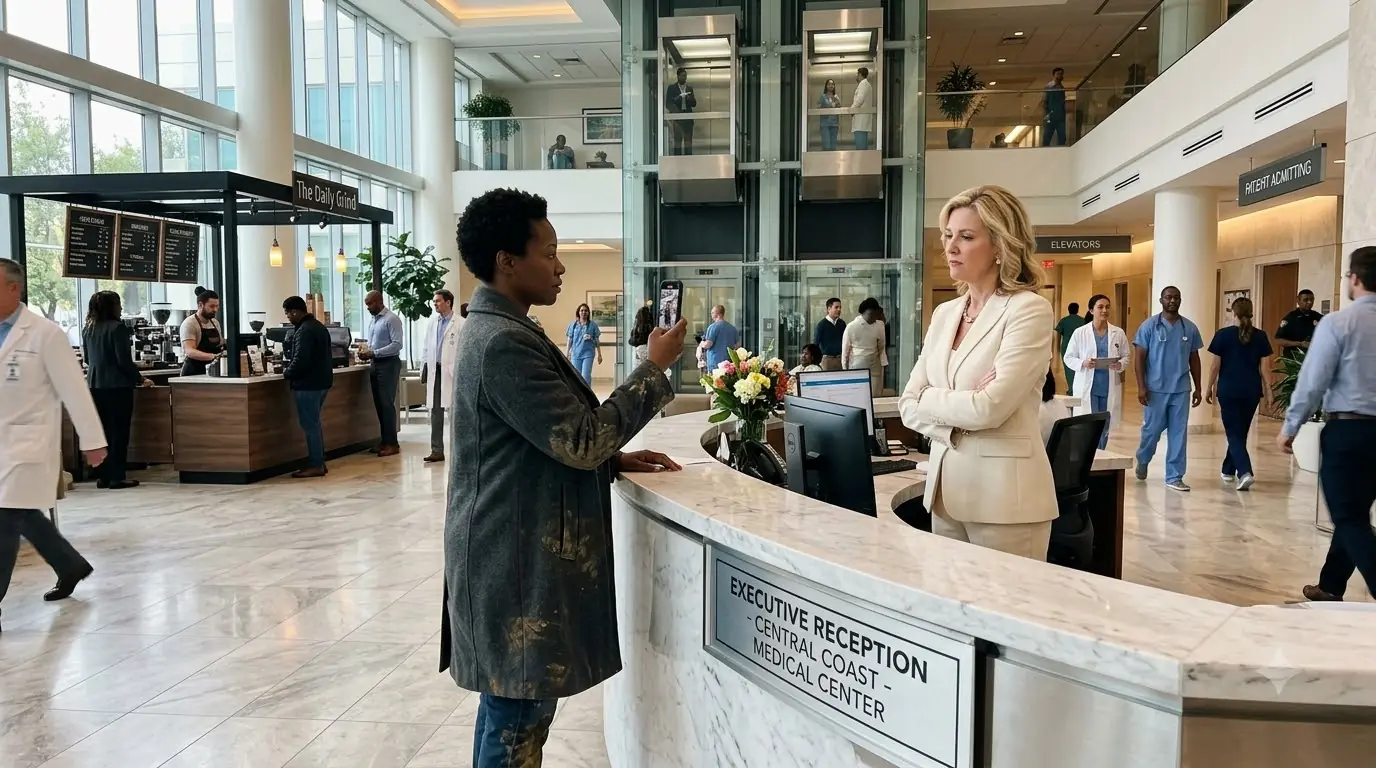
"Paloma, return to your unit," she said. "This is a security matter. "This woman needs to rinse her eye." "This woman was told not to touch anything." Zora pressed a tissue beneath her eye. I told you my name. I asked you to check the board list and I told you the community assistance office is on the lower level.
I am not here for community assistance. I'm here for the 9:00 board meeting. Mallory gave a short laugh and glanced toward the growing cluster of onlookers. The private board session, yes. You expect me to believe you walked into a restricted executive area dressed like that and somehow belong in a private board session.
Zora looked down at the mud on her coat. "A man collapsed outside. I helped him." "Of course he did." There was something in Mallory's voice that made several people shift uncomfortably. Zora unlocked her phone and opened the email bearing Northgate Meridian seal. My invitation is here.
Call the board office and verify it. Mallory did not look at the screen. She stepped back as though Zora had thrust something dangerous toward her. Put the phone down. I'm showing you what you asked for.
I will address your conduct with nursing administration later. A broad man in a dark security uniform emerged from the elevator corridor. Brent Huxley had worked at Northgate Meridian for 11 years, long enough to know which executives could end his career with a complaint. Mallory was one of them. What have we got?
He asked. Possible impersonation, Mallory said. She claims she's attending the board meeting and tried to force her way past me." Zora turned to him. "I have not tried to pass the desk. I gave her my name and offered my invitation." Brent glanced at the damp tissue in her hand, then at Mallory.
"Why is her face wet?" "She became agitated when I sanitized the area." "You sprayed me in the face," Zora said. Mallory lifted both brows. "I sprayed the counter." She lunged forward. "That is not what happened," Paloma said. Mallory ignored her.
"Mr. Huxley, please remove this person before the donors arrive." Zora knew that tone. She had heard versions of it throughout her career. Someone decided what it was before she spoke, then treated every attempt to correct them as proof of aggression. She also knew the trap beneath anger. Raise her voice and Mallory would call her unstable.
Move too quickly and Brent would call her threatening. So Zora kept her voice level. "My name is Dr. Zora Pembroke. Call the board office. Ask for Celestine Rowland." Mallory's smile tightened.
"You looked up the chairwoman's name. That proves nothing." Brent held out his hand. "Phone." "No." "We need to verify what's on it." "You can verify it without taking it." "Ma'am, don't make this difficult." "It became difficult when she sprayed disinfectant into my eye." A man near the elevators raised his own phone and began recording. Another visitor did the same. Mallory noticed and straightened her jacket.
"Recording patients and staff is prohibited," she announced. "We're recording you," the man replied. Brent stepped closer to Zora. "Last chance. Hand me the phone and come with me.
I will walk with you to an office after you call the board. You're not setting the terms. He reached for the phone. Zora drew it toward her chest. Brent seized her wrist.
The movement was practiced. He twisted her arm behind her and pressed her against the marble edge. Pain shot through her shoulder as her phone struck the floor and skidded beneath the desk. Several people shouted at once. Stop.
She didn't do anything. Get off her. Paloma moved forward, but Mallory blocked her with an outstretched arm. Stay back, Mallory snapped. She's resisting.
I am standing still. Zora said her cheek against the cold stone. Brent increased the pressure. Then stop tensing. Mallory picked up the sanitizer bottle again.
With a deliberate sweep, she sprayed the patch of marble inches from Zora's face. We have immunocompromised patients in this building, she said loudly. I will not apologize for protecting them from unknown contaminants. Zora turned her head as far as Brent's grip allowed. You are using infection control as a weapon.
Mallory leaned closer. People who belong here understand our standards. Paloma stared at her. What does that mean? It means I know the difference between a physician and someone pretending to be one.
Based on what? Mallory's gaze flicked over Zora's hair. Her coat, the mud at her knees, then away. Based on experience. Brent's radio crackled.
He answered with one hand while maintaining his grip with the other. Security one, a dispatcher asked for a status update. Mallory spoke before Brent could. Tell them we have an aggressive trespasser attempting to access executive records. Zora's voice sharpened for the first time.
That is false. Brent keyed the radio. Possible impersonation and attempted restricted access. Subject is being detained. I have not crossed the desk.
You refused to leave. Because I have lawful business here. Mallory moved to the computer terminal. There is no record of you. She began typing.
From where she stood, Paloma could see the screen reflected in the polished glass panel behind the desk. A guest profile was open. At the top in large letters it read, "Dr. Zora Pembroke, board guest. Executive access approved." Paloma's breath caught. Mallory saw the same information.
Her fingers froze above the keyboard. For one brief second, fear broke through her composure. Zora noticed. "You found my name." "No," Mallory said too quickly. "You found it." Mallory clicked into the access menu.
A warning box appeared. She typed her administrative code, selected remove temporary credential, and confirmed the change. Paloma watched every step. Then Mallory refreshed the page and turned the monitor slightly toward Brent. "Nothing," she said.
"Just as I told you." Zora's face became still. "You deleted it." Mallory gave her a thin smile. "You are making accusations because your story failed." Paloma pulled out her phone behind a stack of intake folders and took a photograph of the screen's audit notification before it disappeared. The small banner showed Mallory's username and the exact time of the deletion. Brent released one of Zora's wrists long enough to retrieve her phone from the floor.
The screen was still lit with missed calls. Celestine Rowland, he read, "Three calls." Mallory's jaw tightened. "Anyone can rename a contact." A new call flashed across the screen. Celestine Rowland Northgate Board. Brent looked uncertain.
Mallory held out her hand. "Give it to me." Instead of answering, she silenced the phone and placed it behind the desk. Zora stared at her. "You now have my invitation, the board chair calling my phone and my access record." "How much evidence do you need before this stops being a mistake?" Mallory lowered her voice. "You should have left when I gave you the chance." The words were quiet, but the man filming near the elevator captured them clearly.
On the 14th floor, Celestine Rowland stood beside an empty chair at the head of Northgate Meridian's conference table. At 64, Celestine had spent three decades expanding the medical system from one suburban hospital to six regional facilities. She was not easily rattled, but she disliked unexplained absences, especially from people known for arriving early. "Has anyone reached Dr. Pembroke?" she asked. Dr. Lowell Brandt, the hospital's chief executive, checked his watch.
"Her car service confirmed she arrived." "Then where is she?" "There's some disruption in the lobby. Security is handling it." Celestine looked toward him. "What kind of disruption?" Lowell hesitated. "Someone apparently tried to enter the executive area under false credentials. A board member glanced at the closed doors.
"Should we delay the announcement?" Celestine called Zora again. No answer. Below them, Paloma stepped away from the reception desk and moved toward a nurse's station. Mallory saw her. "Where are you going?" "Back to my unit." "Leave your phone here." Paloma stopped.
"That is not hospital policy. It is during an active security investigation." "You mean the investigation where you just erased her access?" Brent turned his head. You saw that Mallory's face flushed. "She saw nothing." Paloma backed toward the corridor. "I saw the board credential on the screen.
I saw you remove it." "You are confused." "I took a picture." Mallory came around the counter. "Give me that phone." Paloma ran. She did not go far. At the nurse's station, she opened the internal directory and sent a secure message to Celestine's executive assistant. "Dr. Pembroke is in main lobby.
Security has her restrained. Her access was deleted after she arrived." Upstairs, the message appeared on a tablet beside Celestine. She read it twice. Then she left the conference room without explanation. Lowell followed her.
Four board members rose and came behind him. In the lobby, Brent had moved Zora to a chair near the security alcove. A plastic restraint circled one wrist attached to a fixed rail beneath the counter. Her eye was red from the sanitizer and the shoulder of her coat had torn along the seam. Mallory stood before two newly arrived police officers speaking with urgent precision.
She became hostile when asked to leave, she said. She attempted to gain access to confidential executive files and may have used forged credentials. One officer, a black woman with sergeant stripes, looked at Zora. "Did she threaten anyone verbally or physically?" the sergeant asked. Mallory said.
Is there a video? Our system will confirm everything. Zora spoke from the chair. Sergeant, before you rely on any statement, please order them to preserve the lobby footage and the access control audit. Mallory shook her head.
See, she keeps issuing commands. The sergeant studied Zora. What is your name? Dr. Zora Pembroke. Mallory sighed theatrically.
She has been repeating that name as though it changes the facts. The elevator doors opened. Celestine Rowland crossed the lobby at a pace that forced everyone behind her to hurry. Her eyes found Zora immediately: restrained to the counter, coat torn, one cheek wet, right eye inflamed. She stopped three feet away.
Zora, the lobby seemed to contract around that one word. Zora looked up. Good morning, Celestine. I'm afraid I'm late. Celestine's shock hardened into controlled anger.
She turned to Brent. Remove that restraint. Mallory stepped forward. Ms. Rowland, please be careful. This woman is Dr. Zora Pembroke, the incoming chief medical officer of the Northgate Meridian system.
Brent stared at Zora's wrist. His hands began to shake as he cut the plastic band. Mallory looked from Celestine to Lowell searching for some sign that the announcement was a bluff. Lowell had gone pale. Celestine faced Mallory.
Why was she restrained? Mallory recovered enough to straighten her shoulders. She presented herself suspiciously, refused security instructions, and attempted to enter a restricted area. We had no way to know who she was. Zora rubbed circulation back into her wrist.
You had my name. You had my invitation. You had three calls from Celestine on my phone. You had my approved access record. Mallory's mouth opened.
Zora continued. Then you deleted it. That is not true. Paloma returned from the corridor breathing hard. She held up her phone.
I photographed the audit banner. Mallory turned on her. You violated patient privacy. There is no patient information in the image. Lowell stepped toward the counter.
Everyone needs to stop speaking until legal counsel arrives. Zora looked at him. That instinct is why this went on as long as it did. He recoiled slightly. Celestine addressed the police sergeant.
Please do not leave. We may need an independent report. The sergeant nodded. No one is going anywhere. Zora stood carefully.
Her shoulder hurt, but she refused the chair Celestine offered. She did not want the scene turned into a private discussion behind closed doors where titles could soften language and reputations could reshape facts. Lock the access system, she said. Preserve all logs from the last hour. Copy the lobby footage to an external server.
Separate each staff member involved and take statements before they can coordinate. Lowell frowned. Dr. Pembroke, you have not formally assumed your position. Celestine looked at him. She has now.
The board members behind her exchanged glances. Mallory's composure began to fracture. I followed protocol. A woman with no badge arrived at an executive entrance wearing soiled clothing and demanding access. I protected this institution.
Zora faced her. You sprayed sanitizer into my eye. "You moved toward me." "The cameras will show whether I moved." You touched a sterile surface. It is a reception counter, not an operating field. A visitor near the coffee kiosk laughed once without humor.
Mallory heard it and raised her voice. This hospital serves transplant patients, oncology patients, people with compromised immune systems. I will not be shamed for taking infection prevention seriously. Zora stepped closer stopping beyond arms reach. I have spent 22 years controlling hospital outbreaks.
I helped design the isolation protocol this system adopted last winter. Nothing you did today was infection prevention. Mallory's eyes flickered. You did not offer me a mask, Zora continued. You did not direct me to hand washing.
You did not call clinical staff. You used a bottle as a prop to humiliate someone you had already decided was dirty. Mallory's confidence collapsed another inch. Brent sat alone on a bench while an officer took his statement. He admitted that Zora never struck him, never tried to cross the desk, and never threatened anyone.
He said he acted because Mallory identified her as dangerous. When asked why he took Zora's phone, he could not cite a policy. The access audit was recovered within minutes. Mallory had opened Zora's approved credential at 8:47 a.m. She removed it at 8:49. At 8:51, she created an incident note claiming no credential had ever existed.
The camera footage was worse. It showed Zora standing calmly while Mallory sprayed her hands. It showed the second stream striking Zora's face after she had already stepped backward. It showed Brent grabbing her without warning. It showed Mallory sanitizing the counter beside Zora's head while speaking to the crowd.
The footage also captured Mallory telling Brent, "Make sure the report says she became aggressive first." There was no interpretation that could rescue her. Celestine watched the recording once, then asked the technician to stop. Mallory was escorted into a consultation room where she sat opposite Zora Celestine Lowell and a human resources attorney who had arrived from the administrative tower. For the first time that morning, Mallory looked small. "I made a judgment call," she said.
"You made a sequence of decisions," Zora replied. "The first might have been prejudice operating faster than thought. Everything after that was deliberate." Mallory swallowed. "I was under pressure. We had donors arriving.
We've had incidents with people entering the building and pretending to need help." "Did any of them present a board invitation?" "No." "Did any of them receive calls from the board chair?" "No." "Did any of them appear in your access system?" Mallory stared at the table. Zora's voice remained quiet. "You had multiple chances to correct yourself. Instead, you erased evidence and tried to create a criminal record for me. I never intended for anyone to be hurt.
My shoulder is injured, my eye is still burning. A police report describes me as a possible impersonator because you supplied false information. Mallory looked toward Lowell. "No. The expectations you placed on my department." You said the executive lobby had to remain controlled.
You said certain visitors made donors nervous. Every person at the table turned toward him. Lowell's expression tightened. I never authorized discrimination. "No," Mallory said.
"You used cleaner words." Silence followed. That afternoon, the board suspended Lowell pending an independent investigation. Mallory's employment was terminated for assaultive conduct, falsification of records, retaliation against a witness, and misuse of security procedures. The police documented the sanitizer incident and the false statements. Any criminal charging decision would be left to the county prosecutor.
Brent was removed from duty immediately when the external review found that he had used force in three earlier incidents without documenting a clear threat. His contract was terminated and the findings were sent to the state licensing authority. Paloma received no promotion bonus or ceremonial title. Zora insisted on something more useful, written protection from retaliation, paid time to participate in the safety review, and authority for nurses to activate an independent conduct response when security actions appeared unsafe. The larger investigation lasted 7 weeks.
It uncovered 23 complaints from patients and visitors who had been labeled disruptive, unsanitary, or suspicious after asking for help in the executive wing or specialty clinics. Most had been quietly closed. Several involved black families. Others involved immigrants, unhoused patients, and people who arrived in work clothes after construction or factory shifts. Mallory had written many of the reports.
Lowell had not written any. He had simply approved the system that made them disappear. When the board asked Zora whether she wanted Lowell fired, she declined to make the decision alone. This cannot become one powerful person replacing another, she said. Use the evidence.
Apply the standard publicly. Then live with it. The board found that Lowell had repeatedly prioritized donor comfort and reputation management over fair access and accurate incident review. He resigned before the final vote. Six months later, the Northgate Meridian lobby still gleamed beneath the same white lights.
The same stone counter curved beneath the same suspended glass sculpture. No plaque marked the place where Zora had been restrained. She had refused one. Instead, the hospital changed procedures that most visitors would never notice. Guest credentials could no longer be deleted without a second administrator's approval.
Security reports automatically preserved relevant video. Words such as aggressive and threatening required a description of specific behavior. Complaints involving race, disability, language, housing status, or perceived ability to pay went directly to an outside review team. The changes did not make the hospital perfect. One physician resigned rather than complete the new training.
A donor withdrew funding after being told he could not demand the removal of a Muslim family from a shared waiting area. Northgate Meridian let him go. On a rainy Tuesday morning, Zora crossed the lobby and saw an elderly man standing near the information desk. He leaned on a cane and studied her face for several seconds before smiling. "Dr. Pembroke." She recognized Everett Sloan, the retired school teacher who had collapsed outside on her first day.
"You look much better standing up," she said. "And you look different without mud on your coat." He laughed then grew serious. "My daughter told me what happened after they took me upstairs. I'm sorry helping me put you in that position." "It did not put me there. It made you late.
It made your clothes look human." Everett nodded. They stood together beside the reception desk. A new guest services employee was helping a woman in paint-stained overalls locate her husband's cardiac unit. The employee did not recoil from the dust on her sleeves. She printed directions, walked around the counter, and pointed out the correct elevator.
Everett watched the interaction. "Do you ever wish you had worn your white coat that morning?" he asked. Zora thought about the question. A white coat would have changed the morning. Mallory might have smiled.
Brent might have addressed her as doctor. Her invitation might have been checked before her skin, clothing, and presence were treated as evidence against her. But the respect would have been conditional. It would have depended on a symbol of authority rather than any recognition of her humanity. No, Zora said, "The coat would have hidden the problem." Across the lobby, Paloma was speaking with a security supervisor about a frightened teenager who refused to leave his hospitalized mother.
No one grabbed him. No one called him aggressive. They asked what he needed and brought in a social worker. The hospital's transformation could not be measured by a speech, a firing, or a viral recording. It lived in those smaller decisions made when no board member stood nearby and no camera promised consequences.
Zora touched the faint line on her wrist where the plastic restraint had cut into her skin. Mallory had believed she could identify who belonged at Northgate Meridian by looking at them. She had believed cleanliness, status, and worth could be read from fabric, posture, accent, or skin. In 15 minutes, she had turned that belief into humiliation, forced false records, and a call to police. The damage had not come from one misunderstanding.
It had come from every opportunity to learn the truth that she deliberately rejected. Zora walked Everett to the elevators. Before the doors closed, he lifted a hand in farewell. Then she returned to the center of the lobby where strangers passed through carrying flowers, medical folders, lunch bags, fear, fatigue, and hope. None of them wore proof of their value where another person could easily see it.
That was why dignity could never be reserved for those who looked important. By the time someone's title was known, the real test was already over.
END