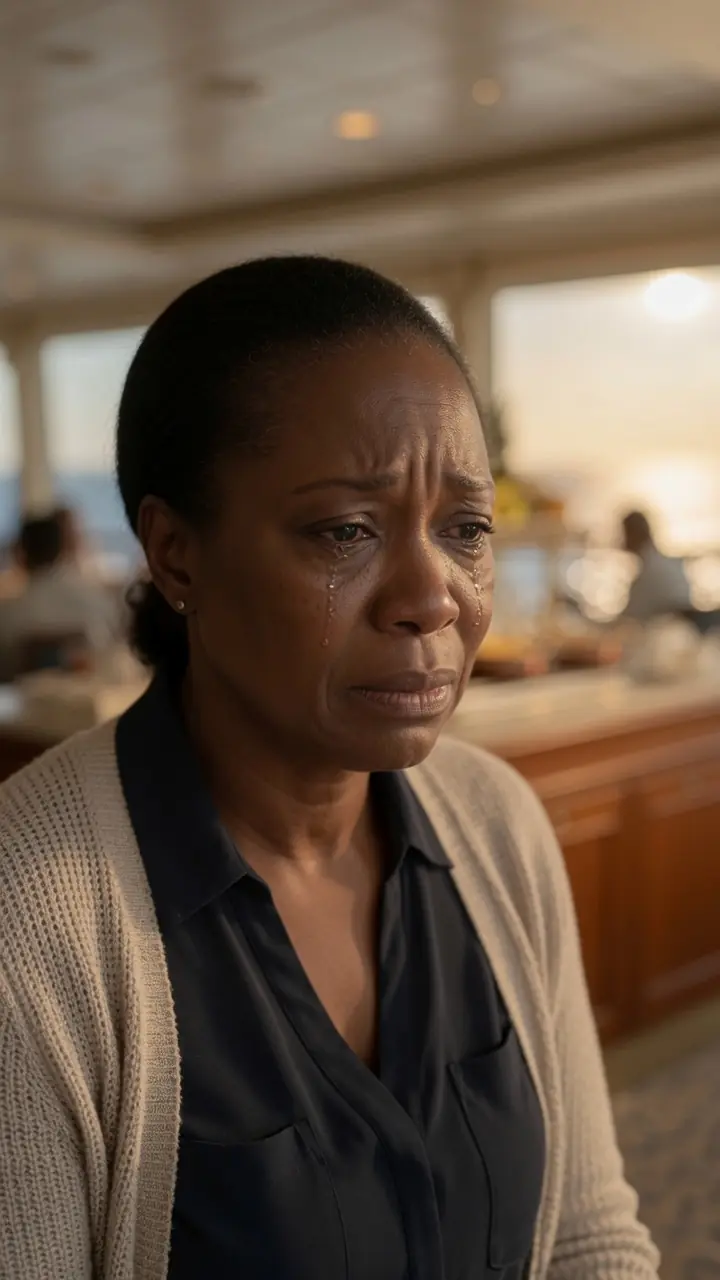
Jasmine Caldwell was 44 years old and for 4 years she believed she was a widow. She sold the house where they built their life, worked double shifts on a factory floor until her hands were permanently calloused and carried the specific hollowness of a woman who had simply learned to function inside grief. She planned the funeral. She filed the insurance claim. She visited the grave every October like clockwork. She did every single thing a woman is supposed to do when the worst thing happens because she believed it had.
Then she boarded a birthday cruise she almost didn't take. Ordered her first rum punch in 4 years and looked up from her breakfast table. He was standing 30 feet away, alive, tanned, laughing. That exact laugh she had buried, leaning into another woman like he had not a single thing to answer for. The crescent scar on his left forearm caught the Caribbean sunlight and confirmed what her eyes were already telling her.
Jasmine set her fork down slowly. She did not stand. She did not make a scene. She picked up her phone and took a photograph. What Jasmine Caldwell did next would unravel everything he thought he had permanently escaped.
The drink was cold in her hand. Jasmine Caldwell had been holding it for 11 minutes. She knew because she'd checked her watch when the server brought it over the same way she checked the clock whenever a new shift started at the plant. Habit. The ice was shrinking. The rum punch was getting warm at the edges. She still hadn't taken a sip.
The ocean stretched out in every direction like something that didn't know what problems were. The Empress of the Atlantic cut through the water smooth and steady, and the Leo deck hummed with the low noise of people who had decided for one week that their lives were good. Somewhere behind her, a kid was laughing too loud. A steel drum version of an old R&B song drifted up from a deck below. The sun pressed down on everything, warm, heavy, honest.
Jasmine sat in all of it, and felt mostly like a woman waiting for a shift to start. She set the drink on the small table beside her and looked at her hands. The calluses along her right palm had been there so long she'd stopped noticing them. Built up from the plant floor from years before the promotion, from pulling cable and running line before she was the woman who managed the men who pulled cable and ran line.
Forewoman now. She'd worked double shifts for 18 months to get there. People at the plant thought she was ambitious. She was not. She was just a woman who needed somewhere to be. She reached into her shirt pocket and pulled out the paperback, The Long Goodbye by Raymond Chandler. She'd been on page 211 for 6 weeks. She opened it, read the same paragraph she'd read three times the night before, and put it back in her pocket.
Today, she was 44 years old. Her daughter Camille had called her that morning before the ship left Miami. She was 17, sharp in the particular way of someone who learned early that the world doesn't stop for you, so you'd better learn to move with it. She had booked this trip herself, found the deal online, argued her into it over dinner on three separate occasions, and eventually just bought it, and handed her the confirmation email with a look that said the conversation was finished.
"You haven't been anywhere, Mom," she'd told her. "Not in 4 years. You need to go somewhere." She hadn't argued after that. She knew she was right. She also knew she was doing what she'd been doing since she was old enough to understand what was missing, trying to fill in the space that the accident had left four years ago.
She let that sit the way she always let it sit. Careful and deliberate. The way you handle something fragile, even after you know you've already survived dropping it. Four years ago, Marcus was driving back from his sister's place in Dayton. A semi ran a red light on State Route 35. The car went into the river. They found it two days later. They found him, a body. Two weeks after that, badly decomposed from the water. The identification came back through dental records.
The funeral director was patient with Jasmine when she couldn't decide between two caskets and stood there in that showroom for 20 minutes without speaking. She'd handled every piece of it. The funeral arrangements made alone, the phone calls made alone, the life insurance forms, the house, their house on Maple Run, the one with the sun room Marcus had painted himself, butter yellow. She couldn't stay in it, so she sold it, took the loss, moved her and Camille into a two-bedroom apartment on the east side.
She sat Camille down, 7 years old, small enough that her feet didn't touch the floor when she sat on the kitchen chair, and explained to her in the clearest, most careful words she knew where daddy had gone and why he wasn't coming back. She still didn't know if she'd done that right. She'd worked. She'd shown up. She'd learned every name on her floor before she made forewoman, not to impress anyone, but because men and women work harder for someone who knows their name. And Jasmine Caldwell had never once in her life done anything half measure.
When the server had brought her drink an hour ago, Jasmine had thanked her and used the name off her badge, Lutia. She'd blinked a little, the way people do when a stranger treats them like a person instead of furniture. She had been functional for 4 years. She knew that. What she also knew in the quiet, private place where she kept things that were too honest for company was that functional wasn't the same as okay.
She'd been going through the motions of a life. Work, home, Camille, sleep, repeat. She had not been anywhere, done anything, or wanted much of anything for herself in a long time. She picked up the rum punch. It was still cold enough, sweet and sharp. The smell of it, the ocean underneath it, the weight of the sun on her forearms. Something in her went slightly loose, like a knot easing off.
She looked at the horizon, a clean, flat line where the blue of the sky met the blue of the water. "Maybe Camille was right," she thought. "Maybe this is good." The breakfast buffet ran along the entire port side of deck 11, and it was the kind of spread that made you feel like someone had set out to solve abundance as a problem. Eggs six ways, pastries stacked in warm pyramids, fruit cut into shapes that had no reason to be shapes.
Jasmine moved through it with a plate she wasn't very committed to. A little bit of everything, nothing she was particularly hungry for, and found a table near the window where the ocean was bright and flat in the morning light. She ate slowly and read the news on her phone. The plant had texted twice. She ignored both. She was off the clock. That was the deal.
The buffet hummed around her. Families negotiating over orange juice. A couple who hadn't spoken since sitting down. A man in a bucket hat photographing his waffles. Jasmine watched all of it the way she watched the floor at work. Peripheral, automatic, not really looking at anything. She was reading an article she wasn't retaining when she heard the laugh.
She didn't look up immediately. That was the strange thing, the thing she'd think about later. Her body heard it before her brain did. Some old deep part of her registered it the way you register your own name. Not a thought, just a turning, a pull. The laugh came again. She looked up.
He was standing at the omelet station, 30, maybe 35 ft away. Jasmine's brain did what brains do when they encounter the impossible. It offered her alternatives, quick and generous. It's not him. Someone who sounds like him. You're tired. You've been alone a long time and your mind is She went still and she looked same jaw, sharp at the angles, softer underneath, the set of his shoulders, the way he stood with his weight slightly on his left foot.
He was wearing a linen shirt and a watch she didn't recognize. He looked rested. He looked healthy. He looked, in fact, better than she had ever seen him look, which was a detail that landed somewhere behind her sternum and didn't move. He reached up and touched the back of his neck. Jasmine's fork lowered itself to her plate. She had watched him do that exact thing 10,000 times.
Whenever he was looking at a menu, whenever he was deciding whether to answer the phone, whenever he was in a conversation, he was calculating his way through. Same motion, same two fingers pressing at the base of his hairline. She needed one more thing, and she knew exactly what to look for. She found it, his left forearm.
He'd turned slightly to take a plate from the buffet attendant, and the shirt had short sleeves, and right there, pale against the inside of his forearm, was a small crescent-shaped scar. He'd caught himself on the oven rack in the kitchen of the Maple Run House in 2014. She'd been the one to clean it. She'd been the one to keep changing the bandage for a week. She knew that scar the way she knew the sound of the apartment door catching on its frame.
He was alive. He was standing at a breakfast buffet on a cruise ship in the Caribbean. He was laughing. The woman beside him was tall, elegant, dressed with the easy confidence of someone who had never had to check a price tag in her life. She had a wide, unhurried smile and a hand resting at the small of his back like it had been there for years. He leaned into it, small and natural, the way you lean into something you've gotten used to. The way you lean into someone you trust.
Jasmine sat with this for approximately 30 seconds. Then she picked up her phone. She was calm. She registered the calm the way you register weather. It was simply the condition she was operating in. Her hand did not shake. She opened the camera. She took two photos, making sure to get his face clearly. The hat pushed back enough to confirm what she already knew. Then she pressed the video button and moved the phone slowly, deliberately, like a woman taking in the view.
His face, his neck, the omelet station, back across down to the forearm, the scar in the morning light, and then to the woman beside him. Full frame, face forward. Then she locked her phone, stood up, and left her plate where it was. She walked back to her cabin at a completely ordinary pace. She sat on the edge of the bed and put the phone face down on the comforter beside her.
The cabin was cool and dim and very quiet. The ship rocked almost imperceptibly. Outside the small round window, the ocean was still doing what it always did, moving without caring about anything at all. Jasmine put her hands on her knees. 11 minutes passed. She knew because she checked her watch at the beginning and at the end.
In those 11 minutes, a specific kind of understanding arrived. Not like a wave, nothing that dramatic, but the way water fills the low places in a floor. Slow, complete, without asking permission. He had not died. He had left. Not the way people leave, not with suitcases, not with a conversation, not with papers signed and furniture divided and the ugly human work of ending something. He had chosen to be dead. He had decided that dying was easier than talking to her.
He had looked at their life, at their daughter, at 7-year-old Camille, with her feet that didn't touch the floor when she sat in a kitchen chair, and he had chosen to simply not exist anymore rather than walk out the front door like a person. The dental records, a body that was identified through dental records, someone else's dental records, the insurance payout, $200,000 that had barely covered the debts and the sale loss on the house. That money had come because he was dead and he was not dead.
And Jasmine had filed those forms herself in a funeral home office with a pen that kept running dry and a director who kept apologizing for the inconvenience. She thought about Camille's face at the funeral. She thought about the dress she wore, small and dark, standing at a graveside in October. She thought about the man at the omelet station, laughing in the morning sun.
She picked up her phone and dialed. It rang twice. Jasmine, you're supposed to be on a boat somewhere, Pat. [clears throat] Her voice was level, even a forewoman's voice. I need you to do something for me, and I need you to not ask questions yet. Jasmine moved to the small desk by the window and sat down. The cabin was 12 ft wide, maybe less. There was a desk, a chair, a lamp that cast a narrow yellow cone across the surface. Outside, the ocean moved. Jasmine did not look at it.
She opened her phone and pulled up the photos from the buffet. She looked at them with the same flat attention she gave to production reports, looking for what was actually there, not what she expected to find. His face was clear. The scar was visible in the second photo, the morning light landing on his forearm at exactly the right angle. The video was steady. She had always had steady hands.
She sent the photo of the woman to Patrice with a single line. Face, search this, need a name. Then she sat back and waited. She did not spiral. She did not pace. She had spent 20 years on factory floors where the cost of panic was a shutdown. And that discipline had become so deep in her that she couldn't have accessed panic now if she'd tried. She simply sat in the chair and let her mind work the problem the way it always worked. Problems backward from the failure point. What broke? Why it broke? In what order?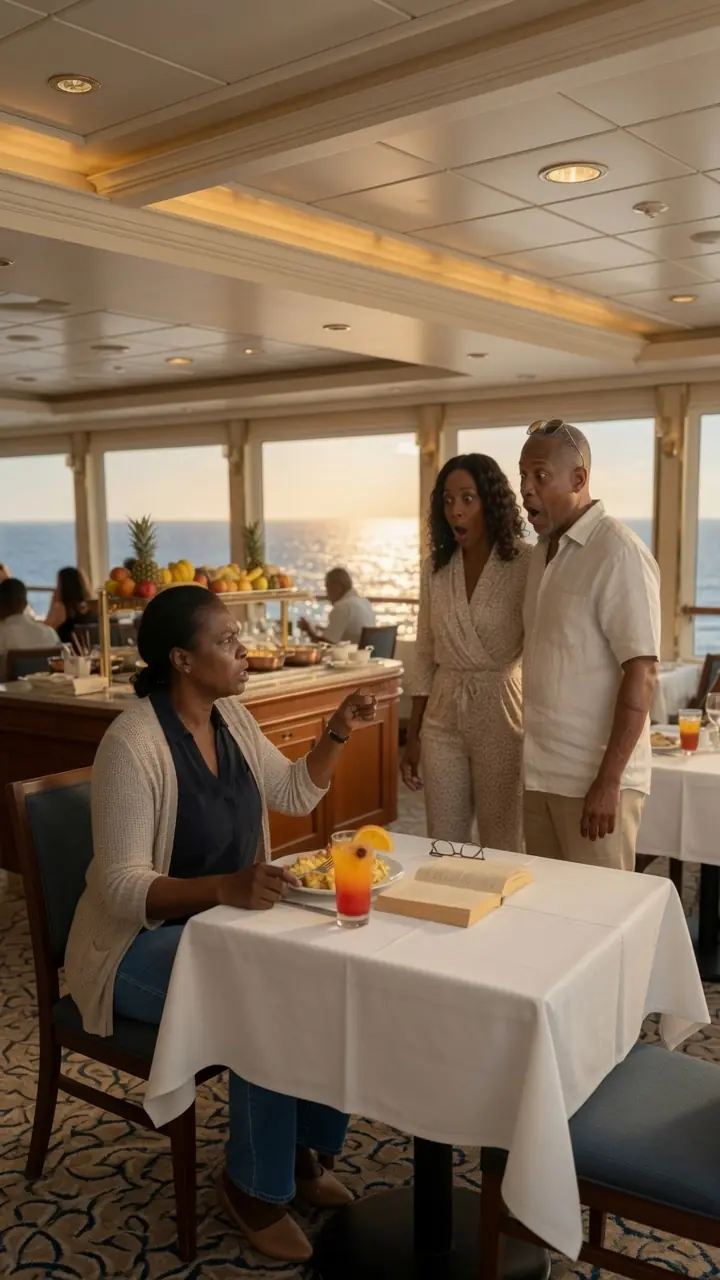
Patrice texted back in just under 2 hours. Elena Voss, real estate developer based in Scottsdale, Arizona. Public filings suggest she's worth a lot. I mean, a lot. More coming. Jasmine read it twice. Saved the name in a note on her phone, added Scottsdale, underlined it in her mind. Then she got dressed for the evening.
The cocktail hour was held on the upper aft deck, and by 7:00 it was crowded and golden, the sun going down behind the ship in a long, slow burn. Jasmine wore a plain dark dress, and took a position near the outer rail with a club soda, her back half turned to the crowd. A woman alone with a drink watching the water. Nobody looked at her twice.
She found him in under four minutes. He was near the center of a loose group. Six people, maybe seven. The kind of mix you accumulate on a cruise ship, different cities, different tax brackets, held together for a week by proximity and open bars. Elena stood at the edge of the group, easy and self-contained, laughing at something someone said. He was beside her working.
That was the word that arrived in Jasmine's mind and stayed. He was working the room. His hands moved when he talked. He tilted his head at exactly the right angle when someone else was speaking. The attentive tilt, the one that made whoever was talking feel like they were the only person on the deck. He touched a woman's arm and the woman smiled like she'd been given something. He laughed. The practiced version of his laugh, the one Jasmine had already cataloged from the buffet. And it was close enough that someone who didn't know him couldn't tell. But Jasmine knew the real one. The real one broke slightly at the top. Caught itself. This one didn't do that. This one was smooth all the way through.
He had been practicing it for years, probably. She watched him move to Elena's side and say something to her just for her. Private in the middle of a crowd. Elena looked at him the way a woman looks at something she can't believe is hers. Jasmine recognized the expression because she had worn it herself once a long time ago. She didn't look away. She just noted it, filed it.
Then she watched him approach the hostess station near the deck entrance where a woman with a clipboard was managing dinner reservations. She wasn't close enough to hear every word, but she was close enough for the name. Marcus Caldwell, she said. Reservation for 2. We pushed it to 8:30. The hostess smiled and made a mark. He moved back to Elena.
Jasmine took a slow sip of her club soda and looked back out at the water. She was in the cabin by 8. She texted Patrice, "Elena Voss, Scottsdale, Arizona. Find her." Patrice came back 40 minutes later, and the text was longer than her others. Driver's license issued 3 and 1/2 years ago. SSN traces back to a real person. Elena Renee Voss, born 1981, died Cincinnati 2019. Jasmine, he didn't just run, he built this. This was ready before he was ever gone.
She read it. Then she set the phone face down on the desk. She opened the desk drawer. Inside was a notepad with the cruise lines logo and a ballpoint pen that she tested twice on the corner of the pad before using. She wrote for approximately 4 minutes. The list had nine items numbered, clean, nothing abbreviated. She printed rather than cursed. Old habit, easier to read under pressure.
When she finished, she looked at it once, start to finish, the way you review a work order before signing off. Then she picked up the phone and started making calls. The grief was gone. She noticed its absence, the way you notice when a sound you've stopped hearing finally stops completely. It had been there so long she'd stopped calling it by its name. What was there now was something else, something quiet, something that did not need to announce itself.
She had the name, she had the face, she had the list. She got to work. Jasmine was back at her desk by 7:15 Monday morning. Same coffee, same mug, same drive-in. She had stopped at the same gas station she stopped at every weekday, filled up, bought a bottle of water, nodded at the same cashier who never said much, and didn't start now.
She parked in the same spot, walked through the same side entrance. The plant smelled the way it always smelt, metal shavings and machine oil, and the faint sweetness of the industrial cleaner they used on the floor drains. She clocked in. She did her morning walk. She reviewed the overnight production log, initialed two maintenance requests, and asked Marcus on the line about his knee because Marcus had been favoring it for 2 weeks, and Jasmine had been watching. Nothing changed. Nothing could.
The only way this worked was if everything stayed exactly the same on the surface. She understood that the way she understood load tolerances, you change one variable quietly. You do not touch the others. You hold the structure steady while you work underneath it. Patrice found her during the 11:00 break. She came into her office, closed the door behind her, and sat down across from her without being asked. That was how they operated. No performance, no preamble.
She put a manila folder on her desk. BMV contact came through. She said, "Original accident report. I also got something else. She opened the folder. The accident report was three pages. She had seen versions of it before. After Marcus died, the insurance company had shared a summary, but this was the full document, unredacted. She read it the way she read everything top to bottom once without stopping.
On page two, buried in the identification section was the name of the dentist who submitted the dental records used to confirm the body. Dr. Raymond Alt. Practice address, Dayton, Ohio. Jasmine looked up at Patrice. Keep reading, she said. The second document in the folder was a printout from the Ohio State Dental Board's public records. Dr. Raymond Alt, license suspended. The date was 8 months after the accident. The reason listed was a formal finding of record falsification related to fraudulent identity documentation submitted on behalf of multiple patients.
Jasmine put the paper down on the desk with the same care she gave to everything she handled. The PI firm confirmed it this morning. Patrice said Alt had a pattern. He wasn't the only case, but one of them matched the timeline and the geography well enough that they flagged it. "They're pulling more." Jasmine nodded slowly. "There's one more thing," Patrice said. Her voice had dropped slightly. Not softer, just more careful.
I went back and looked at Alt's patient records from the public disciplinary file. His suspension was triggered by a complaint filed 14 months before the accident, meaning he was already doing this before he disappeared. Jasmine did the math without reaching for paper. She was good at math. If Alt was falsifying records 14 months before the complaint, and the complaint was filed 8 months after the accident, that put the start of his work, their work, somewhere around 18 months before the accident, maybe more.
Camille had been 6 years old, 18 months before the act. She thought about that for a moment. She let the thought sit where it landed without trying to move it anywhere. 6 years old, losing her first tooth. She remembered that Camille at the kitchen table, running her tongue over the gap, laughing her surprised little laugh. She remembered Marcus had taken a photo of it on his phone. She wondered now what else Marcus had been doing on that phone.
Jasmine. Patrice's voice was level. She was watching her the way she always watched her when she needed to know if she should keep talking or wait. I'm here, she said. Okay. Has the PI confirmed the dentist's connection to the identity documentation specifically to Elena Voss? Not yet in writing, they said by Wednesday. Good. She closed the folder. Let me know when it comes.
Patrice stood. She picked up her coffee cup, paused at the door. You eating? I'll eat. She looked at her for one more second, then left. Jasmine sat alone in her office for a while. After that, she did not move the folder. She did not open it again. She just sat with what she knew the way you sit with a completed calculation. You have the number. You don't need to run it twice.
The number was 18 months. The number was 6 years old. The number was a photograph of a gap-toothed little girl whose father was already building a door out. She had not told Camille anything. Not yet. There was still more to confirm, more to assemble. She needed the full structure in place before she moved because she was only going to move once, and once was going to be enough.
When she was ready, she pulled the folder across the desk and labeled it with a strip of masking tape and a black marker. She wrote one word on the tab. Ult. She slid it into her work bag beside the others. She finished her shift. She drove home. She made dinner. Nothing special. Pasta, something easy. She washed the dishes. She looked at Camille's closed bedroom door and listened to the sound of her music through it. She went to bed at 10:15. She did not sleep well, but she did not stop moving forward.
Jasmine called Darnell on a Wednesday evening just after 7. "Hey, old man," she said when Darnell picked up. She kept her voice easy, warm, the way it always was with Darnell. Because for 4 years it always had been. Because Jasmine had made a point of that, of keeping the relationship intact, of not letting Camille lose her grandfather on top of everything else. She had thought she was being decent.
Jasmine. Darnell's voice was the same as always, low and slow, a little rough at the edges, the way voices get when a man has hit 65 and spent 30 years on a mail route in Cleveland winters. How you doing, daughter? I'm good. Real good, actually. Listen, I've been meaning to get up to see you. Camille's got her college applications almost finished, and I thought it might be nice to sit down, talk through some of it. Get your input. You know she listens to you.
A small pause. She does listen to me, Darnell said, and Jasmine could hear the smile in it. Saturday work? There's that diner on Euclid you like. Saturday works just fine. The diner was old and warm and smelled like coffee that had been sitting on a burner since morning, which was the way Darnell liked it. He was already in the booth when Jasmine arrived, wearing a green cardigan and reading glasses pushed up on his forehead.
He stood to shake Jasmine's hand, and they did the thing they always did, the handshake that pulled into a brief half embrace. Two people who had shared grief and Sunday dinners and Camille's school plays. Jasmine sat down. They talked. It was easy conversation, the kind that comes from years of practice. Darnell had opinions about Howard University and Morgan State. He thought Camille should stay closer to home, but knew better than to say it too directly. He asked about Jasmine's work, and Jasmine told him about the new equipment the plant had brought in. A retooling of the East Line that had been Jasmine's project since spring.
Darnell drank his coffee and listened and asked the right questions. 40 minutes in, their plates were mostly cleared. The server had refilled Darnell's cup twice. Outside, Euclid Avenue moved at its usual Saturday pace. Buses, a few pedestrians, the low gray light of a Cleveland autumn pressing against the diner windows.
Jasmine reached into her jacket pocket. She took out her phone, unlocked it, and set it face up on the table. She slid it across to Darnell without a word. On the screen was the photograph from the cruise ship. Marcus at the omelet station, the wide hat, the linen shirt, the woman beside him, his left forearm visible at the edge of the frame, the crescent scar showing white against his skin.
Jasmine watched Darnell's face. That was the thing. That was the whole thing right there. Jasmine had been watching people her entire working life, reading the small signals that came before the big ones. The micro hesitations that told you where the real problem was before the machine started making noise. She knew what surprise looked like. She knew the exact way a person's eyes moved when something hit them that they were not prepared for.
Darnell's eyes did not move that way. They went still. They dropped to the photograph and stayed there. And what crossed his face was not shock. It was the careful, compressed expression of a man absorbing an impact. He had been somewhere underneath everything, waiting for. He knew. The knowledge sat in Jasmine's chest like something cooling. She had suspected it, had turned the possibility over during the drive up from Columbus, had made herself consider that she might be wrong, that Darnell might be innocent of this. At least she had wanted to be wrong. She was not wrong.
Jasmine took the phone back, set it in her pocket. Then she folded her hands on the table in front of her, and asked the first question in the same voice she used to discuss line tolerances and production targets. Steady without any give in it at all. Did you know before the accident? Darnell opened his mouth, closed it, looked at the table. Have you seen him since?
A sound came out of Darnell then. Not a word. Something smaller and worse. Jasmine waited 3 seconds. Does Camille know she has a grandfather who chose Marcus over her? Darnell's face broke. That was the only word for it. It simply broke apart, the way things do when the structure holding them has been failing a long time, and finally meets the one thing it cannot absorb. He pressed one hand over his mouth, his shoulders pulled in. The tears came, and they were real. Jasmine could see that they were real, and it did not matter.
Jasmine looked at him for a moment. Then she reached into her wallet, counted out enough to cover both meals and a reasonable tip, and set the bills on the table beside her water glass. She stood up. She buttoned her coat. She walked out of the diner without looking back. Her car was parked half a block down. She got in, closed the door, and sat.
The street outside was quiet through the glass. A bus rolled past. A woman walked a dog. Ordinary Saturday morning. Ordinary city, ordinary everything. Jasmine sat still for 60 seconds. She did not count them out loud. She did not need to. Then she started the engine and drove home.
Sunday dinner was their thing. It had been their thing since Camille was 8 years old. When Jasmine decided that whatever else the week took from them, Sunday evenings belonged to the two of them. She cooked. Camille set the table. They ate together without the television on, without phones, just the sound of utensils and easy conversation, and the particular quiet of two people who were comfortable enough with each other that silence didn't need filling.
Tonight, she made smothered chicken, her favorite. Camille ate two helpings and talked about her chemistry teacher, about a group project she had been carrying mostly alone for two weeks, about the girl in her English class who had finally apparently gotten her act together. Jasmine listened and laughed in the right places and passed her the bread without being asked. She let her have all of dinner.
When the plates were cleared and Camille was reaching for her phone, Jasmine said, "Leave that for a minute. I need to talk to you about something." The way she said it made her put the phone down. She knew her mother's voice. She knew every variation of it. The work voice, the tired voice, the proud voice she used at her recital and her honor roll ceremonies. This was the voice she used when something was real.
She folded her hands on the table and looked at her. Jasmine placed her phone between them. Then she opened the folder of documents Patrice had put together and set that on the table too. She took a breath, not because she needed the courage, but because she wanted to be precise. She deserved precision.
Your father is alive, she said. The air in the kitchen changed. Camille stared at her. Her lips parted slightly and then closed. Jasmine watched her face do what she had watched her own mind do in that cabin on the ship. Cycle through the automatic refusals. So that can't be right. The U must have made a mistake. She let her take her time.
Then she told her everything. She showed her the cruise ship photograph first. She told her about the laugh she heard at the breakfast buffet, about the scar, about the four minutes she sat watching before she took the photo. She showed her the picture of Elena. She explained Dana Mercer, the name, the dead woman's social security number, the Scottsdale driver's license issued three and a half years ago.
She showed her the dental record documents, explained what the dentist had done and when his license was pulled, and then carefully, without softening it, she told her what the timeline meant. The planning started at least 18 months before the accident, she said, based on when he first started seeing that dentist. Camille was very still. 18 months before, she said slowly, like she was doing math. I was in first grade. Yes.
She looked at the photograph again. She looked at it for a long time. Not at Elena, not at the linen shirt or the hat, but at her father's face. The searching expression that moved across Camille's features then was the same one Jasmine had seen in her own bathroom mirror the morning after the cruise ship. It was the look of someone dismantling something they had believed in completely, piece by piece, checking each piece for what was real and what wasn't.
She asked her first question without looking up. He's engaged to someone else. Yes. Camille set the photograph down. She straightened it slightly, which was such a precise, controlled gesture that it made Jasmine's chest hurt. She didn't speak for a while. The refrigerator hummed. Somewhere outside, a car passed. The kitchen held them both in its ordinary light. The same table where Camille had done homework for 10 years, where they had eaten birthday cake and Thanksgiving leftovers, and too much takeout during finals weeks. All of it suddenly existing alongside this new information. This impossible enormous thing that had been true the whole time.
Then Camille looked up. What are we going to do? She said, not what are you going to do? We. Jasmine told her the plan. She laid it out the same way she laid out a floor operation in sequence without gaps with clear roles and clear reasoning. She told her about the engagement party, about Elena, about what she had already confirmed and what still needed to fall into place.
She told her that there was one specific moment where she needed her present, not protected, not held back. Present. She told her what that moment would require of her. She listened to all of it without interrupting. When she finished, she nodded once. "Okay," she said. "Just that. Okay." She cried later. Jasmine heard it through her closed bedroom door. Not loud. The kind of crying that a person does when they are trying to keep it private. The kind that is almost worse for how quiet it is.
She didn't knock. She didn't go in. She brought her back down against the hallway wall, slid down until she was sitting on the floor outside her door, and she stayed there. The apartment was dark around her. The only light came from the thin strip at the bottom of her door. She sat until that light went out and the apartment went quiet.
The flight to Phoenix was 2 and 1/2 hours. Jasmine sat in a window seat with her work bag on her lap and watched Ohio disappear beneath the clouds. She had her phone face down on the tray table and a cup of black coffee going cold beside it. She did not read. She did not put in earbuds. She sat and thought through the sequence the same way she always did.
She had the name, she had the face, she had the list. She got to work.