“Accept that I’m going clubbing with my ex tonight, or maybe we should end this marriage.”
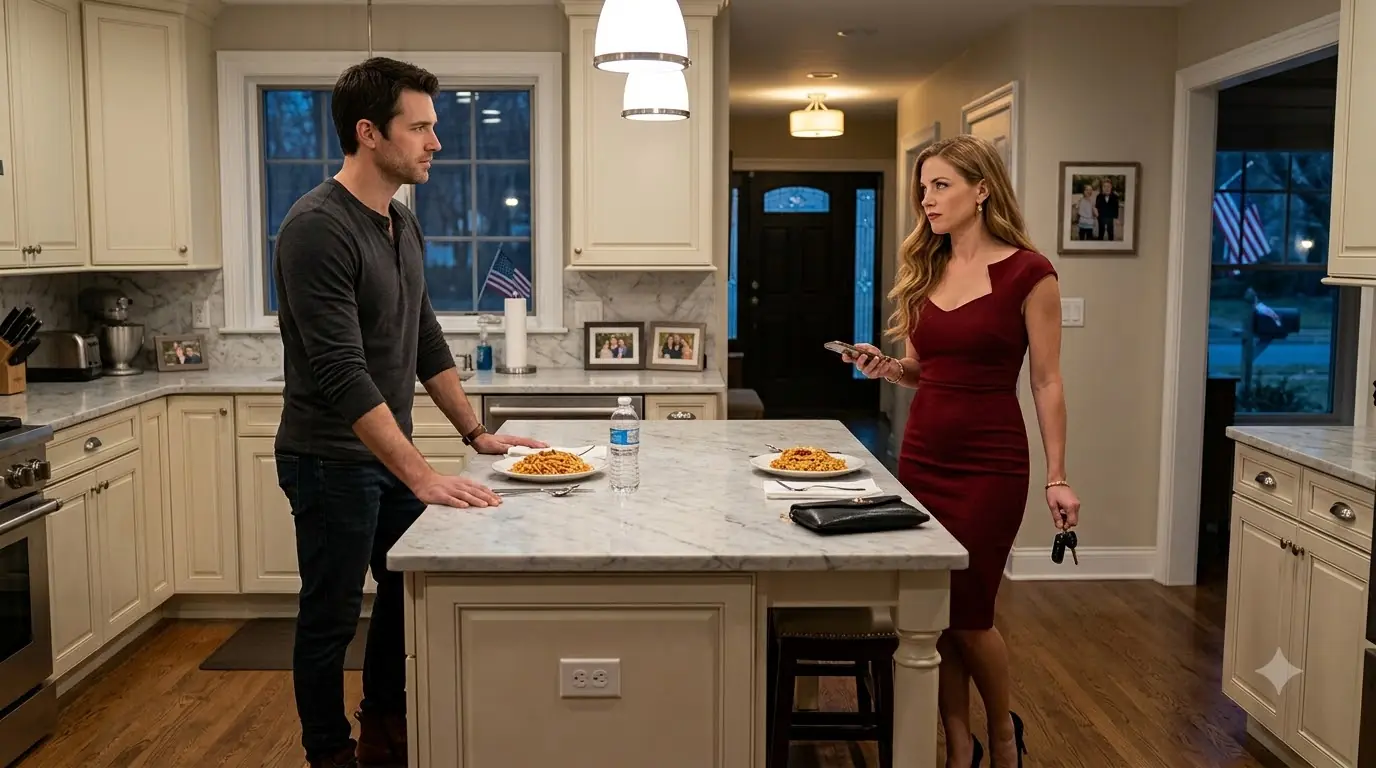
Vanessa stood across from me in our kitchen in Newark with her phone in one hand and her car keys dangling from the other. She wore a small smile that looked almost playful until you noticed how carefully she was watching my face.
“His name’s Daniel,” she added. “Since I know you’re going to ask.”
I had not asked.
Outside, a cold New Jersey wind snapped the little American flag beside our mailbox hard enough to make the metal bracket tap against the siding. Inside, the pasta I had cooked sat untouched on the stove, sauce beginning to skin over in the pan.
Vanessa was wearing the red dress.
I had not seen it since our anniversary dinner in Manhattan eleven months earlier.
I remembered that night because we had been happy, or at least I had believed we were. We had eaten at a small Italian restaurant near Gramercy Park, walked three blocks in light snow because Vanessa insisted the city looked better on foot, and stopped beneath a hotel awning while she laughed at the slush soaking through my shoes.
She had worn the red dress then too.
I had told her she looked beautiful.
She had kissed me and said, “You always look at me like I’m the only woman in the room.”
Now she was wearing it to go clubbing with another man.
Her ex.
Apparently.
That hurt more than I wanted her to know.
But the dress was not the worst part.
The worst part was the tone.
Vanessa was not explaining herself.
She was not asking me to trust her.
She was daring me to stop her.
There was a challenge beneath every word.
I could almost see the argument she had prepared.
If I became angry, I was controlling.
If I objected to Daniel, I was insecure.
If I asked where they were going, I did not trust her.
If I asked what time she would return, I was treating her like a child.
She wanted the fight because she already knew every line.
And I knew them too.
For months, every conversation about our marriage had ended the same way.
“You’re too sensitive.”
“You overthink everything.”
“You’re insecure.”
“You make normal things weird.”
“You’re acting like my father.”
Then, during an argument six weeks earlier, Vanessa had said something I could not forget.
“You’re lucky I still come home.”
She apologized the next morning.
Sort of.
She said she had been frustrated.
She said I should not take every emotional sentence literally.
She said couples say ugly things sometimes.
But once certain words enter a marriage, they do not leave because somebody makes coffee and says they were tired.
They remain.
They become evidence.
So that Friday night, standing in our kitchen while dinner went cold, I finally refused the role Vanessa had written for me.
I did not yell.
I did not ask why an ex-boyfriend mattered more than her husband.
I did not demand to know whether Daniel still wanted her.
I did not ask why she had spent the afternoon smiling at her phone while barely speaking to me.
I just looked at her.
“Okay.”
The keys stopped swinging.
Vanessa’s smile disappeared.
“Okay?”
“Okay.”
She stared at me.
“That’s it?”
“That’s it.”
For the first time that evening, uncertainty crossed her face.
It lasted only a second.
Then the smirk returned.
“You’re not going to ruin the night when I get home, are you?”
“No.”
“You’re not going to sit awake waiting?”
“No.”
“You’re not going to blow up my phone?”
“No.”
Her eyes narrowed.
“Then what exactly are you doing?”
“Letting you make your choice.”
Something about that answer bothered her.
She glanced toward the stove.
“You’re being dramatic.”
“I’m standing in my kitchen.”
“You know what I mean.”
“I do.”
She waited another moment, probably hoping I would break.
I didn’t.
Finally she picked up her purse.
“Don’t wait up.”
“I won’t.”
She walked toward the front door.
At the threshold she turned.
“Daniel and I dated years ago. Nothing is going to happen.”
I almost asked why she felt the need to say that.
Instead:
“Have a good night.”
The door slammed.
The little framed photograph beside it shook against the wall.
I listened to her heels cross the porch, the car unlock, the engine start.
Then headlights moved across the living-room blinds.
Vanessa backed out.
Turned left.
Disappeared.
The house became silent.
I stood alone in the kitchen for almost a full minute.
Then I turned off the stove.
My name is Grant Holloway.
I was forty when that happened.
Vanessa was thirty-six.