The first thing Sarah Jenkins noticed was not the motorcycles. It was the way the teaspoon trembled against the side of an empty mug before she heard the engines coming down the highway.
She stood behind the counter of the last open diner on that forgotten stretch of Route 66 and watched the small silver tremor become a rattle. By the time the low growl reached her ears, she had already put down the dish towel and turned toward the windows.
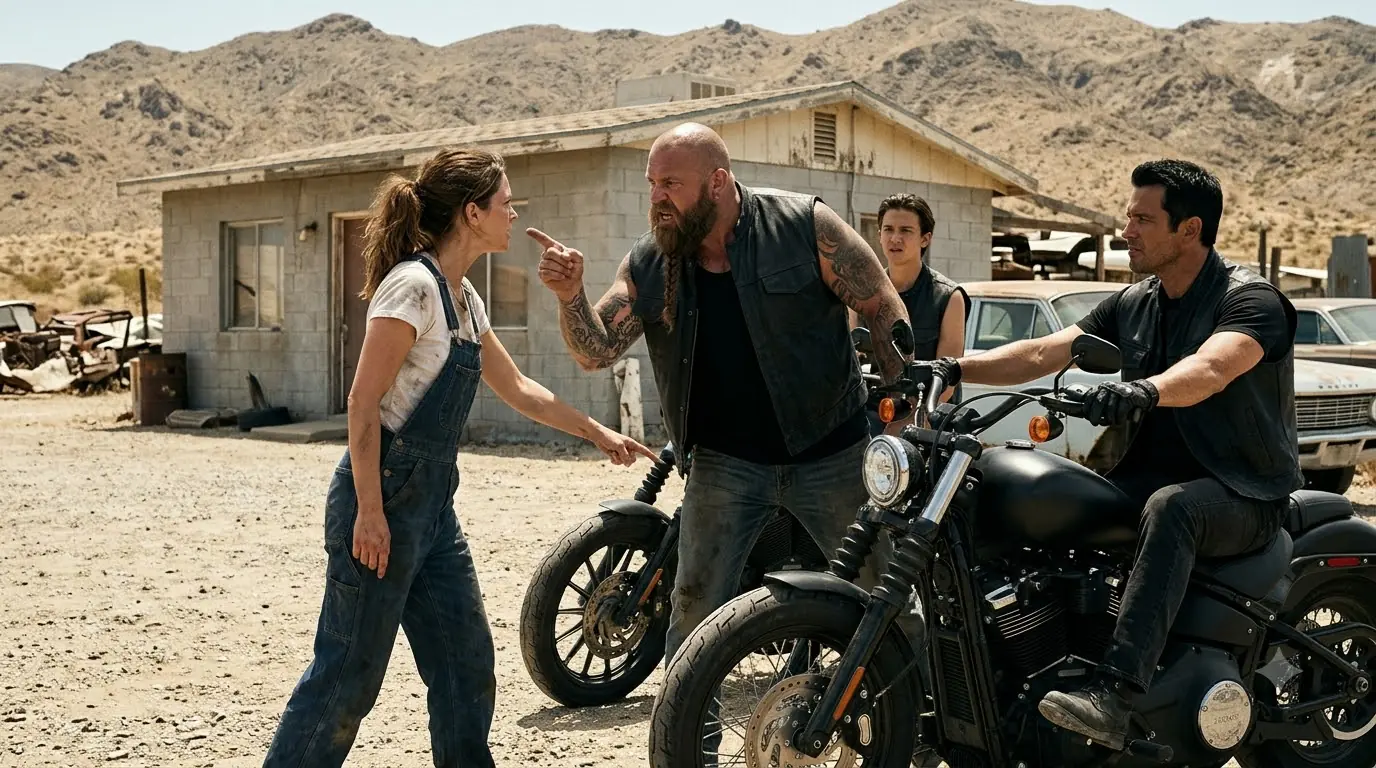
In the Mojave Desert, trouble usually announced itself long before it arrived.
The afternoon heat had climbed past a hundred and ten degrees, although the thermometer outside the kitchen had stopped being trustworthy sometime in June. Everything beyond the windows appeared to bend, as if the highway were being viewed through a pane of old glass. The mountains were pale and distant, the parking lot almost white with dust, and the abandoned service station across the road looked like a photograph somebody had forgotten in the sun. Sarah was thirty-two years old, and she had spent nearly every one of those years learning how much the desert could take from a person who stopped paying attention.
Her father, Martin Jenkins, had called the place the Junction, even though the nearest actual junction was several miles east. A weather-beaten sign over the door still advertised JENKINS DINER AND SALVAGE in faded red letters, and below that someone had added COFFEE, TIRES, PARTS, AND ADVICE in paint that had since peeled unevenly away. The diner occupied one end of the building; the other end held a repair bay, a tiny parts counter, and a workshop crowded with tools that had belonged to three generations of Jenkinses. Behind it sprawled a salvage yard full of vehicles nobody else had wanted enough to save.
Her grandfather had bought the land when there was still real traffic along the old road, and he had collected ruined engines the way other men collected stamps. Her father had turned the collection into a business by knowing which parts fit machines their manufacturers no longer supported. Sarah had inherited both the business and the habit of remembering every machine she touched. She could identify a sick alternator by its whine, a loose heat shield by its rattle, and a failing water pump by the smell that came through a customer's open window.
She had also inherited a pair of rules. The first was that if somebody came in off the highway asking for water, you gave it to them before asking whether they could pay. The second was that you never confused being unafraid with being careless. Martin had repeated that one whenever she climbed onto an unstable pile of scrap or tried to loosen a bolt without checking what else it supported. In his final year, when illness made his voice softer, he had repeated it about people instead of machinery.