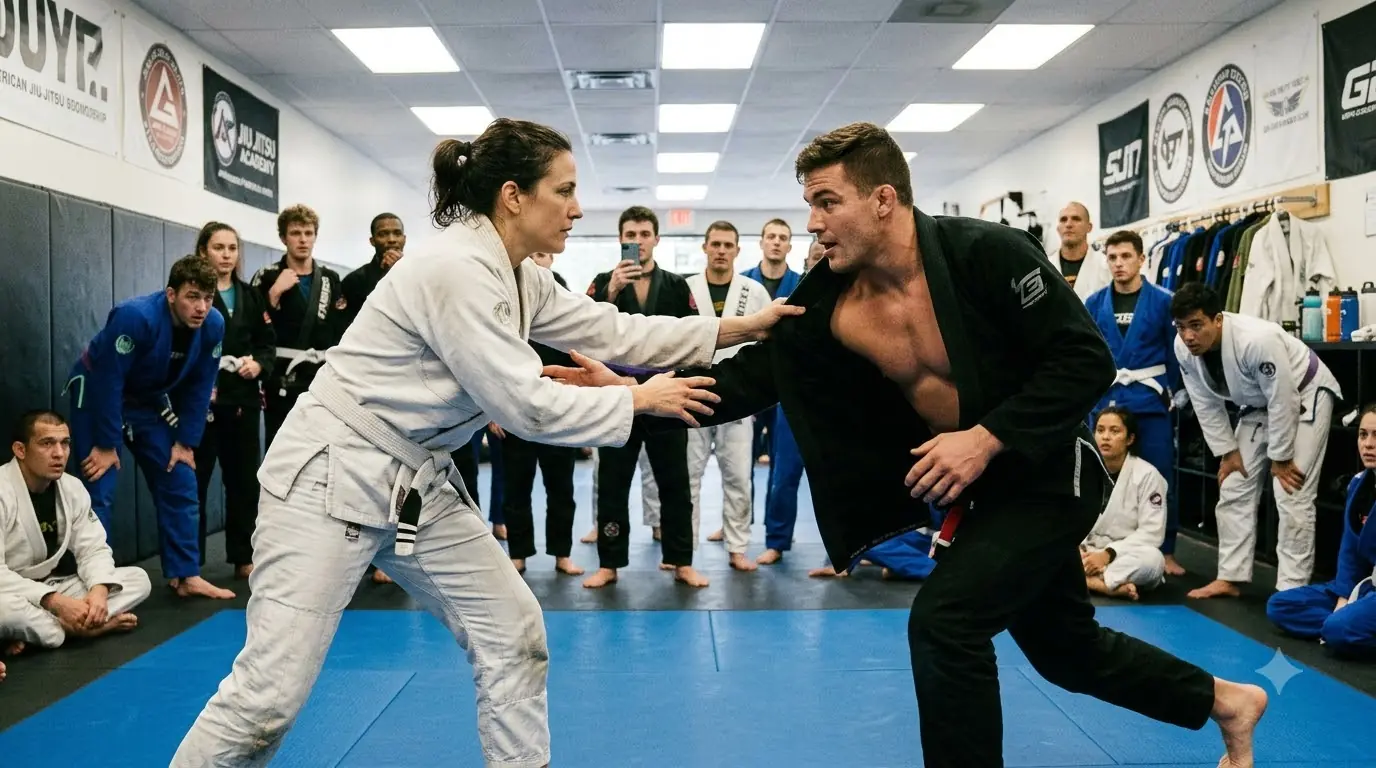
Everyone in the room noticed the woman the moment she walked into the jiu-jitsu academy.
Not because she looked intimidating.
Because she looked as though she had entered the wrong building.
The clack of locker doors continued for another few seconds. Bare feet slapped against the mats. Two students finished a takedown drill near the far wall. The instructor called out a correction.
Then people began looking toward the entrance.
The woman standing there was small, plain, and somewhere in her late thirties.
Her name was Sarah.
She wore a secondhand white gi that did not fit quite right. The sleeves were a little too long. The shoulders hung loosely. Her belt looked as if she had watched several videos that morning trying to remember how to tie it.
Beside the door sat a pair of worn sneakers.
Sarah gave the room a nervous smile.
That was enough.
A few younger students exchanged looks.
Someone whispered.
Another student snickered.
A cocky blue belt glanced at Sarah and said loudly enough for everyone around him to hear,
“Wrong class, lady. Pilates is next door.”
A few people laughed.
Sarah looked down at her belt.
Her fingers trembled as she tightened it.
Even the instructor raised an eyebrow when he saw her.
He did not laugh.
But he did not correct anyone either.
Sarah nodded politely, stepped onto the edge of the mat, and tried to ignore the whispers.
Nobody in that room knew why she had come.
They saw a nervous beginner.
A woman with no athletic background they could recognize.
Someone whose hands looked more accustomed to folding clothes and scanning store merchandise than gripping collars or fighting for position.
What they did not know was that two months earlier, Sarah had been walking home from work when a stranger attacked her.
The mugging lasted only a few minutes.
In her memory, it lasted much longer.
She remembered the surprise first.
Then the helplessness.
The shock of another person deciding, without permission, what would happen to her body.
She remembered the pavement.
The bruises.
The fear that stayed after the attacker was gone.
When Sarah finally reached home that night, she locked the door.
Then the deadbolt.
Then checked both again.
She went into the bathroom and turned on the light.
Her reflection frightened her.
A bruise was already forming along one side of her face.
Her hands were shaking.
There were marks on her arms.
She stood there for a long time.
She did not scream.
She did not break the mirror.
She did not collapse dramatically onto the floor.
She simply stared at herself until the shaking slowed.
Then she whispered two words.
“Never again.”
At first, Sarah did not know what those words meant.
She could not promise herself that nobody would ever hurt her again.
Nobody could make that promise.
She could not control every stranger.
Every sidewalk.
Every dark parking lot.
But she could change the way fear lived inside her.
That became the goal.
Sarah began searching.
Self-defense.
Boxing.
Martial arts.
Wrestling.
Jiu-jitsu.
She watched videos late at night after work.
What interested her about jiu-jitsu was not the violence.
It was the idea of control.
A smaller person learning how to remain calm under pressure.
How to move when pinned.
How to breathe when somebody stronger was trying to control the position.
How to think while afraid.
That was what Sarah wanted.
Not revenge.
Control.
So she walked into the academy wearing a secondhand gi and a nervous smile while strangers laughed.
Her first few weeks were brutal.
Sarah was slow.
Awkward.
Often one movement behind everyone else.
When instructors demonstrated a sequence, other students seemed to understand it immediately.
Sarah did not.
She watched.
Tried.
Forgot the second step.
Started again.
She mixed up directions.
Put the wrong hand in the wrong place.
Crossed her feet when she should not.
During takedown practice, she landed badly enough that even the sound embarrassed her.
Every fall felt like proof that perhaps the people who laughed on her first day had been right.
Maybe she did not belong there.
Sparring was worse.
Sarah spent most rounds underneath somebody.
Pinned.
Compressed.
Trying to remember what she had been taught while another person’s weight made breathing difficult.
Some students were patient.
Others were not.
A purple belt named Jason particularly enjoyed partnering with her.
Jason was talented.
Strong.
Confident.
And absolutely certain that Sarah had nothing he needed to respect.
Whenever the instructor said to choose partners, Jason sometimes looked toward Sarah with an amused expression.
“Easy round.”
He would say it as though she were not standing there.
During training, he moved faster than necessary.
He took positions quickly.
Submitted her.
Reset.
Did it again.
Sometimes he offered advice, but even the advice sounded like mockery.
“You have to actually move, Sarah.”
Or,
“You know you’re allowed to fight back, right?”
Other students laughed.
Sarah never did.
She also never complained.
She tapped when necessary.
Got up.
Reset.
Tried again.
Then came back the following day.
And the day after that.
And the week after that.
For a while, nothing seemed to improve.
Sarah still lost almost every round.
She still went home sore.
Her forearms collected small bruises.
Her knees hurt.
Some mornings she woke up and wondered why a woman nearing forty was voluntarily spending her evenings getting thrown around by people half her age.
Then she remembered the bathroom mirror.
The helplessness.
The promise.
Never again.
So she returned.
Slowly, changes appeared.
Small enough that nobody else noticed at first.
Sarah learned how to fall without panicking.
The sound of her body hitting the mat stopped frightening her.
Her grips became firmer.
Her balance improved.
She stopped closing her eyes when somebody came toward her quickly.
When trapped underneath another student, she no longer reacted with immediate desperation.
She breathed.
Observed.
Waited.
The first time Sarah escaped from a bad position against a stronger student, she almost laughed out loud.
It was not a victory.
The student caught her again twenty seconds later.
But those twenty seconds mattered.
They proved something.
Progress existed.
Sarah became obsessed with that feeling.
While other students took longer water breaks, she practiced forward rolls and backward rolls at the edge of the mat.
When class ended, she stayed a few extra minutes if the instructor allowed it.
At home, she moved the coffee table aside and practiced movements on the living-room carpet.
She watched instructional videos.
Paused them.
Rewound them.
Tried again.
Her retail job took most of her daytime hours.
She stood behind a counter.
Stocked shelves.
Answered customers.
Then went home, changed clothes, and trained.
Jiu-jitsu gradually became less about what happened during the mugging.
It became something of its own.
Six months after Sarah first entered the academy, she registered for an amateur tournament.
The morning of the competition, she nearly became sick from nerves.
Her palms were wet.
Her heart pounded before her division was even called.
She looked around the venue and saw competitors stretching with teammates.
People wearing matching academy uniforms.
Coaches giving last-minute instructions.
Sarah suddenly felt exactly as she had on her first day.