"Sir, if you leave me here, I think I'm going to lose everything."
The words reached Daniel Carter just as he was opening the driver's door of his aging blue sedan. They came from a woman standing beside a black luxury car at the far end of a roadside parking area, her charcoal suit darkened by a fine morning drizzle.
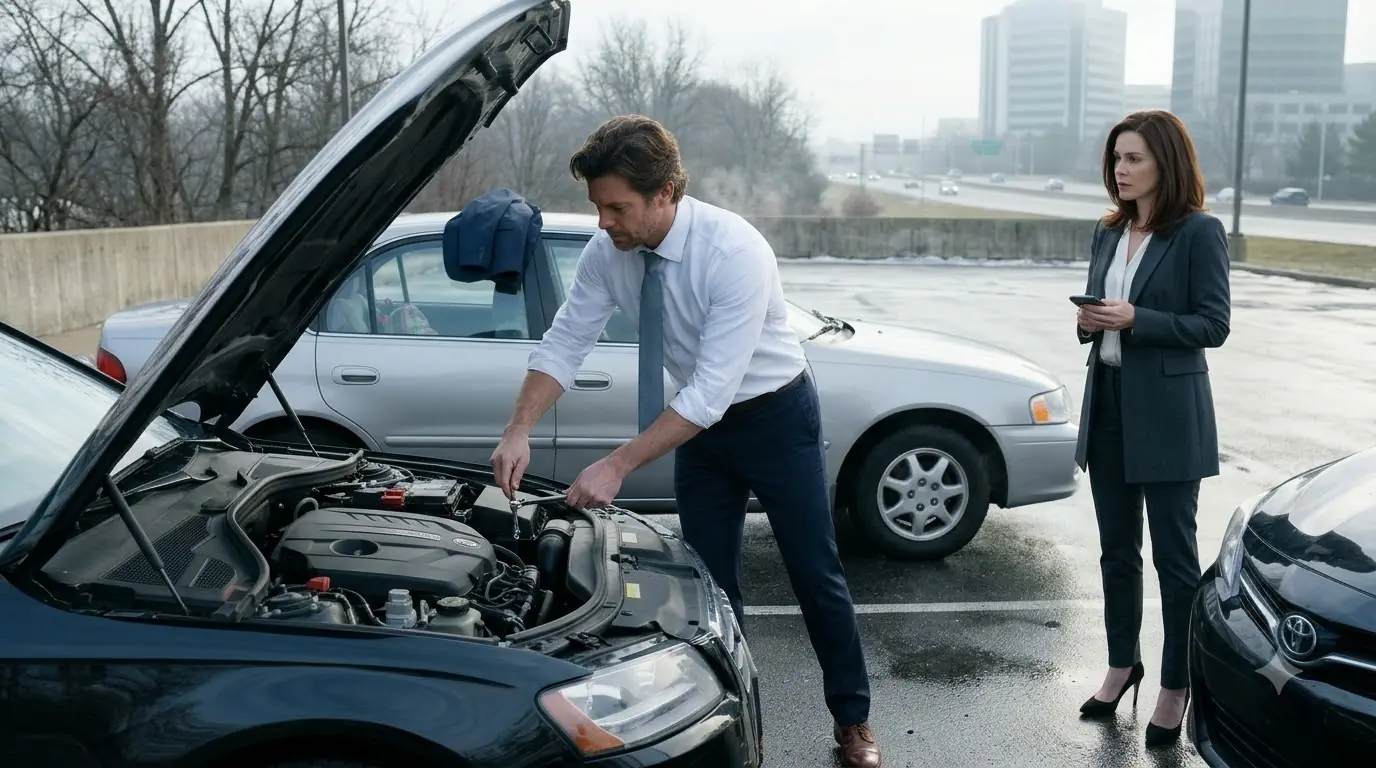
Beyond them, traffic streamed toward the city in two restless lines, tires hissing against pavement still wet from a storm during the night. Daniel had already glanced at the stranded car once and deliberately looked away. He knew exactly what helping a stranger might cost him.
The dashboard clock read 8:41 a.m. His interview was scheduled for nine, and the glass headquarters of Grant Logistics stood almost twenty minutes away in ordinary traffic. Nothing about the traffic that morning was ordinary. A construction lane had been closed without warning, the freeway entrance was crowded with delivery trucks, and every minute had begun to feel like money he could not afford to spend.
On the passenger seat lay a thin blue folder containing two printed copies of his résumé, a reference letter, and a list of questions he had written for the hiring manager. He had polished his only respectable dress shoes the previous evening, pressed a navy jacket over a towel on the kitchen table, and rehearsed his answers after his daughter had fallen asleep. Three months of applications had produced four automated rejections, one telephone screening that never led anywhere, and this single invitation to meet a hiring panel. The operations supervisor position was not glamorous, but it had health insurance, reliable hours, and a salary that could bring a small family back from the edge of uncertainty.
That family consisted of Daniel and a nine-year-old girl named Lily. On the refrigerator at home, a drawing of a purple house stood beside an electricity bill that had acquired a red reminder stamp. Lily had drawn the house larger than the one they lived in, with flowers under the windows and a dog in the yard, although they owned neither flowers nor a dog. At breakfast she had asked whether a new job meant they could stop counting every dollar at the grocery store. Daniel had promised only that he would do his best, but she had looked at him as though those words meant good news was already on its way.
Now he could see the woman's hands shaking around her telephone. She had tried the ignition again, and even from across the lot he could hear the weak clicking that followed. She looked too formally dressed for the weather, with no coat and expensive shoes that sank slightly into the gravel every time she moved. The dangerous thing was not that she appeared helpless. It was that Daniel recognized the precise moment when someone realized a problem was bigger than the tools they had brought to solve it.