"Sir. Your daughter isn't sick. You're publicly—"
"Your fiancée lies."
A poor Black boy, twenty-eight years old in a borrowed uniform, pointed straight at the bride-to-be.
"Shut up."
"What did this waiter just say?"
"The pills you give her every night. They're not vitamins."
Champagne hit him in the face.
"You dare speak at my table? Open her purse, Mr. Moore. That's your proof."
Her jaw tightened, then she snapped.
"Call the police. Security. Get him out."
Gerald Moore's hands gripped the edge of the table. He looked at the boy. Then at his daughter Elaine, twenty-four, trembling in a wheelchair, hair thin as paper.
Eighty guests watched. No one defended Yates Langford. Everyone wanted him gone.
But before this night was over, every one of them would wish they had listened sooner.
Six hours earlier, the Moore estate sat quiet under a copper autumn sky. Twelve acres of manicured lawn rolled down to a private lake in Greenwich, Connecticut. Stone walls wrapped in ivy. A vintage sailboat rocked gently at the dock.
This was old money territory. The kind of place where even the silence felt expensive.
Gerald Moore had bought this land thirty years ago. Back when Stonebridge Pharmaceuticals was nothing but a rented lab and a dream. One FDA approval changed everything. Then another. Then another.
Now the company was worth two point three billion dollars. And Gerald Moore was the man who built it with his bare hands.
Tonight, his estate was transformed. A forty-foot white tent stretched across the south lawn. Italian marble was laid over the grass. Thousands of white roses were arranged in towers along every table. An eight-piece string quartet tuned their instruments near the fountain.
Every detail was handpicked. Every flower was placed with surgical precision. All designed by one woman. Vanessa Cole.
She stood on the terrace in a silk robe directing florists like a general commanding troops.
"Those roses are off-center. Fix them. The champagne towers. Taller. I said taller."
Staff moved around her in quiet terror. She was beautiful. She was composed. And she controlled every room she entered.
Vanessa was thirty-four. Former ICU nurse. Left the profession two years ago. Told people she burned out. The truth was quieter and uglier. Medication discrepancies on her ward. An internal investigation. A private settlement. And a resignation letter no one ever questioned.
She met Gerald at a charity gala six months later. Within a year, she had moved into the estate. Within fourteen months, Gerald's daughter started getting sick.
No one connected the two.
Elaine Moore had been a different person two years ago. Twenty-two then, Georgetown graduate, equestrian, nonprofit worker, a girl who ran half marathons on weekends and laughed louder than anyone in the room.
Now, she was twenty-four and weighed one hundred three pounds. Her hair fell out in clumps. Her hands trembled so badly she couldn't hold a glass. Some days she couldn't leave the wheelchair.
Doctors ran test after test, autoimmune panels, thyroid screens, MRIs. Nothing conclusive.
Doctor Nolan Pierce, the family physician for fifteen years, settled on a diagnosis of atypical lupus-like syndrome and adjusted her medications every few weeks.
Gerald watched his daughter disappear piece by piece. He held her hand at dinner. He kissed her forehead before bed. And he thanked God every night for Vanessa, the woman who prepared Elaine's supplements each morning, who sat beside her during doctor's visits, who seemed to care more than anyone.
He had no idea he was thanking the woman who was killing her.
The supplement was the weapon. A custom capsule ordered from an overseas compounding pharmacy under a fake wellness brand. Inside, thallium sulfate, odorless, tasteless, undetectable in a standard blood panel, mixed into a vitamin D capsule that looked identical to the real thing.
One pill every night. Slow, invisible, and devastating.
Vanessa had done the math. Gerald's will split the estate equally between Elaine and his future spouse. If Elaine died or was declared mentally incapacitated before the wedding, the entire two point three billion dollars went to Vanessa alone.
The wedding was in nine days.
Dr. Nolan Pierce was not a monster. He was something almost worse. A man too proud to admit he was wrong. Fifty-eight years old, Columbia-trained, trusted by the Moore family for over a decade.
He had looked at Elaine's symptoms a hundred times and never once ordered a heavy metal panel. Why would he? Poisoning didn't happen in houses like this. Not to families like this.
His arrogance was Vanessa's greatest ally.
And then there was the catering van. It pulled up to the service entrance at four in the afternoon. The gravel road behind the hedges, invisible from the main house. Staff entered through the kitchen. They were not to be seen by guests until service began.
Yates Langford stepped out last. Tall, lean, quiet. His uniform was borrowed from a co-worker who called in sick. Two sizes too big, sleeves rolled at the wrists.
In his back pocket, a small leather notebook worn soft at the edges, filled with chemical formulas in tight handwriting. It was the only thing he kept from his old life. The life no one here knew about. The life that was about to walk back through the front door.
The dinner began at seven. Guests arrived in black cars with tinted windows, Rolex watches, Hermes ties, dresses that cost more than Yates earned in a year. They moved through the house like they owned the air itself. Because in a way, they did.
Yates carried appetizer trays through the crowd. He kept his head down, his steps quiet, invisible. That was the job. Carry, serve, disappear.
Donna Harlow, the catering manager, had made it clear on the drive over.
"No talking to guests. No eye contact unless spoken to. You are furniture. Expensive furniture that doesn't break things."
He understood. He had been furniture his whole life.
Yates set down a tray of smoked salmon canapés.
And that was when he saw Elaine's hands. She reached for a water glass, and her fingers trembled so badly the glass nearly tipped. He steadied it without thinking. A quick, quiet touch.
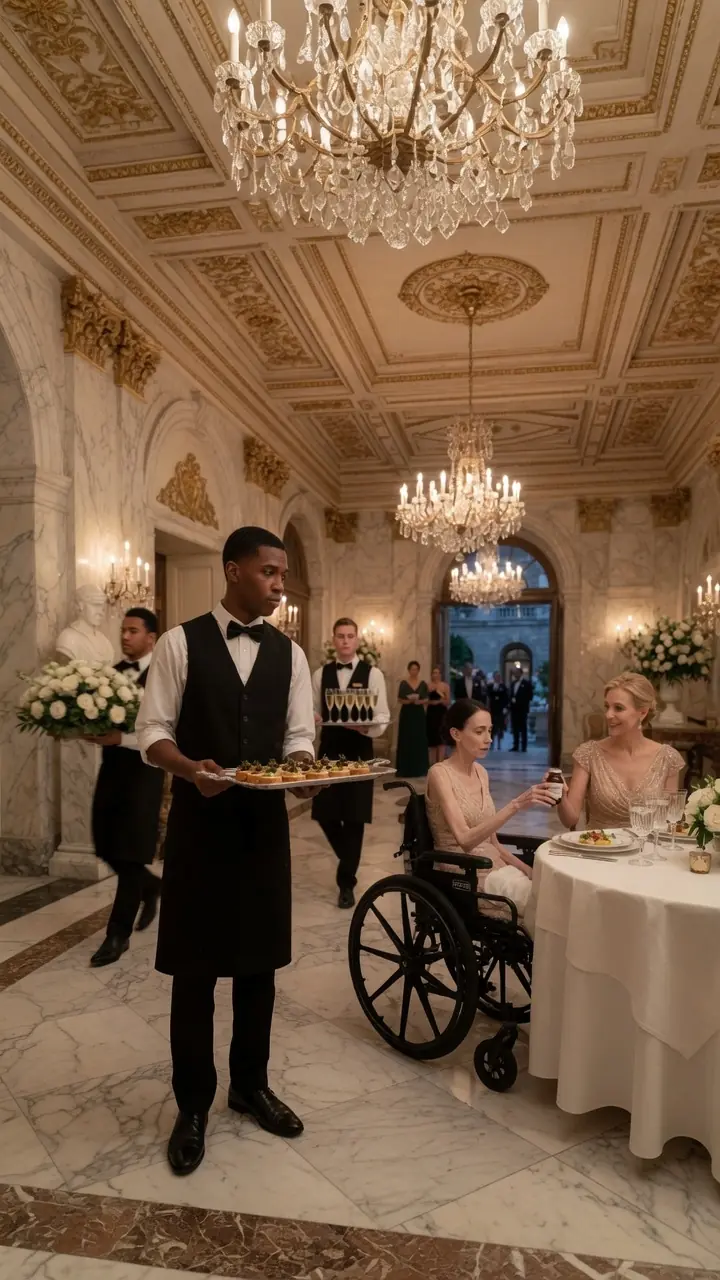
She looked up and whispered, "Thank you."
He nodded. But his eyes stayed on her fingernails. Faint, white, horizontal lines running across every nail. Mees' lines.
He had seen them before, in textbooks, in case studies, in his mother's hands three weeks before she died.
His stomach dropped.
He looked at the amber supplement bottle sitting next to Elaine's plate. Vanessa leaned over, voice sweet as honey.
"Don't forget your evening pill, sweetheart."
Elaine swallowed the capsule with water.
Yates watched it go down and felt something cold crawl up his spine.
He needed to get closer to that bottle.
He reached across to adjust a napkin near Elaine's plate and his elbow caught a wine glass. Red wine splashed across the white tablecloth, spraying droplets toward Vanessa's plate.
The table gasped.
Vanessa recoiled.
"Are you serious right now?"
Gerald Moore stood.
"What the hell is wrong with you?"
"I'm sorry, sir. I'm so sorry."
"Sorry?" A woman in diamonds across the table shook her head. "They'll hire anyone these days."
Donna Harlow appeared out of nowhere, face white as the tablecloth. She grabbed Yates by the arm and dragged him toward the kitchen. Her nails dug into his skin through the fabric.
"Are you insane?" she hissed. "That woman is about to become Mrs. Gerald Moore. This contract pays my rent for six months. Do you understand?"
"Ma'am. The girl at the table. Her fingernails. I've seen those marks before. I think someone is—"
"Stop." Donna held up a hand. "You are a waiter. You carry plates. You are not a doctor. You are not a detective. You are nothing in this house. Go polish the dessert forks and do not go near that table again."
Yates stood in the kitchen, hands shaking. Not from fear, from recognition.
He had been here before. Eleven years old, standing in a kitchen, trying to tell someone that his mother's tea smelled wrong. No one listened then, either.
He stepped outside for air.
The terrace was empty, except for one man, Dr. Nolan Pierce, leaning against the stone railing, smoking a Cuban cigar. Gold cufflinks, silk pocket square, the kind of doctor who looked more like a magazine cover than a medical professional.
Yates approached carefully.
"Excuse me, sir. I don't mean any disrespect, but I noticed something about Miss Moore's fingernails. White horizontal lines. Mees' lines. Combined with her hair loss and tremors, has anyone considered heavy metal exposure? Thallium, specifically?"
Pierce turned slowly. He looked Yates up and down, from the scuffed shoes to the stained uniform to the face still damp with champagne.
"And you are?"
"I work with the catering company tonight, sir, but I studied—"
Pierce laughed. Not a polite laugh. A laugh that came from the belly and was meant to bury.
"You studied? Where? Community college? YouTube University?"
He flicked cigar ash toward Yates's shoes.
"Let me explain something to you, son. I trained at Columbia. I have treated the Moore family for fifteen years. Elaine has an autoimmune condition, complex, layered, not something a boy who carries plates and cleans up spilled wine is going to diagnose on a Saturday night."
"Sir, if you just ran a twenty-four-hour urine panel for—"
"If I what?" Pierce stepped closer. His voice dropped to a whisper. "Listen carefully. Go back to that kitchen. Pick up your tray. And if you approach any member of this family with your little theory again, I will personally ensure you never work in this state again. Not as a waiter, not as a dishwasher, not mopping floors. Are we clear?"
He blew cigar smoke directly into Yates's face and walked inside.
Yates stood alone on the terrace. His hands balled into fists at his sides.
He looked down at them. The same hands that once held a pipette in a Johns Hopkins laboratory. The same hands that wrote a research paper cited in four hundred forensic cases.
Now they smelled like cigar ash and champagne.
Twenty minutes later, a staff member handed him Vanessa's Chanel clutch.
"She left it in the coat room. Bring it to the dining room."
He carried it across the hall. The clasp was loose. It popped open in his grip.
Inside, a second amber pill bottle. Same label as the one on Elaine's table. Identical design.
But when Yates brought it close, his nose caught something the naked eye could not. A faint metallic sweetness beneath the capsule coating.
His blood went cold.
He knew this smell. Not from a textbook, not from a lab. From his mother's kitchen. From the teacup on the counter the night before she went to the hospital for the last time.
He palmed one capsule and slipped it into the leather notebook in his back pocket. Then he closed the clutch, delivered it to Vanessa who took it without looking at him, without a word, without acknowledging he existed, and walked back toward the kitchen.
But he did not go to the kitchen.
Yates pushed through the service door and crossed the gravel to the catering van parked behind the hedges. His hands were steady now. The doubt was gone. What replaced it was something colder, sharper, certainty.
He climbed into the van, pulled the door shut, and sat on an overturned crate. The noise of the party faded into a distant hum.
He was alone.
For the first time tonight, he could think.
He opened the leather notebook. The capsule sat pressed between two pages of chemical formulas. His own handwriting from another lifetime.
He stared at it. Small, amber-coated, perfectly ordinary to anyone else in the world.
Not to him.
He cracked the capsule open over a clean ceramic plate from the catering supplies. A fine white powder spilled out. No smell to the naked nose, but Yates had trained his senses the way a sommelier trains a palate. Seven years of lab work, thousands of samples. His nose was an instrument, and right now it was screaming.
He needed a test. Not a lab test, he didn't have a lab, but he had something better. He had knowledge, and he had whatever was in this van.
He moved fast. Distilled water from the steam iron kit, a coffee filter torn into thin strips, a small bottle of household bleach from the cleaning supply box.
These were not scientific instruments. They were the leftovers of a catering operation. But in the right hands, leftovers could become a laboratory.
He dissolved the powder in a capful of distilled water. He dipped the coffee filter strip into the solution. Then, he applied a single drop of bleach to the wet strip and waited.
Thirty seconds. Forty. Fifty.
The strip turned yellow-green.
Yates held it up under the dome light of the van. His hand did not shake.
The color was unmistakable. A crude, but effective Reinsch test variation. Not admissible in court. Not precise enough for a published paper.
But enough. More than enough.
The reaction was consistent with a thallium compound.
He whispered to himself, "It's the same. It's exactly the same."
He photographed everything. The crushed capsule on the plate, the dissolved solution, the yellow-green strip, the inside of Vanessa's clutch, which he had photographed earlier when the clasp popped open. Every image time-stamped on his phone.
Four photos. Four pieces of a puzzle that no one in that mansion wanted to see.
He sat in the van for a long moment, the leather notebook open on his knee.
His mother's face somewhere behind his eyes. Not the face from the photograph on his kitchen table, but the face from the hospital bed. Gray skin, sunken eyes, hands that couldn't squeeze his fingers anymore.
Grace Langford died on a Tuesday. The doctors wrote renal failure on the death certificate. The police investigated three years later, only after a neighbor reported seeing Ray Langford buy antifreeze in bulk. By then, Grace was bones in a pine box, and Yates was a fifteen-year-old boy sleeping on a cousin's couch.
He swore two things that year.
First, he would learn everything there was to know about poison, every compound, every symptom, every test. He would become the person his mother never had.
Second, if he ever stood in a room where someone was being poisoned, he would not stay silent. Not for comfort, not for safety, not for a paycheck.
He looked at the yellow-green strip.
Elaine Moore was twenty-four years old. She had a father who loved her. She had doctors who failed her. And she had a woman feeding her poison every single night while smiling and calling her sweetheart.
Yates could walk away, call the police anonymously, let the system work.
But he knew how the system worked for people who looked like him. Slow, skeptical, too late.
His mother was proof. Three years to investigate, three years too many.
Elaine didn't have three years. Based on the symptom progression he observed tonight, the tremors, the weight loss, the Mees lines, she might not have three months.
And Vanessa had doubled down. The engagement, the wedding in nine days, the will. Everything was accelerating toward a finish line that ended with Elaine in the ground and Vanessa holding a two point three billion dollar check.
Yates closed the notebook, put it in his vest pocket, buttoned his jacket.
He stepped out of the van. The gravel crunched under his taped-together shoes.
Music and laughter floated from the tent. Crystal and gold and people who had never once been ignored.
He walked toward the light. Not to the kitchen. Not to the service entrance.
Straight to the front door of the dining room.
Whatever happened next, he would not be furniture tonight.
Gerald Moore was mid-toast when Yates walked in. The billionaire stood at the head of the table, champagne raised, voice warm with rehearsed emotion.
"Vanessa brought light back into this house. She gave me a reason to—"
"Mr. Moore."
Gerald stopped. Eighty heads turned.
Donna Harlow dropped a dessert plate in the kitchen doorway. The crash of porcelain echoed through the silence.
Yates stood six feet from the head table, still in his stained uniform, still smelling like the champagne Vanessa threw in his face an hour ago.
Every pair of eyes in the room locked onto him. The waiter who had already been warned, humiliated, and dismissed.
"Mr. Moore, your daughter is being poisoned. The woman sitting next to you is responsible, and I can prove it right now."
For three full seconds, nobody breathed.
Then, the room exploded.
Gerald's face went from confusion to fury.
"You again? I told you to—"
Yates cut him off. His voice was calm, clinical, the voice of a man who had rehearsed this language a thousand times in a laboratory.
"Progressive hair loss over fourteen months, peripheral neuropathy, the tremors in her hands, Mees' lines, white horizontal bands on every fingernail, gastrointestinal distress, cognitive fog, rapid weight loss."
He paused, let the words settle.
"Every single one of these is a textbook symptom of chronic thallium sulfate ingestion."
"Every single one."
The medical terminology hit the room differently than the accusation of a waiter. Guests leaned forward. A few pulled out phones.
Gerald's grip on his champagne glass tightened until his knuckles turned white.
Dr. Nolan Pierce stood from his chair, face red, napkin still tucked into his collar.
"This is absurd. I have treated Elaine for over a year. I've run comprehensive panels, autoimmune markers, thyroid function, inflammatory—"
"Did you run a twenty-four-hour urine heavy metal panel?" Yates asked. Quiet, direct, no anger, just the question.
Pierce hesitated. One second too long.
"Specifically for thallium." Yates continued. "Did you test for thallium, Dr. Pierce?"
"That's—that's not standard protocol for autoimmune."
"You didn't." Yates nodded slowly. "You never considered it because poisoning doesn't happen in houses like this, not to families like this. That's what you told me on the terrace an hour ago, right before you blew cigar smoke in my face."
Murmurs rippled across the room.
Pierce tugged at his collar. His arrogance had been a private performance. Now Yates had dragged it onto the main stage.
Vanessa moved before the momentum could shift. She rose from her chair. Slowly. Gracefully. Tears forming in her eyes. Perfectly timed. Perfectly placed.
Her voice trembled just enough to sound broken.
"Gerald. I don't know who this man is. I don't know why he's doing this to us. On our night."
She reached for Gerald's hand. Her fingers intertwined with his.
"I sit with Elaine every morning. I prepare her vitamins myself. I hold her hand when she can't sleep. And this? This is what I get?"
She turned to Yates. The tears vanished. Ice replaced them.
"You're a waiter. You spilled wine on my table. You were caught touching my purse. And now you're accusing me of murder?"
She let out a short, sharp laugh.
"Gerald. Check his pockets. He probably stole something and made up this whole story to cover himself."
Brenda Coleman, Elaine's godmother, old money, old opinions, stood from her chair and pointed at Yates.
"Gerald, for God's sake. Get this lunatic out before he ruins everything. This is exactly what happens when you hire cheap help."
The crowd turned. Yates could feel it. The room sliding back toward Vanessa. She was winning. She was always going to win. She had the dress, the ring, the tears, the story.
He had a stained uniform and calloused hands.
"Gerald?" Vanessa pressed harder, voice breaking again. "This man is clearly disturbed, a stranger with a grudge, some fantasy about poison. This is textbook extortion. He saw the engagement in the papers and thought he could make a scene for money."
Gerald's jaw tightened. He pulled his hand from Vanessa's and turned to Yates.
"You have ten seconds to walk out of this house or I call the police myself."
"Daddy, wait."
The voice came from the wheelchair. Small, thin, but clear enough to cut through every other sound in the room.
Elaine Moore.
Everyone turned. Gerald's face softened instantly. Vanessa's did not.
Elaine held up her hands. They trembled under the chandelier light. White lines visible across every nail, even from ten feet away.
"He's right about my hands." Her voice cracked. "I showed these to Dr. Pierce two months ago. He said it was calcium deficiency."
She looked at Pierce. The doctor looked away.
"I've been telling everyone something is wrong. No one listens. They just change my pills and tell me to rest."
She turned to Yates. Her eyes were exhausted, but searching. The eyes of a woman who had been drowning in plain sight.
"How do you know what Mees' lines are?"
The room held still.
Yates reached into his vest pocket and pulled out the leather notebook. He opened it on the table. The crushed capsule residue, the dried coffee filter strip still showing the yellow-green discoloration.
"This capsule came from a second bottle inside Ms. Cole's purse. Not the bottle on the table, a different one. Same label, different contents."
He pointed to the strip.
"When dissolved and exposed to an oxidizing agent, the powder produced this color reaction. This is consistent with a thallium compound."
He placed the notebook flat on the table, open, visible to everyone.
"I am not asking you to believe me, Mr. Moore. I am asking you to test it. Call a toxicology lab. Run the urine panel on your daughter tonight. If I'm wrong, I will accept any consequence you choose. Arrest me. Sue me. I don't care."
He paused.
"But if I'm right, every day you wait, she gets worse. And whoever is giving her those capsules knows the wedding is in nine days."
Silence.
Vanessa's eyes darted, fast, involuntary, to her Chanel clutch sitting on the table beside her plate. Just a flicker, half a second, then back to Gerald.
But Elaine saw it.
From her wheelchair, from the lowest position in the room, the girl everyone had written off as fragile and fading, she saw exactly where Vanessa looked.
And she did not forget.
A chair scraped against the marble floor at the back of the room. Every head turned.
An older man stood, seventy-one, silver hair, tweed jacket that looked two decades out of fashion among the tuxedos. He had been sitting quietly at a corner table all evening. No one had paid him much attention. He was not a CEO. He was not a senator. He was not the kind of man who got invited to these events for his money.
Gerald Moore had invited him because fifteen years ago Professor Albert Caldwell's research at Johns Hopkins helped Stonebridge Pharmaceuticals develop its flagship drug. Gerald wrote a five million dollar check to the university that year. Caldwell got a standing invitation to every Moore event since.
He rarely came.
Tonight he wished he hadn't. Until now.
Caldwell walked slowly toward the head table. His shoes were old leather. His tie was slightly crooked. He moved like a man who had spent fifty years in lecture halls. Unhurried, deliberate, impossible to interrupt.
He stopped three feet from Yates.
"Yates?" His voice was soft, almost a whisper.
Yates turned. The color drained from his face. His mouth opened, but nothing came out.
"Professor Caldwell."
Caldwell studied him for a long moment. The borrowed uniform, the champagne stain, the calloused hands.
Something tightened behind the old man's eyes. Pain maybe, or regret.
"I thought I recognized you." Caldwell said quietly. "You've lost weight."
He turned to Gerald Moore. The room was so silent that the candle flames flickering on the table sounded loud.
"Mr. Moore, my name is Albert Caldwell. I ran the toxicology research laboratory at Johns Hopkins University for thirty-one years."
He let that settle.
"And I need to tell you something about the young man standing in front of you."
Gerald said nothing. Vanessa's fingers curled around the edge of her chair.
"Yates Langford was not just a student of mine. He was the most brilliant researcher I have ever worked with in thirty-one years. And I have worked with hundreds."
Caldwell reached into his jacket pocket and pulled out his phone. He opened a browser, typed for a moment, and held the screen toward Gerald.
"This is a paper published in the Journal of Analytical Toxicology four years ago. Rapid field detection of thallium sulfate in consumer food products. It established a new protocol that is now used in forensic investigations in twenty-three countries. It has been cited in over four hundred criminal cases worldwide."
He lowered the phone.
"Yates Langford is the co-author. He designed the core methodology. He was twenty-four years old when he wrote it."
The air left the room.
Guests who had sneered at Yates ten minutes ago stared at him with open mouths. Brenda Coleman, who had called him a lunatic, sat down without a word. Dr. Pierce loosened his tie with shaking fingers. His face had gone from red to gray.
Caldwell was not finished.
"He left our program not because he lacked talent. Not because he failed. He left because his funding was cut and he could not afford to continue."
The professor's voice cracked for the first time.
"I should have fought harder for him. I didn't. That is something I will carry for the rest of my life."
He looked at the test strip on the table. The yellow-green coffee filter sitting on the worn leather notebook.
"The improvised test he performed tonight is crude. It would not survive peer review. But it is scientifically sound. And if that strip turned yellow-green from a capsule found in this house—"
Caldwell looked directly at Gerald.
"You do not have a sick daughter, Mr. Moore. You have a poisoned one. And this young man may be the only person in this room qualified to tell the difference."
Gerald Moore stared at Yates. Really stared. For the first time all night.
He saw the scuffed shoes, the borrowed uniform, the rough hands.
And he saw something he had missed before. Something behind the eyes. Not anger. Not desperation. Certainty.
"How?" Gerald's voice was barely a whisper. "How did you know to look?"
Yates was quiet for a long moment. The room waited.
"My mother."
Two words. Heavy as stones.
"Grace Langford. She died when I was eleven. Her husband, my stepfather, put ethylene glycol in her tea for eighteen months. Doctors called it kidney failure."
He touched the scar above his left eyebrow. The one from the very first moment of this story.
"He gave me this the night I tried to take her teacup away."
The room did not move. Did not breathe.
"I became a toxicologist because I was an eleven-year-old boy who couldn't save his mother. I swore I would never stand in a room and stay silent again."
He looked at Gerald.
"So, no, Mr. Moore, I will not leave."
Vanessa Cole sat perfectly still. Her smile was gone. Her tears were gone.
What remained was something raw. The face of a woman watching her masterpiece crack down the middle.
And the crack was about to split wide open.
Vanessa Cole did not panic. She recalculated.
The tears were done. The trembling voice was done.
A new version of her rose from the chair, harder, sharper, built for war.
"A conspiracy." She said it softly, almost amused. "That's what this is."
She looked at Gerald.
"Think, darling, think clearly. A stranger shows up at our engagement dinner. A man who carries plates for a living. He somehow gets his hands on my purse, takes something out of it, crushes it in a van, mixes it with bleach, and now he's telling you it's poison?"
She gestured at the test strip.
"That could be anything. Turmeric, vitamin residue. He crushed it. No chain of custody. No lab verification. No witness to what he actually tested. This isn't evidence. This is a performance."
She swept her gaze across the room, slow, deliberate, landing on every face.
"Are we really letting a man in a stained uniform with a sad childhood story destroy this family? Where is the actual proof?"
The room wavered.
Vanessa could feel it, the social physics tilting back in her direction. Doubt was easier than belief. Suspicion was easier than action.
And a beautiful woman in a Valentino gown would always outweigh a Black man in borrowed clothes.
Dr. Pierce smelled the shift and stepped forward, emboldened.
"Professor Caldwell, with all respect, a coffee filter test is not admissible evidence. It's a parlor trick. I've treated Elaine with standard protocols for over a year. There is no poisoning here."
Two guests near the back nodded. A woman whispered to her husband, "This is ridiculous." Another shook his head at Yates with open contempt.
Caldwell opened his mouth to respond, but he never got the chance.
Because Elaine Moore gasped.
A small sound. Almost nothing. But it silenced the room faster than any shout.
Her water glass slipped from her fingers and shattered on the marble floor. Shards scattered beneath the table like broken stars.
Her body went rigid in the wheelchair, spine arched, hands clenched into fists.
Then she slumped sideways, eyes rolling back, breathing shallow and rapid.
Gerald screamed her name.
Chairs crashed backward as guests scrambled from the table. A woman knocked over a champagne tower, glass and liquid cascading across the marble in a golden wave.
The string quartet dropped their instruments. A child somewhere in the house started crying.
Pierce rushed to Elaine's side, pressed two fingers to her neck. His own hands were shaking.
"She's tachycardic, pulse over one hundred forty, possible seizure. Someone call nine-one-one."
But Yates was already there.
He knelt beside the wheelchair, took her wrist, not for the pulse, but for the skin temperature. Burning.
He lifted her eyelid gently. Pupils dilated wide.
He pressed the back of his hand to her forehead. Damp. Scorching heat radiating through the skin.
"This isn't a seizure." His voice was steady, dead calm. The voice of a man standing exactly where he was trained to stand.
"This is acute thallium crisis. Peripheral vasodilation, tachycardia. She ingested a higher dose tonight than her body could metabolize."
He looked up. Not at Pierce, not at Gerald, straight at Vanessa.
"You increased the dose tonight. The night you announced the wedding date. You wanted her to collapse here, in front of witnesses, so it would look like her condition finally overwhelmed her. A natural progression, a tragic decline, and no one would question it."
Vanessa's lips parted. No sound came out.
For the first time all evening, her mask slipped. Not much, but enough.
Brenda Coleman, who thirty minutes ago wanted Yates dragged from the building, grabbed Vanessa's arm hard enough to wrinkle the ivory silk.
"What did you give her tonight? What did you give her?"
Vanessa yanked free.
"Nothing. I gave her nothing. This is insane."
Her phone.
The whisper came from below. From the wheelchair.
Elaine, barely conscious, face white as the tablecloth, lips barely moving, forced out two words that changed everything.
"Her phone. Check her phone."
Yates froze.
He remembered the moment in the dining room when he placed the notebook on the table. Vanessa's eyes darting to her Chanel clutch. A flicker, half a second, involuntary.
He hadn't understood it then.
Elaine had.
From the lowest seat in the room, from a wheelchair everyone looked past, the girl no one listened to, had been watching the woman no one suspected.
Quietly, carefully, the way only someone who has been invisible for a very long time knows how to watch.
Yates looked at Gerald.
"Mr. Moore, her phone. Now."
Gerald turned to Vanessa. His face was unreadable. A man standing on the edge of something he couldn't come back from.
"Give me your phone."
"Gerald, this is insane. You cannot seriously—"
"Give me your phone, Vanessa."
She lunged for the clutch. Fast, desperate, all pretense gone.
But Elliot Trent was faster. The old lawyer, Gerald's friend for thirty years, quiet all evening, watching everything, snatched the bag from the table and stepped back.
He opened the clasp with steady hands.
Inside, the second supplement bottle, now missing one capsule, and the phone.
Trent held the phone to Vanessa's face. The screen unlocked. She had used her fingerprint for a selfie earlier, and the auto lock hadn't reengaged.
Trent navigated with a lawyer's instinct. Settings, messages, recently deleted.
And there it was. A text thread. Vanessa Cole to Nolan Pierce. Deleted two hours ago. Recovered in three taps.
Trent's face drained of color.
He handed the phone to Gerald without a word.
Gerald read aloud. His voice broke on every line.
"Vanessa to Pierce: double the dose tonight. She needs to be hospitalized before the signing on Monday."
The room stopped breathing.
"Pierce to Vanessa: that's dangerous. If she crashes at the dinner—"
A woman at a side table covered her mouth with both hands.
"Vanessa to Pierce: then it looks like her disease progressed. No one will question it. You said it yourself. The autoimmune diagnosis is airtight."
Gerald's hand shook so badly the phone rattled against his wedding ring.
"Pierce to Vanessa: fine. But after this, I want the rest of my payment."
Gerald set the phone on the table. Gently. The way a man handles something that has just ended his entire world.
The room erupted. Voices crashing over each other. Shock, outrage, disbelief.
Two men blocked the dining room exit, arms crossed, staring at Pierce.
Pierce crumbled. He backed into the wall, hands raised, sweat pouring down his temples.
"She told me it was a mild anxiolytic, just to keep Elaine sedated. I didn't know it was—I swear I didn't."
He looked at Vanessa with naked desperation. Begging. Drowning.
Vanessa's voice came out like a blade. Two words. Fast. Venomous. Automatic.
"Shut up, Nolan."
Eighty guests heard it. Every waiter, every security guard.
Two words, and the entire architecture of her deception collapsed. Not a denial. Not confusion. A command.
The command of a woman who had been giving this man orders for months.
Her hand flew to her mouth, one second too late.
The words were already in the air, already in eighty memories, already evidence.
Gerald Moore turned to Vanessa. His voice was barely a whisper, but in the silence it carried to every corner of the room.
"I let you into my home. I let you sit beside my daughter. I was going to give you my name."
But Elaine was still fading.
Yates turned from the wreckage and moved.
Kitchen. Filtration cabinet beneath the industrial water system. A sealed bag of activated carbon granules. High-end estates with well water always had them. He had counted on it.
He crushed the granules, mixed them into a glass of water, and came back to Elaine.
The room parted for him. No one blocked his path now.
"This is activated charcoal. It will bind the thallium still in your stomach and slow absorption. It won't cure you, but it buys time until the hospital can administer Prussian blue."
He held the glass steady.
"Can you drink?"
Elaine nodded weakly.
She drank, one sip at a time.
Yates held the glass. Caldwell monitored her pulse. Gerald held her other hand, tears streaming down his face.
The tears of a man who just discovered the greatest danger to his daughter had been sleeping in the bedroom next to his.
Sirens. Distant at first, then growing. Red and blue light washing across the estate windows.
Paramedics came through the front door four minutes later.
Yates briefed them the way he would brief a colleague. Dosage timeline, suspected compound, symptoms observed, interventions performed. Calm. Precise. Every word carrying the weight of seven years of training.
The lead paramedic looked at him.
"Are you her physician?"
"No. I'm the caterer."
The paramedic blinked, looked at Caldwell.
Caldwell nodded once.
Every recommendation was followed without another question.
They loaded Elaine onto the stretcher.
As she passed Yates, a thin trembling hand reached out and found his calloused one.
She squeezed. Barely any pressure. But enough.
"I knew something was wrong," she whispered. "No one believed me. Thank you for believing what you saw."
The stretcher rolled through the front door. Red lights swallowed her into the night.
Yates stood in the dining room. Champagne-stained clothes. An empty glass of charcoal water in his hand. His mother's leather notebook in his pocket.
Eighty guests staring at him.
The man they had mocked, ignored, spat on, and threatened to arrest.
No one called him a cockroach now.
Greenwich police arrived eleven minutes after the paramedics. Two cruisers. No sirens. Elliot Trent had called ahead and asked them to come quietly.
There was nothing quiet about what they found.
Trent met them at the door with the evidence laid out like a case file.
The phone. Text messages between Vanessa Cole and Dr. Nolan Pierce. Timestamped, screenshotted, preserved.
The second supplement bottle from Vanessa's clutch, still containing six capsules that would later test positive for thallium sulfate at a DEA-certified lab in Hartford.
Yates's photographs. The crushed capsule. The dissolved solution. The yellow-green test strip. All timestamped on his phone.
And the statements. Eighty guests who heard Vanessa Cole say, "Shut up, Nolan." Two words that no defense attorney in the country could explain away.
The officers spoke with Gerald first. Then Caldwell. Then Yates.
Then they walked into the dining room where Vanessa Cole sat exactly where they had left her. Ivory gown. Perfect posture. Hands folded on the table.
She had not moved in twenty minutes. She had not spoken. She had not cried.
The officer read the charges. Attempted murder by poisoning. Assault with a toxic substance. Criminal conspiracy.
Vanessa stood when asked. She extended her wrists without resistance.
The three-carat diamond was removed and dropped into a clear evidence bag. It made a small, sharp sound against the plastic. Like a period at the end of a sentence.
She looked at Yates as they walked her past him. Not with anger, not with hatred, with something worse.
The hollow recognition that she had been undone by the one person in the room she never considered a threat.
Dr. Nolan Pierce was arrested separately in the kitchen where he had retreated after the text messages were read. He did not go quietly. He cried. He begged. He said, "I didn't know." Four times before the handcuffs clicked shut.
The dining room emptied slowly. Roses wilting on the tables, champagne going flat in forgotten glasses, candles burning down to nothing.
Gerald Moore stood alone at the head of the table. The place where three hours ago he had raised a glass to the woman who was murdering his daughter.
He looked at Yates. His voice was raw, stripped of everything. Money, power, pride.
Just a father.
"She would have died."
"Yes, sir."
"Eventually."
"Yes."
"And I would have married the woman who killed her."
Yates said nothing. There was nothing to say.
Gerald's hands trembled.
"How do I repay something like this?"
"You don't need to repay me, Mr. Moore."
"Get your daughter tested."
"Prussian blue treatment, chelation therapy. Thallium damage is reversible if caught in time."
He paused.
"She still has time."
Yates picked up his leather notebook from the table, tucked it into his vest pocket, buttoned his jacket, the same borrowed, stained, champagne-soaked jacket he had worn all night.
He turned toward the kitchen, back to the catering van, back to his other life.
"Mr. Langford."
Yates stopped.
"Wait."
Six weeks later, Elaine Moore walked out of Greenwich Hospital on her own two feet. No wheelchair, no trembling hands, jeans, white sweater, sneakers, the kind of clothes a twenty-four-year-old should have been wearing all along.
She had gained twelve pounds. Her hair was growing back, short, dark, stubborn. Her fingernails were clear. The Mees lines were gone.
The toxicology panel run the night of the dinner confirmed lethal concentrations of thallium in her blood, urine, and hair follicles. Fourteen months of accumulation.
Doctors told Gerald that without intervention, Elaine had eight to ten weeks left. Not before death, but before permanent brain damage. The kind you don't come back from.
Prussian blue treatment began within three hours of admission. Yates's activated charcoal had bought the critical window.
The attending toxicologist later told the press, "The field intervention at the Moore estate was unorthodox, but medically sound. It may have saved her cognitive function entirely."
He did not know the intervention was performed by a caterer.
Elaine posted one photograph the day she left the hospital. Herself, standing in sunlight, holding a handwritten note.
"Someone saw what no one would. Signed, thank you, YL."
Four million shares in forty-eight hours. Six million by the end of the week.
Vanessa Cole's trial began three months later.
The prosecution's case was surgical. Text messages, supplement bottles, six capsules testing positive for thallium sulfate at forty times commercial concentration. Overseas pharmacy records traced through a shell company and a fake business license. Fourteen months of purchase history. Fourteen months of poison labeled vitamin D daily wellness.
Denied bail.
Her defense attorney argued entrapment.
The judge dismissed it in nine words.
"The defendant was not trapped. She was caught."
Convicted on all charges. Attempted murder, assault with a deadly substance, criminal conspiracy.
Twenty-eight years, no parole for fifteen.
She showed no emotion when the verdict was read.
Dr. Nolan Pierce cooperated fully. Testimony, records, bank statements, three payments totaling three hundred forty thousand dollars from Vanessa's account. License permanently revoked. Guilty plea. Twelve years.
His public statement was five sentences. The last one hit hardest.
"I chose comfort over curiosity. I diagnosed what was easy, not what was true. A young man in a waiter's uniform saw what I refused to see in my own examination room."
Gerald Moore did three things.
First, a full doctoral scholarship for Yates at Johns Hopkins. Professor Caldwell personally sponsored the re-enrollment and called it the most overdue decision in the history of this university.
Second, the Grace Langford Foundation, named after Yates's mother, free heavy metal toxicology screening for domestic abuse victims. The test never run for Grace. The test that could have saved her.
Yates was named founding scientific director.
Third, a corner office at Stonebridge Pharmaceuticals, head of health and safety, six-figure salary, company car, everything a man from a trailer in Appalachia was never supposed to have.
Yates said, "No. I appreciate it, Mr. Moore, truly, but I do my best work when I'm the person nobody expects. The moment I sit behind a desk with my name on the door, I become someone people see coming."
He smiled.
"I'd rather be the waiter."
Elaine and Yates never became lovers. They became something rarer, two people who understood what it meant to be invisible in a room full of people who should have seen them.
She wrote him letters, real ones, paper and ink, no email, no text. She sent them to his apartment in McDowell County, where he still lived while finishing his doctorate.
In one, she wrote, "You told my father I could recover fully. You were right, but you recovered something else, too. My belief that good people exist in rooms full of people who've stopped looking."
Yates kept every letter in the leather notebook next to the chemical formulas, next to the empty space where the capsule page used to be, now sitting in an evidence locker in Hartford, tagged as exhibit 14B in the case of State of Connecticut versus Vanessa Cole.
He went back to his water treatment plant job. His co-workers didn't know what happened at the Moore dinner. He didn't tell them.
He brought coffee for the morning shift, ran his lab tests, went home to his small apartment where his mother's photograph sat on the kitchen table.
Some nights he looked at her face and said nothing.
Some nights he said, "I didn't stay quiet this time, Mama."
That was enough.