PART 2 — CURRENT CONDITION UPDATE
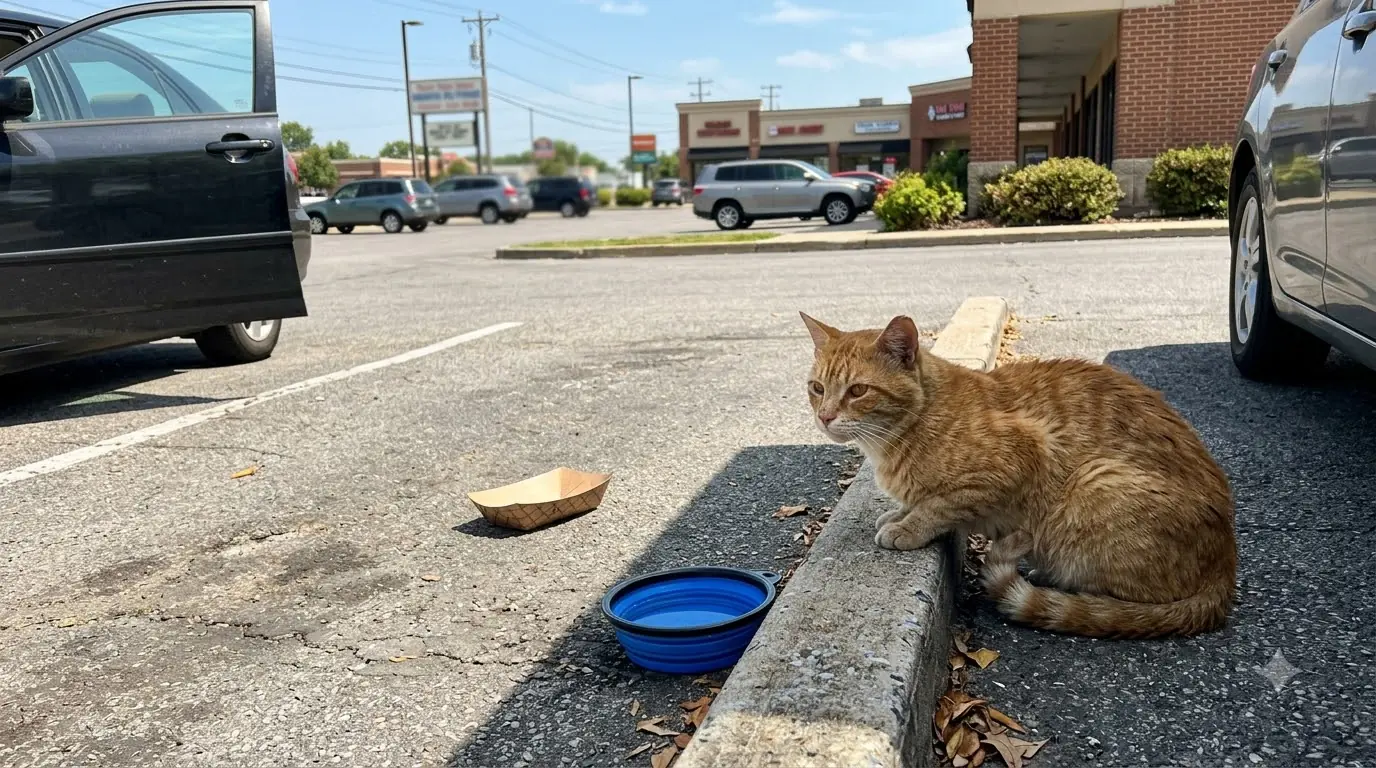
The first thing our veterinary team wanted to know was how much the summer heat had affected Teddy.
By the time he reached us, the 2-year-old orange Domestic Shorthair was alert and responsive, but he was dehydrated enough that his gums felt tackier than normal. His body condition was also leaner than we would expect for a young adult cat.
Fortunately, Teddy was not showing signs of severe heatstroke when he arrived. His temperature stabilized once he was indoors, and his initial bloodwork did not reveal the kind of major organ changes that can occur after a serious heat-related emergency.
That was encouraging.
But it didn't mean we could immediately consider him completely recovered.
For the first day, Teddy was kept in a quiet, climate-controlled area where staff could monitor his temperature, hydration, appetite, urine output, and general behavior. Fresh water was always available, and we offered small portions of wet food to provide additional moisture without overwhelming his stomach.
Teddy accepted the food almost immediately.
In fact, one of our first challenges was convincing him to slow down.
He ate with the urgency of a cat who wasn't sure when another meal might appear. Instead of allowing him to consume a large amount at once, caregivers divided his food into several smaller portions.
Within the first 24 hours, he was drinking independently as well.
His litter box gave us another reassuring sign. Teddy was urinating normally, and there were no immediate signs that dehydration had caused an obvious urinary problem.
Over the next several days, his hydration continued to improve.
The dusty orange coat he arrived with began looking brighter as Teddy resumed regular grooming. He spent long stretches licking his front legs and chest, occasionally stopping whenever footsteps passed outside his kennel.
That was when another part of Teddy's recovery became impossible to miss.
This cat desperately wanted company.
Many rescued cats need days or even weeks before they feel comfortable approaching people. Teddy was almost the opposite.
From the beginning, he appeared accustomed to human contact.
If a staff member entered the room, Teddy immediately stood.
If someone stopped near his enclosure, he came to the front.
If they walked away, he often followed them from inside the kennel until he reached the end of the enclosure.
And then he called after them.
His meows weren't constant throughout the day. When the room was busy and he could hear people nearby, Teddy often settled down. He might sit at the front of his kennel, watching staff work, or stretch out where he could see the hallway.
The difficult part came when everything became quiet.
At night, Teddy rarely chose the soft bed positioned toward the back of his kennel.
Instead, staff repeatedly found him sleeping directly against the front door.
That behavior didn't tell us exactly what had happened before Teddy arrived. We don't know whether he had been intentionally abandoned, accidentally lost, or allowed outdoors and unable to find his way home.
We also can't know why he returned to the same parking space for three evenings.
Perhaps the location was familiar to him.
Perhaps it was simply where he had found water, shade, and people willing to stop.
What we did know was that Teddy behaved like a cat who had lived around humans before.
Because of that, our team began the normal process of looking for a possible family.
He was scanned carefully for a microchip.
None was found.
We documented where he had been discovered, reviewed local lost-pet information available to our team, and made sure his description could be matched against reports from people searching for an orange cat.
During that period, Teddy remained safely in our care.
And his health continued moving in the right direction.
A follow-up examination showed that his hydration had improved significantly. His appetite remained strong, and he was tolerating his meals well. There had been no vomiting or diarrhea, and his litter-box habits remained consistent.
His weight was still something we wanted to watch.
Teddy was not dangerously emaciated, but he needed to regain what he had lost gradually. Our veterinary team established a feeding plan based on his body condition rather than simply allowing unlimited food.
That meant measured portions, regular weigh-ins, and patience.
Young cats can appear to recover quickly once they're eating again, but healthy weight restoration takes time.
After several days, Teddy began to understand that meals were predictable.
He stopped rushing quite as urgently when the bowl appeared.
Sometimes he even left a small amount, walked away to investigate a toy or greet a caregiver, and returned later.
For us, that was meaningful progress.
It suggested that food was beginning to feel like something dependable rather than something he had to consume immediately.
His physical energy changed, too.
During his first day, Teddy spent much of his time either seeking attention or resting.
Once he was better hydrated, his personality expanded.
A staff member placed a lightweight ball in his enclosure one afternoon. Teddy watched it roll for several seconds, tapped it once, and then chased it to the other side of the kennel.
The entire burst of play lasted less than a minute.
But the next day, he did it again.
Soon he was batting at a soft toy and reaching through the bars toward a wand toy held safely outside the kennel.
Those short periods of play were another indication that he was feeling physically better.
Yet the biggest changes continued to happen around people.
The volunteer who had started sitting beside Teddy in the evenings kept visiting him.
She didn't reach through the kennel or constantly try to entertain him.
She simply sat nearby.
On the fourth night, Teddy stretched one orange paw between the bars and placed it against her hand.
The volunteer stayed still.
After several minutes, Teddy lowered himself onto the floor without pulling his paw completely away.
Eventually, he fell asleep.
It became a small routine.
Not every night looked exactly the same. Sometimes Teddy was energetic and wanted to play. Sometimes he rubbed his cheeks against the kennel door. Other evenings he ate his dinner and then settled several inches away from the volunteer.
Giving him the choice mattered.
Although Teddy was exceptionally social, our staff didn't want his constant requests for attention to become the only way he could feel secure.
Shelters are unfamiliar places filled with sounds and smells that cats cannot understand. Doors open. Dogs bark in distant areas. Cleaning equipment moves through hallways. Different people arrive and disappear throughout the day.
Even a friendly cat can become stressed.
So Teddy's care plan included more than affection.
We gave him places to retreat when he wanted privacy, predictable feeding times, toys, scratching surfaces, and opportunities to engage with caregivers without forcing interaction.
Gradually, he began using more of his kennel.
One morning, a staff member entered and found Teddy asleep in the bed at the back instead of pressed against the door.
He woke when she began preparing breakfast.
But he didn't immediately rush forward.
He stretched.
Then he walked toward her.
It was a tiny change, but an important one.
For the first time, Teddy seemed comfortable enough to sleep somewhere that didn't place him as close as possible to passing people.
Over the following days, we saw that behavior more frequently.
He still preferred the front of the kennel when the shelter was active. He clearly enjoyed watching people and seemed determined not to miss an opportunity for attention.
But when he became tired, he sometimes returned to his bed.
That told us he was beginning to recognize his enclosure as a safe temporary space rather than simply somewhere he had been confined.
His veterinary recheck brought more good news.
Teddy's hydration was back within a normal range. His body temperature remained stable, and his heart and lungs sounded normal on examination.
His skin and paw pads were checked carefully because he had spent several days walking and resting on hot outdoor surfaces.
They were mildly dry and irritated but did not have the severe burns we had initially worried could be hidden beneath the fur.
No intensive treatment was necessary.
Rest, indoor housing, good nutrition, hydration, and continued observation were the main priorities.
We also kept watching for delayed problems.
Cats are extremely good at concealing discomfort, and Teddy's friendliness could easily distract from subtle physical symptoms. Staff documented his eating, drinking, litter-box use, activity level, and behavior each day.
So far, those observations have remained reassuring.
Teddy eats every meal.
He drinks on his own.
He urinates and defecates normally in his litter box.
He walks, stretches, jumps onto his resting platform, and plays without showing obvious discomfort.
His weight has begun moving slowly in the right direction.
And his coat is changing.
The dusty fur around his back and sides has gradually become smoother as Teddy grooms himself. When he first arrived, his coat looked dull from his time outdoors. Now the orange tabby pattern is becoming more noticeable.
There is still one question we cannot answer medically.
Where did Teddy come from?
His behavior continues to make us believe he had meaningful human contact before being found.
He knows what happens when someone picks up a food bowl.
He leans into gentle cheek scratches.
He doesn't appear confused by ordinary household sounds.
And when a carrier is opened, he investigates rather than immediately panicking.
None of those behaviors proves that Teddy belonged to a particular person.
They simply tell us that people were probably part of his life before the parking lot.
During the appropriate search period, we continued watching for someone who could reliably identify him and provide information that matched our records.
We hoped there might be a simple explanation.
Maybe someone was searching desperately for him.
Maybe Teddy had slipped through a door or window during the summer.
Maybe the parking lot was only a few blocks from the place he knew as home.
But rescue work also requires us to prepare for another possibility.
Sometimes nobody comes.
When that happens, the cat still deserves a future.
As Teddy's medical condition stabilized, our team began thinking about what kind of home would suit him if he became available for adoption.
His personality gives us some useful clues.
Teddy is social, curious, and strongly interested in people.
He doesn't merely tolerate attention.
He actively seeks it.
When a familiar volunteer sits beside his enclosure, Teddy often rubs his face along the door and settles nearby. During supervised handling, he relaxes quickly and frequently presses his forehead into a hand asking for another gentle scratch.
He also appears to appreciate routine.
Breakfast matters.
Evening visits matter.
The predictable sounds of familiar staff members entering the room seem to matter.
For a cat whose recent life included waiting beside parked cars in extreme summer weather, predictability may be particularly valuable.
That doesn't mean Teddy needs someone beside him every second.
One of our goals has been helping him become comfortable when people aren't immediately available.
The progress there has been gradual but noticeable.
He can now spend periods resting independently without calling whenever someone leaves.
He uses his bed more often.
He grooms himself after meals.
He occasionally becomes absorbed in a toy long enough to ignore activity in the hallway.
These are ordinary behaviors.
In rescue, ordinary can be wonderful.
It means Teddy has enough security to behave like a young cat rather than spending every moment focused on whether the next person will disappear.
There are still evenings when he returns to the front of his kennel.
The volunteer who sat with him on that fourth night recently came in after several days away.
Teddy recognized the familiar footsteps before she reached him.
He stood, stretched against the kennel door, and gave several short meows.
When she sat down, he didn't immediately put his paw through the bars this time.
Instead, he ate part of his dinner.
Then he groomed one shoulder.
Finally, he walked to the front and settled beside her.
That may not sound dramatic.
To us, it was exactly what we wanted to see.
Teddy no longer appeared to believe that he had to demand attention immediately or risk losing it.
He seemed to understand that she was staying for a while.
His next veterinary step is straightforward.
We will continue monitoring his weight until he reaches a healthier body condition and complete the routine preventive care appropriate for him before any placement. His medical record will follow him so future caregivers can continue watching his weight, hydration, appetite, and general health.
Just as importantly, we'll continue supporting his emotional adjustment.
Teddy has already shown us that being rescued isn't only about moving an animal from danger into a building.
Safety has to become something the animal can understand.
For Teddy, that process seems to be happening through repetition.
The water bowl is full again tomorrow.
Breakfast comes again tomorrow.
Someone opens the kennel and speaks gently again tomorrow.
A familiar volunteer returns again tomorrow.
And when the shelter lights dim, he doesn't have to curl beside a parking-lot curb and listen for car doors.
He has a clean bed.
He has fresh water.
He has food he doesn't need to search for.
He has veterinary professionals watching his health and caregivers learning the small details of his personality.
Most importantly, Teddy is no longer waiting outside for every opening car door to bring someone back.
For now, he is safe with us.
And whether his next chapter eventually leads back to a verified family or forward to a carefully chosen new home, Teddy won't have to face the summer heat alone again.