On Wednesday, May 7, at 5:18 in the morning, seventy-four-year-old Warren Puit stepped onto the front porch of the farmhouse his father had rebuilt after a storm in 1968 and stopped halfway down the steps.
The light was only beginning to spread across the flat country, pale and blue over the tree line, but there was already enough of it to show him that the lowest part of his farm had vanished beneath water.
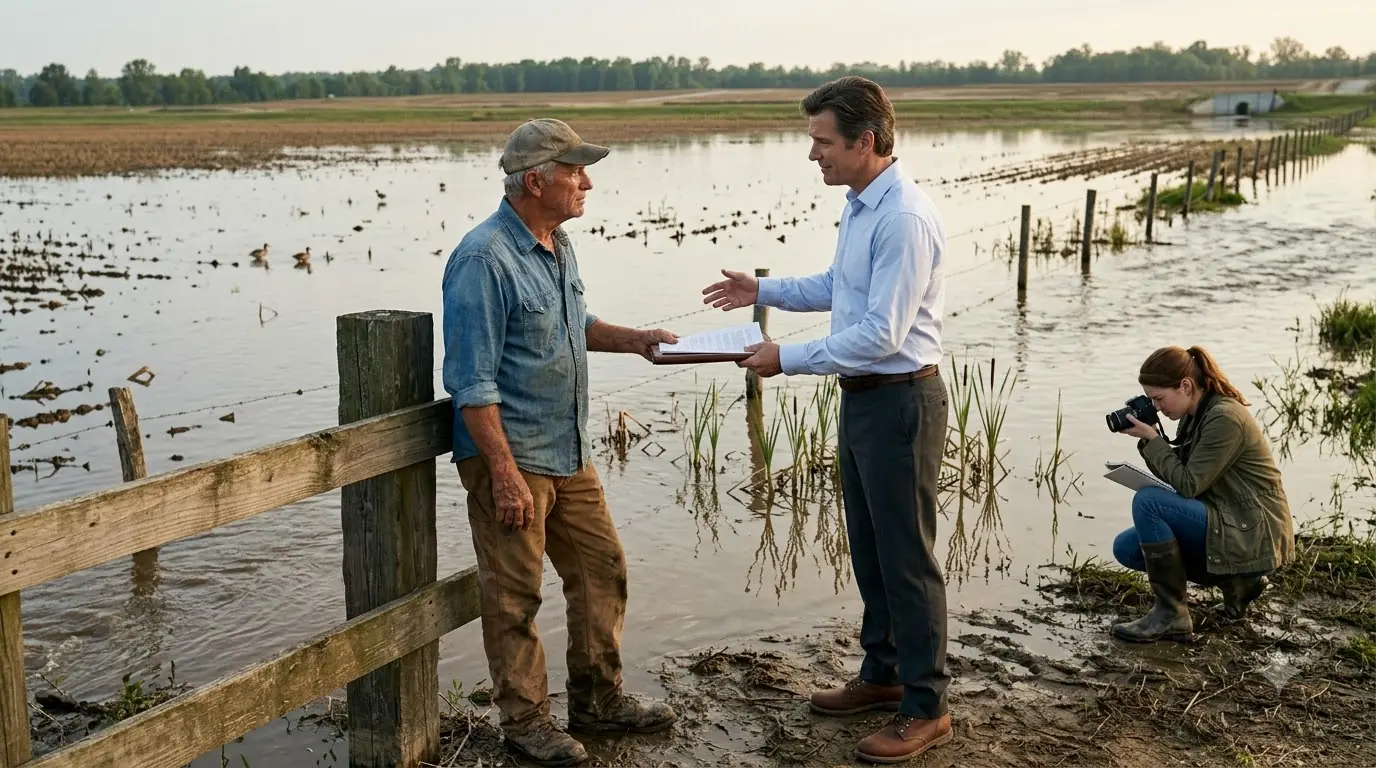
Where eighty acres of young soybeans had been planted less than a month earlier, there was now a broad sheet of brown water broken only by fence posts, the upper strands of wire, and the dark tips of rows that disappeared almost as soon as they emerged. For several seconds Warren did not move, because before fear came confusion, and confusion was harder for him to accept.
It had not rained enough for this. He knew that as certainly as he knew the sound of his own tractor starting cold. There had been storms in his lifetime that dropped four inches in an afternoon, storms that turned field roads into chocolate-colored rivers and made every drainage ditch in the county boil at once, but the rain the night before had been ordinary.
The ground near the house was damp but firm, the creek along the eastern boundary remained inside its banks, and the neighboring fields did not hold enough water to explain what lay across his bottom ground. Warren put on his boots, took his cane only because Casey had been nagging him to use it on slick ground, and started walking toward the lower acreage.
The Puit farm covered six hundred acres in one long, irregular piece that had been assembled by Warren's father and grandfather over decades. The high ground carried grain reliably in most years, while the low ground had always required more patience: careful grading, seasonal ditch work, and an understanding of where water wanted to go before a man tried telling it otherwise.
Warren had learned those lessons before he was old enough to drive legally. His father used to say that farming low ground was not about defeating water, because water always won in the end; it was about giving it a route that did less damage than the route it would choose for itself.
For more than forty years, Warren had lived by that rule. He could stand at the edge of a field and tell from the shine on the soil which rows would stay wet after a spring storm.
He knew which culvert needed cleaning after cottonwood fluff clogged the grate, which swale cut across the south quarter, and which section of the eastern ditch tended to back up after three days of north wind. That was why the moving water bothered him more than the depth. When he reached the field and crouched beside the ditch, he saw immediately that the current was flowing toward his land instead of away from it.
He followed the drainage channel upstream through a strip of brush that separated his boundary from a tract that had recently changed hands. Until the previous year, that ground had belonged to a family who kept it in rough pasture and timber, and runoff had moved across it slowly through shallow depressions before spreading into the county drainage system.
Then a development group began buying land along the highway, grading roadbeds, clearing trees, and installing utilities for a project nobody in the farming community fully understood. Warren had watched the work from a distance because it was not his property and because, until then, the construction had seemed like one more example of the county changing around him.
That morning he found something different. At the edge of the cleared tract was a concrete outlet that had not been there during planting. A widened channel ran from it directly toward the old ditch that crossed onto his boundary, and water was pouring through the outlet with enough force to make a visible tongue of current all the way into his soybean field. Warren stood behind the fence with both hands wrapped around the top rail and watched the flow for almost a minute. He did not know yet whether the outlet violated any permit, whether somebody had made a mistake, or whether the drainage plan simply assumed his land could absorb what the project no longer wanted to hold.
What he knew was simpler. Water that had once spread over a broad area upstream was now being collected and sent toward the narrowest, lowest part of his farm. The result sat in front of him.
Warren walked back to the house shortly after six and found his granddaughter's coffee mug already on the kitchen counter. Casey Puit had come home the previous winter after several years away, telling Warren she needed time to decide what she wanted next and that the farm could use another set of hands in the meantime. He had told her the farm always needed another set of hands, but he had not asked how long she planned to stay because he was afraid a direct question might sound too much like hope. She was asleep in the small room off the hallway, and for once Warren let her sleep.
He made coffee he did not drink. Then he opened the file drawer beside the refrigerator and pulled out the latest letter from Cornerstone Agricultural Bank.
The bank had financed Warren's operating note for years. The relationship had once been simple enough that he knew the loan officer's children's names and could settle small questions in a ten-minute conversation over a desk cluttered with commodity reports. That changed when Cornerstone expanded, consolidated several county branches, and began moving agricultural loans through a regional office. Warren's loan was now reviewed by people who spoke in ratios and risk categories more often than they spoke in planting dates.
Gerald Voss, the regional vice president, had been courteous every time they met. Warren distrusted him anyway, not because Gerald had ever openly threatened him but because he had a talent for making threats sound like sensible advice. Over the previous eight months Gerald had raised the same subject three times: the value of Warren's lower acreage, the financial strain of farming marginal ground, and the possibility of selling a portion of the property to reduce debt. Each time Warren had refused. Each time Gerald had smiled as though the refusal was temporary.
At seven o'clock, Warren was back beside the flooded field when a dark pickup turned onto the farm lane and came slowly toward him. The truck was clean enough to look wrong beside the mud. Gerald stepped out wearing pressed khakis, a pale blue shirt, and work boots that had not yet learned what real clay did to leather. He closed the door carefully, looked across the water, and gave a low whistle.
"That's a hard sight," he said.
Warren did not answer immediately. "You get many calls about floods before breakfast?"
Gerald looked at him. "I had a meeting nearby and heard there'd been trouble along this side of the road. I thought I'd stop in."
Warren turned his eyes toward the upstream outlet. "Trouble started before the weather did."
Gerald followed his gaze but did not walk toward the ditch. "Drainage changes can do strange things. Development, roads, more hard surface, less absorption. That's one reason land like this becomes difficult to carry year after year."
"Land like this was carrying beans a week ago."
"I'm not arguing with you." Gerald tucked his hands into his pockets. "I'm saying this may be the kind of moment when you stop fighting the same ground and use it to strengthen the rest of the operation. Cornerstone could help you sell the lower eighty, restructure the note, and leave you with the productive acreage free of the pressure you're under now."