The wine hit Lara Wynn’s dress like a slap.
Dark red liquid splashed across the charcoal fabric, spreading over her chest before running in narrow streams toward the hem. Several drops struck the polished marble at her feet, bright and ugly beneath the crystal chandeliers.
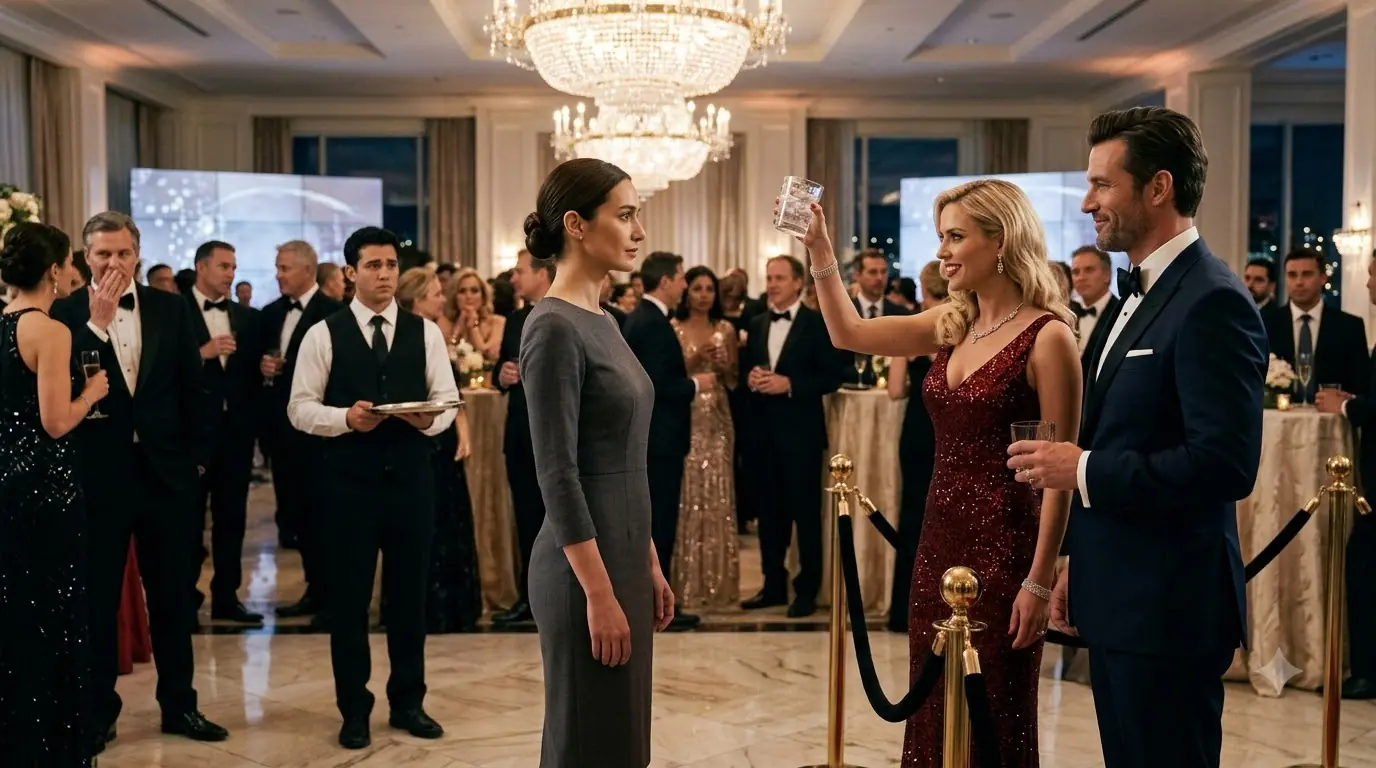
For one strange second, nobody in the ballroom moved.
Then Selene Hart laughed.
It was not a nervous laugh from someone suddenly realizing she had gone too far. It was bright, deliberate, almost triumphant. Beside her, Adrien Crest lifted his whiskey glass and smiled as though the humiliation happening three feet in front of him was the most entertaining thing he had seen all evening.
Lara remained perfectly still.
She did not gasp.
She did not yell.
She did not touch Selene.
She simply looked down at her ruined dress, then slowly lifted her eyes to the two people standing in front of her.
Around them, more than a hundred executives, investors, attorneys, consultants, bankers, and invited guests watched.
Some looked embarrassed.
Some looked fascinated.
A surprising number looked amused.
Several phones were already recording.
Adrien gave Lara a dismissive glance.
“That’s what happens,” he said loudly enough for the people around him to hear, “when someone pretends to belong somewhere she doesn’t.”
Selene handed the empty wineglass to a stunned waiter.
“Someone should probably call security.”
Nobody in the ballroom knew that the quiet woman they had just humiliated owned Windche Industries.
Nobody knew that Windche was the company behind the eight-hundred-million-dollar strategic partnership Hexton Global had spent nearly seven months negotiating.
Nobody knew that the final agreement had not yet been signed.
And nobody knew that Lara Wynn had personally insisted on one final night inside Hexton Global’s world before she put her name on it.
She wanted to see the people.
Not their presentations.
Not their financial models.
Not their carefully rehearsed conference-room manners.
The people.
Less than ten minutes later, she would know exactly what she needed to know.
And the most important deal in Hexton Global’s history would disappear before midnight.
The Grand Aurelia ballroom occupied the top two floors of one of the most exclusive hotels in the city. Everything about the room had been designed to remind guests that ordinary rules did not apply there.
Crystal chandeliers hung from a ceiling three stories high like frozen waterfalls. Tall windows overlooked the financial district. White marble floors reflected gold light from hundreds of small fixtures hidden among floral arrangements and silk drapery.
Waiters moved between guests carrying champagne on silver trays.
A quartet played near the eastern wall.
Every few minutes, another black car deposited someone important beneath the hotel entrance canopy downstairs.
Hexton Global had spared no expense.
The company had already spent almost three million dollars entertaining investors, advisers, analysts, and potential international partners during the closing phase of what Adrien Crest had repeatedly called “the transaction that would redefine Hexton.”
The numbers justified the confidence.
If completed, the partnership with Windche Industries would create a combined distribution and infrastructure network spanning North America, western Europe, and parts of Southeast Asia. Hexton would gain access to Windche’s proprietary logistics systems, international suppliers, and several manufacturing partnerships it had failed for years to obtain on its own.
The projected transaction value was just over eight hundred million dollars.
Hexton executives had begun referring to it simply as “the Windche deal.”
Adrien referred to it as his deal.
That distinction mattered.
At forty-three, Adrien Crest had spent most of his adult life building a reputation as the kind of executive who entered weak businesses and forced them to grow. He had inherited money but not Hexton. He joined the company at thirty-one, became chief operating officer at thirty-seven, and took over as CEO four years later.
His performance during those first years had been impressive.
Revenue increased.
Several underperforming divisions were sold.
A European acquisition competitors said was impossible closed under Adrien’s direction.
Business magazines described him as aggressive, disciplined, and fearless.
His employees used other words when journalists were not around.
Brilliant.
Demanding.
Vindictive.
Charming when he needed something.
Cruel when he believed he no longer did.
The problem with years of success was that Adrien had gradually stopped distinguishing between confidence and infallibility.
By the time negotiations with Windche began, he spoke about the partnership as though Windche were fortunate to be invited into his plans.
That attitude irritated several members of Hexton’s board.
It worried Windche’s negotiating team.
Lara Wynn noticed it immediately.
She simply chose not to confront it.
Not yet.
Lara was forty-two and looked younger when she was not dressed for business.
Unlike Adrien, she rarely appeared in magazines.
That was partly deliberate.
Windche Industries was privately held, and Lara owned almost eighty-seven percent of it personally through a holding company established years before. A small group of early employees and senior executives held the rest.
She had no obligation to perform for quarterly analysts.
No public shareholders demanding television interviews.
No personal interest in becoming famous.
Windche had become known because its systems worked, not because Lara wanted her face attached to them.
She founded the company fourteen years earlier from a rented warehouse with nine employees.
Before that, she had worked in logistics procurement for a manufacturing conglomerate that routinely lost millions because departments refused to share information. Lara had spent four years watching executives blame suppliers for problems caused internally.
When her recommendation for an integrated logistics platform was rejected for the third time, she resigned.
Her former employer laughed at her business plan.
Three years later, it became one of Windche’s customers.
By the time Lara turned forty, Windche employed more than six thousand people.
Its software tracked manufacturing, freight, warehousing, customs compliance, and industrial procurement across nineteen countries. The company also controlled several specialized manufacturing operations and regional distribution centers.
Its annual revenue had crossed two billion dollars.
Yet Lara continued to fly commercial more often than private.
She drove herself when possible.
She wore expensive clothes when work required it but never cared whether strangers recognized the labels.
Her mother had given her a reason for that long before Windche existed.
“Watch how people treat someone they believe cannot help them,” she used to say. “That’s the version you can trust.”
Lara’s mother, Evelyn Wynn, had spent thirty-four years working as an administrative assistant at a hospital. She had seen important doctors charm donors and insult janitors within the same hour.
When Lara began managing people, Evelyn repeated the lesson.
“The receptionist knows more about a company’s character than the person giving you the tour.”
Lara never forgot it.
That was why she declined Adrien’s offer to send a limousine for the gala.
It was also why she refused the diamond jewelry a stylist suggested.
She chose a charcoal dress from a small independent designer.
Beautifully made.
Simple.