The wind in Wyoming did not simply blow. It scoured. It pressed against a man's chest like a physical weight and stripped the moisture right out of his eyes. Elias Thorne stood on the wooden platform with his hat pulled low, listening to the telegraph wires singing their mournful song overhead.
He was 26 years old, though the sun and wind had already carved fine lines around his eyes. He was tall and broad in the shoulders from years of lifting beams and wrestling calves. But despite his size, Elias held himself with a quiet, shrinking posture, like a man trying to take up less space than God had given him. His hands were twisting the brim of his hat.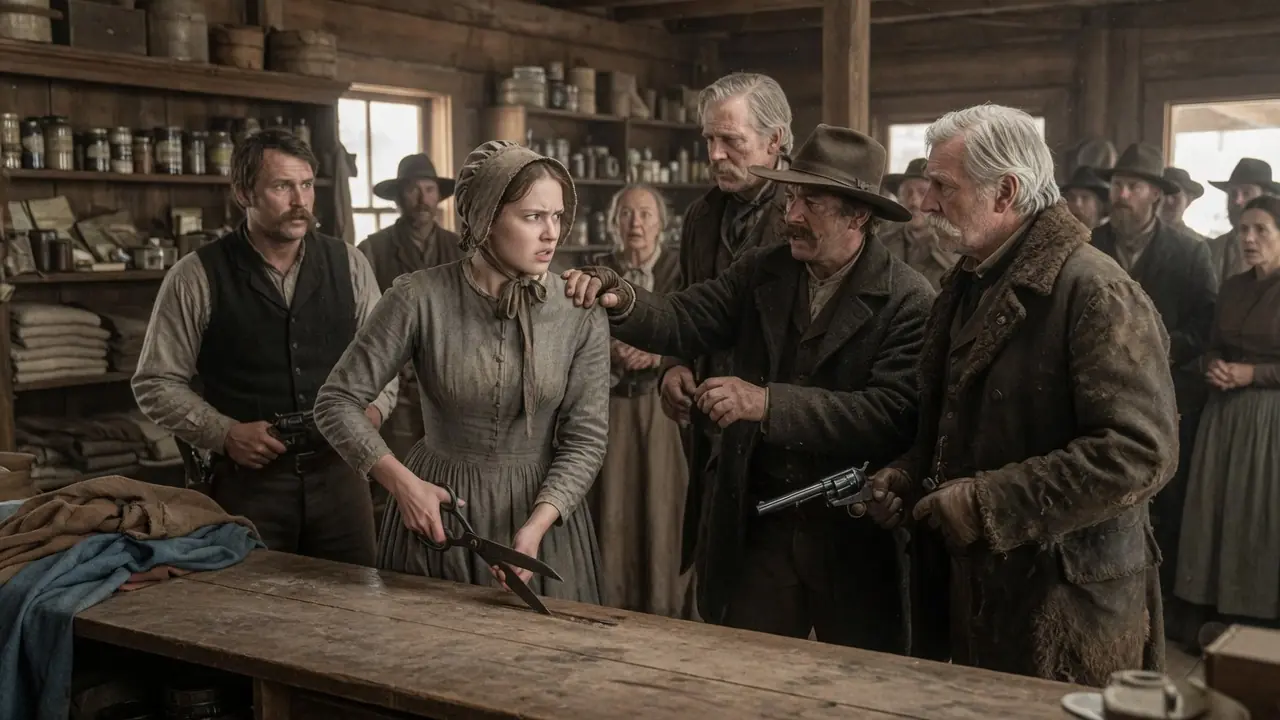
Those hands were calloused and scarred from honest work. They could build a fence or calm a spooked horse, but right now they were trembling with a fear that no stampede had ever put in him. He was waiting for a wife. The thought made his stomach turn over in a slow, sickly rotation.
He glanced toward the town of Blackwood, a settlement that looked like it had been nailed together in one bad week. False-fronted buildings and raw timber shacks leaning into the endless wind. Two men sat on the porch of the general store with their boots propped up on the railing. One of them was a thick-necked ranch hand named Jeb, who had delighted in tormenting Elias since they were boys in school together.
Jeb pointed and laughed. The wind snatched the sound away, but the gesture was clear enough. "There goes Elias," they would be saying. Too soft to court a girl proper, so he had to buy one from a catalog.
Elias turned his back to them and stared down the iron rails that converged in the distance. He had not done this out of desire. He had done it because the silence in his half-finished cabin had become unbearable. He had done it because a man alone in this country was a ghost before he was dead.
And if he was being honest with himself, he had done it because the thought of walking into the brothel on the edge of town or trying to speak to the daughters of the church congregation paralyzed him with a shame he could not put into words. A mail-order bride was a business arrangement. It was paper and ink. It was safe.
Or so he had told himself when he sent that letter and the bank draft for her ticket three months ago. A low rumble vibrated through the planks beneath his boots. Black smoke smeared the horizon. The train was coming.
Elias wiped his palms on his trousers. He felt a desperate urge to run, to mount his horse, and gallop back to the safety of his empty claim. But his feet stayed rooted to the platform. He was a man who kept his word, even when his word terrified him.
The locomotive grew from a speck to a roaring iron beast, grinding to a halt with a screech that set his teeth on edge. Steam hissed and enveloped the platform in a damp sulfurous cloud. Passengers began stepping down, a salesman with a sample case, a family of homesteaders looking bewildered and dusty, a few miners heading up to the hills, and then her. She stepped down from the second car with a slow, deliberate movement, clutching a small battered trunk in one hand and a worn leather Bible in the other.
Her dress was dark gray wool that had seen better days, patched neatly at the hem. Her bonnet hid her face until she lifted her chin to scan the platform. Clara Vance was not the blushing, rounded girl the advertisement might have implied. She was lean and sharp-angled with pale skin that looked like it had not seen proper sunlight in years.
Her hair, tucked severely beneath her bonnet, was the color of dried wheat. But it was her eyes that stopped Elias cold. They were blue. They were cold and flat.
And they moved over the crowd, not with curiosity, but with the rapid, calculating assessment of an animal looking for a trap. She saw him. She saw the way he stood apart from the others, holding his hat like a shield. She walked toward him, her movement smooth and contained.
Elias swallowed hard and stepped forward. "Miss Vance," he asked, and his voice cracked. He hated himself for it. She stopped three feet from him.
She did not smile. She set her trunk down and folded her hands over her Bible. "Mr. Thorne.
" "Yes, ma'am. Elias. Elias Thorne. " "Clara," she said.
Her voice was low and devoid of any warmth. It was a voice that expected nothing good from the world. "I trust the journey is over. " "Yes, ma'am.
The wagon is just over yonder. " He reached for her trunk, but she flinched. Her hand darted out to intercept his. For one second, her cold, dry fingers brushed his wrist before she pulled back, clutching her hand against her chest like he had burned her.
"I can manage my own things," she said sharply. Then she smoothed her tone with a practiced hollow politeness. "It is not heavy. " Elias stepped back to give her space.
"I would not hear of it, ma'am. It is the gentlemanly thing. " She looked at him, then really looked at him. Her eyes searched his face for the anger that usually followed when a woman refused a man.
When she found only blushing, terrified confusion, something like bewilderment crossed her face. She stepped back and nodded once. "Very well. " Elias hoisted the trunk onto his shoulder.
It was light, heartbreakingly light. Everything she owned in the world fit in a box a child could carry. "This way," he murmured. And so began the strangest journey two broken people had ever taken together.
They had to walk the length of the platform to reach the hitching post where the wagon waited. It was a walk that felt like a march to the gallows. The town of Blackwood had noticed the new arrival. Conversations on the boardwalks died away.
Heads turned. The silence was thick, broken only by the wind rattling the loose boards of the station house. Mrs. Gable, a pillar of the Methodist church and the town's self-appointed moral judge, came out of the mercantile just as they passed.
She stopped and her eyes narrowed as they swept over Clara's gray dress and travel-stained hem. The old woman sniffed loud and distinct, then turned her back, pulling her shawl tight like she needed protection from some kind of disease. Clara did not flinch. She kept her chin high and her eyes fixed on the horizon.
But Elias saw her knuckles turn white where she gripped that Bible. She had been on the ground for less than five minutes, and she already knew her place in this town, the mail-order woman, a creature considered one step above a prostitute and three steps below a decent wife. As they passed the saloon, the door swung open. Jeb and his drinking companion had moved from the store to get themselves some liquid courage.
"Well, now," Jeb called out, his voice slurring. "Looks like the package arrived intact. Eli, did you check her teeth? I hear they send the old ones out west when they cannot work the cities anymore.
" Laughter rippled from the shadows of the porch. Elias froze. Heat flooded his neck and burned all the way to his ears. He should say something.
A real man would drop the trunk and plant a fist in Jeb's face. A real man would defend his wife's honor. But Elias Thorne had never been a fighter. He was the boy who patched up birds with broken wings.
The man who apologized when someone else stepped on his boot. The violence that came so natural to other men terrified him, not because he could not match it physically, but because he simply did not understand the language of it. He stood there with his mouth opening and closing. Paralyzed by the shame of his own inaction.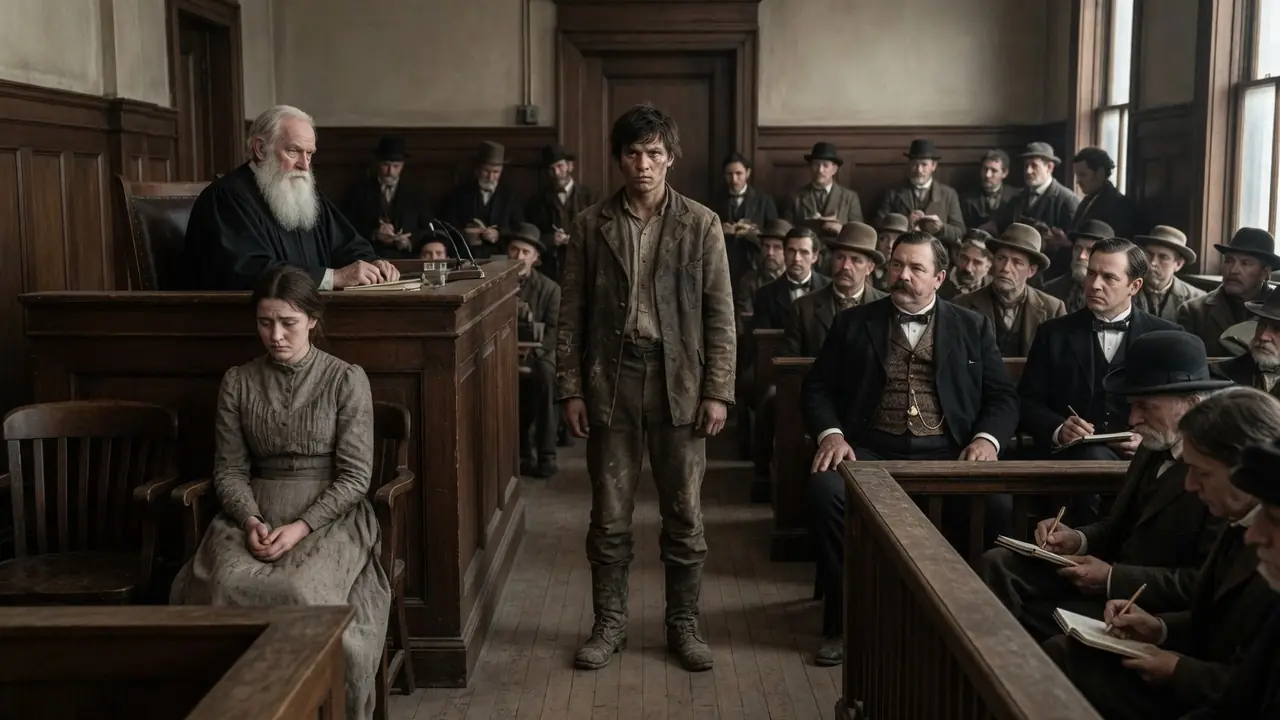
It was Clara who moved. She stopped walking and turned her head slowly to look at Jeb. She did not speak. She did not scowl.
She simply looked at him with those flat dead eyes, an expression of such utter bored indifference that it sucked all the oxygen out of his taunt. It was the look of a woman who had heard every insult a man could invent, and found this particular one lacking in originality. Jeb's smile faltered. He shifted his weight, suddenly uncomfortable, and spat on the ground before retreating back into the saloon.
Clara turned back to Elias. "Is the wagon far, Mr. Thorne? " "No," Elias whispered.
"Just here. " The ride to the homestead took two hours. For the first hour, neither of them spoke. The only sounds were the creak of the wagon wheels, the rhythmic thud of hooves, and the wind hissing through the dry grass.
The landscape was overwhelming in its emptiness. To the north, storm clouds were gathering like dark bruises against the sky. The light was failing and turning the world into a gray etching of sagebrush and dust. Clara sat with her spine rigid, never leaning back.
Her eyes never stopped moving. She watched the horizon, the gullies, the distant shapes of cattle. She scanned the land like she expected an ambush at any moment. "It gets cold at night," Elias said finally.
His voice startled them both. "There is a buffalo robe in the back if you are chilled. " "I am fine," Clara said. She paused, then added, "Is it always this open?
" Yes, ma'am. There is not a fence for 50 miles to the south, just grass and sky. "It is a good place to hide," she said almost to herself. Elias looked at her sideways.
"Hide? " She tightened her grip on her Bible "To be alone. That is what I meant. It is a quiet place.
" "It is that," Elias agreed. "Lonely, some say. " "Loneliness is quiet," Clara replied. "Noise is worse.
"I have been meaning to finish the siding on the south wall, and the floor inside is just packed earth in the kitchen, though I laid planks in the bedroom. " He stumbled over that word, bedroom. It hung between them, heavy with suggestion. Clara stared at the little house.
It looked small and fragile against the darkening sky, but there was smoke curling from the chimney. He must have banked the fire before leaving. "It has a door," she said. "And a lock," Elias promised quickly.
A sturdy crossbar. I made it myself out of oak. "Good. " That single word carried more weight than any thank you could have.
Inside the cabin was clean, surprisingly so. The main room served as kitchen and living area with a cast-iron stove radiating dying heat. A table with two chairs sat in the center. To the right was a door that led to the only other room.
Elias lit the kerosene lamp, and golden light pushed back the shadows, revealing how sparse his life truly was. A single shelf of books, a tin of coffee, a calendar from the feed store. "I have stew on," Elias said, moving to the stove. "Just needs heating.
" "I can do that," Clara said quickly. "That is part of the bargain. " "You have had a long journey, ma'am. Please sit.
" She hesitated, then sat on the edge of one of the chairs. She watched him move. He was clumsy with the ladle, his hands shaking slightly, but he set a bowl before her with a kind of reverence that was almost painful to witness. They ate in silence while the wind rattled the door on its hinges.
Every time a coyote howled in the distance, Clara's spoon paused halfway to her mouth. When the meal was finished, the silence stretched thin as wire. There was nothing left to do. The plates were cleared.
The fire was banked. The clock on the mantle ticked loud in the quiet, and the question neither of them wanted to face hung in the air between them like a loaded gun. What happened next would change everything. Elias stood up from the table.
He took off his hat and ran a hand through his hair, trying to find words that would not come. "I expect you will be wanting to rest," he finally managed. Clara rose, too. Her face had gone pale as the lamplight smooth as a mask.
Something flickered in her eyes. Fear maybe, or resignation. Yes. The bedroom is through there.
Elias pointed to the door. I brought your trunk in already. Clara walked to the door and opened it. She stood there looking at the bed.
It was a sturdy frame covered in a patchwork quilt with two pillows resting side by side. It was the only bed in the house. She turned to face him. The calm she had worn like armor all day was starting to crack.
Her chest rose and fell too fast. She looked at the door, then at him, then back at the bed. She was calculating distances, the weight of him, the likelihood of survival. "Mr.
Thorne," she said. Her voice was steady but brittle as dry glass. "Elias, we should speak of the arrangements before... " She could not finish the sentence.
" Elias stood by the table with his hands hanging useless at his sides. "Arrangements? The marriage? " Clara said, "I am your wife now.
I signed the papers at the office in Cheyenne before the last leg of the trip, just as the proxy arrangement required. I understand the duties that come with that. " "Duties? " Elias echoed.
The words sounded strange in his mouth. Clara began to unbutton the cuffs of her gray dress. Her fingers moved with mechanical efficiency. There was no seduction in it.
It was the motion of someone preparing for an unpleasant but necessary task. I am not a woman who plays games. Elias, I prefer to know the rules of the house right from the start. I cook, I clean, I mend, and at night.
She paused, her eyes locked onto his with an intensity that made his blood run cold. "I need to know," she said. "Can you make me come? " The question hit the room like a gunshot.
Elias blinked. The air seemed to leave his lungs all at once. He stared at her, his mind reeling, trying to make sense of what she had just asked. He had expected her to ask for water or privacy or maybe time to pray.
He what? Clara took a step toward him. Her expression was intense in searching. She was not asking out of desire.
She was asking the way a soldier asks how many rounds the enemy has in his rifle. She needed to know the nature of the weapon pointed at her. She needed to know if he would demand performance, if he expected her to fake pleasure to stroke his vanity, or if he intended to use her body with a skill that might become its own kind of trap. "Can you?
" she pressed, her voice trembling just slightly. Because if you cannot, I need to know if you expect me to pretend. I need to know if I'm supposed to lie to you, or if you simply take what you are owed and then sleep. Elias felt the blood drain from his face, leaving him cold as the wind outside.
He looked at this woman, the stranger with the haunted eyes, and he felt a crushing wave of inadequacy wash over him. He was 26 years old. He lived on the edge of the civilized world, and he had never so much as kissed a woman. He looked down at his boots, unable to meet her gaze.
The shame was a hot, bitter taste in his mouth. "I do not know how," he whispered. The silence that followed was absolute. "I do not know how," Elias repeated.
His voice cracked, and he forced himself to look up, expecting to see disgust on her face. He expected her to laugh the way Jeb laughed. He expected her to realize she had sold herself to a man who was not even a real man at all. "I have never.
" "I am a virgin, ma'am. " He braced himself for ridicule, but it did not come. Clara stared at him. Her hands stopped moving on her buttons.
Her eyes went wide, not with mockery, with shock. And then slowly, so slowly, the tension in her shoulders collapsed. She let out a long, ragged breath that sounded almost like a sob. It was relief.
"You have never? " she asked softly. "No, ma'am. " Elias was miserable with shame.
"Now I kept to myself mostly. My mother raised me strict. And then, well, the brothel in town. It never seemed right.
And I never had a sweetheart. Never knew how to talk to women proper. Clara closed her eyes for a moment. When she opened them again, the cold calculation was gone.
In its place was a tentative, confused wonder. A man who did not know. A man who had no history of taking. You do not know how, she repeated, testing the words like they might shatter.
"I am sorry," Elias said, hanging his head. I know a wife expects her husband to be experienced. I know I am not what you bargained for. "No," Clara said quickly.
"No. " She took a step back and pulled her cuffs closed again, covering the skin she had started to reveal. No, Elias, that is that is good. Good.
"It means we can wait," she said, and her voice gained a fraction of strength. It means you do not have habits. It means you do not require things from me tonight. She looked at him with new intensity.
I do not want to be forced, Elias. I do not want to be used like a tool. If you do not know how, then we can simply sleep. Elias nodded so fast his neck hurt.
Yes. Yes, ma'am. I would never force you. To be honest, I scarcely know how to touch a woman without trembling.
Clara looked at his hands. Those large scarred hands that were currently twisting the fabric of his trousers. She saw the truth in him. He was terrified of her.
We agree then, she said. No demands, no lies. We sleep. And if the time comes where we must change that arrangement, we discuss it first like partners.
"I swear it," Elias said. On my mother's Bible. Clara nodded once. Then she walked into the bedroom carrying her trunk.
Elias followed but stopped at the doorway. I can sleep in the barn, he offered, or on the floor by the stove. I do not mind. No, Clara said.
She looked at the bed with its two pillows. The town talks Elias. If you sleep in the barn every night, they will know something is wrong. They will think I am diseased or that you are weak.
We must look like a real marriage to the outside world. She pointed to the bed. It is large enough. You stay on your side.
I stay on mine. Yes, ma'am. They prepared for bed in separate corners of the room, turning their backs to each other to undress down to their undergarments. Elias blew out the lamp, and the room plunged into darkness.
The wind picked up outside, screaming around the corners of the house like a living thing trying to get in. Elias lay on the far left edge of the mattress, his body rigid as a board. He was terrified that even his breathing might somehow offend her. He could feel the warmth of her body just a foot away, but he did not move.
He did not dare. Clara lay on her back, staring up at the ceiling she could not see. She was safe. For tonight, at least she was safe.
The man beside her was a boy in a man's body, frightened and gentle. But as she lay there, her mind drifted back to something she had tried to push away the moment she stepped off the train. She had been scanning the crowd for her husband, but her eyes had caught something else entirely. Standing in the shadow of the water tower, separate from everyone else, had been a man.
He wore a long duster coat and a hat pulled low over his face. He had not boarded the train. He had not greeted anyone. He had just stood there rolling a cigarette, watching the passengers step onto the platform.
When Clara had appeared, the man stopped rolling his cigarette. He looked directly at her. He did not smile. He did not move.
He just watched with a calm, predatory patience. And then, as she walked away with Elias, she saw the man turn and walked toward the telegraph office. Clara squeezed her eyes shut now in the darkness of the bedroom. It was just paranoia.
It had to be. It was the ghost of the life she had fled. Her former owner, the man she refused to name, even in her own thoughts, was a thousand miles away in St. Louis.
He could not have found her this fast. He could not know where she was, but the fear curled in her gut anyway, cold and sharp as a blade. Outside, a coyote howled, a long, wavering note that sounded like a woman screaming. The wind rattled the boards of the house, testing the strength of the nails, looking for a way inside.
In the darkness, two strangers lay in the same bed. They were separated by a foot of cold quilt and a lifetime of damage. Both of them were afraid. Both of them were hoping that morning would bring some kind of mercy, though the West was not a place known for granting any.
"Good night, Elias," Clara whispered into the dark. Good night, Clara," he whispered back. Neither of them slept for a long time. November settled over the Wyoming plains like a heavy gray blanket, suffocating and cold.
The wind found every gap in the cabin logs and whistled a high, lonely tune that grated on the nerves day and night. But for Elias and Clara, the days became a rhythm of survival that left little room for awkwardness. The land demanded labor, and it did not care one bit about their strange arrangement. They fell into a routine born of necessity.
Morning arrived before the sun. Elias would rise from the buffalo robe he had dragged to the floor, leaving the bed entirely to Clara, despite her protests. He would stoke the stove, break the ice on the water bucket, and head out to the barn. Clara would rise in the chill, dress quickly in the cold air, and take over the kitchen.
The work was hard. The pump mechanism on the well was stiff with rust and required two people to operate efficiently. One to pump and one to haul the heavy oak buckets. On the third day, Elias tried to stop her from helping with the fence repairs.
"No, Clara," he said, his hands fluttering uselessly as she lifted a heavy roll of barbed wire. "That is too heavy. I can manage. Please go back inside where it is warm.
Clara did not drop the wire. She looked at him with her face flushed from exertion, her breath pluming in the cold air. "I am not a China doll, Elias. And I am not a guest in this house.
If I do not work, I do not eat. That is the way the world works. She marched past him with her boots crunching on the frost hardened ground. Elias watched her go with a mixture of shame and admiration warring in his chest.
He was used to the women of the town, fragile things, or at least pretending to be fragile. Women who expected men to shield them from every hardship. Clara attacked work with grim efficiency. She held the fence post steady while he hammered.
She twisted the wire with gloved hands, not flinching when a barb caught her sleeve and tore it. She was nothing like what he had expected. And slowly, day by day, something began to change between them. The intimacy between them grew not from grand gestures, but from the quiet, unavoidable friction of living together in a small space.
It happened when the stove handle broke. Elias was moving the heavy iron lid when the rusted handle snapped clean off. The lid fell, and his hand came down on the scorching metal. He hissed in pain and jerked back, the instinct to hide his weakness kicking in immediately.
But Clara was already there before he could retreat to nurse the burn alone. She took his hand in hers without asking permission. Her fingers were cool and firm as she led him to the wash basin. She packed snow from the window sill against the angry red welt on his palm.
She dried his hand with a clean cloth, her touch methodical but gentle. Elias watched the top of her head as she worked. A stray lock of wheat-colored hair had fallen over her brow, and he realized with a jolt that no one had touched him with the specific purpose of healing, since he was a small child in his mother's care. It happened again when Elias came in from the barn one evening to find Clara struggling to mend one of his work shirts.
The fabric was thick canvas, and her needle kept getting stuck in the tough weave. She was frowning hard, biting her lower lip in concentration. "Here, let me," Elias said before he could remember to be shy. He took the shirt from her hands.
"You have to twist the needle as you push like this. " He showed her, and his large hands were surprisingly deft with the fine work. They sat close together by the lamplight, heads bent over the mending, close enough that he could smell the lavender soap she had used. Neither of them mentioned how close they were sitting.
And it happened on a Tuesday afternoon when the mule decided he had worked enough for one lifetime. Old Silas was supposed to be pulling the wagon to the creek for water. Instead, he simply sat down in the mud of the yard and refused to acknowledge that the universe existed at all. Elias pushed.
He pulled. He pleaded with the stubborn animal. He threatened the mule with glue factories and coyote bait. Old Silas chewed a mouthful of dry grass and blinked slowly.
Elias threw his hat in the mud and let out a groan of pure frustration. From the porch came a sound that stopped him cold. It was rusty and creaking like a gate that had not been opened in years. Elias turned around.
Clara was laughing. She had one hand pressed over her mouth, but her shoulders were shaking. It was not some polite little titter meant to spare his feelings. It was a real belly laugh at the sheer absurdity of watching a grown man argue philosophy with a mule.
Elias looked at the mule, then at his hat lying in a mud puddle. Then he felt something bubble up in his own throat. He started to chuckle. The chuckle became a laugh.
Soon they were both standing in the cold wind, laughing until their sides ached and tears streamed down their faces. The grim silence of the homestead shattered, at least for a moment. It was the first time Elias had seen Clara's eyes light up. They were not cold anymore.
They were just blue, beautiful, and alive. But if the homestead was slowly becoming a refuge, the town of Blackwood remained hostile territory. They rode into town on a Saturday to buy flour and coffee. The reception was as cold as the November wind.
As they walked down the boardwalk, Elias could feel the eyes tracking them like gun sights. He held out his arm stiffly. Clara took it, her grip tight on his sleeve. They passed the church where Reverend Caldwell stood on the steps, shaking hands with his parishioners.
The Reverend was a tall gaunt man who preached hellfire and offered very little grace to go with it. When he spotted Elias and Clara, his welcoming smile vanished like snow on a hot stove. "Mr. Thorne," the reverend said loudly enough for everyone to hear.
"Reverend! " Elias nodded, trying to keep walking. "We missed you at service last Sunday. " The reverend's voice dripped with false concern, though perhaps it is for the best.
A man must have a clean house before he invites the Lord inside it. There is much repenting to be done in this world, especially for those who buy their salvation or their company from a catalog. The women standing near the reverend turned their backs in perfect unison. It was a wall of bonnets and wool shawls, a coordinated snubbing.
Elias felt Clara flinch beside him. Something hot flared in his chest. A rare spark of anger that surprised even him. My wife is a Christian woman, Reverend.
His voice trembled, but it was loud enough to carry. And my house is plenty clean. Caldwell raised one eyebrow. The Lord knows the heart, Mr.
Thorne. And he knows the history. Elias grabbed Clara's arm and hurried her away before he could do something foolish. They went to the mercantile where the clerk took their order in stony silence and slammed the tins of coffee on the counter with unnecessary force.
By the time they reached the wagon, Elias was shaking with suppressed rage and humiliation. He helped Clara up onto the bench seat and climbed in beside her. "I am sorry," he whispered. "I am so sorry, Clara.
" She looked straight ahead at the road out of town. "It is not your fault. They are small people with small minds. Let us just go home.
" "Home! " She had called it home. That single word warmed something in his chest that the cold could not touch. That night, the wind howled louder than usual outside.
The fire was dying down, casting long, dancing shadows on the cabin walls. Clara sat in the rocking chair, staring into the embers. Elias was by the door, oiling his boots. "Elias," she said quietly.
He looked up. "Yeah. " "Why are you like this? " He blinked.
"Like what? " She gestured at him with one hand. You are strong enough to build this house with your own two hands. You work until your palms bleed.
But you act as if you have no right to take up space in the world. You say you are a virgin, but I know religious men. They are usually the cruelest of all. So what is it?
What made you this way? Elias set down the boot he was holding. He wiped his hands slowly on a rag, taking his time before answering. "It is not religion," he admitted softly.
Not mostly, anyway. He stared at the fire for a long moment. My father was a hard man. Not to me for the most part, but to my mother.
He believed being a man meant taking what you wanted without asking. He used to say that the land and the woman were the same. You had to break them both until they yielded to you. Elias swallowed the lump forming in his throat.
I saw things when I was a boy. I saw how my mother shrank over the years, how she stopped singing, how the light went out of her eyes, and then when I was 18, I went on the cattle drives. I saw what the men did in the towns we passed through. The way they grabbed at women, the way they laughed when a woman said no like it was the funniest joke they ever heard.
They thought it was their right. He finally looked up at Clara. His eyes were wet, but he did not wipe them. I decided then and there that I would rather be alone my whole life.
I would rather be mocked for being soft than ever be the reason a woman looked at me with fear in her eyes. I never wanted to take I never wanted to be a thief of somebody else's peace. He let out a shaky breath. So, I just stayed away from women entirely.
And I started to wonder if maybe there was something wrong with me. Maybe I was not really a man at all. The silence that followed was not empty. It was heavy with understanding, with recognition.
Clara stood up slowly from the rocking chair. She walked to the window and looked out at the blackness of the night. "I was 16," she said. Her voice was flat, devoid of all the emotion that Elias had shown.
Elias went completely still. It was not a catalog that brought me here, Clara continued. It was a debt. My father owed money to a man in St.
Louis. He died before he could pay it back. The man came to collect. He said I could work off what was owed.
He called it a job. She traced a crack in the window glass with her finger. It was not a job. It was ownership.
I was put in a house with other girls. We were not allowed to leave. The whole town knew. The police knew.
Nobody helped us. They said we were fallen. They said we had chosen it. She turned to face Elias.
Her jaw was tight, but her eyes were dry. You are afraid of taking Elias. I am afraid of being erased. Every time a man touched me against my will, I became less real.
I became just a thing, a piece of furniture for them to use. She took a steadying breath, and her voice shook for the first time. I came out here because I wanted to be a person again, even if it was just being a wife on paper. I wanted to exist.
Elias rose to his feet. Every instinct told him to cross the room and pull her into his arms, to find the man in St. Louis, and tear him apart with his bare hands. But he stayed where he was.
He knew enough now to understand that she needed space more than she needed comfort. "You are real, Clara," he said fiercely. You are the realest thing in this whole territory, and I swear to you on everything I have, I will never let anyone make you feel like a thing again. " She looked at him for a long moment, searching his face for the lie.
She did not find one. The change happened two nights later. The air in the cabin had shifted after their confessions. The poison of secrecy had drained away and left something cleaner in its place.
They moved around each other with a new awareness now, a new tenderness. It was late. The lamp was out. The darkness was so complete that Elias could not see his own hand in front of his face.
He lay on his back, listening to Clara's breathing just a foot away. It was uneven. She was awake. Elias, she whispered into the dark.
"Yes, Clara. " There was a long pause. Then her voice came again. So small he almost missed it.
Can I ask you something? Anything. I want to try. Elias felt his heart slam against his ribs.
Try what? I want to know if it can be different, Clara whispered. I want to know if I can be touched without disappearing. Elias turned his head on the pillow even though he could not see her.
Clara, I told you. I do not know what I am doing. I know, she said. That is exactly why I am asking you.
If you knew how, you would have a method. You would have expectations. I want to guide you. I want to be the one in control of what happens.
He heard the quilt rustle as she moved closer. The warmth of her body was a shock as she crossed the invisible boundary that had separated them every night. "Give me your hand," she said softly. Elias lifted his hand.
His fingers were trembling like leaves in a storm. He felt her smaller hand find his in the darkness. She guided it slowly and placed his open palm against the side of her waist over her night gown. "Just there," she whispered.
"Just hold. Do not grab. Just hold still. " Elias barely breathed.
He could feel the curve of her hip, the warmth of her skin radiating through the thin cotton. He focused everything he had on being gentle, on being a wall she could lean against rather than a cage trying to trap her. "Is this all right? " he asked, his voice rough as gravel.
"Yes," she breathed. "Now move your hand slowly up, and if I say stop, you stop like a statue. I swear it. " He moved his hand a few inches.
He felt the rapid flutter of her heartbeat beneath her ribs. He was terrified. But beneath the terror was something else, a profound aching tenderness unlike anything he had ever known. He was not taking.
He was being given a gift. Clara's breathing hitched. She was waiting for the grab, the pinch, the sudden violence. It did not come.
There was only the large, calloused hand of a man who was shaking more than she was. "Touch my face," she whispered. Elias moved his hand slowly to her cheek. He brushed his thumb gently over her cheekbone.
It was wet. She was crying. "Did I hurt you? " He pulled back instantly, horrified.
"No! " Clara gasped and caught his wrist before he could retreat. "No, do not stop. It just...
It does not hurt. That is why I am crying. It does not hurt at all. " She turned into his palm and pressed her face against his rough skin.
Then she kissed his knuckles one by one, a desperate seeking gesture that broke something open inside him. Elias felt the shame of his inexperience crack apart and fall away. He was not less than other men. He was not broken.
He was not a conqueror. He was a harbor. He used his other hand to stroke her hair. Clumsy but reverent.
"Clara," he whispered. Clara. They did not go further that night. The act of touching and stopping, of asking and answering was the intimacy they needed.
It was the proof that something different was possible. Clara wept for a long time. The grief of five years poured out of her like water from a broken dam. Elias held her, wrapping his arms around her rigid frame until she softened.
He pulled her against his chest and held her like she was made of something holy. Outside the wind battered the walls of the house. But inside, for the first time, the cold could not reach them. The winter deepened.
The creek froze solid. Three days before Christmas. The world shrank to the radius of heat thrown by the cast-iron stove. But something had shifted between Elias and Clara.
The formal distance was gone. They talked now. Real conversations about everything and nothing. They learned each other's habits and preferences and fears.
Clara learned that Elias loved to read, but was embarrassed by how slowly he did it. She started reading aloud to him in the evenings while he mended harnesses by the fire. Elias learned that Clara had a wicked sense of humor that only emerged when she felt safe. She could deliver a joke so dry that it took him a full minute to realize she was teasing him.
They learned to work as a team. When Bess the milk cow fell ill with a winter cough, it was Clara who mixed a poultice of mustard and warm lard. She spent hours in the drafty barn, rubbing the animal's chest while Elias held the lantern and talked to the cow in a low, soothing voice. But as the weeks passed, Elias found himself wrestling with a new kind of storm inside his own heart.
The proximity was maddening. They lived in one room. They breathed the same air. He watched her brush her hair by the firelight and felt his chest ache.
He watched her hands kneading bread dough and had to look away. He wanted her, truly wanted her. Not just to touch, but to merge his broken life with hers into something whole. But the desire brought the old fear roaring back, sharper than ever.
He was a large man with rough hands. He had spent his whole life watching how men like his father used their size to intimidate and control. The thought of his own strength crushing her terrified him. She had been hurt.
The fragments of her story haunted him. If he touched her with real desire, would she see him as just another man trying to own her? One evening in late January, the tension broke. They had spent the day hauling firewood from the grove down by the frozen creek.
They were both chilled to the bone, their joints aching from the cold. Elias filled the large copper wash tub in front of the stove. It took an hour to heat enough water to fill it properly. Steam rose in the small room smelling of sage and lye soap.
"You go first," Elias said, keeping his back turned to give her privacy. The water will not stay hot for long. He sat at the table pretending to fix a bridal while he listened to the rustle of her clothes. The splash of water as she stepped in, the long sigh of relief as the heat soaked into her frozen muscles.
The sound of water lapping against copper was the loudest thing in the world. Elias, she said. He froze with a leather strap clutched in his hands. Yes, Clara, my back.
The cold has settled into my shoulders. Something fierce I cannot reach. Elias set down the bridle, his heart hammered against his ribs like a trapped bird. He stood and walked slowly to the tub.
Clara was submerged to her chest with her knees drawn up. Her skin was flushed pink from the heat. She leaned forward and rested her forehead on her knees, exposing the long, elegant line of her spine. Elias picked up the cloth and the lavender soap she had bought with her egg money.
His hands shook as he worked up a lather. He touched the cloth to her shoulder blade. She did not flinch. She leaned into the pressure.
"Is that too hard? " he whispered. "No, harder. " "There is a knot right there.
" Elias worked the tension with his thumb, finally discarding the cloth entirely, skin against skin. Her body was soft, impossibly soft compared to the rough calluses of his hands. He learned that she held all her tension at the base of her neck. He learned that she shivered not from cold but from sensation when he brushed the hair away from her nape.
Clara turned her head and rested her cheek on her knee so she could look at him. Her eyes were dark, the pupils wide in the dim light. You are shaking, Elias. I am scared, he admitted.
Of what? Of hurting you. Of being too much. I am not a small man, Clara.
I do not know the gentle way. Clara reached up with a wet hand and took hold of his wrist. She pulled his hand from her back and brought it to her lips. She kissed each of his knuckles slowly.
"You are the gentlest man I have ever known," she whispered. "And I am not made of glass. I am made of gristle and bone, just like you. " She turned fully in the tub, the water sloshing.
She reached up and placed both her hands on his face, pulling him down toward her. "Kiss me," she said. "Not like a friend. Kiss me like you want to.
Elias made a sound low in his throat. He leaned down and pressed his mouth to hers with desperate trembling reverence. It was not perfect, their noses bumped. He did not know where to put his hands and left them hovering awkwardly in the air until Clara grabbed them and put them firmly on her wet shoulders.
But when she sighed into his mouth, the sound of pure wanting, something finally broke free inside Elias's thorn. He kissed her deeply. He explored the shape of her mouth, the warmth of her tongue against his. He felt her fingers tangle in his hair and pull him closer.
For the first time in his life, he understood that his body was not a threat. It was an instrument of connection. When he finally pulled back, gasping for air, they were both flushed and breathless. "The water is getting cold," Elias managed to say.
Clara smiled, a true wicked smile that transformed her entire face. "Then you had better help me out. " The thaw came in March, turning the world into a slush of mud and melting drifts. With the thaw came the realization that they had survived the winter together.
But the supplies were running dangerously low. The flour barrel was scraped clean. The coffee tin was empty. They hitched up the wagon, the wheels sinking deep into the muck, and made the slow, arduous journey into Blackwood.
The town had changed over the winter. There were new fences up on the outskirts, a fresh painted sign hung over the bank that had not been there before. Elias felt a prickle of unease crawl up the back of his neck. They went to the general store first.
Mr. Henderson, the proprietor, looked nervous as a cat in a room full of rocking chairs. He weighed their flour and sugar quickly with his eyes darting toward the door every few seconds. "You folks had best be careful," Henderson muttered as he wrapped their bacon.
"Why is that, Mr. Henderson," Elias asked, counting out the coins from his dwindling supply? "Cyrus Consencade is in town," Henderson said, lowering his voice to barely a whisper. "Bought out the livery stable in the freight office over the winter.
He is buying up everything in sight. Says the small claims are inefficient. Says he needs the water access for his cattle herds. Elias went stiff as a fence post.
My claim has the only year-round creek in the South Valley. Henderson nodded grimly. I know Elias, and so does he. Clara was across the store looking at a bolt of fabric.
A pretty blue ribbon had caught her eye. She had not heard the conversation. The bell above the door jingled. The temperature in the store seemed to drop 10°.
A man walked in. He was older, perhaps 50 years of age, with a thick shock of silver hair and a coat made of fine buffalo hide. He did not look like any cattleman Elias had ever seen. He looked like a senator or a railroad baron.
He was flanked by two men. One of them was the stranger Elias had noticed at the train station months ago. The one with the waxed mustache who had been watching Clara step off the train. Cyrus Consencade walked with the heavy assured stride of a man who believes he owns the ground beneath his feet.
Henderson, he boomed. I need three boxes of Havana cigars. Put them on my ledger. Yes, Mr.
Consencade. Henderson was practically cowering. Consencade turned and his gaze fell on Elias. He smiled.
It was a thin, cruel expression that did not reach his eyes. Mr. Thorne, I presume I have heard much about you, the man who sits on the Sweetwater Creek claim. Elias stepped away from the counter, placing himself between Consencade and Clara.
Mr. Consencade, I sent a man to visit you last week, but the roads were impassable with all that snow. Consencade said smoothly. I have a proposition for you.
I am expanding my operation. I am willing to offer you a fair price for your claim. $600 cash. Elias kept his voice steady.
That land is worth $2,000 at least, and it is not for sale. Consencade chuckled. It was a dry rasping sound like dead leaves scraping on stone. Everything is for sale, son.
It is just a matter of finding the right currency. His eyes drifted past Elias and landed on Clara. She had frozen in place by the fabric bolts. She was staring at the man with the waxed mustache.
Her face had gone white as bleached bone. "Ah," Consencade said, his voice dropping to a purr. "And this must be the bride, the import. " He took a step toward her.
The man with the mustache leaned in and whispered something in Consencade's ear. Consencade's eyebrows rose with interest. Is that so? He murmured.
Well, well, it seems we have mutual acquaintances in St. Louis. A Mr. Dalton speaks very highly of your uh talents.
Clara did not move. Her face had gone beyond pale. It was gray now, the color of ash. Her eyes glazed over and went somewhere far away.
Elias recognized it instantly. She was not here anymore. She was back in that parlor with the velvet curtains, back in the prison that had held her for five years. Consencade reached out.
He did not grab her. He simply brushed a piece of imaginary lint from her shoulder. A possessive gesture, a test. You know, Mrs.
Thorne, Consencade said softly. There are unresolved ledgers. A woman who runs away with company property. That is a very serious matter.
The touch snapped Clara back into her body. The feeling of his gloved fingers on her shoulder was a spark thrown into a powder keg. The frozen dissociation shattered into something else entirely. White hot rage.
Clara's hand moved in a blur. She snatched a pair of heavy fabric shears from the counter beside her, and with a sound that was half sobb and half snarl, she swung them down with all her strength. The shears slammed into the wooden counter three inches from Consencade's hand and buried themselves deep in the oak. The sound was like a thunderclap in the small store.
Consencade jerked backward, his composure cracking for the first time. "Do not touch me," Clara said. Her voice was unrecognizable, low and guttural and vibrating with something feral and dangerous. "I am not property.
Not. I am not a ledger entry, and if you ever put your hands on me again, I will not miss. " The man with the mustache reached for the gun on his hip. Elias moved faster than he had ever moved in his life.
He grabbed the man's wrist and twisted it hard, using the strength of years spent wrestling steers. The man cried out in pain and dropped to one knee. "We are leaving," Elias said. His voice was calm, but his eyes were burning with a fire he had never felt before.
He grabbed the sack of flour with one hand and took Clara's arm gently with the other. Come, Clara. They backed out of the store. Consencade stood by the counter, staring at the shears still vibrating where they were embedded in the wood.
He was not scared. He looked interested. You have spirit. Concincaid called after them.
I do enjoy breaking spirits. It makes the horse so much more valuable once the breaking is done. They did not go straight to the wagon. Elias pulled Clara into the narrow alley between the bank and the assay office.
She was shaking violently now, the adrenaline crashing through her system. He took her by the shoulders. Clara, look at me. She looked up.
Her eyes were wide and wild with terror. He knows, she gasped. He knows Dalton. They are going to take me back.
No, Elias said firmly. No one is taking you anywhere. But the law, Clara started. The law here is Consencade, Elias said bitterly.
The sheriff drinks at Consencade's saloon. The judge plays cards at Consencade's table. But that does not mean we are helpless. We have to run, Clara whispered.
We have to go to Oregon or California, leave everything behind and start over. Elias shook his head. No, that is exactly what he wants. He wants us to run so he can take the water rights without a fight.
If we run, we look guilty. If we run, they will hunt us down as fugitives and criminals. Then what do we do? She cried.
We fight, Elias said. But not with guns. With not yet. He looked down the street at a small, dusty office above the feed store.
A faded sign swung in the wind. Thaddius Holt, attorney at law, notary public. Hol was a newcomer to the territory. The rumors said he was a drunk who read Greek philosophy on his porch and had come west for his health.
But more importantly, he was not on Consencade's payroll. Not yet, anyway. Come on, Elias said. There is someone we need to talk to.
They found Thaddius Holtt asleep at his desk with a half empty bottle of whiskey beside a towering stack of law books. He was a scarecrow of a man with a hacking cough and inkstained fingers. Elias slammed his palm on the desk. Wake up, Mr.
Holt. We have business. Holt jerked awake and blinked through blurry eyes. He fumbled for his spectacles and peered at them.
Elias Thorne and the mysterious Mrs. Thorne to what do I owe this intrusion into my productive afternoon. They told him everything. Clara spoke haltingly at first, then with growing strength.
She told him about the debt her father had left behind, the contract she had been forced to sign at 16, the nature of the work, the years of captivity, the escape. Holt listened without interrupting. The cynicism slowly faded from his face as the story unfolded. He poured a small glass of whiskey, but did not drink it.
He just turned the glass in his fingers, watching the amber liquid catch the light. And this concenade, Holt said when she had finished, he claims to represent this Dalton fellow. He implies it, Elias said. He says there is a debt still owed.
Holt stood up and walked to the window. He looked down at the street where Consencade was just emerging from the bank across the way. "This is not about any debt," Holt said quietly. "It is about the creek.
" "Consencade has been overgrazing the north pastures for 2 years. He needs water access or his whole cattle empire dies of thirst next summer. He is using your wife's past as a weapon to steal your future. Can he do it?
Clara asked. Her voice was small. Can he legally take me back? Holt turned to face her.
Under the law, it is murky territory. Indentured service contracts have been largely illegal since the war ended, but debt repayment arrangements exist in a gray area. If Consencade finds a friendly judge willing to interpret that contract as a valid labor agreement, they could issue a warrant for your arrest. Theft of services, they would call it.
Clara's face crumpled. However, Holt continued, a glint of steel entering his watery eyes. If the original contract was signed under duress, if it was obtained from a minor without proper legal counsel, if the nature of the work violates the moral statutes of this territory, then the whole thing is void from the beginning. He looked at Clara intently.
You say you signed it after your father died. Did you have any legal representation? No, Clara said. I was 16 years old and alone.
Holt slapped his hand on one of his law books with unexpected force. Fraud, coercion of a minor. And if we can prove Consencade is conspiring to enforce an illegal contract for the purpose of land extortion, we have him on federal charges. That means a federal court, not the county court that Consencade owns.
We need evidence. Elias said, "We need the original contract," Holt corrected. The one they are holding over your heads and we need to file a preemptive claim on your water rights that ties everything up in federal proceedings. He sat down and pulled out a fresh sheet of paper.
It will cost you, he warned. I do not work for free. I have $40, Elias said. Holt waved a dismissive hand.
Keep your money. I want a side of beef when you slaughter in the fall. He smiled. Then a crooked, dangerous expression.
And I want to see the look on Cyrus Consencade's face when I serve him with a federal injunction. I truly despise bullies, Mr. Thorne. The ride home was quiet, but it was a different kind of silence than before.
This was the silence of soldiers moving into position before a battle. They reached the cabin as the sun was setting, painting the sky in violent streaks of orange and purple. Elias unhitched the team while Clara lit the stove inside. When he came through the door, she was standing by the table with her hands flat on the worn wood surface.
Elias went to her. He wrapped his arms around her from behind and rested his chin on top of her head. "We are in the thick of it now," he said softly. "Yes," she answered.
She leaned back against his chest. Elias. Yeah. When I grabbed those shears in the store, when I nearly stabbed him, did I scare you?
Elias turned her around gently so he could look into her face. The fear was gone from her eyes. The hesitation was gone, too. What remained was something fierce and unbreakable.
"No," he said honestly. "You looked like a warrior. I was proud of you. " Clara let out a breath.
She seemed to have been holding for years. I am not going back, Elias. I will die first. I will burn this whole territory to the ground before I go back to that life.
You will not die. Elias said, "And you will not go back. This is our land. You are my wife, and I will destroy any man who tries to take you from me.
It was a vow, quiet and simple, spoken in a kitchen that smelled of cold ash and yesterday's coffee. But it was as binding as anything carved in stone. They ate a simple supper and went to bed early, exhausted from the day, but in the darkness the intimacy between them was fierce and urgent. There was a desperation in their touching now, a need to remind each other that they were real, that they were here, that they belong together.
Elias kissed the hollow of her throat. He felt her pulse beating strong and steady against his lips. "I love you, Clara," he whispered. The words felt strange and new in his mouth.
"I love you, too, Elias," she whispered back. They fell asleep, tangled together, limbs heavy with exhaustion, hearts full of fear and hope in equal measure. They were woken 3 hours later by a sound that cut through their dreams like a knife. A rifle shot.
Elias was out of bed before the echo faded. He grabbed his trousers and his Winchester, moving low and fast. "Stay down," he hissed to Clara. He crawled to the window and peered out through a crack in the shutter.
The moon was high and full, bathing the landscape in silver light. The south pasture fence had been cut. The wire was coiled back and hanging from the gate post. And there, in the moonlight, he could see a shape.
It was not a person. It was Bess, the milk cow. She was dead. Her throat had been cut, and her body had been strung up on the fence like some grotesque scarecrow.
On the side of the barn, painted in huge jagged letters with something dark that looked like tar, was a message. Pay the debt or lose the land. Debt or Elias gripped the rifle until his knuckles turned white. A cold, deadly calm settled over him like a blanket of fresh snow.
The time for being soft was over. He turned to Clara, who was crouching by the bed, her eyes wide in the moonlight. "What is it? " she whispered.
"It has started," Elias said. He looked back out at the dark hills. Somewhere out there, Consencade's men were watching. Let them watch, he thought.
Let them come. The next weeks were a siege. Sheriff Grady arrived three days later with a piece of paper, an attachment order from the county court. Judge Holloway had signed it that very morning.
"Means there is a dispute regarding title to this land," Grady explained, not meeting Elias's eyes. You are not to sell any stock or move any timber or leave the county until the hearing is resolved. That order is illegal, Elias said flatly. Thaddius Holt is filing an injunction with the federal court.
Grady laughed bitterly. Halt is a drunk Elias. Judge Holloway does not read filings from drunks. He tossed the paper at Elias's feet.
Listen, boy. Consincade eats men like you for breakfast. She is just a woman, a male order girl with a spotted past. Is she really worth your land?
Is she worth your life? He nodded toward the cabin where Clara stood watching from the doorway. Just send her back to St. Louis.
Consencade says if you hand her over, the whole debt is cleared. He will even give you $500 for your trouble. You can start fresh. Find yourself a nice, clean girl from the church.
Elias stepped forward. The snow crunched loud beneath his boots. Get off my land, Grady. The sheriff's hand drifted toward his holster.
You threatening an officer of the law? I am telling a trespasser to leave. If you come back here without a federal marshal, I will treat you like any other hired gun coming onto my property uninvited. " Grady stared at him for a long moment.
He saw something in Elias's eyes that had not been there before. The softness was gone. The apologetic boy who used to back down from every confrontation had been burned away, leaving only cold, hard determination. Have it your way, kid.
But do not say I did not warn you. He turned his horse and rode away. That night, someone set fire to the hay shed. Elias smelled the smoke first.
Then he saw the orange glow through the window. By the time he reached the yard, the entire structure was engulfed in flame. The dry hay went up like gunpowder despite the winter moisture. Flames licked at the sky, casting a grotesque dancing light across the snow.
"Get the horses! " Clara screamed from the porch. Elias ran to the adjacent barn. The heat was intense.
Smoke billowed in the rafters. The horses were screaming and kicking at their stalls in terror. He threw open each stall door and slapped the rumps of the panicked animals, driving them out into the safety of the paddic. He managed to drag out the tack trunk and a few tools before the heat became unbearable.
But the hay was gone. All of it. He stood in the snow with his face blackened by soot, watching the shed collapse into a pile of glowing embers. Without feed, the horses would starve before the spring grass came in.
Without the horses, they could not work the land. It was a death sentence delivered with a match. Clara appeared beside him. She was staring at the fire with no expression on her face.
They did this, she said. Elias nodded grimly. He could see the tracks in the snow leading away from the back of the shed. Two riders.
They had come in from the north ridge, lit the fire, and vanished into the darkness. Clara waited until Elias went back to the barn to check on the horses. Then she did the hardest thing she had ever done. She wrote a letter.
My dearest Elias, she began. Her hand shook so badly the words were barely legible. The fire was because of me. The cow was because of me.
Next time it will be the house, and you will be inside it. I cannot let you die for a mistake I made six years ago. I am going to town. I will go to concate and tell him I ran away on my own.
I will tell him you knew nothing. I will tell him I tricked you into the marriage. He will take me back and leave you alone. Do not come for me, please.
If you love me, let me save you this one time. I love you. You made me real again, Clara. She left the letter on the table, waited down with the salt shaker.
She put on her coat and her boots. She slipped out into the freezing night and started walking through the snow toward town. She made it three miles before the cold took her legs out from under her. She collapsed in a snowdrift and started crawling, dragging herself forward inch by inch with the last of her strength.
That was how Elias found her. He had come back inside, seeing the letter, and felt his heart stop beating. He did not bother with a saddle. He threw a bridle on the bay mare and galloped bareback into the darkness, following her tracks in the snow.
"Clara," he screamed when he saw her. He threw himself off the horse and ran to her. She was blue white with cold. Ice crystals clung to her eyelashes.
She looked up at him with a confused dreamlike expression. "Go back," she slurred. Her teeth were chattering so hard she could barely form words. "Go back, Elias.
" He gathered her into his arms. She felt like a block of ice. "You stupid, stubborn woman! " and he sobbed, pulling her against his chest, trying to force his own body heat into her frozen limbs.
"You think this is saving me? You think I can live without you? " "Have to pay the debt," she whispered. "There is no debt," Elias shouted into the wind.
He ripped off his own heavy coat and wrapped it around her, ignoring the bitter cold that immediately attacked his exposed arms. "I do not need the land," he yelled. "I do not need the horses. I need you.
You are my heart, Clara. If you go, I am dead anyway. He managed to heave her up onto the horse. He climbed up behind her, sandwiching her between his body and the animals warm neck.
Stay awake, he commanded. Talk to me. Tell me about the blue ribbon. Tell me anything.
Blue ribbon, she mumbled. Pretty. He turned the horse and raced back toward the cabin. The ride was a blur of terror.
Every time her head lulled forward, he shook her and shouted her name. They made it back. He carried her inside and laid her on the rug in front of the stove. He threw every piece of wood they had into the firebox until the cast-iron glowed red with heat.
He stripped the frozen clothes off her. He stripped off his own. He pulled the mattress from the bed and dragged it to the fire. He wrapped them both in every quilt and blanket they owned.
He held her skin-to-skin, shivering violently as the cold slowly leeched out of her body and into his. He rubbed her arms, her legs, her back. He kissed her frozen face and prayed harder than he had ever prayed in his life. Please, God, just this.
I will never ask for anything else. Just let her live. It took an hour. Slowly, so slowly, the color began to return to her cheeks.
She stopped shaking. Her breathing deepened. She opened her eyes. They were clear.
Elias, she croaked. I am here. He was weeping now. I am here.
Why did you come for me? Because I am selfish, he whispered, stroking her hair back from her face. Because I cannot be the man I want to be without you. " She buried her face against his chest and began to cry.
Morning brought a cold, hard clarity. Elias sat at the table cleaning his rifle. Clara was wrapped in a blanket drinking hot water. They had no coffee left.
They had almost nothing left. "We cannot stay here," Elias said. His voice was steady and calm in a way it had never been before. He will burn the house next and we will be inside it.
So we run, Clara said. We go to Oregon. Start over with nothing. No.
Elias shook his head. He spread a worn map out on the table. If we run, we are fugitives. Consincade will send men after us.
He will put a bounty on your head. We will spend the rest of our lives looking over our shoulders. Then what? We go to Cheyenne.
Elias pointed to a spot on the map. It is 70 miles south through the mountain pass, the territorial capital. That is where the federal district court sits. That is where the United States Marshall has his office.
He looked up at her. Judge Holloway is Consencade's man. Sheriff Grady is Consencade's man. But the federal judges in Cheyenne answer to Washington.
They are not bought and paid for by some cattle baron. 70 miles, Clara said quietly. In the snow with horses that have no feed left, we take the strongest horse. We pack light.
Four days, maybe five. It is suicide. Staying here is suicide, Elias countered. At least out there we are moving.
At least we are fighting. He reached across the table and took her hand. I am done hiding, Clara. I am done apologizing for existing.
I want my life back. I want our life. Clara looked at him for a long moment. Then she looked out the window at the blackened ruins of the hayshed, at the endless white expanse of prairie that stretched to the horizon.
She turned back to face her husband. Her jaw was set with determination. When do we leave now? Elias said before the snow starts falling again.
They packed in near silence, a bag of dried meat, the last of the flower, a cooking pot, the rifle, Clara's worn Bible. Elias saddled the bay mare. They turned the other two horses loose, hoping they would find shelter in the canyon on their own. Elias helped Clara up into the saddle.
He would walk and lead the horse to save the animals strength. He took one last look at the cabin, the half-finish siding on the south wall, the smoke still curling from the chimney. It was the only real home he had ever known. He turned his back on it.
"Ready? " he asked, looking up at Clara. She gripped the pommel tight. Her eyes were full of fear, but also something fiercer.
"Ready. " Elias took the res. He stepped forward into the deep snow, breaking the trail. They headed south into the teeth of the wind, leaving the safety of everything they knew for a justice that might not even exist.
The journey nearly killed them. The pass was choked with drifts 10 feet deep in places. The wind cut through their clothes like knives made of ice. They slept in shallow caves and abandoned line shacks, huddled together for warmth without daring to light a fire.
On the third day, they saw dust on the horizon. Riders, four of them moving fast. Consencade's men, Elias said, watching through his spyglass. They are tracking us.
They rode hard into a narrow canyon and hid among the boulders while the pursuers thundered past on the valley floor below. That night, crouched in a shallow cave without a fire, Clara cleaned the rifle while Elias kept watch. "They will not stop," she whispered. "They will keep coming.
" "We are almost there," Elias said. One more day. Cheyenne was not a town. It was a machine made of brick and iron and noise.
Locomotive screamed in the railyard. Men in clean linen collars hurried down boardwalks, clutching leather portfolios and checking pocket watches. Elias and Clara arrived looking like ghosts. Their horse was gaunt and stumbling.
Their faces were raw and windburned. Their clothes were stiff with dirt and ice. But they had made it. They found the federal courthouse, a massive stone building designed to make ordinary people feel small.
They navigated a maze of clerks and secretaries and bailiffs. Each one a gatekeeper trying to filter out the desperate. Finally, they were granted an audience with an assistant United States attorney named Percival. He was a young man with inkstained fingers and a perpetually exhausted expression.
Mr. And Mrs. Thorne. Black did not offer them a seat.
My clerk says you have a frantic story about land fraud and illegal contracts. I have exactly five minutes. This territory is full of land disputes. What makes yours special?
It is not just a dispute, Elias said. It is a conspiracy. Clara stepped forward. She placed their documents on the desk, the threatening note, the affidavit Holt had prepared, her own marriage certificate.
It is about slavery, Mr. Black, she said quietly. Slavery is still alive in this territory, and I am here to prove it. She began to speak.
It was the first time she had told the complete story from beginning to end to someone who actually held power. She told him about the debt, the contract, the house in St. Louis, the men who paid for time, the money that only ever went to interest and never touched the principal. She told him about concade, about his connection to Dalton, about how he was using that illegal contract to steal her husband's water rights.
Black's bored expression slowly changed as she spoke. By the end, he was leaning forward with his elbows on the desk, completely focused. "And you say Consencade has been enforcing this contract," Black said slowly, using it as leverage to acquire federal land claims. "Yes, sir.
Black opened a drawer and pulled out a fresh sheet of paper. This office takes a very dim view of peonage, Mr. Thorne, and an even dimmer view of land fraud. He dipped his pen in the inkwell.
I am scheduling a preliminary hearing for tomorrow morning. Judge Abernathy is presiding. He is a hard man, but he despises traffickers. The hearing was packed.
Word had spread through Cheyenne like wildfire. Reporters from the Cheyenne leader filled the front row, pencils poised. Judge Abernathy sat on the bench like a gargoyle carved from living stone. He was ancient with a white beard that reached his chest and eyes that had seen every form of human cruelty.
Consencade's lawyer was a man from Chicago named Sterling, who wore a suit that cost more than Elias's entire farm. Sterling did not attack the facts of the land dispute. He attacked Clara. He called her to the stand.
He made her recount every shameful detail of her years in St. Louis. He called her a thief, a liar, a woman of loose morals who had entrapped a naive rancher to hide from her crimes. The gallery buzzed with whispers.
Women hid behind their fans. Men smirked. Clara sat in the witness chair with her face burning, stripped naked by their judgment. Then Sterling turned to the crowd with a theatrical flourish.
"This woman is a known prostitute," he declared. "She fled St. Louis to avoid arrest. She used her body to secure this poor man, just as she once used it to secure money.
" "And now she wants the federal government to break a valid contract because she is tired of her own bargain. " "Objection! " Black shouted. But the damage was done.
The judge looked at Elias. "Mr. Thorne," Abernathy growled. "Do you have anything to say on your wife's behalf?
" Elias stood up. His legs felt like lead. He looked at Clara, sitting in the witness chair with her head bowed in defeat. She believed the lies they were telling about her.
She had heard them so many times, she thought they were true. Elias walked to the front of the courtroom. He did not go to the witness stand. He stood in the center of the room facing the judge directly.
"Your honor," he said. His voice was not loud, but it carried to every corner of the room. "This lawyer says my wife trapped me. He says she used her body to buy me.
" Elias took a deep breath. "I want this court to know the truth. " He looked at the reporters. He looked at Consencade sitting smug in the back row.
When my wife arrived in Wyoming last October, she asked me if I wanted to sleep with her. She thought it was her duty. She thought it was the price of the ticket I had paid. He paused.
I told her no. A murmur rippled through the courtroom. I told her I did not know how. The murmur became a confused silence.
I am 26 years old, Elias continued, his voice rising. And I am a virgin. Dead silence. Absolute shock.
In the west, a man admitting such a thing in public was unheard of. It was social suicide. I have never been with a woman in my life until I met Clara. Elias said, "I did not marry her for her body.
I married her because I was lonely. I wanted a partner and she did not trap me. She saved me. He turned to look at Clara.
Tears were streaming down her face. She told me her whole story the first week she arrived. She hid nothing from me. She is the bravest person I have ever known in my life.
And if decency is now a crime in this court, then lock me up, but do not call her immoral. He turned and pointed a shaking finger at Consencade. That man has more cruelty in his little finger than my wife has in her whole body. She has more honor than he will ever know.
The courtroom was absolutely silent. Even the judge looked stunned. Elias Thorne had stripped away his own masculine pride, had exposed his deepest shame to the world, all to shield his wife. It was an act of sacrificial love that no one in that room could fail to understand.
Judge Abernathy cleared his throat. The court finds that the contract held by Mr. Dalton of St. Louis violates the 13th Amendment to the Constitution of the United States.
It is void. He slammed his gavel. Furthermore, this court issues a temporary injunction against the Consencade Cattle Company. You are to stay off the Thorn claim.
You are to cease all harassment. Violate this order and I will send the marshals to burn your entire operation to the ground. Case closed. The victory was sweet, but it was brief.
As they walked out of the courthouse, Percival Black caught up with them. "Do not celebrate yet," Black warned. "Consencade left the building in a hurry. He looked very unhappy.
" "We have the injunction," Elias said, holding up the paper. "Paper burns," Black replied. "Watch your back on the road home. It is a long way to Blackwood.
" They left Cheyenne within the hour. They did not wait for morning. The city felt dangerous now, like a trap waiting to spring. They were two days out when Elias spotted the dust cloud behind them.
Four riders moving fast. They rode hard into the broken hills, losing their pursuers in the maze of canyons. They arrived at the Blackwood Valley on the fourth day. But when they crested the final ridge and looked down at their homestead, Elias felt his heart stop.
There were men at the cabin, not two or three, a dozen. They were building new corrals, moving cattle onto the south pasture, Elias's pasture. And sitting on the porch of Elias's cabin, his boots propped up on the railing like he owned the place, was Cyrus Consencade. He ignored the injunction, Clara whispered.
Elias lowered his spyglass. "He has the sheriff with him and the mayor. " The paper means nothing here, Clara said. Elias looked at the document in his pocket.
Federal law, the power of the United States government, but out here it was just ink on paper. The real power was the Winchester in his hand and the men with guns sitting on his porch. "If we run now," Elias said quietly. "We run forever.
" He checked the load in his rifle. "I am done running. " Neither am I," Clara said. She pulled a skinning knife from her boot, a blade she had bought in Cheyenne.
"Then we go down. " But before they could move, a sound came from the road behind them. "Wagon wheels! " Elias spun around with his rifle raised.
"But it was not Consencade's men. It was Thaddius Holt. " The drunk lawyer was driving a rickety wagon down the trail. Behind him on a mule rode Henderson, the storekeeper.
And behind Henderson, carrying a double-barreled shotgun, was Smith, the blacksmith. Holt pulled up and coughed into a handkerchief. He looked terrible, half dead from consumption, but he was grinning. "Mr.
Thorne," Holt wheezed. The telegraph is a wonderful invention. The Cheyenne leader ran the story of the trial. The virgin cowboy and the cattle baron.
It is quite the sensation. Henderson looked scared but determined. My wife read the article. Elias.
She cried. She said, "We treated you folks wrong. She made me bring the shotgun. " Elias looked at this ragtag group, a dying lawyer, a terrified shopkeeper, a blacksmith.
It was not an army, but it was a start. Consencadeate has a dozen men down there, Elias said. Holt shrugged. And I have a very loud voice and knowledge of federal law.
More importantly, there is a United States marshal on the train from Cheyenne. He will arrive in 2 days. We just have to hold out until then. Two days, Elias said.
He looked at Clara. Can we do it? Clara looked at the townsfolk who had finally come to stand with them. We can do it, she said.
Elias turned his horse toward the valley. Let us go home. They rode down into the valley in the early morning light. Consencade's men saw them coming and reached for their guns.
The confrontation was inevitable. Words were exchanged. Threats were made. And then someone fired a shot and everything exploded into chaos.
The gunfight was ugly and desperate. Bullets tore through wood and flesh. Henderson dove for cover behind the water trough. Smith fired both barrels of his shotgun into the barn wall.
In the middle of the chaos, Thaddius Holtt stood up with the federal injunction clutched in his hand. "Stop! " he screamed. "This is a federal crime scene.
You are all accessories. " A shot rang out from the cabin window. Holt spun around. A red bloom appeared on his chest.
He looked down at it with surprise, then crumpled into the snow. The paper fluttered from his dead hand. Something inside Elias snapped. He walked out of cover.
Bullets kicked up snow around him, but he did not run. He walked with steady, relentless purpose toward the cabin, firing as he went. He reached the porch. Sheriff Grady stepped in front of him with his gun drawn.
Elias looked him in the eye. "Get out of my way," Elias said. "Or I will go through you. " Grady saw death in those eyes.
He lowered his weapon and stepped aside. Elias climbed the steps. Consencade was scrambling backward trying to pull a derringer from his coat. Elias kicked the gun from his hand and grabbed him by the throat.
He pulled his knife and pressed it against the cattle baron's windpipe. A thin line of blood appeared. "Kill him! " Clara screamed from the yard.
"He deserves it! " Elias looked at the man who had tried to destroy everything he loved. "It would be so easy. One motion, but if he did this, he would become the thing he hated.
" "No," Elias said. He spun concade around and slammed his face into the cabin wall. The cattle baron collapsed unconscious to the deck. And then in the distance, a train whistle sounded.
Riders appeared on the ridge, men in blue uniforms, federal marshals. It was over. Spring came late that year, but it came. The snow melted into the creek, swelling the waters until they rushed brown and loud with life.
Green shoots of grass pushed up through the black scorch marks where the hay shed had burned. Rebuilding was slow, but they were not alone anymore. Henderson came out every Saturday with supplies. Smith appeared on Sundays to help frame the new barn.
Even a few of the church ladies started nodding to Clara on the street, though they still kept their distance. They buried Thaddius Holtt on the hill overlooking the creek under a cottonwood tree that would shade his grave in summer. Henderson said a few words about courage and justice. Smith made a cross out of iron.
Elias stood at the grave with his hat in his hands. "He believed in the paper," Elias said quietly. He believed that words on a page could change the world. They received a letter from Cheyenne the following week.
Cyrus Consencade had been sentenced to 20 years in the federal penitentiary. Dalton in St. Louis was under investigation. The entire trafficking ring was being dismantled.
It was over. And yet it was not. One evening in May, Elias and Clara sat on their new porch, watching the sunset paint the sky in soft pinks and golds. The air smelled of wet earth and sage and new beginnings.
Elias was whittling a piece of cedar. Clara was mending one of his shirts. Elias, she said without looking up. Yeah, do you think he has friends?
Consencade. Do you think people will come looking for revenge someday? Elias stopped whittling. He looked out at the horizon.
The West was vast. It was full of men who held grudges and men who could be bought. Maybe, he said honestly. Rich men have long reaches.
Clara put down her sewing and looked at the Winchester leaning against the doorframe. Are you afraid? Elias looked at her. He thought about the boy he used to be.
The one who hid in his house and apologized for taking up space. Then he thought about the man who had walked through gunfire to protect the woman he loved. "Yes," he said. "I am afraid.
" He reached over and took her hand. His palm was rough and warm and steady. But I would rather be afraid with you than safe without you. Clara squeezed his hand.
She looked at the darkening hills where the coyotes were starting to call their evening song. "Me, too," she said. The West did not promise safety. It did not promise fairness.
It only promised that if you were strong enough and brave enough and lucky enough, you could carve out a place to stand. Elias and Clara had done that. They had carved out their place with blood and tears and love. And as the stars came out one by one over the endless prairie, they sat together on their porch, watching the night settle over the land.
Two broken people who had found each other in the wilderness. Two damaged hearts that had learned to beat as one. They had claimed something wilder than any territory. They had claimed each other.
And that was enough. That was everything.
END