The bolt lay in Mason Rourke's open palm, small enough to disappear when he curled his fingers around it. Under the bright lights of the assembly floor, it looked ordinary: a narrow length of steel, a threaded shank, a hexagonal head, and a faint silver sheen.
At a hardware store outside Wichita Falls, Texas, a customer could have bought one for about a dollar and carried it home in a paper sack.
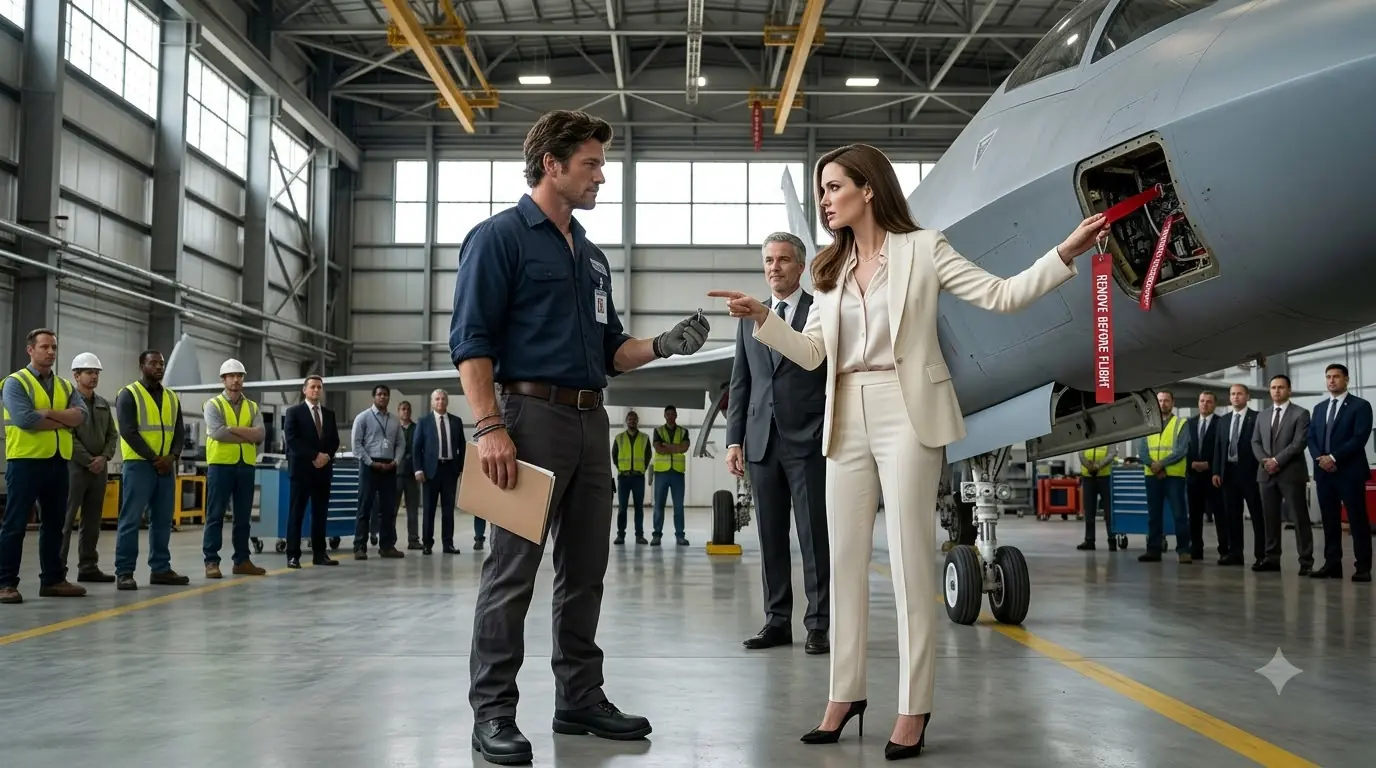
In the aircraft behind Mason, the difference between that bolt and the certified fastener it had replaced was large enough to jeopardize a defense program valued at $1.2 billion.
Cassandra Whitmore saw only the dollar. She stood before the partly assembled A-47 Sentinel reconnaissance aircraft, surrounded by executives, technicians, visiting military representatives, and a handful of journalists invited to witness the company's final qualification tests. The red warning tag Mason had fastened to the tail assembly moved gently in the current of an overhead ventilation fan. Cassandra pointed at it as if the tag itself were the insult. "You're telling me we have stopped a billion-dollar program over a piece of hardware cheaper than breakfast?"
"I'm telling you the part is not approved for this application," Mason answered. His voice carried no challenge, only a fact he had already verified three different ways. He held out a folder containing the photographs, purchase records, and material specifications. Cassandra did not take it. Instead she looked at the faces gathered around her, apparently hoping they would share her disbelief, and asked how a man earning an inspector's salary could presume to overrule an entire executive team.
Mason could have told her he once helped design the assembly she was defending. He could have explained that his own engineering signature appeared on the original reliability specification, written nine years earlier, when the Sentinel existed only as a collection of prototypes and calculations. He could have told her about the nights he had spent rebuilding test plans after the first tail-bracket failure nearly killed the project before it began. He said none of those things, because even if he had been an ordinary inspector without an engineering degree, the part would still have been wrong.
Cassandra reached past him and tore the red tag loose. The rip of the cardboard through its fastening sounded oddly loud beneath the factory lights. "You're finished here, Mr. Rourke. Security can walk you out. We are not going to sacrifice our future to somebody who mistakes stubbornness for expertise."
A few people laughed, but most remained silent. Mason watched the tag fall onto the concrete near her polished shoes, then looked down at the bolt. There was no point in arguing with a person who regarded an inspection as an interruption rather than a protection. He slipped the component into an approved evidence pouch, marked the location and time, signed across the seal, and asked for his safety objection to remain in the official record. Before anyone answered, his access badge stopped working.