The Fake HOA Enforcer Threw a Brick Through His Window — Then Dad Lost Control
Reader Theme:
Font Size:
24px
The Georgia sun hung high over Oakridge Drive like a warm promise. It was one of those lazy afternoons where time seemed to stretch out over the neighborhood like a soft blanket. Lawn mowers buzzed somewhere in the distance. Birds chirped lazily on power lines, and the scent of fresh-cut grass floated in the air.
In the heart of it all stood a modest cream-colored house with a porch swing that creaked gently in the breeze. Inside, Allison Grace, a 30-year-old Black mother with tired eyes and a heart full of love, rocked her newborn son Logan in her arms. The baby was wrapped in a pale blue blanket, his soft brown skin warm against the fabric, his chest rising and falling in soft, rhythmic motions against her shoulder. She hummed something old and familiar, half lullaby, half prayer.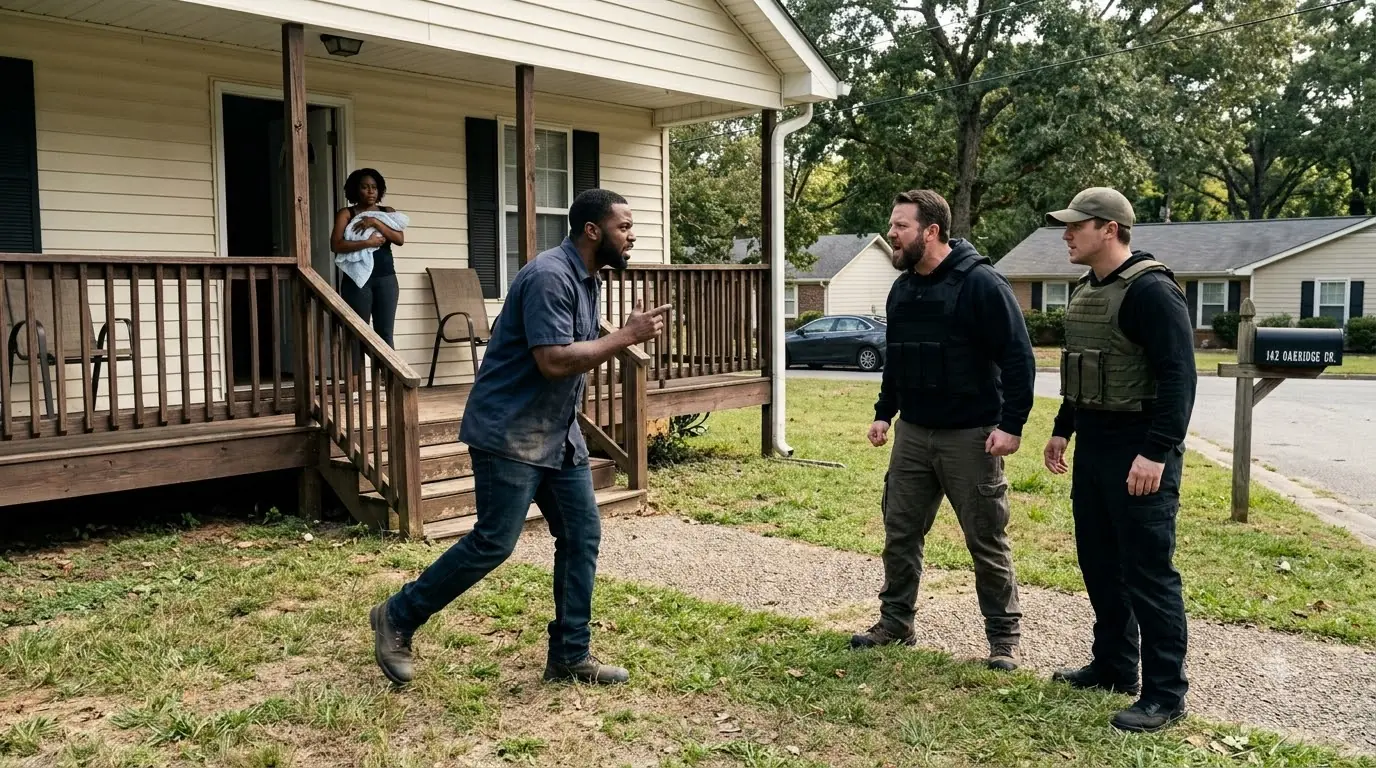
Her husband, Nick, a quiet Black man with weary eyes and a steady presence, had just walked through the door. Dust clung to his boots, and the collar of his work shirt was damp with sweat. He was an electrical engineer, meticulous and quiet, the kind of man who triple-checked every socket and kissed his wife on the forehead before saying a word. He toed off his boots in the foyer, cracked open a bottle of water, and sighed deeply.
They were an ordinary Black family living an ordinary life in a not-so-ordinary neighborhood. Their subdivision was governed by a local HOA, an association that didn't just monitor fences and lawns, but seemed to breathe down the neck of every homeowner. Still, Nick and Allison kept their heads down. They followed the rules, painted their fence when told, paid their dues on time.
They didn't like the HOA, but they didn't challenge it either. That was before the black pickup truck pulled onto the street. It rolled slowly, deliberately, like it owned the road. The words HOA Enforcement Unit were stenciled in block letters on the side.
No sirens, no license plates, no city markings. Just two men in tactical vests and black boots climbing out with stiff, robotic movements. They weren't police, but they moved like they wanted to be. Nick stepped onto the porch with his water bottle in hand, his dark brows drawn into a tight frown.
"Hey," he called out. "What are you doing on our lawn? We haven't broken any rules." The taller of the two men glanced back at his partner and muttered something.
Then he walked to the rear of the truck, lifted the tailgate, and pulled something heavy from the bed. Allison had stepped outside now, cradling Logan against her chest, the baby's tiny hand gripping the collar of her shirt. "You can't just walk onto our property," she said, her voice trembling. "We didn't authorize any inspection." And that's when it happened. The man with the square jaw and cold stare suddenly turned, raised his arm, and hurled a brick straight at the living room window. The glass shattered with a thunderous crack. Nick dropped the bottle, his arms reaching out instinctively, but too late.
The brick struck Logan. It hit the baby's head with a dull sickening thud before falling to the hardwood floor. The world froze. Allison didn't scream, not at first.
She dropped to her knees like her legs had forgotten how to stand. Logan's body was limp in her arms. Blood smeared across her sleeve, and her mouth formed words, but no sound came. Nick rushed to them, eyes wide in disbelief, hands shaking as he reached for his family.
The two men jumped back into the truck and peeled away, tires squealing, disappearing around the corner before anyone could get a license number. Then came the scream. Raw, endless. Allison rocked back and forth with Logan still pressed to her chest.
Nick fumbled with his phone, his fingers clumsy and soaked in fear. The 911 operator's voice was calm, but nothing felt calm in that moment. The ambulance took 23 minutes. By the time they arrived, Logan was still breathing.
Barely. But he was alive. The emergency room smelled like disinfectant and fear. Everything looked clean, too clean, as if the white walls and shiny floors were trying to erase what had just happened.
But the metallic scent of blood clung stubbornly to Allison's sweater and the sharp tang of shattered glass lingered in her nostrils. She sat stiffly in one of the cold plastic chairs, her arms wrapped tightly around herself, rocking slightly. Her eyes didn't blink much. Her lips moved, barely whispering fragments of old prayers, the kind handed down through generations, not for peace, but for strength.
Nick paced the hallway in slow, tight circles. He hadn't spoken in a while. In his hand he held a jagged chunk of brick, the same one that had torn through their window and struck their son. It was still stained near the edge.
He didn't know why he held onto it. Maybe he needed to. Maybe he wasn't ready to let it go. Detective Jared Wells stood nearby, leaning against the reception desk with the tired posture of a man who'd seen too much.
He looked to be in his early 40s, with creases under his eyes and a badge clipped casually to his belt. His notebook was open, but his expression was unreadable. He cleared his throat. "You said the men were from the HOA?
" he asked, pen hovering above the paper. Allison's head snapped up. "No," she said sharply. "They were not officers. They were wearing fake tactical gear. No name tags, no identification. They didn't speak like professionals. They spoke like people who came to send a message." Her voice trembled at the end. Wells nodded slightly and scribbled a few lines. "Unfortunately," he said, "HOA groups aren't official law enforcement. They're private organizations.
Some have their own enforcement arms, sure, but they don't have the same oversight. A few even contract third-party security. It's messy." Nick stopped pacing.
"They threw a brick," he said quietly, then louder, "They threw a brick at my child. They didn't ask questions. They didn't show paperwork. They attacked." His hand gripped the brick tighter. Wells sighed. "Mistaken identity happens. Wrong address, overreaction.
It's not always malicious intent." Nick stepped closer. "You call this a mistake?" His voice cracked as he pointed at the red-stained brick.
"This isn't a wrong address. This is a message, and it nearly ended my son's life." The detective looked down, avoiding eye contact. "If your son pulls through, you can pursue a civil case.
Damages, liability, maybe negligence. But a criminal investigation? That's harder to build without direct evidence." He closed his notebook with a quiet snap.
Allison didn't answer. She stared at the floor, still rocking. Her lips moved, but no words came now. The television in the waiting room played some cheerful segment about a local festival.
Nothing about Oakridge Drive. Nothing about what happened to Logan. No updates, no alerts. Silence.
Late that night, the HOA's official website posted a single line of text. "We regret the misunderstanding on Oakridge Drive. An internal investigation is underway." That was it.
No mention of Allison, no apology, no responsibility. Just sterile distance. Nick didn't sleep that night. At 4:12 a.m., he sat in the kitchen, laptop open, the screen lighting his face in the dark.
He'd worked in electrical systems long enough to understand digital infrastructure. The HOA website wasn't secure. It took less than an hour. He bypassed their basic protections and found their internal communications.
Dozens of emails, dozens of familiar names. But one name kept showing up over and over, Kelly Mason, HOA president. In message after message, she referenced their house, "unapproved construction in the rear, unresponsive homeowners, no cooperation from the city. " And then, in a single email dated three days before the attack, the line that made Nick go still.
"If the city won't do it, we will." Footsteps approached. He didn't turn. Allison appeared in the doorway, wrapped in a blanket, eyes hollow and red.
She looked at the screen, then at him. "She sent them," she said softly. "She gave the order. To our baby." Nick turned the screen so she could read it for herself. The diagnosis came late in the night. Logan had suffered a traumatic brain injury with internal bleeding. The doctors were cautious, their words measured.
He was stable but critical, under constant observation in the pediatric ICU. Tubes ran across his tiny body. Machines beeped softly beside him. Allison never left his side.
She sat in the rigid hospital chair like it was her new home. One hand wrapped around Logan's fingers, the other clutching a blanket that still smelled like their living room. Her world had shrunk to that room. That bed.
That moment. Everything else could wait. Nick didn't cry. He didn't shout.
Instead, he went quiet in a way that didn't feel like grief. It felt like calculation. Something inside him shifted, hardened. His eyes lost their softness.
"They're not walking away from this." He whispered to Allison. "I swear to you, none of them are walking away." By the following morning, he had already taken steps.
He contacted a friend from his college days, someone who now worked in data and analytics for a satellite imaging firm. Within hours, he had overhead snapshots of their block from the past 72 hours. He cross-referenced the timestamps with traffic footage from the county's street cameras. Frame by frame, he tracked the black pickup as it rolled into the neighborhood and left minutes later.
The license plate was covered, but not completely. A few digits were visible enough to match. The truck was registered to Dave Thompson, a former security guard with a record of misconduct, fired after a physical altercation with a teenager, now living in a small house two towns over. Nick didn't stop there.
He dug deeper and uncovered a second name: Ken Rudolph. No job, living out of a trailer near the edge of the county with a misdemeanor on file for assault. Nick compiled the information into a digital file, photos, documents, addresses, everything meticulously labeled. He wasn't just angry, he was focused.
Every step was deliberate. He contacted a civil rights attorney known for lawsuits against aggressive HOA boards. He handed over the evidence, then he sent a copy to a local journalist. But the story didn't spread, no headlines, no breaking news.
HOA boards had influence. And Kelly Mason, the president of their HOA, sat on the city planning committee. Nick realized the truth wasn't enough on its own. Not in a place where silence was easier than change.
Allison didn't say much. She hadn't spoken more than a few words at a time since the night in the ER, but her silence wasn't hollow. It was dense, heavy. It carried more than sorrow.
It carried resolve. She watched the monitors, held Logan's hand, waited. Then, on the third day, something changed. Logan's fingers twitched.
His eyelids fluttered. Slowly, unsteadily, his eyes opened. Not fully, just enough. Just enough to know he was still there, still fighting.
Allison leaned over him, tears sliding down her face for the first time since it all began. She pressed her forehead to his and exhaled a single word. Hey. Nick stood in the doorway, watching.
Allison turned, walked straight to him, and said quietly, but firmly, "We're going all the way." On the sixth day after the attack, Nick's phone rang just after sunrise. The number was unfamiliar. The voice on the other end calm and precise.
"Mr. Grace, this is Agent Donnelly with the Federal Civil Oversight Division. We've received the files you submitted. What you're describing goes well beyond a civil matter.
A homeowners association acting as an armed enforcement group? That's a federal concern." Nick stood up straighter, the fatigue in his shoulders lifting for the first time in a week. He stepped out into the hospital corridor, heart racing, not with fear this time, but something sharper.
"What do you need from me? " he asked. "Everything," the agent replied. "Names, photos, screenshots, messages, any digital trail, every document you got.
We're opening an investigation." Nick didn't hesitate. He went straight back to the laptop he kept beside Logan's hospital bed and began organizing the evidence into folders, his hands finally moving with purpose again. Every piece of data now had a destination.
Every name on his list would soon be under review by a federal team. And for the first time, this didn't feel like a fight they were losing. While Nick built his case from digital ashes, Allison took a different path. She began reaching out through forums and local support groups, spaces where mothers gathered to share the stories no one else would publish.
She wasn't looking for sympathy. She was looking for patterns. Within days, she found them. Four separate families from three nearby counties had reported eerily similar incidents over the past two years.
In one, a boy had collapsed from fear after two HOA officers cornered him for riding a scooter on a sidewalk they claimed was restricted. In another, a child was pulled off his bike and interrogated for playing without a visible name tag. The parents had filed complaints, but each time the situation had been quietly resolved. No charges, no news stories, no justice.
Just silence. Sealed with waivers and payouts. Allison compiled the testimonies. She didn't ask the families for anything they didn't want to give.
But the more she read, the more the silence around HOA enforcement felt coordinated, like a curtain drawn over the same act again and again. Meanwhile, Kelly Mason said nothing publicly. But inside city meetings and backroom phone calls, she began to show signs of strain. Whispers circled that she was worried that someone from her HOA board had spoken out.
The federal eyes now lingered on her emails and calendar invites. Then, on the evening of the seventh day, Allison's phone buzzed. Unknown number. "Ms.
Grace," said the voice on the line, cool, clipped, familiar. "Let's resolve this peacefully. You don't want to stir up more than necessary. There's a lot in the past that's better left alone.
" Allison didn't answer right away. She walked to the hospital window, looking out over the city as lights began to flicker on across rooftops. Her hand tightened around the phone. "You threw a brick at my son," she said calmly.
"He lived, and now you won't." The line went silent. That was the moment it all shifted. The pain was still there, but now it had a direction.
They no longer stood in the ashes of what happened. They stood at the beginning of what came next. Two weeks after the attack, Nick and Allison sat side by side in front of a small camera. The lighting was soft, but clear.
The background plain. A neutral wall inside Logan's hospital room. There were no theatrics, no shouting, just a quiet determination and the truth. The interview aired on a growing YouTube channel run by civil rights advocates who had covered similar cases, but none quite like this.
Allison held up a photo. Logan swaddled in white sheets, a bandage wrapped around his small head. His face pale, but peaceful. She spoke steadily, recounting every detail.
Not with anger, but with clarity. Not just what happened, but what led to it. The policies, the threats, the silence. Nick followed with the digital evidence.
A screenshot of an internal email casually referencing their address. A joke from one of the HOA officers about teaching young parents discipline the old-fashioned way. Then came the audio clip. Kelly Mason's voice unmistakable, clipped and clear.
"If they won't cooperate, then let them learn who runs this place." The video was 22 minutes long. It wasn't flashy, but it hit a nerve. Within three days, it had over a million views.
The comments poured in. Thousands. Raw. Emotional.
Furious. "This isn't a housing issue. This is a federal crime." "Where were the real police when that brick flew through their window?
" "Every mother in America should be standing with Allison Grace." The story spread fast from local Facebook groups to national news outlets. Allison was invited to speak at rallies against HOA overreach. Her voice shook at first, but steadied with each word.
Nick launched a petition to dismantle private HOA enforcement teams. It gained 10,000 signatures in less than a week. By the end of the month, morning news shows were reciting Logan's name. State senators made statements.
One even called for an official audit of all local HOA units acting beyond their bounds. The country was listening. But just when it felt like the tide was turning, something shifted. It was early morning when the knock came.
Not a bang, just a firm, deliberate knock. Allison opened the door and found three officers from the local police department standing on their porch. Real uniforms, real badges. "We received an anonymous tip," one of them said, "Allegations of unregistered weapons inside the home." Nick appeared behind her. His voice was calm. "We don't have any weapons." "We still need to check," the officer replied, "Standard procedure." They let them in. They had nothing to hide, but Allison stood motionless as they walked past her into the living room. She watched their movements, not with fear, but with clarity. This wasn't about safety.
It was about pressure. When the officers left with nothing to report, Allison let out a quiet laugh. It wasn't amused. It was tired, resigned, sharp.
"She's trying to scare us," she said, glancing at Nick. "Kelly knows she's losing." Nick didn't respond. He just nodded and walked back to his desk, opening his laptop.
There was still more work to do. The investigation gained momentum. Federal agents officially launched a probe into the operations of the Fulton County HOA. What began as one family's story quickly unraveled into something much wider.
Dozens of anonymous complaints surfaced. Reports of intimidation, forced inspections, unannounced raids, and even destruction of property. For years, people had remained silent, too afraid to speak up or convinced that no one would listen. But now, the silence was breaking.
Documents were collected, testimonies gathered. Some residents had saved letters, threatening notices with no legal weight, but plenty of fear behind them. Others had phone recordings, voicemails left by HOA enforcers warning them about everything from their lawn height to the color of their door. The evidence painted a picture not of neighborhood management, but of control.
In response, Kelly Mason stepped forward with a public statement. Standing at a polished podium in front of HOA headquarters, she spoke clearly and confidently. "The Grace family," she said, "is engaging in an effort to destabilize our community and undermine private governance. Their actions risk dismantling years of cooperative work among residents." But it was too late for speeches. The community had already made up its mind. At the next town hall meeting, Allison walked in holding Logan, now out of the hospital, and wrapped gently in a soft blue blanket. The room was full.
Residents stood and applauded. The sound echoed not with noise, but with meaning. "You are our voice now," said an elderly woman in the front row, her hands clasped over her heart. "You showed us what they've been doing to us all these years." When Kelly Mason took the floor minutes later, the atmosphere shifted. Her usual composure cracked as voices rose from the crowd. "Murderer! " "You threw a brick at a baby!" The room grew tense. Kelly tried to speak again, but the words drowned beneath the wave of voices. This time, the town wasn't afraid to talk back. Meanwhile, Nick secured a meeting with the district attorney.
He brought everything, emails, financial records, photographs, even purchase receipts showing that tactical gear for the so-called HOA officers had been bought using a private fund overseen by Kelly herself. The district attorney didn't hesitate. Formal charges were filed within the week. They included unlawful use of force, creation of an unauthorized paramilitary unit, attempted destruction of evidence, and obstruction of a federal investigation.
The case moved forward quickly. Given the scale and nature of the allegations, prosecutors requested special legal status for Nick and Allison as victims of targeted aggression. This granted them the right to attend every hearing, view submitted evidence, and deliver impact statements during sentencing. They weren't just names on a file; they were recognized.
And this time, the system didn't look away. In court, Kelly Mason no longer looked like the polished figure from press conferences and community events. The usual confidence in her expression was gone. Her hair hung limp at her shoulders, her blazer slightly wrinkled.
The sharpness in her eyes had been replaced by something duller, worry, perhaps fear. She sat quietly at the defense table, hands clasped, as the courtroom filled with quiet anticipation. Nick and Allison took the stand separately. Their voices were calm, unwavering.
They didn't embellish. They didn't dramatize. They spoke in measured, steady tones, recounting the events exactly as they lived them. The brick, the silence, the recovery, the evidence.
There were no outbursts, no emotion for show. But their words carried weight. They were no longer just a story online. They were a case in a court of law.
The prosecution presented its findings, financial records linking HOA funds directly to the purchase of tactical gear. Text messages exchanged between enforcement members, voice recordings, and photos that had been circulated privately, some even joking about discipline. It all came together like pieces in a clear puzzle. During the proceedings, news broke that Dave Thompson and Ken Rudolph had attempted to flee the state.
One was stopped at a rest stop in Alabama with weapons in his trunk. The other was found in Tennessee using false identification. Their arrests were presented as part of the case, proof that this was not just about poor decisions, but a pattern of calculated avoidance. The jury deliberated for less than two hours.
When they returned, the verdict was unanimous, guilty on all counts. Kelly's team attempted one last move. They offered a plea deal, three years probation, no prison time. The courtroom held its breath as the judge reviewed the motion.
Then he spoke, his voice firm and echoing through the chamber. "You orchestrated an act of violence under the guise of authority." "You directed others to act, then hid behind bureaucracy. You let a child be harmed.
You are not just a threat to one family, you are a danger to the fabric of civil society." He denied the deal. Sentencing was immediate, 10 years in federal custody, no early release, no parole. As the gavel struck, the courtroom exhaled.
It was not celebration; it was resolution. Outside, cameras flashed as reporters clustered by the steps. One turned to Allison with a microphone, voice eager for a headline. "What do you feel right now?" the reporter asked. Allison glanced at Nick before answering. Her voice was quiet, but certain. "Peace," she said, then paused.
"And the strength to build something better." Then she turned, took her husband's hand, and walked forward. Not away from the past, but toward something finally within reach. Spring arrived slowly, but when it did, it brought more than warm air and green lawns.
It brought quiet. It brought healing. In the backyard of the Grace family home, Nick had spent a weekend building a wooden swing set by hand. It wasn't perfect.
Some boards sat at uneven angles, and the paintbrush strokes were a little thick in places, but it stood strong. On it, Logan laughed. The scar on his temple was faint now, a thin line just above his brow, but it held the weight of everything that came before. Every time Allison pushed the swing and he soared just a little higher, he laughed louder, and the sound filled the air like sunlight.
Neighbors began to stop by more often. Some brought casseroles, others left cards in the mailbox. A few said nothing, just gave a knowing nod across the fence. And one, a retired art teacher, spray-painted a mural on the old HOA office wall before it was boarded shut.
In bold, looping letters, it read, "This time, the brick came back." The message spread. Nick and Allison, once private people, a Black couple who had been forced into the public eye by pain, filed a formal petition for the full dissolution of the local HOA. What had seemed impossible months earlier was now a public movement.
Signatures poured in. Community meetings filled beyond capacity. The momentum was real. Six months later, the county held a referendum.
The turnout was historic. The result, the HOA was disbanded. But Nick and Allison didn't stop there. They knew this wasn't just about one neighborhood.
It wasn't just about one child, one brick, or one woman in a blazer. They launched a nonprofit dedicated to supporting families affected by HOA-related harassment and abuse of power. They built a website, a helpline, and a series of short videos telling their story and encouraging others to come forward. In the first video, Allison sat in a simple chair, speaking directly into the camera.
"No association," she said, "should ever be allowed to stand above the law. If it happens once, it can happen again. But if we speak together, loudly, clearly, maybe it never has to." Their story reached beyond their town.
Across the country, other families began to share their own experiences. Stories poured in, letters, emails, videos. A network began to form, a new kind of community. One built not on fear, but on accountability.
And yet, for Nick and Allison, it always came back to something smaller. Backyard afternoons, Logan's laughter, the wooden swing swaying gently in the breeze. Because the story didn't start with a movement. It started with a brick.
And a boy who survived it. Because truth, spoken clearly, shared without fear, is its own kind of force. Especially when it hits exactly where it should.
END
News in the same category
The Black Belt Shoved the Limping Handyman — Then He Stood Back Up
The Black Belt Shoved the Limping Handyman — Then Kept Mocking Him
He Caught the HOA President Beside His Internet Line
She Blocked His Rolls-Royce and Started Yelling
He Humiliated the New Officer in Front of Everyone
NEXT MOVIE: A Black Belt Publicly Humiliated the New Bus Driver — Then the Entire Depot Went Silent
A Cop Soaked a Black Woman in Her Own Yard — Then She Pulled Out Her Badge
A Black Belt Mocked the Quiet New Bus Driver — He Had No Idea Who He Was Challenging
NEXT : Karen's Spoiled Son Vandalized My Lamborghini — He Picked the Wrong Owner
CHAPTER2: Karen's Spoiled Son Vandalized My Lamborghini — He Picked the Wrong Owner
A Black Belt Mocked the Quiet New Bus Driver — He Had No Idea Who He Was Challenging
A Cocky Black Belt Bullied the New Bus Driver — Then Everything Changed
CHAPTER 2: A Cocky Black Belt Bullied the New Bus Driver — Then Everything Changed
CHAPTER 3: A Cocky Black Belt Bullied the New Bus Driver — Then Everything Changed
Black CEO Steps Into His Daughter’s School Cafeteria — Then One Sentence Makes Him Freeze
A Cocky Black Belt Mocked the Quiet Farmer Before Their Bet — Then His Hidden Past Changed Everything
Black CEO Quietly Enters His Daughter’s School Cafeteria — The First Words He Hears Change Everything
Old Black Mechanic Stops to Help 12 People in the Pouring Rain — Their Return Leaves Him Speechless