A faded flannel shirt, scuffed work boots, and a quiet apology murmured
to a stranger who just shoved him. To the casual observer, it is the
textbook posture of a pushover. The arrogant loudmouth who threw the
shove thinks the exact same thing, puffing out his chest for an audience
of laughing onlookers. What nobody in the bustling fairground realizes
is that the unassuming father wiping lemonade off his daughter’s
sneakers spent a decade clearing rooms in some of the most violent
combat zones on earth. The loudest man in the room is rarely the most
dangerous.
The truly lethal man is the one praying he doesn’t have to hurt you. The
heat radiating off the asphalt was oppressive, a suffocating physical
weight that smelled of diesel exhaust, boiling fryer grease, and melting
sugar. It was the kind of sweltering dead air Saturday afternoon that
made tempers run short and patience evaporate before it even formed. The
county fairgrounds were packed shoulder-to-shoulder, a writhing sea of
damp T-shirts and sunburned necks. Over blown-out PA speakers, a tinny
country song fought a losing battle against the mechanical shrieks of
the Tilt-A-Whirl and the barkers working the midway games.
Philip adjusted the brim of his faded ball cap, pulling it lower over
his eyes, and shifted his weight. His left knee ground with a dull,
familiar ache. It always flared up when the barometric pressure dropped
or the humidity spiked, a permanent souvenir from a bad hard landing
outside of Kandahar a lifetime ago. The doctors at the VA had offered
him a plastic bottle of muscle relaxers and a glossy pamphlet on joint
health. Philip had thrown both in the trash can outside the pharmacy.
He didn’t want the chemical numbness. He needed to feel the ground under
his feet. He needed to know his body was still answering to him, even if
it complained about it. He looked down. A small hand, impossibly warm
and sticky with the sugary remnants of a melted cherry popsicle,
tightened around his calloused index finger.
“Dad, can we get the blue one?” “The guy said the blue cotton candy
tastes like raspberries, but I think it tastes like the sky.” Juliettete
looked up at him. Her 7-year-old face was flushed red from the
oppressive heat, a smear of chocolate at the corner of her mouth, her
hair escaping in damp wisps from a haphazard ponytail. She was missing a
front tooth, a recent casualty of an ill-advised jump off the living
room sofa, and her smile was a lopsided crescent of pure, unadulterated
trust. Philip’s chest tightened. It was a sharp, involuntary physical
reaction, the way it always hit him when she looked at him with absolute
faith.
“Yeah, bug, we can get the blue one. Whatever you want.” He didn’t look
like much. To the casual observer brushing past him in the throng of
sweaty fairgoers, Philip was completely invisible. He was just another
tired father in a faded, rolled-up flannel shirt, worn Levi’s, and heavy
work boots that had seen too many concrete floors. He held his shoulders
in a slight slump, intentionally minimizing his frame.
He kept his eyes downcast in crowds. He moved with a slow, deliberate
shuffle that screamed of 50-hour weeks loading pallets at the regional
distribution center. He looked exactly like a guy who just wanted to go
home, turn on a fan, and drink a cheap beer on a quiet porch. And he
was. Now, but old habits are etched into bone, and the neural pathways
in Philip’s brain had been permanently rewired by 10 years in naval
special warfare.
You don’t just turn off the scan. You don’t unlearn how to read a room.
As they walked toward the concession stands, Philip’s eyes were tracking
everything. It wasn’t paranoia. It was an ingrained mechanical baseline
check operating beneath his conscious thought.
A balloon popped at a nearby dart game with the sharp, flat crack of
small arms fire. The teenager next to Philip jumped. Philip didn’t even
blink. His pulse didn’t elevate. Instead, his eyes automatically mapped
the four viable exits in the immediate vicinity.
He clocked the agitated, red-faced teenager aggressively arguing with
his girlfriend by the ring toss game, noting the kids’ clenched fists
and elevated shoulders. He registered the distance to the nearest
concrete barrier just in case a vehicle breached the flimsy perimeter
fencing. He noticed a heavy-set man in an oversized windbreaker sweating
entirely too much for a guy just standing still. For a fraction of a
second, Philip’s brain categorized the bulky, square shape under the
man’s jacket as a concealed holster. Then, analyzing the man’s sluggish
gait and the plastic tubing peeking out from his waistband, Philip
reclassified him.
A harmless diabetic with an insulin pump, not a threat. He processed
this entire threat matrix in fractions of a second, breathing slow,
steady, controlled breaths. He was a dangerous man trying desperately,
exhaustingly to play the role of an ordinary one. Since his wife passed
away 3 years ago, Juliettete was his entire world. Sarah’s death hadn’t
been loud or violent.
It was a quiet, ruthless, agonizing battle with cancer. It was an enemy
Philip couldn’t track, couldn’t shoot, couldn’t physically dismantle to
save her. When she died, it broke him in a way war never could. Without
Juliettete, he knew he would have drifted back to the private military
circuit, back to the dusty, blood-soaked expanses of the Middle East,
back to the only language he was truly fluent in. But Juliettete needed
a dad.
She needed Saturday afternoons at the fair, sticky fingers, blue cotton
candy, and the fragile illusion that the world was a safe, bright place.
Philip was determined to provide that illusion, even if he had to
swallow his own instincts and choke down his past to do it. They stepped
out of the glaring sun and into the relative shade of a wide striped
awning. The line for the lemonade and sugar spun treats was thick, a
disorganized mass of impatient people. Philip gently guided Juliette to
stand directly in front of him.
He squared his shoulders just a fraction, naturally creating a physical,
immovable barrier between his daughter’s small frame and the crushing,
unpredictable press of the crowd. He stood at relaxed readiness, his
hands hanging loosely at his sides, breathing in the scent of fried
dough, waiting for his turn. He just wanted a quiet afternoon. The
universe, unfortunately, rarely respects what quiet men want. Grant was
having a phenomenal week, and he desperately needed everyone in a
10-mile radius to know it.
Three nights ago, he had won the main event at Valley Brawl, a regional
mixed martial arts promotion held in the back room of a failing casino.
Grant had knocked out a 35-year-old plumber in the second round with a
sloppy overhand right. It wasn’t pretty, and the technique was garbage,
but the referee raised his hand, and Grant was given a plastic belt
painted to look like gold. To Grant, this victory was empirical proof
that he was a god among men. He was 24, built like a fire hydrant, and
fueled entirely by cheap energy drinks, gas station supplements, and a
fragile, toxic ego.
He wore a skin-tight black rash guard that showcased his heavily
tattooed biceps, mostly tribal bands and aggressive skulls, paired with
expensive designer athletic shorts and pristine white sneakers. He
walked with a wide rolling swagger, his lats flared out, forcing people
to step out of his path. He wasn’t alone. He had an entourage. His
girlfriend Amber clung to his left arm, chewing gum loudly and scrolling
through her phone.
On his right were Kyle and Justin, two sycophants who trailed behind him
like pilot fish, laughing entirely too hard at his jokes and carrying
his customized “I’m telling you, bro.” Grant said loudly, ensuring his
voice carried over the din of the fair. “If the UFC doesn’t call by
December, they’re cowards. Did you see the way his eyes rolled back? I
possess lethal power, man. Lethal.” “Total knockout, bro.
You destroyed him. ” Kyle chimed in, dodging a passing stroller. Grant
fed on the validation. He needed an audience. He needed the world to
recognize the alpha male walking among them. He was hopped up on
residual adrenaline and the desperate need to assert dominance over a
crowd of farmers, mechanics, and tired parents.
They were cutting straight through the midway, ignoring the unwritten
rules of traffic flow. Grant didn’t veer. He didn’t yield. If you were
in his way, you moved. It was a simple arrogant geometry.
Up ahead, the line for the concession stand spilled out into the main
thoroughfare. Juliette was vibrating with excitement. The man in the
apron was spinning a massive cloud-like web of blue sugar on a paper
cone. “Dad, look how big it is. It’s bigger than my head.” She took a
sudden half step backward out of the line, her eyes wide, pointing at
the confection.
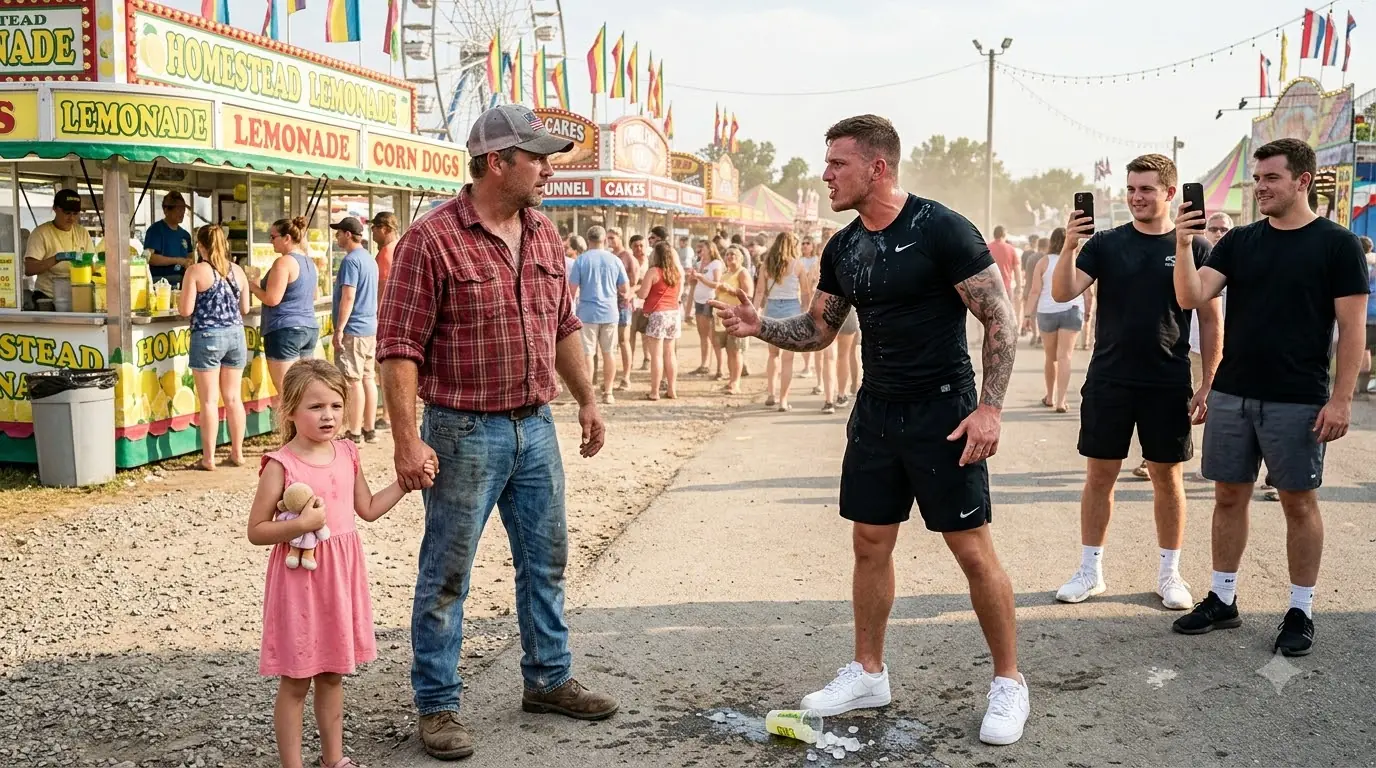
She stepped right into the blind spot of the thoroughfare. Philip saw it
happening a second before it did, but the spacing was too tight. He
reached out to pull her back. Grant was looking over his shoulder,
laughing a joke Justin had just made about a passing teenager. He wasn’t
looking forward.
He was holding a massive 32-oz cup of iced lemonade, the condensation
making the plastic slick. The impact was entirely avoidable, but
inevitable. Grant’s heavy, swaggering frame collided hard with Philip’s
left shoulder as Philip leaned down to grab his daughter. The force of
the collision was jarring. Grant stumbled.
His grip slipped. The plastic cup crushed in his hand. The lid popped
off like a gunshot. 32 oz of freezing, sticky, neon yellow lemonade
exploded across Grant’s chest, splashing violently down his rash guard,
and completely soaking his pristine $400 white sneakers. The world
seemed to stop spinning for a fraction of a second.
The loud hum of the fairgrounds muted. People in the immediate vicinity
turned their heads. Grant stood frozen, looking down at his ruined
shoes. A dark, ugly red flush began to creep up his thick neck, staining
his cheeks. The humiliation was instantaneous.
And for a man whose entire identity was built on looking tough in front
of an audience, humiliation was the equivalent of a physical attack.
Philip didn’t look at Grant right away. His only concern was Juliettete.
He knelt instantly, checking her. A splash of lemonade had caught the
hem of her shorts, but she wasn’t knocked over.
She was just startled, her eyes darting between her father and the
towering, angry man next to them. “You okay, bug?” Philip asked softly.
She nodded, shrinking back against his leg. Philip stood up slowly. He
kept his hands open, palms facing outward, held at waist height.
It was universal body language for surrender, for peace. The
de-escalation posture. “My fault, man.” Philip said. His voice was calm,