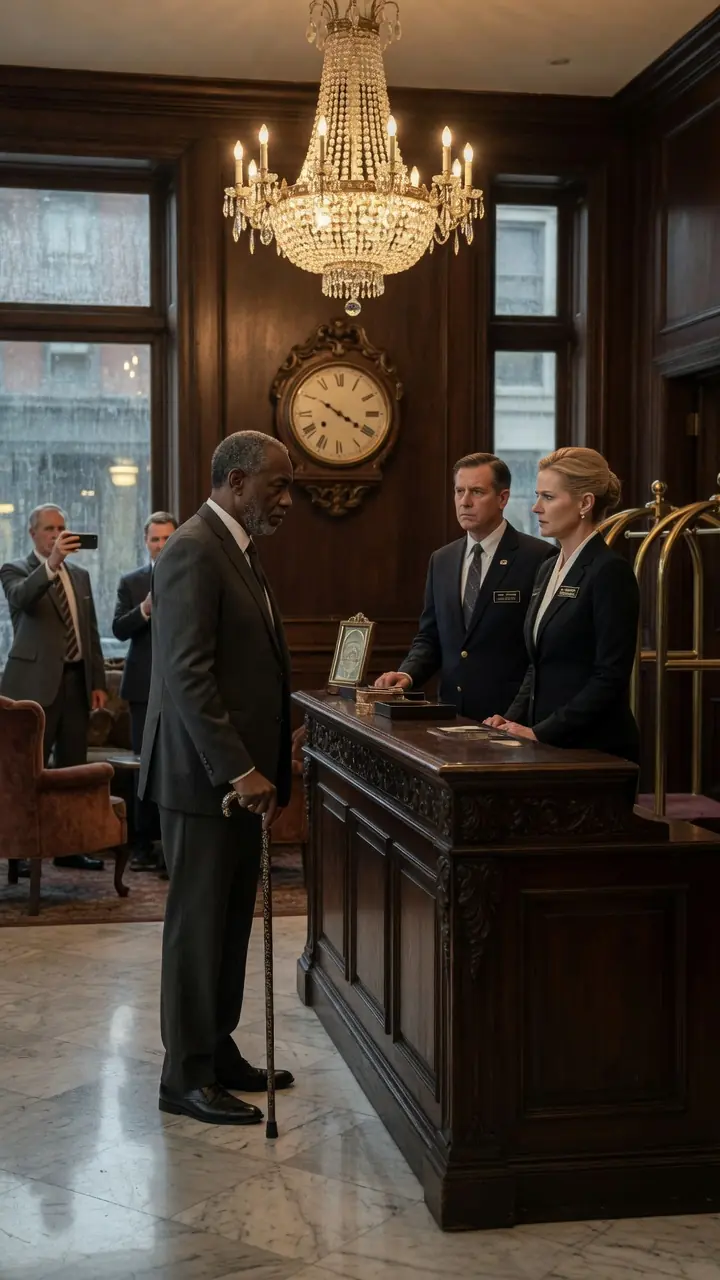
Megan Whitlock, front desk supervisor at the Marlowe Heritage Hotel, looks up from her screen. A crippled Black man like you thinks he belongs in this hotel? Get out! The guest has taken two steps inside.
Bennett Carter, 60-something, Black, charcoal suit, cane in his right hand. Ma'am, I have a reservation. Bennett Carter, four nights. I don't care what your name is.
Out! Megan comes around the desk. She rips the cane from Bennett's grip and kicks it. It skids across the marble and clocks against the brass kick plate.
Bennett Carter goes down to one knee. A second voice, navy blazer, Travis Whitlock, assistant general manager, Megan's husband. Babe, what's going on? This thing wandered in off the street.
A guest lifts a phone. The brass clock ticks. 3:12. In 12 minutes, security will walk Megan and Travis Whitlock out of this lobby.
The man who opens the door for them shares Bennett's last name. 3 hours earlier, Bennett Carter is on Interstate 26, driving in from Columbia. The wipers move once every 4 seconds. Rain has been falling since Orangeburg.
On the passenger seat is a folded charcoal suit, a small leather case for the cane, and a sealed white envelope with a name written on it in his own handwriting. The name on the envelope is Caleb. Bennett is 58, retired army combat engineer, 22 years. The cane is from Anbar province, 2006.
The engraving near the grip reads, "B. Carter ENG BN Anbar '06. " He runs his thumb across that line about once a week. He has done so for 19 years.
The suit is for his daughter Hannah's rehearsal dinner tomorrow night. Hannah Carter, 27, his daughter from his second marriage. The envelope is 3 months in the writing. He has not been able to finish the last paragraph.
His phone rings on speaker. Daddy? Are you driving? Hands at 10:00 and 2:00.
Good. Listen. He said yes. He said yes to what?
Drinks. Tonight, after you check-in. He'll come to your hotel. Bennett does not answer for a moment.
The wipers move once, twice. You told him which hotel? I told him yours. Daddy, he runs the place.
Of course he knows. Hannah, he's been the GM at the Marlowe for five months. I thought you knew. He had not known.
He had thought he was checking into a quiet downtown hotel for four nights, walking his daughter down the aisle on Saturday, and slipping the envelope into a coat pocket somewhere between the rehearsal and the toast. He had not thought he was checking into his own son's lobby. The son he has not spoken to face-to-face in 12 years. Caleb Carter is 34, Black like his father, raised by his late mother in Boston after the divorce.
He carries his father's last name because his mother kept it. He has been the general manager of the Marlowe Heritage Hotel since May. He has never put a family photograph in his office. He does not do town halls.
He runs the property out of the back of the third floor and lets the rest of the staff assume the previous general manager, a man named Richard Sterling, is on a long, undefined leave. Caleb has wanted it that way. Megan and Travis Whitlock have worked the front desk and the manager's office, respectively, for 3 years. They have never met Caleb.
Most of the staff have not. There is no photograph anywhere on the property. There has not been one in five months. Bennett turns onto King Street at 2:58.
The valet takes his keys. The bellman lifts his bag from the trunk. Bennett tips him an extra $5 because of the rain. The bellman thanks him by name from the luggage tag and walks ahead to hold the door.
Bennett steps inside. The lobby smells of orange oil cleaner and old cedar. A brass clock above the front desk ticks. The marble is polished to a wet shine.
A housekeeping cart rolls quietly down the corridor. It is pushed by a woman in her early 50s named Cassandra Reed, who has worked at the Marlowe for 11 years and has, as of this morning, kept a thumb drive in her apron pocket for 6 months. Bennett does not see her. She sees him.
She has seen this before with other guests who looked like Bennett or moved like him or both. She slows the cart. She does not look away. He takes one step.
He takes a second. 3:12 on the brass clock. Megan Whitlock looks up from her screen. The kick has already happened.
Travis Whitlock takes a position at her shoulder. They look for a moment like a portrait of management. Get up, sir, Travis says. You're embarrassing the lobby.
Bennett does not get up. He puts one palm flat on the marble. He breathes out once through his nose. He looks for the first time at the cane lying against the brass kick plate.
He looks at the engraving near the grip. He runs his thumb across the line, B. Carter ENG BN Anbar '06. The way a man checks that a wound is still where it was.
Then he picks the cane up. He places it back against the front of the counter. Exactly where it was when she kicked it. He stands.
He does not lean. "Ma'am," Bennett says, "I would like to speak to your general manager, please. " Megan laughs. It is a dry, short sound.
"Honey, I am the supervisor on duty. He is the manager on property. Mr. Sterling is out of town until Monday.
There is no one above us in this building this afternoon. Do you understand? " "You said Mr. Sterling.
" "I said Mr. Sterling. Richard Sterling, the general manager. " "Ma'am, Richard Sterling has not been the general manager of this hotel for five months.
" A small pause. Just half a beat. Megan does not know this. Travis does.
The pause belongs to him. "Sir," Travis says, "I don't know where you're getting your information, but I'm getting it from your company website, heritagehospitality.com/leadership, updated in May. " "Sir, the website is not always— I would like to speak to your current general manager, please. " A second guest has lifted a second phone.
The first live stream has 11 viewers. The second has six. Cassandra Reed in the corridor has stopped pushing her cart. She is not pretending to push it.
She is simply standing there. Bennett pulls his own phone from his inside jacket pocket. He dials a number printed on the back of his reservation confirmation. He puts the call on speaker because he wants the lobby to hear it.
Heritage Hospitality Group guest relations after hours line, how may I assist? My name is Bennett Carter. I am a prepaid four-night guest at your Marlowe Heritage Hotel in Charleston. The supervisor at the front desk has just kicked my mobility cane out of my hand.
I would like to file an incident report and speak to a regional director. The line is quiet for 2 seconds. Sir, can you confirm the property name and your reservation number? He confirms it.
He reads it off his phone screen, slowly, loud enough for the brass clock to hear. The operator says, I am required to escalate this. Please hold. Travis Whitlock very quietly picks up the desk phone and pretends to answer a call that is not ringing.
Megan looks at her husband. Megan does not yet know what her husband is doing. Travis is buying time. He believes he has 3 hours.
He is wrong. The hold music starts. It is a recording of a brass clock recorded 3 years ago in this lobby counting itself. The brass clock above the front desk ticks beside the brass clock recorded inside the phone and for one moment in this lobby, time is being kept by two clocks at once.
The hold music plays. The lobby listens. Travis lowers his fake phone call. He leans toward Megan and speaks behind his hand.
Babe. What? Did you kick a man's cane in front of two cell phones? He was Did you kick a man's cane in front of two cell phones?
Travis. Look at him. I am looking at him. He's the one with the lawyer voice and a federal hotline on speaker.
We have a problem. Megan Whitlock is the daughter of a Marlow general manager from the 1990s. She has worked the front desk for 3 years. She has 31 prior complaints in the internal log over 23 months of which 19 were filed by Black guests, disabled guests, or guests who were both.
12 of those entries have been edited after submission. Every single edit was made on her husband's login. She does not know any of this is about to come out. She does not know any of it has been preserved.
She does not know that a housekeeper she has never spoken a kind word to has 6 months of original lobby footage in an apron pocket 15 feet away. Travis Whitlock is the assistant general manager. He is the one who edited the log entries. He turns his back to Bennett.
He pulls his cell phone. He texts Megan a single line. GM at airport 3 hours. Hold the lobby.
It is a lie. The general manager is not at the airport. The general manager is on Interstate 26 Northbound returning from the airport with a colleague in the passenger seat 8 miles south of the city. Travis knows this because Caleb Carter texted him personally at 1:52 and the message is still on Travis's lock screen.
The hold music stops. A new voice, female, crisp, not friendly. Mr. Carter, this is the regional director for the Heritage Hospitality Group Southeast Region.
I am on a recorded line. I have been listening for the last 90 seconds. I would like the front desk supervisor and the assistant general manager to identify themselves on the record, please. Megan looks at Travis.
Travis looks at the floor. Megan Whitlock, front desk supervisor. Travis Whitlock, assistant general manager. And you are married to each other, correct?
A pause. Yes. Mr. Travis Whitlock, please put me on hold for one minute.
I'm calling the general manager of your property. The line clicks to hold. Travis Whitlock's face does something it has not done in 3 years of work at the Marlowe. It pales.
Megan sees it. Megan does not understand yet what she is seeing. Travis, why is she calling Sterling? She's not calling Sterling.
What? Sterling left in May, Megan. What? He left in May.
There's a new GM. He started in May. I told you in May. You said it was an interim guy.
He's not interim. He's permanent. He's been here five months. Why doesn't anyone know that?
Because he doesn't put pictures up in his office. Because he doesn't do town halls. Because he runs the property out of the back and lets the rest of us think Sterling is on a long vacation. Because that is how he wanted it.
Why? Travis does not answer. The hold music returns. The brass clock recorded in 2022 ticks beside the brass clock ticking now.
Bennett Carter has not said a word for 90 seconds. He is standing very still with the cane in his hand and the phone in his other hand. And he is looking at the front door of the lobby. He is listening for tires on the wet pavement.
Outside a black sedan turns off King Street into the valet lane. Cassandra Reed in the corridor lifts the rag from her cart and folds it once. She has been waiting 6 months for this minute. The hold music stops a second time.
The regional director comes back on. She speaks slowly. She speaks loudly enough for the lobby to hear. Mr.
Travis Whitlock, Mrs. Megan Whitlock, I have the general manager on the other line. I have read him the timestamps. I have played him 15 seconds of the bystander livestream that is currently being shared on a public platform.
I have his decision. The lobby has not had this much silence in it since the Marlowe opened in 1889. Effective immediately, the two of you are to surrender your key cards, your name plates, and your access badges to the senior security officer on duty. You are to leave the property by the front entrance.
You are to have no further contact with hotel systems, guests, or staff pending review. Your general manager will be in the lobby within seven minutes to confirm receipt of this order in person. Megan Whitlock's mouth opens. Wait.
Who is the general manager? The regional director answers in two words. Mr. Carter.
The lobby hears it. The brass clock hears it. Bennett Carter hears it. The only person in the room who looks neither surprised nor confused is the man on the marble with the cane in his hand.
He lifts his eyes. Just an inch. Just enough. The black sedan in the valet lane has stopped.
The driver's door is opening. Caleb Carter, 34, general manager of the Marlowe Heritage Hotel, walks through the front door of his own lobby at 3:21. He is wearing a dark suit. He is carrying nothing in his hands.
He is alone. He does not look at Travis. He does not look at Megan. He does not look at the bellman who has straightened.
He does not look at the two guests with phones who are now live streaming to a combined audience of 1,205 viewers. He looks at his father. He walks the length of the lobby in nine steps. He stops 2 feet from Bennett Carter.
He does not embrace him. He does not say his name. He looks at the cane in his father's hand. He looks at the place on the marble where the cane skidded to a stop 9 minutes earlier.
Then Caleb Carter goes down to one knee in the same spot his father knelt. He kneels there for 1 second. two three The cane is already back in Bennett's grip, so there is nothing for him to pick up. He simply kneels in the place his father knelt in the lobby of his own hotel in front of his own staff and lets the marble register the weight of him. He stands.
He turns to Travis Whitlock. He speaks at a normal volume. The lobby hears every word because the lobby has gone quiet enough to hear a brass clock count down a year. This is my father.
Megan Whitlock makes a small sound. It is not a word. It is the sound a person makes when a floor moves. Travis, Caleb says.
Megan, key cards, name plates, badges to Mr. Foster, now. A man at the door has stepped forward. Gabriel Foster, 49, third shift senior security officer, 1five years on the property, former South Carolina National Guard.
Foster does not draw anything. He does not raise his voice. He extends one open palm. Megan Whitlock surrenders her badge to Gabriel Foster's hand.
Travis Whitlock surrenders his. Caleb Carter walks them personally to the front door. He does not touch them. He does not need to.
Foster walks one step behind. The bellman opens the inner door. The valet on the sidewalk has already stepped away from the sedan that no longer belongs to anyone in the building. Caleb opens the outer door himself.
He opens it outward for them. Megan turns once on the sidewalk. She looks back into the lobby. She looks at Bennett, who is still standing where he stood.
She opens her mouth. She closes it. Travis takes her elbow. They walk.
Caleb Carter stands at the open door for two more seconds. The rain has started again. He does not feel it. Then he turns.
He walks back across the lobby. He stops in front of his father. He does not embrace him. He says quietly, so that only the brass clock and Cassandra Reed can hear, "I'm sorry it took 12 years and a kick to get me to walk across this floor to you.
" Bennett Carter says, just as quietly, "Walk me to the elevator, son. " They walk. Cassandra Reed picks up her rag. She folds it again.
She has been waiting 11 years to fold a rag in this lobby in this particular silence. She does not say anything to anyone. She turns her cart and pushes it back the way it came. By the time she reaches the service corridor, she has already decided what she is going to do with the thumb drive in her apron pocket.
She is going to call her cousin at the Charleston Ledger. At 6:03 the next morning, an attorney named Eleanor Hayes will open her email and find a name she has been waiting 18 months to see. Eleanor Hayes is 44, ADA and civil rights litigator. She practices out of a two-room office on Broad Street with her name on the door and a filing cabinet behind it that has not closed all the way since 2023.
She has been waiting for a Marlow file for a year and a half. She meets Bennett Carter at a coffee shop on King Street the next morning. She does not perform sympathy. She opens a leather binder.
She sets a digital recorder on the table. She asks him to walk through every minute from 3:12 to 3:28 twice. He walks her through it twice. The second time is identical to the first.
She nods. She closes the binder. She says, "You're going to win, Mr. Carter.
The question is who else gets named in the wind? " By the end of the day, she has a federal complaint drafted. By the end of the week, she has subpoenas out for the Marlowe's incident log, the Marlowe's ADA training records, and the Heritage Hospitality Group's vendor agreements with any third-party software provider used at the property level. The incident log comes back on day three.
31 entries name Megan Whitlock as the responding employee in the past 23 months. 12 of those entries have been edited after submission. Every single edit was made on Travis Whitlock's login. The edits soften the language.
Refused service becomes guest declined to comply with policy. Used profanity becomes was assertive. Kicked becomes redirected. Of the 31 complainants, 19 are identified in the log as black, disabled, or both.
Hayes reads the line twice, then she calls Bennett. Mr. Carter, the pattern is on paper. The ADA training records come back on day four.
Both Whitlocks are listed as having completed the chain's required ADA training for the past two years. The third-party vendor that issues the certificates has no record of issuing certificates to either of them. The dates do not match. The signatures do not match.
The course identification numbers, on close inspection, are reused from a different property in Atlanta. Hayes flags this and moves on. On day five, Nora Bishop, 39, investigative reporter for the Charleston Ledger, calls Hayes's office. They divide the work.
Hayes builds the legal case. Bishop builds the public record. On day five, also, Cassandra Reed reaches Bishop through a cousin who delivers linen to the Ledger. Cassandra brings a thumb drive.
The thumb drive contains six months of original lobby footage captured before the property's routine 89-day rotation overwrote the system copies. Cassandra had pulled the spare from a discarded backup unit Travis Whitlock had personally ordered destroyed. The footage is intact. The dates are intact.
The metadata is intact. On the drive, in addition to the footage of Bennett's kick, there are clips of three other incidents at the front desk. A wheelchair user being told the elevator is out of service while two other guests use it. An elderly Black woman being told her credit card has been declined for verification while the card is, in fact, charged.
A father with an autistic son being told the lobby is not appropriate for the child's behavioral situation. In all three clips, the supervisor on the desk is Megan Whitlock. In all three clips, Travis Whitlock arrives within four minutes to back her up. Hayes plays the clips for the lead Doe plaintiff candidates over the course of two days.
By the third day, she has three signed retainer agreements. The eight prior complaint letters surface on day seven. Three from Black veterans, two from wheelchair users, one from a parent traveling with an autistic child, two from elderly Black women traveling alone. All eight have been dispositioned non-actionable by the Marlow's HR department.
The handwriting on six of the eight dispositions matches a signature exemplar in Travis Whitlock's HR file. Bennett Carter, throughout all of this, refuses television. He sits for one print interview with Nora Bishop. He answers exactly the questions she asks.
He says, "I am not the story. The pattern is the story. Please cover the pattern. " Bishop covers the pattern.
Caleb Carter does not strategize with Hayes. He walls himself off from the case on the advice of his own attorney. He authorizes, through the property's compliance officer, full lawful production of internal records. He tells Hayes, in a single email with no greeting and no closing, "Whatever you need that the law lets you have, you get.
I will not be in the room. " Hayes prints the email. She files it. She does not respond.
A phrase begins to appear in the internal email she does receive. Low friction occupancy. It appears in three messages between Travis Whitlock and a regional operations director. None of the recipients can define the phrase on the record when Hayes asks.
None of them say they have ever heard of it before. All of them have used it repeatedly. On day 12, Hayes amends the complaint. She names the Marlowe Heritage Hotel, the Heritage Hospitality Group, and three Doe defendants.
She requests a preliminary injunction restraining the property from using a piece of internal software referred to in the emails as the guest profile optimization tool. She schedules the injunction hearing in federal court for the morning of day 31. Cassandra Reed's hours at the Marlowe are cut to 12 a week the morning after she hands the drive to Bishop. She does not tell anyone.
She comes to work. She wipes the same mirrors. She waits. The Heritage Hospitality Group issues a press release on day 14.
The release praises the diversity and accessibility programs at our flagship Charleston property. It does not mention Bennett Carter by name. It does not mention Caleb Carter at all. It is signed by an executive vice president nobody at the property has ever met.
On the same day, a one-star review of Eleanor Hayes appears on three separate legal rating websites within 11 hours of one another. The reviews use slightly different words. The syntactic fingerprint is identical across all three. The same comma splice appears in each.
The same misspelling of plaintiff. Hayes archives all three. She does not respond. Cassandra Reed, on day 15, receives a written warning at work.
The warning sites unauthorized handling of property equipment. The warning is dated three days before she handed the thumb drive to Nora Bishop. The metadata embedded in the document, however, shows it was created the morning after. Cassandra prints both versions.
She gives them to Hayes. Hayes flags it as exhibit 10. On day 16, Bennett Carter's hotel room door at his backup hotel is knocked on at 11:12 at night. A man in a windbreaker with no name tag and no clipboard claims to be from guest relations.
Bennett does not open the door. He calls Gabriel Foster, who is no longer with the Marlowe as of 2 days ago. Foster calls a sheriff's deputy he served with in the National Guard. The deputy comes within 15 minutes.
The man in the windbreaker has, by then, walked back to a parked car with no plates and driven away. The deputy files an incident report. Hayes files the report. On day 17, an anonymous online effort begins to challenge Bennett Carter's military record.
Within 12 hours, three veteran organizations have published verifications. The records hold. The effort dies inside a day. A separate online effort begins on day 18.
This one suggests, anonymously, that Bennett engineered the entire encounter because his son runs the property. The narrative is sophisticated. It cites timestamps. It cites a daughter's reservation.
It implies coordination. Hayes responds in one filed paragraph. She attaches three timestamps. The first is Hannah Carter's August reservation made when Caleb Carter was not yet the general manager of the Marlowe.
The second is Caleb Carter's text message to Travis at 1:52 on the day of the incident alerting him only that a colleague was being picked up at the airport. No mention of his father. No mention of Bennett. No mention of any guest.
The third is the regional director's call to Caleb at 3:38 after the kick alerting him to an incident at his own property. The sequence is documentary. The smear collapses by the end of the news cycle. Cassandra Reed is suspended pending review on day 19.
She tells Bishop, "I have wiped enough fingerprints off enough mirrors in this building to know what a frame looks like. " Bishop prints the line. Bishop does not edit it. On day 20, Hayes loses a procedural motion to expedite discovery on the parent company emails.
Her face does not change in the courtroom. Outside the courthouse on the steps, she calls her office. She pulls two associates onto the file full-time. The Heritage Hospitality Group's outside counsel issues a one-line statement to the Charleston Ledger on day 21.
Through counsel, the Whitlocks deny the characterization and dispute the chain of custody on the recovered drive. Bishop publishes the statement in full in a column three sidebar. It runs flat. It runs neutral.
It runs exactly as long as Hayes's response in column four which says only, "We look forward to addressing every claim on the record at the preliminary injunction hearing. " Bennett Carter, through all 21 days, has not appeared on television once. He has not spoken to any radio station. He has not posted anything on any platform.
He has gone to his daughter's dress fitting. He has gone to the rehearsal venue's tasting. He has answered the phone twice a day for Hayes. He has answered the phone once an evening for Hannah.
He has not yet answered any of the messages on his phone from Caleb. There are three of them. They have been sitting unread for 19 days. At 11:38 at night on day 21, Caleb Carter knocks three times on a hotel room door across town.
The man inside already knows who it is. The cane is on the desk in Bennett's hotel room, parallel to the edge, the way a ruler sits in a drafting kit. Bennett is 58 years old, and he is sitting in a leased room across town from a hotel that bears his son's name on a leadership page he did not know existed until three weeks ago. He is not sleeping.
He has not slept much in 21 days. His daughter's wedding is in 72 hours. He thinks in a sentence the brass clock above his head will never hear that the easiest thing he has ever done was carry a 60-pound pack across loose sand under fire. The hardest thing is sitting in a hotel room and refusing to disappear.
His phone rings. Eleanor Hayes. Mr. Carter.
We lost the discovery motion on the parent company emails. I heard. It is a procedural setback. It is not a fatal one.
It will cost us three weeks. Understood. Mr. Carter.
I am not going to soften this for you. I do not soften things. You did not hire me for soft. I know.
Get some sleep. I'll try. He does not sleep. At 11:12, Cassandra Reed sits at her own kitchen table in a small apartment on the north side and counts what is in her checking account.
She counts $612. She counts it twice. She closes her laptop. She does not cry.
She makes tea. She turns the kitchen light off and sits with the tea in the dark looking at the streetlight outside the window. And she thinks about her grandmother who worked for 31 years at a hotel three blocks from the Marlowe and was never once allowed to use the front door. At 11:20, Nora Bishop's first piece is pulled from the Ledger's website by an editor above her for fact-checking.
Bishop does not yell. She files an internal grievance. She opens a new document. She starts on part two.
At 11:38, three knocks land on Bennett Carter's hotel room door. He does not look through the peephole. He already knows. Caleb Carter is in the hallway.
He is wearing the same dark suit he wore at 3:21 on day one. He looks like a man who has been awake for three days. He has been. They do not embrace.
They sit across the small round table by the window. Bennett's cane is between them, still parallel to the edge of the desk. The white envelope is on the desk, too. It has been on the desk for 21 days.
It has not been opened. For a full minute, neither of them speaks. Caleb breaks first. I should have called you, Dad.
Not a Christmas card, not a birthday card, called. 12 years of I'll call tomorrow. Bennett does not answer right away. He pushes the white envelope across the small round table with one finger.
The way a man slides a letter under a door he does not have the key to. Caleb does not open it. He places it beside the cane. He lines up the long edge of the envelope with the long edge of the cane.
He says, "Tonight is not when I read this. Tonight I just sit here. " They sit. The brass clock in this hotel room is not as old as the one in the Marlowe lobby, but it ticks at the same rate.
The room has the same orange oil cleaner, the same wet smell of Charleston in October, the same silence. Bennett eventually says, "Hannah's voicemail. " "What about it? " "She said, 'Don't forget you said you'd see him tonight.'" "I thought she meant a friend.
" "She meant me. " "I know she meant you. " "I'm sorry, Dad. " "For what?
" "For the floor. " Bennett looks at the cane on the desk. He looks at his son. "You picked it up, Caleb.
You picked it up in the right spot. You picked it up with both hands. The floor is not your apology to make. " Caleb does not answer right away.
He places one hand flat on the desk beside the envelope. He looks at the hand. He looks at his father's hand on the cane. 12 years, Dad.
12 years. I read every one of your letters. I just couldn't write back. I couldn't figure out which sentence to write first.
I had the same problem with that envelope. 3 months on the last paragraph. What's in the last paragraph? Bennett does not answer.
He places one hand on top of his son's hand on the desk. They sit like that for a while. The brass clock ticks. The street light outside the window flickers once.
Somewhere down the corridor, a luggage wheel squeaks. Outside at 6:03 the next morning, Eleanor Hayes's phone lights up with a text from a number she does not recognize. The message is two words. Me, too.
She uses a wheelchair. Her name is on a federal complaint by the end of the week. The first Doe plaintiff is Jane Doe 1, 58, Black. She uses a power wheelchair.
She was a guest at the Marlowe Heritage Hotel 11 months ago. She was relocated mid-stay to a sister property in North Charleston. The relocation was logged as for the guest's own accessibility comfort. Her statement says the elevator was working when the white couple ahead of her used it and out of service when she tried to use it.
Her statement says she watched both of them ride up while a bellman told her with apparent regret that the lift had just gone down. The supervisor on the desk that night was Megan Whitlock. The second Doe plaintiff is Jane Doe 2, 36, mother of a 9-year-old son who uses an AAC speech device. The son's name is Daniel.
She recorded the conversation at the front desk on her phone propped against her purse. The audio matches Megan Whitlock's voice in three independent forensic comparisons. On the recording, Megan tells the mother that the lobby is not really set up for, you know, behavioral guests. On the recording, the AAC device in a generated voice says, "My name is Daniel.
I am a person. " Megan does not respond to the device. She responds to the mother. She tells the mother that the property has standards and this isn't the right fit.
The third Doe plaintiff is John Doe 1, 41, black, Iraq War veteran. He spent a night in his car after Megan Whitlock, on overnight desk, declined to honor a prepaid reservation citing verification. He has the receipt for the prepaid reservation. He has the photograph of his car in the parking lot of an all-night diner across the bridge.
He has the timestamp on the photograph. Jane Doe 1 is the woman who texted, "Me, too. " By day 26, all three have signed retainer agreements with Eleanor Hayes. By day 28, a regional veterans organization has issued a public statement of support and offered to coordinate affidavits.
By day 29, Bishop's part one is republished with two new sources by an editor higher than the one who pulled it. The editor who pulled it does not respond to a request for comment. The editor's name does not appear on any byline at the Ledger that month. By day 30, Cassandra Reed is contacted by a hospitality workers rights group out of Atlanta.
They offer to pay her bills through trial. Cassandra accepts. She is back at work with restored hours by the end of the week. Caleb Carter, walled off from strategy but not from his fiduciary authority, signs the order personally.
He does not say a word about it on the property. He does not need to. By day 30, the case has become a class. The defendants' lawyers begin for the first time to ask quietly about settlement parameters.
Hayes does not answer. Hayes is still building the file. Bennett Carter is asked by Bishop in the second print interview how he feels. He says, "I feel correctly believed.
" That is the only sentence Bishop prints in column one. The rest of the column is the names of the three Doe plaintiffs and the two-line description of what happened to each of them. The headline is Three strangers, one front desk. Below the fold in smaller type, the subhead reads, "And one cane that stayed on the floor for nine seconds.
" Bennett reads it once. He folds the paper. He puts it on the desk beside the unopened envelope. The cane stays where it is.
Hannah's wedding is in five days. A manila envelope arrives at the Charleston Ledger on day 30. It is addressed only with Nora Bishop's initials. It contains three pages.
The envelope is plain. The paper inside is corporate stock. The header reads, Heritage Hospitality Group Board Materials, April. Nora Bishop reads the three pages once.
She reads them again. She walks the envelope in person to Eleanor Hayes's office on Broad Street. Hayes reads the three pages once. She closes the binder around them the way a person closes a Bible at the end of a service.
The memo describes a vendor agreement. The vendor sells a piece of internal software called the guest profile optimization tool. The vendor pays the Heritage Hospitality Group a rebate of 12 cents per room night when a participating property's low-friction occupancy rate exceeds 89% in a calendar month. Low friction occupancy is defined on page two of the memo as the percentage of completed stays that do not generate an incident report, an accommodation request, a complaint, or a refund.
The definition does not exclude denied check-ins. The definition does not require the guest to have actually stayed at the property. A turnaway at the front desk counts the same in the math as a completed four-night stay with no complaints. A footnote on page two, unredacted by what appears to be a clerical error, names three flagship pilot sites for the vendor program.
The first name on the list is the Marlowe Heritage Hotel. Page three is the part Hayes reads three times. Page three describes the tool's input parameters. The list includes guest profile attributes contributing to perceived complaint likelihood.
The attributes are listed. They include declared mobility aids, recorded accessibility requests, prior complaint volume, and zip code of origin demographic indicators. Hayes reads the phrase zip code of origin demographic indicators twice. She picks up the phone.
Mr. Carter? Counselor. The system was not asleep at the wheel.
The system had a wheel. The wheel paid 12 cents a turn. Then the wheel needs to come off. It will be off by Friday.
She hangs up. She drafts an amended complaint within 72 hours. The Heritage Hospitality Group is added as a primary defendant. The complaint sites title two of the Civil Rights Act, the Americans with Disabilities Act, and a state-level disability access statute.
The complaint requests a preliminary injunction restraining the use of the guest profile optimization tool at every flagship property pending review. It requests federal monitoring of any successor tool. It requests sworn certification that no replacement vendor has been engaged. The receipt is in the file.
The Whitlocks were not the disease. They were the symptom that corporate paid 12 cents a room night to keep alive. If a hotel can save 12 cents on a black guest with a cane by keeping that guest from completing a check-in, the math will eventually find a Megan Whitlock to do the saving. The math in this case found two and married them to each other.
Bennett Carter, when he hears this, does not raise his voice. He does not curse. He says one sentence. The cane was kicked because the math required it.
Hayes writes it down. She enters it into her opening notes for the injunction hearing. She underlines it twice. Friday morning, United States District Court, District of South Carolina, Charleston Division, Courtroom 3.
The Honorable Patricia Holloway presiding. The cane is on the evidence table. Eleanor Hayes places it there herself. She does not ceremonialize.
She lays it down the way a carpenter lays down a tool. She reads the engraving into the record. B. Carter e n g b n Anbar '06 She enters the VA card as exhibit one.
She enters the lobby footage, angle A, as exhibit two. She does not narrate. She lets the 7 seconds of skid breathe in the courtroom. The brass clock on the courtroom wall is not the brass clock from the Marlow lobby.
The two clocks tick at the same rate. Nobody in the courtroom knows that but Bennett Carter. And he does not say it. Travis Whitlock is called to the stand on day 31.
He's questioned by Hayes for 56 minutes. He attempts twice to attribute the order to remove Bennett Carter from the lobby to his wife. On the third attempt, Hayes plays a 15-second segment from the lobby's internal intercom recording. Travis's own voice is on the recording.
The order is in his voice. The order is, "Get him to the airport property and make it his idea. " The defense at that moment becomes two defenses, and they are no longer aligned. Megan Whitlock in the second row of the gallery makes the same small sound she made in the lobby on day one.
The sound a person makes when a floor moves. Megan Whitlock's deposition is read aloud by a court reporter. The phrase low-friction occupancy appears nine times in the deposition. Megan cannot define the phrase on the record.
She says three separate times, "I don't know what that means. They told me to keep my number up. " She does not say who they is. The record does not require her to.
The record simply lets the absence stand. A representative of the Heritage Hospitality Group is examined briefly. He delivers the statement his outside counsel wrote for him. "The rebate program was lawful and was not communicated to property staff.
" Hayes does not argue. She enters the board memo as exhibit 12. The footnote naming the Marlowe as a flagship pilot site is read into the record. The court reporter pauses on the unredacted line.
The judge does not. Bennett Carter does not testify. He sits at counsel table with the cane between his knees. He looks straight ahead.
He does not turn his head once during the entire hearing. Caleb Carter sits in the second row of the gallery. He does not testify. His own attorney in a one-page filing has confirmed that the general manager of the Marlowe Heritage Hotel will not be called as a witness, will not strategize with plaintiff's counsel, and will not benefit financially from any settlement.
When Hayes places the cane on the evidence table, Caleb closes his eyes for one full second. He does not open them until the engraving has been read aloud. Cassandra Reed is in the third row. Gabriel Foster is in the fourth.
Hannah Carter is in the fifth in a quiet gray dress with three days left until her wedding. The Honorable Patricia Holloway, 61, 28 years on the federal bench, does not perform. She listens. She takes one set of notes.
She asks one question of Hayes and one question of opposing counsel. Then she rules from the bench at 11:12 in the morning after 112 minutes of hearing. She grants the preliminary injunction in part. The guest profile optimization tool is suspended at every Heritage Hospitality Group flagship property pending full review.
Megan Whitlock and Travis Whitlock are barred from any guest-facing role at any Heritage Hospitality Group property in any state in writing in perpetuity. The Marlowe Heritage Hotel is ordered to produce a full ADA training audit within 60 days conducted by an independent third-party auditor selected by the court. The class certification motion is set for a hearing in eight weeks. The gavel comes down.
Bennett Carter does not stand. He puts one hand on the cane and one hand flat on the table. He breathes out once through his nose, the way he did on the marble at 3:21 on day one. The exhale is the same exhale.
The room is different. Caleb Carter in the second row opens his eyes. After the courtroom empties, Caleb walks to the front of the gallery. He files a one-page resignation as general manager of the Marlowe Heritage Hotel with his own corporate office citing irreconcilable conflict between his fiduciary duty to the company and his understanding of what dignity requires.
He has by then already accepted a position with a hospitality workers rights organization out of Atlanta. The same organization that paid Cassandra Reed's bills. The same organization that hired Gabriel Foster 2 weeks ago. The brass clock in the courtroom ticks.
Outside on the sidewalk in front of the federal courthouse, Bennett Carter waits for the rain to stop. It does not. He puts the cane down anyway. He walks to the car with his son.
Nora Bishop's phone buzzes with a tip from the Heritage Hospitality Group employee at a property in another state. The tip names a vendor. The vendor is not the guest profile optimization vendor. It is a different one.
Cassandra Reed is reinstated with full back pay on day 33. She is transferred at her request to a property where she does not have to wipe anyone's fingerprints off any mirror. She works there now. She still keeps a thumb drive in her apron pocket.
She says, when asked, that she does not expect to need it again. She also says that she did not expect to need it the first time. Gabriel Foster's new title is Field Operations Director, Hospitality Workers Rights Project. He keeps the same badge number he read into the regional director's recorded line on day one.
He says it reminds him which lobby he stopped pretending in. Eleanor Hayes is asked by Nora Bishop in a follow-up interview what changed. She answers in one sentence. A receipt is not a feeling.
It is the law learning your name. The settlement framework is announced on day 58. The dollar figure is sealed. The structural reforms are not.
The reforms are 11 pages long. The first page names the Marlowe Heritage Hotel as the trigger property. The second page names the guest profile optimization vendor and bans the use of any perceived complaint likelihood parameter at any Heritage Hospitality Group property in writing in perpetuity subject to federal monitoring. The third page mandates third-party ADA training audits for every flagship property every six months for the next five years.
The 11th page is a single signature line. It is signed. Bishop's part three runs on the same day. It names the next three properties under the same vendor program.
The next three hearings are already on Eleanor Hayes's docket. She has cleared her calendar through the end of the year. On day 58 in the late afternoon, Bennett Carter walks his daughter Hannah down the aisle of a small ceremony at a venue 11 blocks from the Marlow. The cane is in his right hand.
He has polished it. The engraving catches the light once when he turns. Hannah does not cry. She smiles.
She squeezes her father's arm at the second pew. Caleb Carter is in the front row on the bride side. For the first time in 12 years, he and his father are in the same row. He is wearing the same dark suit he wore at 3:21 on day one and at 11:38 on day 21 and at Council Table on day 31.
The suit has been to a tailor. It fits him better now. The white envelope finally is open. Caleb reads it on the small balcony of the venue between the ceremony and the reception.
The script does not recite what is in it. The script is voice only, and the letter is between a father and a son. Caleb reads it once. He folds it.
He slides it into the breast pocket of his suit, heart side. He keeps it there for the rest of the night. Hannah dances with her father once. The song is short.
Bennett does not lean on the cane during the dance. The cane is on a chair at the head table. Hannah leads. Bennett follows.
He has, in fact, been following her lead since she was 4 years old. When the brass clock above the venue's reception desk ticks past 9, Hayes leaves early. She has a motion to file in the morning at a different courthouse, in a different city, for a different family that has not yet heard her name. She picks up her coat.
She does not say goodbye. That is how this kind of work moves.
END