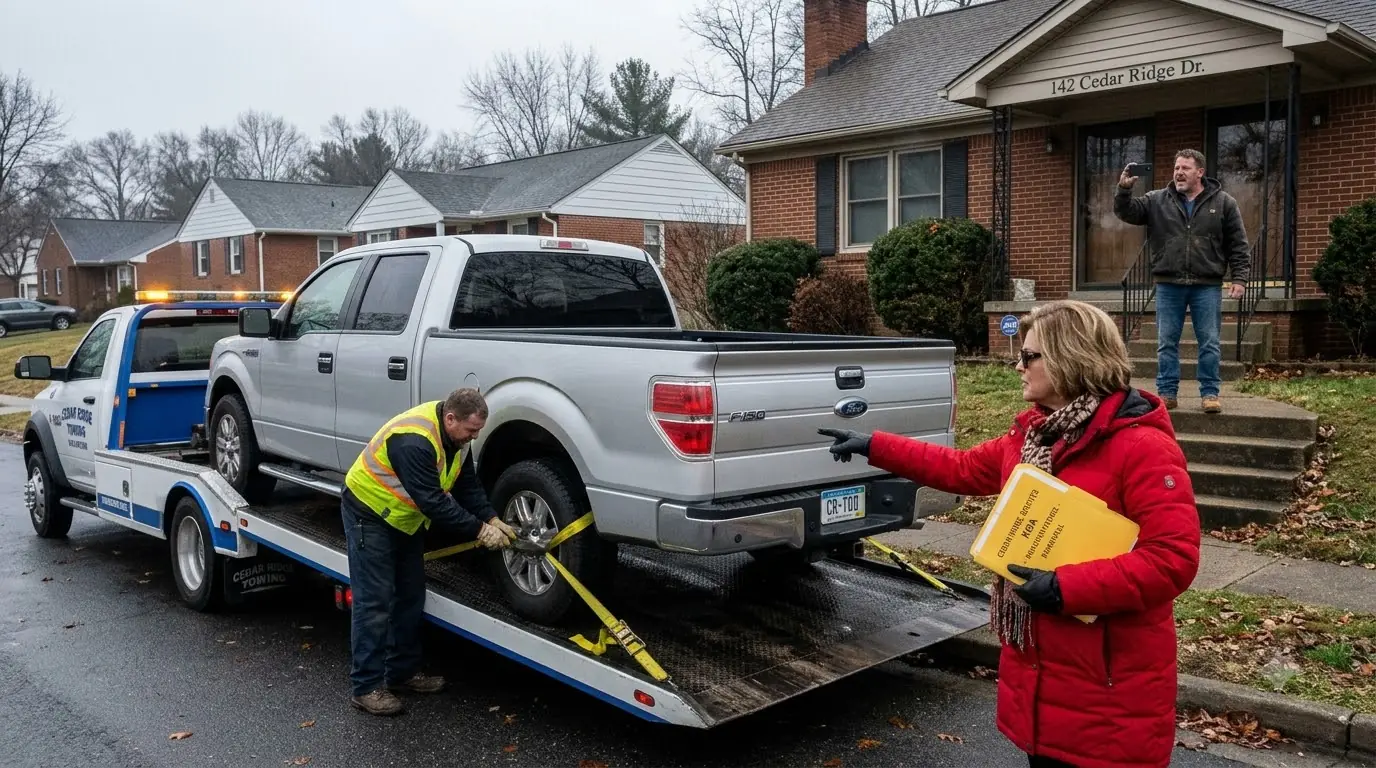
At 7:12 on a cold Tuesday morning, Ethan Walker stepped onto his porch and saw his silver pickup already halfway onto a tow truck. HOA President Karen Whitmore stood beside the curb with a violation folder pressed against her coat. Calmly telling the driver that commercial vehicles were prohibited. Ethan did not shout. He raised his phone and asked, "Who authorized you to remove a vehicle from this parcel? " Karen answered for the driver.
The HOA controls this entire road. 20 minutes later at the tow yard, the manager opened a county parcel map, looked at Ethan, and frowned. Wait, who actually owns this road? Ethan placed a recorded deed on the desk. I do.
Three weeks earlier, nothing about Ethan Walker's mornings suggested that his driveway would become the center of a neighborhood fight. He was 47, lived alone in the same one-story house his father had spent decades maintaining, and kept his life simple enough that most of his neighbors knew him only as the man who waved from the mailbox, and fixed his own fences. His property sat near the western edge of a planned subdivision called Cedar Ridge Estates, where matching stone entrance signs, trimmed medians, and freshly painted mailbox posts announced that the community took rules seriously. Ethan's land was older than all of it. His father had bought the acreage when the area was still pasture, scrub oak, and a narrow county access lane.
Years later, when a developer turned the neighboring tract into Cedar Ridge, that lane became a paved road connecting 38 homes to the county highway. The asphalt looked continuous. The street signs looked official. The HOA paid to patch potholes on part of it. To anyone driving through, the entire road appeared to belong to the subdivision.
Ethan knew better, though he rarely had a reason to say so. His driveway joined the road at a shallow angle just past a drainage ditch and an old galvanized mailbox. Near the edge of the grass, half hidden by clover, sat a rust stained metal survey pin his father had told him never to disturb. That little piece of steel has outlived three fences and two arguments. His father once said Ethan had laughed, but he left it in the ground.
Inside the house, in a gray filing cabinet under property tax folders and appliance manuals, his father had also kept an old subdivision plat, a recorded deed, and a survey map folded along yellowing creases. Ethan had not opened that drawer in years. His pickup was a 6-year-old half-ton truck with a locking aluminum toolbox behind the cab. He used it to haul feed, fence posts, lumber, bags of concrete, and the small utility trailer that carried his mower when he helped friends. It was titled and registered in his own name.
There was no business logo on the doors, no company number, no commercial plate, and no advertising. The toolbox made it look more work ready than the polished SUVs common in Cedar Ridge, but that had never been a problem. Ethan parked it in front of his garage or along the wide gravel shoulder inside his driveway, always leaving the travel lane clear. Then Karen Whitmore became HOA president. Karen did not arrive with sirens or threats.
She arrived with policy. In her first six months, Cedar Ridge residents received new reminders about trash bins, basketball hoops, lawn edging, holiday decorations, guest parking, and the color temperature of exterior lights. Most of the rules already existed somewhere in the covenants, but Karen enforced them with a prescission previous boards had never attempted. At meetings, she spoke in a measured tone about consistency, standards, and protecting property values. She rarely called anyone irresponsible.
She simply issued notices that made people feel irresponsible for failing to match her interpretation of the rules. The towing contract appeared in a March board packet. Karen had proposed hiring Lakeside Recovery, a local company that handled apartment complexes, shopping centers, and several private communities. Her stated goal was to eliminate recurring parking hazards, and unauthorized commercial vehicle storage. The board approved a six-month contract after a short discussion.
Two days later, every Cedar Ridge household received an email warning that prohibited vehicles, trailers, and vehicles parked in restricted areas could be removed without further notice after documented violations. Ethan read the email because it landed in his inbox, then forgot about it. He did not live on HOA common property, did not park in the subdivisions marked guest spaces, and had never signed a Cedar Ridge membership agreement. His parcel touched the neighborhood, but its legal description predated it. He assumed the notice had nothing to do with him.
Karen disagreed. The first violation letter arrived in a white envelope with the Cedar Ridge logo in the upper left corner. Ethan opened it over his kitchen counter and read the bold line twice. Commercial vehicle prohibited from residential streets. Below it was a photograph of his pickup taken from across the road.
The image showed the silver truck, the toolbox, and part of his mailbox. A second page cited section 8.4 of the Cedar Ridge parking rules and gave him 72 hours to remove the vehicle or face a fine. Ethan pulled the HOA covenants from the public county records website and read the provision. Section 8.4 did prohibit vehicles primarily used for commercial operations, oversized fleet vehicles, and certain work trucks from remaining on HOA streets and common areas overnight. It also gave the association authority to enforce restrictions on property under its control.
What it did not say was that every pickup with a toolbox became a commercial vehicle. More important, nothing in the provision described Ethan's driveway as association property. He wrote Karen a short email. Please identify the specific provision that classifies my privately registered pickup as a commercial vehicle. Please identify the parcel on which you believe the truck is parked.
Please provide the recorded document that gives Cedar Ridge HOA towing authority over my driveway. He expected a reply from the property manager. Instead, 2 days later, another envelope appeared in his mailbox. This one included a $150 fine and a warning that continued non-compliance could result in towing. Ethan read it standing beside the mailbox, then looked at the survey pin in the grass.
He sent the same three questions again. Karen answered with one sentence, "The board has confirmed that all road frontage maintained by Cedar Ridge is subject to community parking standards. " Ethan noticed what she had not said. She had not said the HOA owned the land. She had not named a parcel. She had not explained how maintenance became towing authority.
She had simply replaced three questions with a statement of control. That was the first time Ethan sensed the dispute might be about more than a truck. He pulled the pickup closer to his garage, well inside the line his father had always treated as the driveway boundary. For a week, nothing happened. He went to work, repaired a sagging gate on the back fence, and used the truck to bring home six bags of gravel.
On Sunday evening, he washed mud from the wheel wells, and parked it facing the house. The following morning, he found a third notice taped to his mailbox. Final enforcement warning. The fine had increased again. He photographed the notice in place before removing it.
That small habit, document first, argue later, would become the difference between a neighborhood disagreement and a record no one could easily rewrite. The Tuesday tow began with the sound of a diesel engine idling outside Ethan's bedroom window. He glanced at the clock, pulled on jeans, and stepped through the front door. A white and blue Lakeside Recovery truck, sat nose down at the edge of his driveway. Its wheel lift was already under the front tires of his pickup.
The operator, a broad shouldered man in a reflective jacket, was tightening the straps. Karen stood a few feet away with board member Paul Danner, both holding coffee cups. Karen had a clipboard tucked beneath her arm. Ethan stopped on the porch long enough to unlock his phone and start recording. "Morning," he said as he walked closer.