Officer Curtis Bole slammed the cruiser door hard enough to rattle the frame, and the sound cracked across the quiet morning like a starter's pistol. Get on the ground now. The man kneeling by the mailbox didn't move. He was 61 years old, wearing a faded gray Howard University sweatshirt with a coffee stain on the collar, and he was holding a wooden handled garden trowel that had belonged to his mother. He looked up slowly, the way a man looks up when he has been shot at before, and knows the difference between a threat and a bluff.
Officer, he said, "You are making a mistake you will not be able to take back." Boille didn't hear him. Boille never heard anyone once he'd already decided what he was looking at. Rewind 6 hours to 6:14 in the morning before any of this happened. Back when the only sound on Ridgemont Hollow Lane was a sprinkler ticking against a hedge and a morning dove complaining somewhere in a magnolia tree. This was Ashcom County, Virginia, 22 minutes outside of Washington DC by the beltway when traffic behaved itself, which it rarely did.
The houses here didn't have addresses so much as they had names. the Ellery House, the old Callaway Place, the brick Georgian at the top of the rise that had sold for $7,4 million 18 months earlier and still sat half furnished because the new owners only used it four weekends a year. Ridgemont Hollow was the kind of neighborhood where the hedges were trimmed by contract, not by hand, and where a man kneeling in the dirt at dawn was. To most eyes that didn't know better, a strange enough sight to remember. Marcus Ashworth was that man, and it was his own dirt. He had bought the house at 14 Ridgemont Hollow Lane 9 years earlier, back when he was still an assistant director running the bureau's criminal investigative division, back when his wife Denise was alive and used to stand at the kitchen window with a cup of Earl Gray watching him lose the fight against the hydrangeas every single spring.
She'd been gone 3 years now. An aneurysm on a Tuesday afternoon while she was grocery shopping. No warning, no goodbye. And the hydrangeas had become the one argument Marcus refused to lose to anybody, including the root rot that kept creeping up from the mulch bed near the mailbox. He was out there most Saturday mornings before the sun cleared the treeine in sweatpants gone gray from a hundred washes and a t-shirt with his alma mater's name cracking off the chest because for one hour a week nobody needed him to be director of the Federal Bureau of Investigation.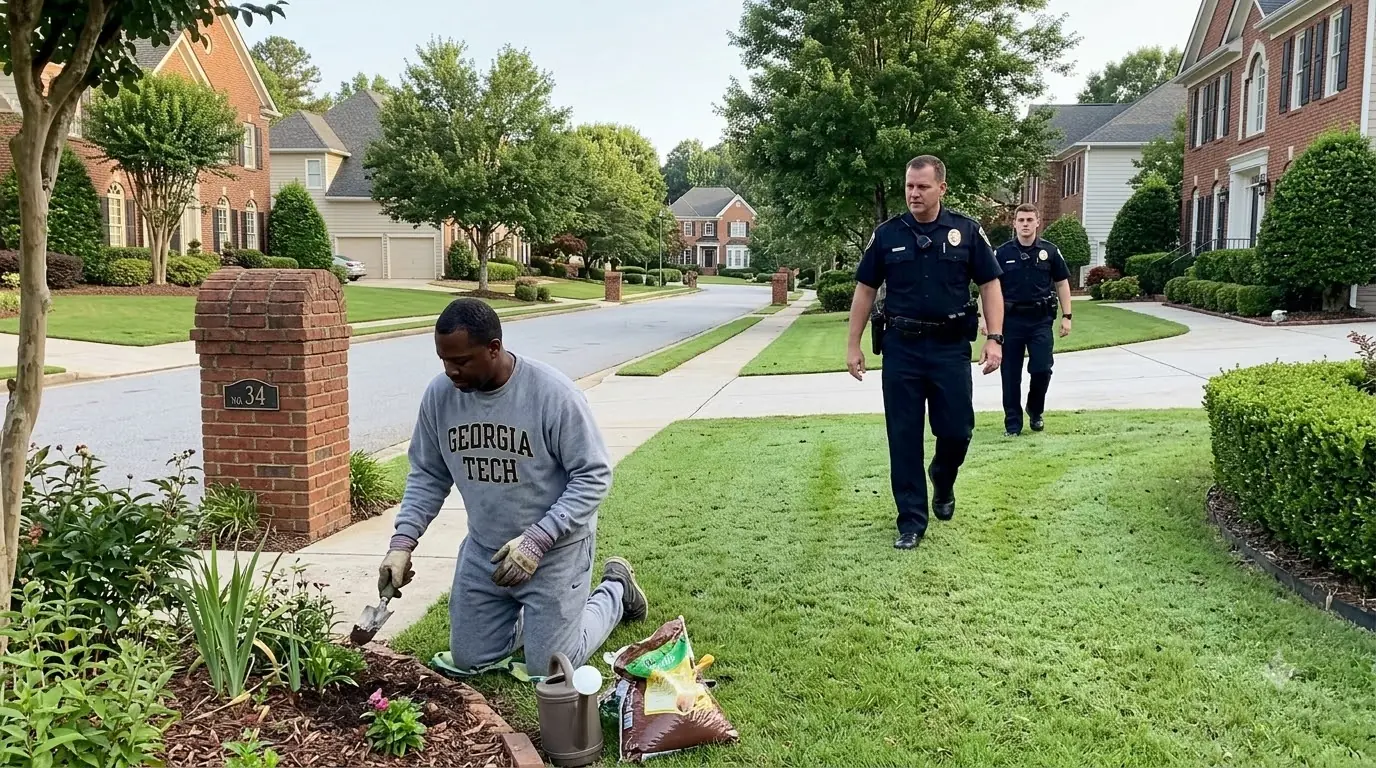
He could just be a man with dirt under his fingernails missing his wife talking softly to a row of flowers she used to love. 23 days earlier in a Senate hearing room with more cameras pointed at him than he'd faced. In 31 years of federal service, Marcus Ashworth had been confirmed as the ninth director of the FBI, sworn in with his hand on his mother's Bible, the same Bible she had carried to work every day of her life as a domestic housekeeper for families in neighborhoods exactly like this one. families who paid her in cash and never once asked her last name. He kept that Bible in a drawer of his desk in the Hoover building. Now, he kept her tel in his own garden shed, and every Saturday he pulled it out and used it, because some inheritances you're supposed to spend down to nothing, and some you're supposed to keep using until your hands remember the shape of the person who gave them to you. his security detail.
Six agents rotating in three shifts, armored suburbans, the whole choreography of protecting the most powerful law enforcement officer in the country, had been stationed at the estate's front gate that morning, 400 yd down the drive at Marcus' own explicit and repeated instruction. One hour, he'd told special agent Daniel Cross the night before. Let me have one hour where I'm just a man in his own yard. Dany, that's all I'm asking. Cross hadn't liked it.
Cross never liked it. But you did not argue twice with Marcus Ashworth once he'd made up his mind. And so at 6 that morning, the detail held its perimeter at the gate while the director of the FBI knelt 50 yards away in a sweatshirt with a hole in the cuff, utterly, deliberately, dangerously alone, two streets over in a Ashcom County patrol cruiser with 61,000 m on it and a check engine light that had been on for 3 weeks. Officer Curtis Bole was drinking gas station coffee and complaining about the commander's offensive line to a rookie who had learned in his first four months on the job to nod at roughly the right intervals. Officer Nathan Cole was 24 years old, 11 weeks removed from the academy and still believed, genuinely, stubbornly believed that the badge on his chest meant something close to what they'd told him it meant in training.
Report came in last week. Amazon boxes walking off half these driveways. Guys ride the bus in from the city. Grab and go before anybody's even had coffee. He said, "The city, the way some men say a curse word, feels pretty dead out here," Cole offered, looking at the empty, gleaming sidewalks.
"It's never dead," Bole said. "You just got to know what you're looking at." The cruiser came around the bend onto Ridgemont Hollow Lane at 6:41, and Bole's foot found the break before his brain had finished the thought. He was looking at a black man in sweatpants kneeling in the mulch near the mailbox of a house that in Curtis Bole's 11 years of pattern recognition did not belong to a black man in sweatpants. That was the entire chain of reasoning. It took him 4 seconds and every one of those seconds felt to him like certainty.
There he said already reaching for the door handle. Look at that. Cole followed his eyes. He's got a trowel, Boille. He's gardening.
He's casing it, Bole said. And something in his voice had gone flat and sure. The tone of a man who has stopped listening to the world and started listening only to himself, checking if the mails piled up, seeing if anybody's home. You think a guy who looks like that owns a house on this street? Cole didn't answer because 11 weeks into the job, he still had a conscience that hadn't yet been sanded down.
And the conscience was telling him something the training academy hadn't put into words. That the sentence his training officer had just said out loud was not a theory about a crime. It was a theory about a man's skin. They got out of the car. Marcus heard the doors. that particular heavy official slam that a man who has spent three decades around federal vehicles could identify with his eyes closed and stood.
One hand pressed to the small of his back, the trowel still loose in his other palm. He watched Bole come across the lawn first, walking with the rolling chestforward swagger of a man who has never once in his adult life had to wonder whether a room would take his authority seriously. Cole trailed two steps behind, and something about the way the younger officer held his shoulders, tight, apologetic, already bracing, told Marcus everything he needed to know about which one of these two men might eventually matter. Morning, officers, Marcus said. His voice was calm.
It was always calm. Three decades of interrogation rooms had burned the panic reflex out of him a long time ago. Can I help you? Step away from the mailbox," Boil said, stopping at the edge of the grass, one hand resting on his duddy belt in a posture that was pure theater and pure threat at once. Marcus raised an eyebrow and did not move an inch.
"Excuse me, you heard me. Drop the tool. Step back onto the sidewalk. I am tending my garden," Marcus said, setting the trowel down in the mulch with the unhurried precision of a man giving nothing away for free. Is there a problem?
Yeah, there's a problem, Bole said. And now he stepped onto the grass itself, closing the last 6 ft of distance until he was standing inside the small circle of space that in any ordinary conversation between two adults belongs to the person being spoken to. We've had thefts in this neighborhood, and I find you crouched at somebody's mailbox in a stained t-shirt on a property that plainly isn't yours. Something in Marcus' posture changed then. Not fear, nothing close to fear, but the specific ancient straightening of a man who has decided a line is about to be crossed and wants the other side to see him standing at his full height when it happens.
I assure you, officer, this property is mine, and I am not going through anyone's mail. Boil laughed. It was not a laugh that contained any real humor in it. Yours? Sure, let's see some ID.
My identification is inside the house, Marcus said, and his voice dropped, not louder, but lower into the register he used in briefings with three star generals and Senate committee chairs, a register that had made grown men reconsider their next sentence for 30 years. I'll retrieve it now. You're not going anywhere, Bole snapped, and he reached out and closed his hand around Marcus's forearm. That was the first frozen moment. For two full seconds, nothing moved.
The sprinkler two houses down kept ticking. A jogger's footsteps faded around the far corner without slowing down. Without seeing, the way most footsteps in most stories like this one keep walking. Marcus looked down at the hand on his arm the way a man looks at a stain that has just appeared on a clean shirt, not with panic, but with a kind of cold cataloging disbelief. "Remove your hand," Marcus said very quietly.
"Before you make a decision you cannot undo. You have no reasonable articulable suspicion to detain me, and none whatsoever to put your hands on me while I am standing on my own property." Boille's face went a deep modeled red, the color of a man who has just heard his own authority questioned in language too precise to argue with and hates the questioner for it more than he would have hated an insult. Oh, we got a lawyer out here. Cole, grab his other arm. Cole hesitated.
It was the kind of hesitation that lasts less than a second and changes nothing in the moment and everything in the story. Boille, maybe we let him go get his ID. Grab his arm, Boille roared, and before either Cole or Marcus could do anything else, Boille wrenched Marcus' right arm behind his back and drove him forward against the brick pillar of his own mailbox. Marcus' cheek met warm, sunbaked brick. The cuffs went on with a sound like a small machine, finishing a job it had done 10,000 times before.
That flat ratcheting click that means something has just been permanently decided. Marcus didn't struggle. He let his cheek rest against the brick, breathing evenly, and when he spoke, his voice carried no strain at all, which somehow made it worse to hear. You are making the most expensive mistake of your career, officer. Shut up, Bole said, patting him down hard enough to bruise. finding no weapon, no wallet, nothing but a phone in the sweatshirt pocket, which he yanked out and dropped into an evidence bag without looking at it twice, prowling, failure to identify, resisting, "You're going downtown, and we'll see how much of that fancy talk survives a holding cell." Two houses away, behind a curtain of raw silk, 83-year-old Eleanor Pratt, watched the whole thing from her breakfast nook with her hand pressed flat against her chest.
And then she picked up her cordless phone and dialed the one number in Ridgemont Hollow that everyone quietly understood was for emergencies of an unusual kind. The drive to the 9inth district station took 11 minutes, and it was the longest 11 minutes of Nathan Cole's short career. The plexiglass divider kept the sound thin, but not the tension. Boille talked the whole way. Loud, expansive, pleased with himself, the way men get when they've convinced themselves that cruelty was actually competence.
That's proactive policing, rookie. You don't wait for permission. You see something out of place, you act. In the rear view mirror, Cole kept catching sight of the man in the back seat, sitting bolt upright despite the cuffs, staring not out the window, but at the back of Boil's head, with an expression that had nothing panicked in it at all. Cole had been in this job 11 weeks.
He had already learned that suspects came in three varieties: furious, terrified, or drunk and rambling. The man in the back seat was none of those things, and that frightened Cole more than any of the three would have. "If you just give us your name," Cole tried, twisting to look through the security grate, we can clear this whole thing up back at the station. Marcus turned his gaze to the younger officer, and for a moment something almost gentle moved across his face. "Recognition, maybe of a man who might still be salvageable." My name, he said quietly, is about to become the smallest of your partner's problems.
Bole barked a laugh from the front seat. Tough guy. Love it. Let's see how tough he is in booking. The 9inth district station smelled the way every busy precinct smells.
Burnt coffee, old floor wax, the metallic tang of nerves. And Sergeant Walter Higgins, 22 years on the job, and 11 months from a pension he'd already mentally spent three times over, didn't even glance up from his paperwork as Bole marched his prisoner up to the booking desk. "Got a live one, Walt," Boille announced. "Prowling, failure to ID, resisting, caught him casing the Carrington Place over on Ridgemont." Higgins finally looked up, and what he saw made him set his pen down slowly, dignified posture. Steady eyes.
Absolutely nothing in this man's bearing that matched the word prowler. "He refused to identify," Boil said, arms crossed, before Higgins could ask. "Sir," Marcus said, and his voice carried just enough to cut through the noise of the room without shouting. Before this officer files paperwork that will end his career and expose this department to a lawsuit, it cannot survive. I am entitled to a phone call.
I would like my phone back. The one your officer removed from my person unlawfully. He wants his lawyer. Boil sneered. Let him use the precinct line.
No, Marcus said. I'll use my own device now. There was something in the way he said now. Not loud, not desperate, simply final. That made Higgins's stomach drop half an inch before his mind had caught up to why.
Give him the phone, Curtis. Are you serious? He's a suspect. Give him the damn phone, Higgins said, already regretting every choice that had led him to this particular Saturday shift. Bole slammed the evidence bag onto the desk, unlocked one cuff, so Marcus' right hand was free, while his left stayed shackled to the booking rail, and stepped back with his arms crossed, smirking.
Marcus didn't dial a lawyer. He pressed a single speed dial digit, and the call connected on the first ring. Director. The voice on the other end was crisp, alert, already moving before the sentence finished. Special Agent Daniel Cross had spent four years learning to hear the difference between his boss's ordinary calm and the specific controlled calm that meant something had gone badly wrong.
And he was hearing the second one now. Christian Marcus said old habit. An old code name from a joint task force 8 years back that Cross had never quite let go of and neither had he. I've been detained. I'm at the 9inth district station in Ashcom County, 400 yardds from Marcus' own front gate, sitting behind the wheel of an armored suburban, Daniel Cross felt something cold drop through his chest.
"Sir, you were arrested." "I was," Marcus said, watching Bole lean against the desk, arms folded, grinning at what he clearly believed was the pathetic bluff of a cornered man. "Stand down on any tactical response. I want the detail brought to the station in a controlled fashion and I want you to reach Deputy Director Gregory Sanders. Tell him to activate a civil rights division response team out of the Washington field office. Tell him the director of the Federal Bureau of Investigation is currently handcuffed to a booking rail in a county precinct.
Boil close enough to catch fragments of the conversation burst out laughing. Director of the FBI, Walt. This guy's a straightup psychase. Somebody call Count Tentel. Sergeant Higgins wasn't laughing.
While Marcus had been speaking, Higgins had already pressed the older man's right index finger to the digital scanner mounted on the booking counter, more out of procedural habit than any real suspicion that anything unusual would come back. The machine beeped. It did not return a local wrap sheet. The screen flashed solid red. Clearance top secret SCI.
Agency Federal Bureau of Investigation. Title: Director Nameworth. Marcus T. Higgins felt every drop of blood leave his face at once. He looked from the glaring red banner to the calm silver-haired man cuffed to his own booking rail, and then back again twice as though the second look might correct the first.
Curtis, he said, his voice cracked in the middle of the single syllable. What? Boille was still pouring himself a cup of coffee, unbothered. He's got warrants or something, Curtis. Higgins was on his feet now, hands shaking so badly.
He dropped his keyring twice trying to find the right one. You didn't arrest a prowler. He looked Marcus dead in the eyes, and something like real fear moved into his face for the first time. You arrested the director of the FBI. The room went absolutely totally silent.
The second frozen moment, and this one had weight to it, the kind of silence that seems to press the air out of a space rather than simply fill it. The ringing phones seemed to fade to background static. Two officers processing a shoplifting suspect at the far end of the room stopped midsentence and turned to stare. Everyone's eyes moved between the glowing red screen and the handcuffed man standing utterly, terrifyingly still at the center of the room. Curtis Bole let out a short, disbelieving laugh.
The sound of a man whose entire nervous system was refusing the information his ears had just delivered. Come on, Walt. Machines glitching. Or he stole somebody's ID. You think the director of the FBI is out here in dirtance on Ridgemont Hollow?
Higgins didn't answer him. His hands were shaking so badly the little brass key skated twice off the lock before it finally caught, and the cuffs opened with a soft double click, swinging free from Marcus's wrist and leaving behind two angry red welts. Director Ashworth Higgins stammered. Sir, I I had no idea. Marcus rubbed his wrist slowly, feeling the indentations the steel had already carved into his skin, and his face had gone as cold and as still as a lake in November.
Your ignorance of my identity is not the issue, Sergeant. The issue is what your department is willing to do to a man it believes has no name at all. He was casing the Carrington place," Boil shouted, though his voice had thinned considerably, the swagger draining out of it in real time. I saw him. I saw what I saw.
You saw a black man kneeling in a garden in a wealthy neighborhood, Marcus said, turning the full weight of his attention onto Boil for the first time. And you built a crime around it to explain what you'd already decided before you ever got out of that car. Before Bole could answer, a low mechanical rumble began rattling the reinforced glass at the front of the station. Distant at first, then closer, then close enough that Nathan Cole, standing frozen near the door, felt it in the soles of his boots. He looked out through the front windows, and his jaw actually dropped.
Boil Sergeant, you need to see this. Six matte black armored suburbans tore into the precinct parking lot in tight formation, jumping the curbs, blockading every exit, forming a perimeter with the kind of practiced silent violence that only comes from years of drilling exactly this maneuver. Red and blue strobes buried in their grails through chaotic light across the precinct's front windows. "What is happening?" Boil whispered. And for the first time that morning, he took a step backward.
The double doors did not open. They were shoved open hard enough to bang against the interior walls, and a wave of tactical vests and dark suits flooded the lobby. A dozen agents in FBI raid gear moving with total wordless coordination, securing exits, the front desk, the holding cells in under 9 seconds. Local officers threw their hands up instinctively, backing away from a show of force that outmatched anything the 9inth district had ever housed under its own roof. At the front of the formation was special agent Daniel Cross, and his eyes swept the room like a targeting scope until they found Marcus standing near the booking desk, rubbing the marks on his wrist.
Cross's face hardened into something that had no patience left in it at all. Secure the room, cross barked. Nobody makes a call. Nobody touches a keyboard. Nobody leaves.
Two agents flanked Higgins, who raised his hands without being asked. Two more moved in front of Cole, who looked for a moment genuinely close to fainting. Crossed the room straight to Marcus. Director, are you hurt? I'm fine, Danny.
Marcus adjusted his sweatshirt with the unbothered ease of a man stepping out of a minor traffic delay. A little inconvenience, nothing more. Deputy Director Sanders is 3 minutes out with the civil rights response team, Cross reported, his hand resting on his holster as he turned his glare on Boille. Identify the officer who put hands on you, sir. Marcus didn't need to point.
Boil was already pressed against the back wall. The color drained clean out of his face, breathing in short, ragged pulls, every trace of the swagger he'd worn onto that lawn completely gone, replaced by the crushing physical understanding that he had personally with his own hands, arrested the most powerful law enforcement officer in the United States. "Who runs this precinct?" Marcus said, and now his voice filled the room with the full authority of the office he held. A door at the back flew open, and Captain Harold Weaver came stumbling into the hallway, a heavy set man in a rumpled uniform shirt, sweat already darkening the collar, still fighting one arm into his jacket as he half ran toward the noise. "I do.
I'm Captain Weaver." He was stopped cold by the flat arm of a federal agent, and when his eyes finally landed on Marcus, he swallowed so hard the sound was almost audible. Director Ashworth, Captain, this is this is clearly a a terrible misunderstanding, sir. My officers, they make mistakes sometimes, but I assure you, stop talking, Marcus said. And the room went silent for the third time that morning. the deepest silence yet. The kind where you can hear the individual ticks of a wall clock.
There is no misunderstanding here, Captain. A misunderstanding is a clerical error. What happened to me this morning was a deliberate deprivation of civil rights under color of law. And if one of your officers felt confident enough to do that to me in broad daylight on my own front lawn, it tells me exactly one thing. He has done it before to people who did not have a call to make that would send six suburbans through your front doors.
Marcus took one slow step toward Boille. Boil actually flinched. You thought you were the predator this morning, Officer Bole, Marcus said quiet and terrible. You thought you'd found easy prey. What you actually walked into was a trap you built for yourself 11 years ago, one bad stop at a time, and you never even felt it closing.
What Boille could not have known, what none of them in that room could have known, because it had not yet been made public, was that 3 days earlier, the Department of Justice had quietly flagged the 9inth district for a pattern of excessive force complaints and unconstitutional stops disproportionately targeting black residents of Ashcom County. Marcus Ashworth had been scheduled to personally authorize a preliminary federal civil rights investigation into this exact precinct on Monday morning. Curtis Bole had not simply arrested the director of the FBI on a Saturday. He had personally gift wrapped handed the bureau probable cause. It had been waiting on for 3 days, walked it in through the front door in handcuffs and set it down on the booking desk himself.
The glass doors opened again and Deputy Director Gregory Sanders stroed in tall graytempled a leather folio under one arm and three federal prosecutors trailing behind him like awake. Marcus Sanders said handing a thick stack of paper to cross. Magistrate signed off in 11 minutes flat. We have full authorization to seize body camera footage, dash cam recordings, and internal affairs files for this precinct going back 36 months. Captain Weaver looked physically ill.
Director, you cannot seize an entire department's records over one stop. I absolutely can, Marcus said, settling into the desk chair Higgins had vacated with the unhurried ease of a man reclaiming territory that had always belonged to him. and I already have. Captain, I suggest you disarm Officer Boille immediately before I ask one of my agents to do it for you. Weaver didn't hesitate this time. Boil badge and weapon now.
Captain, please. Boil's voice had collapsed into something thin and pleading. All the certainty of that morning burned out of it. I was doing my job. He looked out of place.
You can't let them. You did this to yourself," Weaver said, stripping the sidearm from Boille's holster and tearing the silver shield off his chest in one motion. Deputy Director Sanders stepped forward with a set of federal cuffs. Curtis Bole, you are under arrest for violation of Title 18, United States Code, Section 242, deprivation of rights under color of law. You have the right to remain silent, and I would strongly recommend you use it.
The cuffs closed around Boille's wrists with the exact same flat ratcheting click that had closed around Marcus' wrists on his own front lawn less than an hour earlier. And this time it was boil's knees that buckled first. He didn't go quietly. Wait, he said, his voice climbing, cracking. Wait, please.
I have a daughter. I have a I didn't know. How was I supposed to know? He was in the wrong clothes. He was He was in the wrong yard.
And then mid-sentence, something in him seemed to simply give out the way a levy gives out, not gradually, but all at once, the whole structure failing in a single moment. He looked up at Marcus, and for the first time that morning, his eyes weren't defiant. They were just afraid, and beneath the fear, something that looked almost like recognition. "It wasn't the yard," he said so quietly that only the people closest to him heard it. I looked at you and I already knew what I was going to see.
I didn't even look at you. I looked at what I already believed and I called it evidence. Nobody in the room said anything to that. Marcus watched him for a long moment and something in his face shifted. Not forgiveness, nothing so simple as that, but a kind of exhausted recognition that at least this much honesty existed somewhere underneath everything Boil had done.
That is the first true sentence you've said to me all morning. Marcus said it is 11 years and three known victims too late. But it is true. The federal prosecutors weren't finished. Within the hour, two names surfaced from the seized internal affairs files.
A 19-year-old delivery driver. Boille had thrown to the pavement outside a gated community 14 months earlier over a package he was legally delivering. and a retired Army Colonel Black, 68 years old, stopped and searched twice in one summer, walking his own dog on his own street. Both complaints closed by the department with a single line, unfounded. Neither man had a name that opened a booking screen the way Marcus Ashworths had. Neither man had gotten six suburbans through the doors.
They had simply absorbed it and gone home the way people without that kind of leverage are expected to. As Bole was marched out past his stunned former colleagues and loaded into the back of a federal vehicle, Marcus turned his attention to Nathan Cole, who had been standing rigid near the door the entire time, certain his own arrest was next. "Officer Cole," Marcus said. The younger man flinched at his own name. Yes, sir.
Marcus crossed the room slowly and stopped in front of him. You knew it was wrong, he said, his tone shifting from command into something closer to instruction. I saw it in your face in that cruiser. You knew your partner was out of line and you stayed quiet because he outranked you and you didn't yet know how much that would cost. I should have stopped him, sir.
I'm sorry. Apologies don't protect anyone's rights, Marcus said. Courage does. The badge you're wearing is a weight, Officer Cole, and it demands that you police your own with the same seriousness you police the street. If I ever hear that you watched something like this happen again and said nothing, you will not simply lose your job.
You will lose the right to ever wear that badge in this country again. Do you understand me? Yes, director. Completely. Marcus studied him another moment, then gave a single nod.
Not warmth exactly, but something adjacent to it, the smallest possible extension of a second chance. Then go be the kind of officer your partner never was. Start today, 6 months later, on a warm Saturday morning in late spring. The 9inth district precinct operated under a federal consent decree with a court-appointed monitor reviewing every stop, every use of force, every complaint that crossed Captain Weaver's desk. Weaver, who had kept his job only by cooperating, fully and personally overseeing the retraining of his entire patrol division.
Two officers named in the newly surfaced pattern of complaints had resigned rather than face their own hearings. Curtis Bole pleaded guilty to federal civil rights violations and was sentenced to 31 months in federal prison. At his sentencing, he stood and unprompted apologized by name to the delivery driver and the retired colonel, both of whom were in the courtroom gallery, neither of whom had ever expected an apology, and both of whom afterward said it didn't undo anything, but it was more than they thought they'd ever get. Nathan Cole made Detective 18 months ahead of the department's usual timeline, largely on the strength of a formal citizen commendation, written by a 19-year-old delivery driver who said Officer Cole was the first officer who'd ever actually listened to him. And on Ridgemont Hollow Lane, in the soft gray light of a Saturday morning, Marcus Ashworth knelt again in the mulch bed by his mailbox, his mother's wooden-handled trowel turning the same soil it had turned for 9 years.
The hydrangeas finally, stubbornly blooming. He didn't look up when the sprinkler two houses down started ticking. He didn't look up when a jogger's footsteps passed and faded around the corner. Same as they always had, same as they always would. Most people never even glancing at the man in the dirt.
He simply kept working, patient, unhurried, a small green chute pressing up through the soil under his hand. The kind of thing that takes root slowly and holds long after everyone has stopped watching.
END