Chapter 1: The Old Man Who Knew the Court
Excuse me, officer. My neighbor's hearing starts in 5 minutes. May I go in? Wait outside, old man. I beg your pardon?
You heard me. Court is for people who matter. Not shuffling grandpas in thrift store sweaters. Sir, the gallery is open to the public. I only want to sit in the back.
And I only want you gone. What is this? A diary? Please be careful with that notebook. It was a gift from my wife.
Now it's mine. Call it evidence of loitering. Son, do you know whose courtroom this is? Yeah. Mine.
I keep the trash out of it. Move before I find a reason to cuff you. Then I'll wait. I'm very good at waiting. Whatever, old man.
Just stay out of my courtroom. The hallway laughed with Officer Voss, not knowing the quiet man he mocked had run this entire court for 20 years. The next morning, courtroom four filled before 9. Fairmont County still loved a trial. Word had spread that a local teenager faced 3 years for assaulting a police officer, and the gallery benches creaked under the weight of curiosity.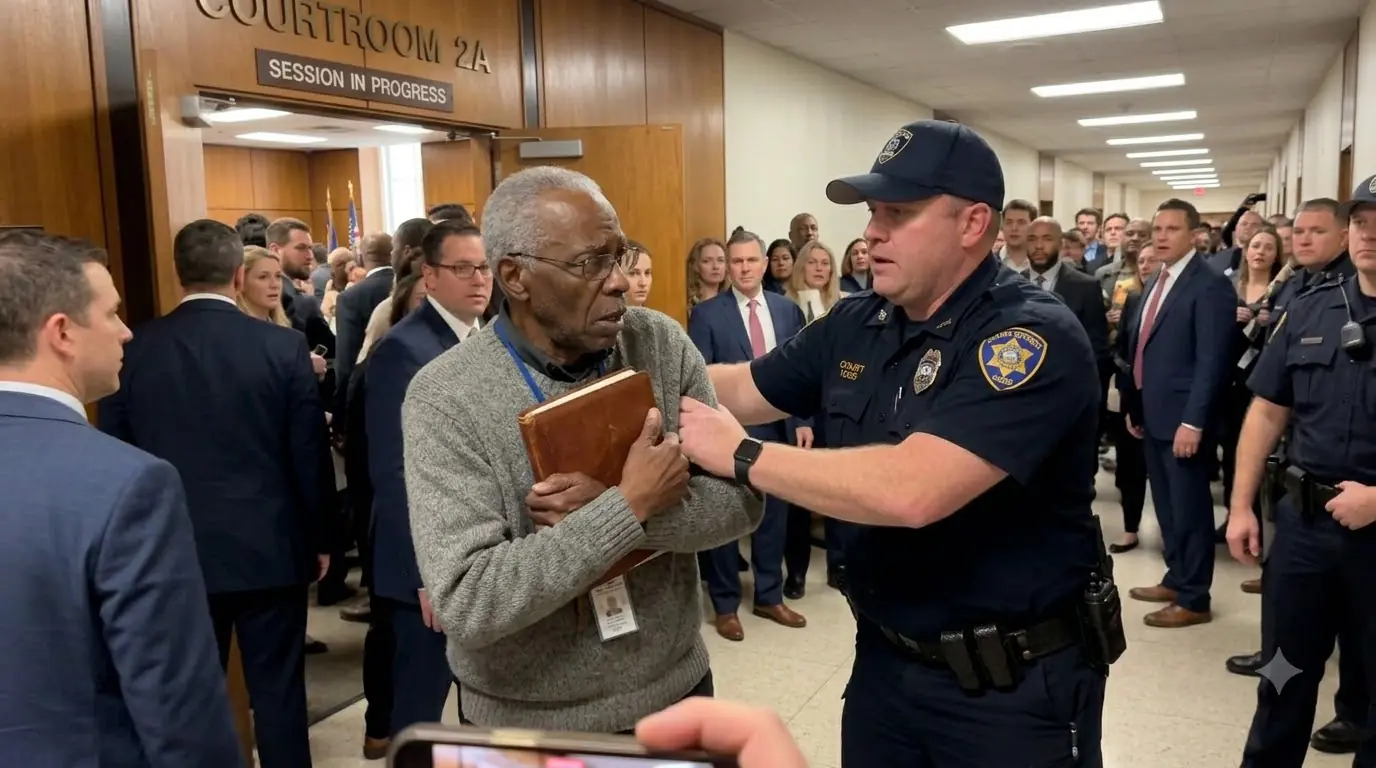
Miles Keller stood at the door again. This time it was not Voss who met him. It was a heavy-set bailiff with silver hair and a careful limp. A man named Gus Halloran. Gus studied the old man's face for a long moment.
Something flickered behind his eyes, half a memory trying to surface. Gallery is open, sir. Gus said quietly. Back row has space. Thank you kindly.
Do I know you from somewhere? I have one of those faces, Miles said, and walked in. He took the last seat in the last row, folded his hands, and watched the machinery of justice begin to move. He knew this room. He knew the sticky hinge on the jury door.
He knew the water stain above the clerk's desk shaped like the state of Florida. 20 years leaves fingerprints on a man's memory and the man leaves fingerprints on a room. At the defense table sat Elijah Brooks, 19, in a borrowed suit one size too big. His mother had ironed it twice that morning. His hands stayed flat on the table exactly the way his lawyer had told him.
He looked like a boy trying very hard to seem small. Assistant District Attorney Scott Calloway rose first. He was tall, polished, the kind of lawyer who rehearsed his pauses. Your honor, the evidence will show that on the night of March 12th, the defendant attacked Officer Derek Voss during a routine stop. This was not a misunderstanding.
This was an assault on a man who wears a badge so the rest of us can sleep at night. Judge Eleanor Vance listened from the bench with a stillness that gave nothing away. She was in her 50s, sharp-eyed, famous for patience and infamous for the end of it. Then the state called Officer Derek Voss. He walked to the stand like a man accepting an award.
Pressed uniform, fresh haircut. He smiled at the jury before he even sat down and half of them smiled back. People want to believe the uniform. That is the whole point of one. Officer Voss, tell us about that night, Calloway said.
Routine patrol on Carver Street. Around 9:15, I observed the defendant acting suspicious near the hardware store. Pacing. Checking windows. I initiated contact, polite and professional.
He got aggressive immediately, shouting, swearing. When I attempted to detain him, he struck me in the chest and resisted. I used the minimum force necessary to bring him under control. The story rolled out smooth as poured concrete. Every sentence landed in order.
Every detail arrived on time, dressed and rehearsed. The jury leaned in. A woman in the second row shook her head at Elijah as if she already knew the verdict. In the back row, Miles Keller did not move. But inside his mind, a single phrase had snagged like a thread on a nail.
Around 9:15. The charging documents had been read aloud during arraignment, and Miles had been listening from the hallway. The original incident report logged the stop at 9:40. 25 minutes did not just vanish from a trained officer's memory. Sloppy men forget details.
Lying men rearrange them. The story was perfect. That was the problem. Lies rehearse. Truth remembers.
Callaway kept going, feeding his witness easy questions, and Voss kept hitting them like batting practice. The teenager swung first. The officer feared for his safety. The arrest was textbook. Somewhere in the third retelling, the strike to the chest became a strike at his face.
Nobody else seemed to notice the wound migrating. Miles noticed. He had spent two decades watching testimony from a higher chair than anyone in this room. He knew the rhythm of a memorized script. Real memory wanders.
It backtracks, corrects itself, stumbles into honesty. Voss never stumbled once. His story had no loose threads because someone had already cut them all off. "And the defendant's notebook claim," Callaway said almost casually, "he alleges you confiscated personal property in the courthouse yesterday." "I removed a potential security item from an unidentified loiterer," Voss said. "Standard procedure." In the back row, the unidentified loiterer allowed himself one slow blink.
Gus Halloran turned from his post by the wall and looked at Miles again, longer this time. His brow folded as if he were doing arithmetic with very old numbers. Miles met his eyes, calm as Sunday, and the bailiff turned away with the question still sitting on his face. The defense had its turn. Nora Whitfield stood up, and the difference between the two tables became painful to watch.
She was young and smart and drowning. 80 open cases will do that. Her cross-examination was earnest and toothless. "Did you identify yourself?" "Yes." "Did you feel threatened?" "Of course." Each answer closed a door she did not know how to reopen. "No further questions," she said finally, and the words sounded like surrender.
But the state had one more witness, and this is where the concrete cracked. Officer Tyler Brennan had been Voss's partner for 2 years. He took the stand the way a man steps onto thin ice, testing each word before putting weight on it. He confirmed the stop. He confirmed the arrest.
Then, Callaway asked him to describe the moment the defendant struck Officer Voss. Brennan paused. It was a small pause. 2 seconds, maybe 3. But silence has a different texture when it is hiding something.
And the whole room felt the temperature change. "It happened fast," Brennan said. "There was a struggle. I was focused on calling it in." "You were 3 ft away," Callaway said, smiling thinly. "Did you see the defendant strike your partner?" "Like I said, it was fast." Callaway moved on quickly, the way lawyers do when the floor creaks.
The jury barely registered it. Juries hear words. Old judges hear the spaces between them. Miles unfolded his hands and looked at Elijah Brooks, who had stopped breathing through the entire exchange. The boy's mother gripped the bench in front of her.
One row over, a man whispered that the kid would take a plea by Friday. And everyone always does. The court recessed at noon. The gallery emptied past Miles in a river of chatter and cheap cologne. Voss came down the aisle last, escorting his own grin, and slowed when he reached the back row.
"Still here, old man? Hope you enjoyed the show." "Very educational," Miles said. "Stick around for the verdict." "Kid swings at a cop, kid learns what consequences feel like." "And what do they feel like, Officer?" Voss laughed, tapped the badge on his chest twice, and walked out swinging his keys around one finger. Miles sat alone in the empty courtroom for a moment longer. He looked at the bench where Eleanor Vance had sat.
He looked at the witness chair, still warm from a man whose story had no wrinkles. Then he took out a pen, smoothed a courthouse visitor pamphlet against his knee, and wrote four words in the margin in small, steady letters. 9:15 9:40 Some men collect grievances. Judges collect discrepancies. By sundown, that little gap of 25 minutes would have company.
The second floor hallway smelled like floor wax and old paper, as it had for 40 years. Miles found Elijah's mother on a wooden bench outside the vending alcove, folding and unfolding a tissue that had given up an hour ago. Mrs. Brooks? She looked up.
You're Mr. Keller, from Hartwell Street. Elijah cuts your grass. He used to cut it for my wife when she was sick. Never once let her pay him.
Miles sat down beside her. That boy carried her trash cans to the curb every Tuesday for 2 years. I have not forgotten. Her eyes filled. They're going to take him from me.
That lawyer is trying, but she's got a stack of folders thick as a Bible. And that officer talks so smooth. Smooth is not the same as true, Miles said. Polished floors are the ones you slip on. Down the hall, Nora Whitfield stood over a rolling crate of case files, eating a granola bar in three bites while reading two documents at once.
Miles approached the way you approach a startled animal, slow and sideways. Counselor, you have a minute? I really don't, sir. Then I'll only use half of it. Three questions.
He held up one finger. Did you receive the full body-camera footage or a clip the department selected for you? Nora stopped chewing. Two. A second finger.
Does the time stamp on Officer Voss's incident report match the time he testified to this morning? Because I heard 9:15 from the stand and arraignment said 9:40. The granola bar lowered slowly. Three. Has anyone pulled the dispatch log to see when the stop was actually called in?
Dispatch does not rehearse. Dispatch just records. The hallway noise went on around them, but Nora Whitfield had gone very still. She looked at the old man in the worn gray sweater, at his thrift store shoes, at his patient brown eyes, and recalculated everything. Who are you?
She asked. A neighbor of the defendant. Neighbors don't ask about dispatch logs. Curious neighbors do. He smiled.
Ask for the full footage, counselor. Ask the body-camera. Then ask him again. One of them will change its story and it will not be the camera. Before she could answer, a familiar voice cut down the corridor like a thrown bottle.
You have got to be kidding me. Officer Voss came toward them with his thumbs hooked in his duty belt. Still here, old man? This is a courthouse, not a senior center. Bingo's at the church on fifth.
A couple of clerks laughed. Somebody's phone came up hungry for content. He's with the defense, Nora said. The defense. Voss looked Miles up down from white hair to worn soles.
What is he, your expert witness? Expert in what? Early bird specials? More laughter. Miles let it pass over him like weather.
You should drink water, son, he said mildly. All that talking this morning. A dry throat makes a man misremember his timestamps. Something moved behind Voss's grin. Just a flicker.
Fast as a fish under ice. Then the grin repaired itself. Whatever. Court's back in 20. Enjoy the show, Grandpa.
He shouldered past, close enough to make the old man rock half a step. And the moment was gone. Nora watched Voss go. He took your notebook yesterday. Elijah told me.
You should file a complaint. It's on his desk in the patrol annex. Third drawer, with the other things he takes from people. They always keep trophies. Miles straightened his sweater.
File nothing yet. Complaints warn a man. Evidence convicts him. She wanted to ask how a retired nobody knew about the third drawer in the patrol annex. The bell for session rang before she could.
The gallery refilled. Miles paused at the stone bench outside courtroom four, the one with the chipped corner, and rested his hand on it the way you rest a hand on an old dog. 3,000 mornings he had sat on that bench. He used to come down from chambers at dawn with Ruth's coffee in a thermos and a draft ruling on his knee. The marble took the words better than the desk did.
That bench had heard him reason through sentencing decisions that kept him awake. It had heard him talk himself out of anger more than once because anger writes bad law. Ruth had given him the brown notebook the morning of his swearing in. "For the rulings you make outside the courtroom," she had written inside the cover. He had filled 20 notebooks since.
Hers was the one that mattered. And it was sitting in a bully's trophy drawer. He went in and took his seat in the back row. The afternoon session was procedural sand, stipulations, scheduling, the slow grinding of the docket. But two small things happened and Miles caught them both because catching small things had been his profession.
The first happened at the bench. Judge Eleanor Vance was scanning the gallery during a sidebar when her eyes crossed the back row. They stopped. They came back. For two full seconds, Eleanor Vance looked at the old man in the gray sweater and her pen went quiet against her legal pad.
20 years is a long time and a face can age. But some faces you studied too closely for too many years to ever fully lose. She blinked, wrote something, and the moment closed like water over a stone. The second thing happened at the prosecution table. A clerk brought Callaway a folder.
Callaway opened it, read for a moment, and his eyes flicked once toward Voss seated in the second row in his pressed uniform. It was a brief look. It was not a friendly one. Prosecutors can smell a problem witness the way sailors smell weather. And somewhere in that folder a wind had shifted.
Court adjourned at 4:30. Tomorrow, the state would rest and the defense would begin with almost nothing in its hands. Almost. On the courthouse steps, Nora caught up with Miles, crate wheels clattering behind her. "I filed the request," she said breathless.
"Full body-camera footage, original metadata, and the dispatch log. The clerk said first thing tomorrow." She hesitated. "If you're wrong about this, I just spent capital I don't have. And if I'm right, then Officer Voss lied under oath, and somebody edited the record to cover it." She said it quietly, like the words might be illegal to say out loud. "People like me don't beat people like him, Mr.
Keller. I've watched it go the other way too many times." Miles looked back at the courthouse. The evening sun lit the limestone gold, and the carved words above the doors threw long shadows. Equal justice under law. He had spent 20 years under that sentence.
He intended to spend one more day. "You won't be beating him alone," he said. The house on Hartwell Street kept its lights low. Miles liked it that way. Since Ruth passed three winters ago, the quiet had become a kind of company.
He hung his sweater on the hook by the door and stood a moment in front of the photograph in the hallway. Ruth, on the courthouse steps, laughing, one hand holding her hat against the wind, the day of his retirement ceremony. She had leaned over that afternoon and whispered that he was finally hers full-time. Eight months later, the doctors found the shadow on the scan. It was Elijah Brooks who mowed their lawn that whole last summer.
15 years old, pushing a second-hand mower in August heat, refusing every folded bill Ruth tried to press into his hand. When the ambulance came the final time, the boy stood at the curb holding his cap, and he cried like family. Miles owed no speeches to anyone. He owed that boy a debt. He made coffee at 9:00 in the evening, which Ruth would have vetoed, and carried it to the small study.
The desk held a reading lamp, a county directory, and the laptop his granddaughter had set up two Christmases ago. He typed slowly with two fingers and with absolute precision. Court records are public. Most people never learn how public. Miles pulled the docket index and searched the name Derek Voss, badge number 8312, arresting officer.
The screen filled. He read for 2 hours, the way he used to read briefs, with a pencil and total stillness. Resisting arrest, assault on an officer, resisting, resisting. Six cases in 4 years. Every defendant young, every defendant from the East Side.
Every case resting on the officer's word. Four had pleaded out. Plea deals leave no transcripts worth reading, but two had gone far enough to generate filed reports, and Miles read those twice. Then he saw it, and his pencil stopped moving. The subject became combative and struck me in the chest with a closed fist, at which point I employed department approved control techniques.
Word for word, identical. The same sentence in the same order in a report from 3 years ago and a report from 14 months ago. Two different nights, two different young men. One sentence photocopied from memory. Honest reports differ because honest nights differ.
The Officer Shoved an Old Man Outside the Courtroom — Then the Bailiff Stood at Attention
Theme:
Font Size:
24px