The bat came down before Renata Cole finished her sentence. Glass exploded across the hood of the Rolls-Royce Phantom, and for a half second, the world went white and silver, tiny cubes of safety glass raining onto black paint like hail. Garrity swung again, jaw locked, attacking the windshield as though it had personally offended him. "Sir, that vehicle is registered to me." Renata said. Her voice didn't rise.
It never did. Not through hundreds of traffic stops and briefings she'd conducted herself from the federal side of the badge. Not now, on her knees on a residential street with her wrists zip tied behind her back. "Sit still." Garrity said, not looking at her. Deputy Miles Answer stood behind her, one hand loose on her shoulder, watching the second strike land.
He didn't say anything. He'd wanted to 3 minutes ago. He hadn't. 41 minutes. The number sat quietly in the back of Renata's mind as shattered glass settled across the Phantom's leather seats.
41 minutes until someone in her office realized she'd missed a check-in she had never missed before. She didn't say that, either. 6 minutes earlier, this had been an ordinary road in Ashford County, the kind with maple trees old enough to arch over both lanes, and lawns cut in careful diagonal stripes. Renata had been driving the speed limit, hands at 10 and 2, the way her father had taught her before she could legally drive. "Not because you'll get caught, Ren.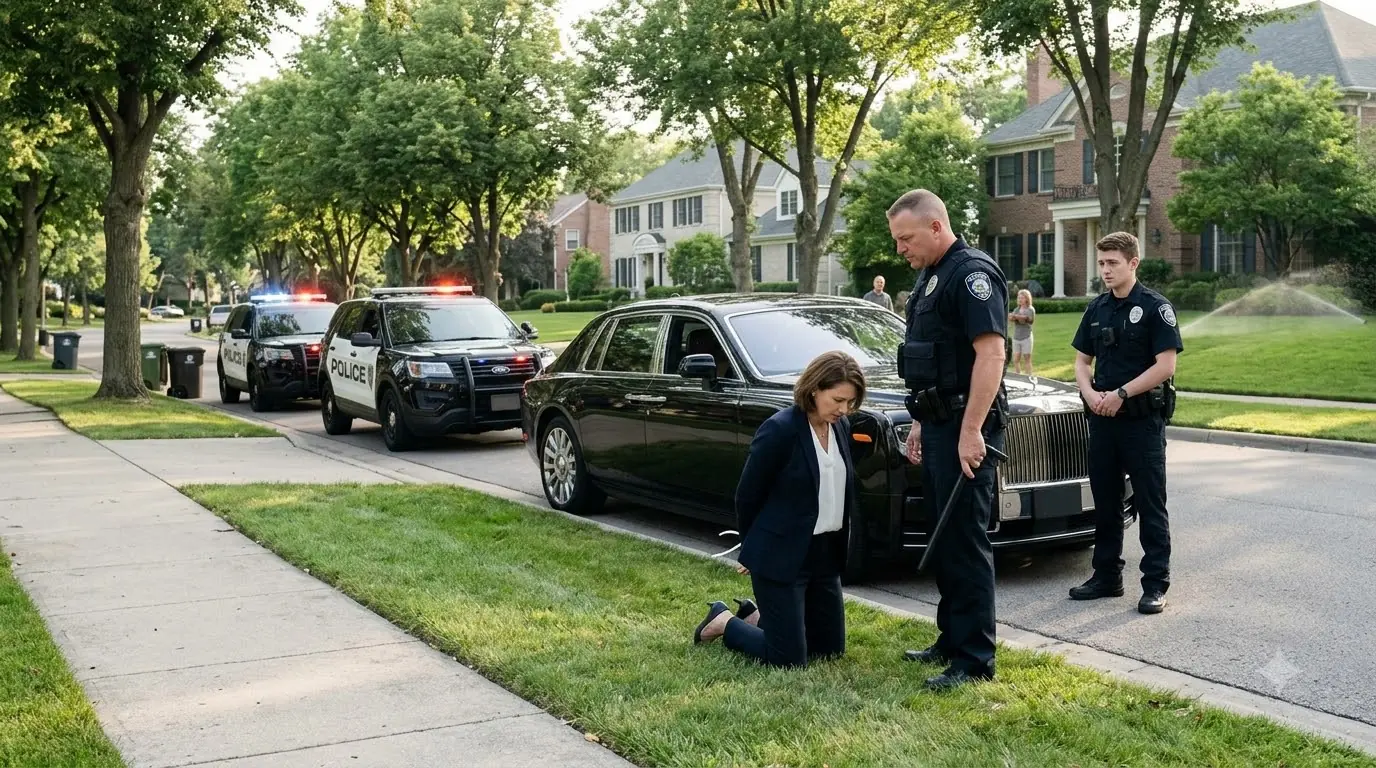
Because you don't get a second chance to be seen as careful." He'd said that a hundred times over 30 years of driving a postal route in a van that rattled at 60 and stalled twice a winter. And he'd said it again the day she signed the papers on the Phantom, 5 years after he died without ever seeing her drive it. The lights had come on behind her without warning. She'd signaled, pulled to the shoulder, put both hands on the wheel where they could be seen. Standard procedure.
She'd taught those same steps to younger agents more times than she could count. Garrity had approached slow, one hand resting on his belt, and looked at the car before he looked at her. License and registration. She'd handed both through the window. He hadn't looked at either.
This your car? Yes. You sure about that? She'd felt the shape of the question before she understood it. Not is this stolen, but does this make sense to me?
Now, on the pavement with the second window gone and a woman she didn't yet know standing frozen on a nearby lawn with her phone half raised and her hand shaking too hard to hold it steady, Renata watched Answer's face instead of Garrity's baton. Answer wasn't watching the car. He was watching her. Wade, he said finally, quiet. The first thing he'd said since the stop began.
She gave you the registration. Garrity didn't turn around. Anybody can print a registration, Miles. That's not Answer stopped himself. Garrity swung the bat a third time, this one lower, into the driver's side door, and the metal folded with a sound like a held breath finally let out.
The woman on the lawn, gray hair pulled back, a cardigan buttoned wrong at the top like she'd dressed in a hurry, or hadn't meant to be dressed at all when this started, took one step toward the street. Officer, she called, and her voice cracked on the word. Officer, I'm I'm recording this. Garrity glanced at her the way a man glances at weather he doesn't plan to change his day around. That's your right, ma'am.
Renata turned her head just slightly, enough to meet the older woman's eyes for 1 second. She didn't nod. She didn't need to. Something passed between them anyway, the particular understanding of two women watching the same thing happen and deciding independently not to look away from it. Garrity crouched in front of Renata, close enough that she could see the sweat at his hairline.
"Where'd you really get this car?" he asked. He didn't ask how she'd paid for it, only how she'd gotten it. Like ownership itself was the part that didn't add up. Renata looked past him at the ruined windshield, at the small crystalline pile of glass gathering in the gutter like it belonged there. "You should call your supervisor," she said, "before this goes any further." Garrity smiled, convinced the expensive car had finally exposed the person driving it.
"I don't need permission to do my job," he said, and stood, and reached for the driver's door handle, the one still attached to its hinges, and pulled. 31 minutes remained. Every one of them was pulling something much bigger toward Ashford County. 6 miles away, inside a federal building, a phone was about to ring because one of its senior agents had just disappeared from a check-in she had never once missed. The door came open before Garrity finished pulling it.
Hinges that had been engineered in Goodwood, England, to close with a whisper now hung crooked, and Garrity reached inside without asking, without looking at Renata at all, and dragged the leather driving gloves off the passenger seat, and dropped them onto the road like they were evidence of something. "Those belong to my father," Renata said. It was the first time her voice had changed all morning, not louder, just tighter, like a wire pulled one more turn. Garrity didn't stop. He pulled open the glove box, scattered the registration papers she'd already shown him twice, knocked her sunglasses case onto the floor mat with the back of his hand.
Each motion small, almost bored. A man going through the gestures of searching rather than actually looking for anything because he'd already decided what he'd find before he started. "I do not consent to a search." Renata said. "Noted." Garrity said in the tone of a man writing something down he had no intention of reading later. Ansah shifted her weight behind her.
"Wade, if she's not consenting, we need probable cause on record before you go further than a plain view check." It was the most complete sentence he'd said all morning and something in it made Garrity go still for half a second before he straightened out of the car. "I've got probable cause." he said. "Luxury vehicle. Driver couldn't produce ID fast enough. Evasive about ownership." "She produced it in 4 seconds." Ansah said.
"I timed it." Garrity turned to look at his partner. The first time all morning he'd taken his eyes off Renata for longer than a glance and the look on his face wasn't anger yet. It was something quieter and more dangerous. Recalculation. He was doing the math on who was still on his side.
"You writing the report?" he said. "Or am I?" Ansah didn't answer. But his hand resting on Renata's shoulder shifted. Not gripping harder, just present. The small unconscious adjustment of a man discovering he no longer knew which side of a line he was standing on.
That was the first thing that changed. Not loudly. Just enough that Renata, on her knees, felt it. A hairline crack opening in the wall of the two men in front of her. Ruth Okafor had lived on Oakhurst Lane for 41 years in the brick colonial with the hydrangeas her husband had planted the summer before his heart gave out.
And in all that time, she had made a private religion out of not getting involved. She'd watched a neighbor's dog get struck by a delivery truck without going outside. She'd watched a teenager pulled from a car two doors down years ago and told herself afterward that it wasn't her business, the way she told herself most things weren't her business. Because that belief had kept her comfortable for four decades. She'd come outside that morning only to bring in her recycling bin.
The phone was already in her cardigan pocket. She didn't remember deciding to take it out, only that her thumb found the record button sometime between the second window breaking and the woman on the pavement closing her eyes once before opening them again. That was the detail Ruth couldn't stop looking at. The woman wasn't afraid. She was waiting.
And Ruth had spent 41 years learning that waiting people were usually the ones who knew something everyone else didn't. Her hands weren't shaking anymore. That surprised her more than anything else that had happened so far. "Where's it registered?" Garrity asked again, flipping through papers as he was no longer reading, holding them now like an accusation rather than a document. "Says here Ashford County.
That check out for you?" "You've read that page twice." Renata said, "I'll read it as many times as I want." "You should call your supervisor." She said, for the third time that morning, quieter now. The words worn smooth from repetition. "You're past the point where this stays small." Garrity crouched in front of her, close enough that she could smell coffee on his breath and underneath it the sour edge of a man whose morning had stopped going the way he'd planned and who had already decided, somewhere below conscious thought, that this was her fault rather than his. "You know what I think?" he said. "I think you borrowed this car.
I think you're testing how far you can push it before somebody finally stops you." "I bought this car." Renata said, "in full." "Five years ago." "With what money?" The question sat there, ugly and specific, and Renata understood, the way she'd understood a thousand times before in a thousand rooms that weren't this one, that he wasn't actually asking. He'd already answered it for himself hours before his lights ever came on behind her. She didn't answer him. She looked instead at Ansa and watched his jaw tighten. His eyes dropped to the pavement.
A man doing arithmetic he didn't like the answer to. Garrity stood, walked back toward the crumpled hood, and drew his baton. Not to strike this time, but to drag it slowly along the fender. A long gray scar opening across black paint from headlight to door handle. Deliberate.
Almost lazy. The kind of damage a man does when he stopped trying to solve a problem and started trying to prove a point. "Please," Renata said, "and for the first time all morning, something in her voice cracked. That car has my father's name on the paperwork. He co-signed it.
He never got to sit in it." Garrity didn't look back at her. "Should have thought about that before you tried this." That was the second thing that changed. Renata had given him four chances now to stop. The registration, the consent, the supervisor, her father's name, and he had used every single one of them as fuel instead of a reason to pause. She filed that away the way she filed everything.
Not as an insult, but as evidence. "Ma'am," Garrity's voice, without turning his head, aimed at Ruth. "You want to put that away before I have a reason to take it." Ruth's thumb didn't move off the button. "Try," she said. The word came out steadier than she expected.
Steadier than anything she'd said out loud in years, and it surprised her enough that she almost lowered the phone out of sheer disbelief at herself. She didn't. Ansa's radio crackled, and this time the words came through clean enough to hear. "Unit 14, dispatch. Need you to confirm a plate registration on Oakhurst.
Coming back registered to a federal employee, category flagged. Advise. Ansars hand went to the volume knob fast, like he could take the sentence back if he turned it down quickly enough. He didn't answer the radio. He looked instead at Garrity, then at Renata, then at the torn registration papers still scattered across the passenger seat.
The same papers Garrity had spent the last 10 minutes not reading. Category flagged? Renata repeated quietly, not quite a question. Garrity's jaw worked once, and for the first time that morning his certainty didn't reach his eyes. "That doesn't mean anything." He said, more to Ansars than to her.
"Could be anything." "Delivery route. Postal contractor." But he didn't reach for his own radio to find out. He turned instead and walked back toward the cruiser, moving faster than he had all morning. And Renata watched him go. Watched the particular urgency of a man who no longer wants an audience for his next decision.
Ansars stayed where he was, radio still humming with the dispatcher waiting on an answer he hadn't given her. His eyes fixed on the scattered papers on the passenger seat, like they might rearrange themselves into something he could still walk back from. Ruth kept recording. And Renata, still on her knees, still bound, understood the one thing neither man standing over her did yet. That the words category flagged were not the end of the sentence.
They were only the first half of it. Garrity didn't answer the radio until he was inside the cruiser with the door shut, which told Renata almost as much as whatever he said into it. The words stayed behind the glass. She could only read the shape of them, short sentences, a pause too long for someone confident in his answer. Then his hand coming up to rub the back of his neck.
The universal gesture of a man realizing a problem has grown past the size he can still manage alone. Answer hadn't moved. He stood by the open passenger door of Renata's ruined Phantom, the dispatcher's voice still faintly audible from his shoulder radio, unanswered. "You should tell them what you heard." Renata said quietly. "I heard a flag." Answer said.
"That's not the same as knowing anything. It's enough to ask a follow-up question." For the first time that morning, he looked at her without weariness. Not suspicion now, something closer to a man recalculating the odds on a bet he'd already made. "You're not going to tell me who you are, are you?" "No." "Why not?" Renata considered the question the way she considered most things, weighing what it would cost against what it would buy. "Because the moment I do, the story stops being about what happened here." she said.
"It starts being about who it happened to. I'd rather you all finish the story you're already telling." Answer didn't have an answer for that. He glanced toward the cruiser where Garrity was still talking, still rubbing the back of his neck, and something in his face suggested he understood exactly what she meant, and didn't like how much sense it made. Garrity climbed out 5 minutes later, jaws set differently than before, not softer, just recalibrated. A man who had decided what story he was going to tell before anyone could ask him for one.
"Dispatch wants confirmation on the plate." he said, to Answer, not to Renata. "I told them we're processing. Arrest stands." "On what charge?" Answer said. "Obstruction. She refused a lawful search.
She declined to consent." "That's not obstruction, Wade, and you know that's not obstruction." It was the sharpest thing Answer had said all morning, loud enough that Ruth, still recording from the sidewalk, lowered her phone half an inch in surprise before raising it again. Garrity turned on him fully and for a moment Renata watched something old pass between the two men, not this morning's disagreement, but the residue of every other morning that had led to it. Every time Answer had swallowed a correction rather than voice one. "You want to keep second-guessing me in front of a suspect?" Garrity said low, "Or you want to help me finish the stop?" Answer didn't answer right away. And in the silence Renata understood something the morning hadn't given her before now, that this wasn't really about her anymore, not entirely.
It was about which version of himself Answer was going to have to live with by the end of his shift. "I'll finish the stop," Answer said finally, "but I'm writing my own supplemental, separate from yours." Garrity's face didn't change, but something behind it did, the particular stillness of a man realizing for the first time all morning that he might not be the only author of what happened here. Six miles away in a windowless office with a Civil Rights Division seal on the door, Agent Priya Nakamura noticed the missed check-in at 11:47 exactly because she always noticed exactly. Renata Cole never drifted. Not by 5 minutes.
Not by 2. In 3 years of coordinating field logistics for the division's regional review, Priya had never once had to flag a missed call from her, not during the Meridian County audit. Not during the week the hospital records subpoena had kept the office lit past midnight. Renata called when she said she would call, the way some people showed up early to funerals. Priya waited 4 minutes before she picked up the desk phone instead of typing a message because some instincts didn't wait for confirmation.
"She's not answering," she told her supervisor, "Cole. She was due in at 11:40." A pause. On the other end, the particular silence of someone doing the same math Priya had just finished. Location ping. Now.
The result came back at 12:03, a residential road in Ashford County, stationary for 11 minutes. Not her assigned route. Not anywhere near it. Priya felt something cold settle low in her stomach. The specific dread of two facts refusing to stay separate.
A federal civil rights agent quietly building a case against exactly that department gone silent inside its jurisdiction. "Get me the county dispatch line." she said. Now. Back on Oak Hurst Lane, Garrity reached for the handcuff key at his belt, not to release Renata, but to walk her to the cruiser when his radio crackled again. And this time, the dispatcher's voice carried a different weight entirely.
"Unit 14, be advised. County's fielding a direct inquiry from a federal switchboard. They're asking specifically about a stop on Oak Hurst Lane. Need you to hold position and confirm status of the individual in custody." Garrity's hand stopped on the key. Renata watched his face do something she'd been waiting all morning to see.
Not fear yet, but the first crack of it. The moment a man's certainty meets a fact it can't absorb. "Copy." he said after a beat too long. "Suspects secured. Everything's documented." He said it like a man rehearsing a line he was no longer sure he believed.
Behind him, Ruth Oak Harbor hadn't lowered her phone once. And Renata, still on her knees, still bound, felt something she hadn't let herself feel yet that morning. Not relief, not quite. Just the quiet certainty of watching a door that had been closed all morning begin, finally, to open from the other side. The first vehicle arrived at the Ashford County Sheriff's Station a little before 3:00.
A A sedan, government plates, two agents in unremarkable suits who asked for the watch commander by name before they'd finished closing their doors. Deputy Miles Anson watched them from the window near the booking desk, his supplemental report still unfinished on the screen in front of him, and felt the particular vertigo of watching something he'd half expected arrive and still not be ready for. Renata Cole sat in an interview room down the hall, wrists finally free of the zip ties, replaced 20 minutes earlier with department-issue cuffs that at least didn't cut. She hadn't asked for water. She hadn't asked for a phone call.
She simply waited with the stillness of someone who already knew real investigations measured time differently. The two agents didn't come to see her right away. They spoke first with Sheriff Kowalski in his office for the better part of 40 minutes, a conversation Renata couldn't hear, but could measure by the silence it left behind in the station's hallway, the way conversations do when they matter. Agent Reyes finally came into the interview room a little after 4:00, alone, her credentials already put away. "Deputy Assistant Director Cole," she said, "I'm Special Agent Reyes, Civil Rights Division.
Your office flagged the missed check-in a few hours ago. We've been coordinating with the county since. I appreciate the coordination." Renata said, and meant it. She understood, better than most, how many phone calls and approvals stood behind those few words. Reyes looked at the faint bruising along Renata's wrist, and something in her expression flattened into professional stillness, the look of someone filing away details she'd need later, rather than reacting to them now.
"I want to be straight with you about where we are," Reyes said. "We've got authorization to begin a preliminary review of the stop. That's not the same as a formal inquiry yet. That still has to work its way through the right offices, given your position. State investigators are already looking at the use of force question independently.
Those two things are going to run in parallel for a while before anyone can say for certain how this gets charged or by who. "That's fair." Renata said. "I'd rather it be done correctly than quickly." "Good." Reyes said. "Because it's going to be neither for a few days at least." Down the hall in Kowalski's office, the sheriff had spent the last hour on the phone more times than he wanted to count. The county attorney, his own department's legal counsel, a state investigator with the Bureau of Criminal Apprehension who'd asked, not unkindly, whether Kowalski wanted to preserve the dash and body camera footage himself or have it collected under chain of custody.
"Collect it." Kowalski had said. "I don't want any version of this where somebody says we had the chance and didn't." He found Garrity in the break room afterward staring at a coffee that had gone cold an hour earlier. "Walk me through it." Kowalski said. "All of it. Now." "She was evasive." Garrity said.
"Wouldn't answer straight about the car." "I had reasonable suspicion." "Reasonable suspicion of what?" Garrity didn't answer right away and in the silence Kowalski understood, the way he'd understood about a dozen deputies over three decades, that the man in front of him had built his version of the morning on a foundation he'd known was thin even while he was laying it. "There's a witness video." Kowalski said. "State investigators already have a copy. The preliminary report says you put a baton through her windshield. Tell me it's wrong." Garrity didn't answer that either.
"There's your problem." Kowalski said quietly. Neither of them said anything else for a long moment. Kowalski didn't reach for Garrity's badge yet. That would come later. Once the state investigator's preliminary findings were in writing.
Once there was a form to attach it to instead of just his own certainty. But he made the call to place Garrity on administrative leave that afternoon, effective the following morning, giving the paperwork time to catch up to the decision he'd already made. It was 2 days before Agent Reyes came back to the department with anything resembling an answer. And by then, Renata had returned to Washington, her statement filed, her wrist no longer bruised so much as faintly yellow at the edges. The review was formally authorized, Reyes told her over the phone.
State's use of force investigation is moving on its own track. They'll likely finish before we do. Honestly, they don't carry the same layers of sign-off we do. But the two will feed each other. An answer?
His supplemental doesn't match Garrity's report on three separate points, Reyes said. That's either the best piece of corroborating testimony we're going to get, or it means we have to look at him with the same scrutiny we're giving everyone else on scene. We haven't decided which yet. Neither has he, I think. Renata was quiet for a moment, thinking of the deputy's hand shifting on her shoulder, not gripping harder, just present.
He'll decide, she said. Give him time. People usually do once the version they wrote down stops being deniable. Reyes didn't answer right away. And in the silence, Renata understood that the investigation, unlike the morning that had started it, was not going to move at the speed of a single held breath.
It was going to move the way real things moved, slowly, through phone calls and approvals and forms, toward a conclusion that would matter more for having taken the time to be right. 3 months later, Renata Cole stood in the driveway of her father's old house, watching a moving truck back out from the postal facility across the street. Not her father's route anymore, hadn't been in years, but the same lot, the same chain-link fence, the same gravel that had once thrown dust onto every uniform he owned. She still came here sometimes. Today she'd come because of a phone call.
The county settled, her lawyer had told her that morning. Full civil resolution and the state's use of force review just closed. Garrity's been charged falsifying his report, excessive force. He's not fighting it. His attorney's already talking plea.
An answer? Cleared. Fully. His supplemental helped out on every point that mattered. Actually, a pause she could hear him deciding how to phrase, is applying to a state civil rights liaison position.
Wanted me to pass along that he hoped you'd remember him kindly, whatever that means to you. Renata had stood in her kitchen for a long moment after hanging up, turning that over. She did remember him kindly. She remembered the exact second his hand had shifted on her shoulder, presence instead of gripping, the first small crack in a wall that had otherwise seemed solid all morning. Ruth answered her door in the same cardigan, buttoned correctly this time, and didn't seem surprised to see Renata standing on her porch.
I wondered if you'd come by eventually, Ruth said. I wanted to thank you properly. Not through a lawyer's letter, Ruth waved that off, but her eyes were bright in a way that suggested the wave meant less than it looked like. I didn't do anything special, she said. I pressed a button.
You pressed it, Renata said. When you'd spent 41 years deciding it wasn't your business to press anything. Ruth was quiet, looking past her toward the street, toward the exact spot where a Rolls-Royce had once nailed a woman on the asphalt in front of her hydrangeas. I keep thinking about it, she said. Not the bad part, the part where you looked at me, just once, like you already knew I'd do it.
I didn't know, Renata said. I hoped. Same thing some days. They stood together in a silence that had already said what needed saying. Then Ruth mentioned, almost shyly, a small laminated card she now kept by her door.
Numbers for the county's civil rights liaison, the sheriff's non-emergency line, a legal aid hotline. She'd given copies to six neighbors. Two more had asked for their own, in case, Ruth said, "Somebody sees something again." The fund had been her lawyer's idea, technically. But Renata had known within a week of the settlement what she wanted to do with the money she didn't need. She named it for her father, the man who had spent 30 years believing that being careful was the only protection people like him got, and who had never once needed protecting from a system, because being careful had always been enough.
Until it wasn't, for someone else, on a road he never drove. The fund covered legal representation for people who couldn't afford to fight a wrongful stop, a false arrest, a report written to justify a decision that had already been made before the first question was asked. It wasn't large, not yet. Renata didn't keep the Phantom. The insurance company had offered to replace it, write a check, order the same model, same color, delivered within the month.
She declined. What she kept was the gloves. They sat now on the passenger seat of an ordinary car, a dark sedan, nothing anyone would ever kick a window in over. She drove it to the cemetery sometimes, the way she used to drive the Phantom, and sat for a while without saying much of anything, because her father had never needed speeches. He needed to be believed.
She picked up the gloves once, on the drive home, at a red light, and held them the way she used to, not out of ceremony, just habit. A city bus pulled up beside her. A little girl sat near the window, watching the world with the same serious expression Renata remembered wearing herself once, on a bus that didn't matter to anyone but her. The girl noticed her looking and gave a small wave. Renata waved back, set the gloves down gently on the seat, and pulled forward when the light changed.
Dignity isn't defended loudly. It's defended by the person who stays calm when they don't have to. The stranger who stops looking away. The partner who writes down the truth instead of the easier version. Renata didn't win because she had power.
She won because she stayed herself when the day gave her every reason not to.
END