"Ma'am, step away from the pool now." Officer Roland Vance's voice cut across the rooftop the way a siren cuts across traffic. Not loud, exactly, but built to override everything else in the air. It wasn't a question. It had never been a question.
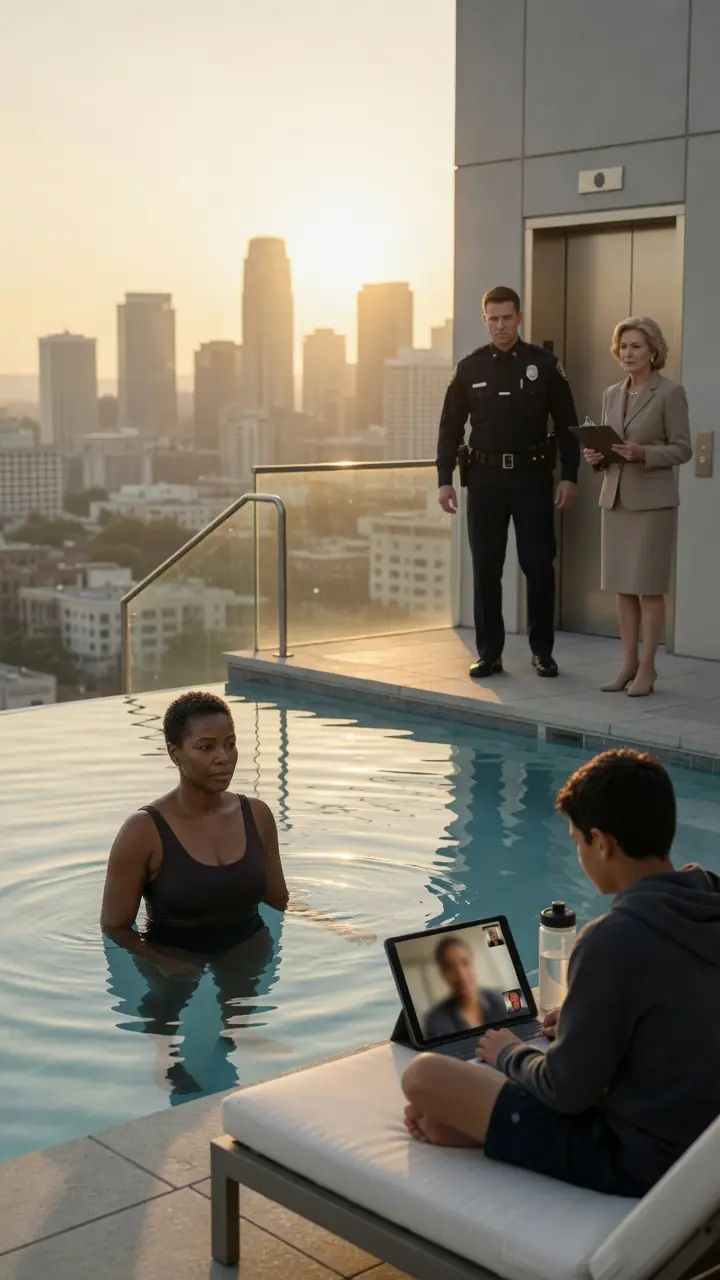
It was a Sunday morning in early October, the kind of morning the city only gets a handful of each year when the sky over the glass towers turns the particular pale gold that makes even strangers on the sidewalk look up. 41 floors below the streets were already humming with brunch traffic and dog walkers. Up here on the rooftop terrace of Meridian Sky Residences. The air was clean and cool, and the infinity edge pool seemed to spill directly into the skyline water and sky blurring at the horizon line.
In a way that had made Naomi Carter stop walking the first time she saw it six weeks ago, holding a moving box against her hip and thinking quietly, "I earned this." She had not said it out loud. She rarely said things like that out loud. 19 years in federal law enforcement had taught her that the people who announced what they'd earned were usually the ones still trying to convince themselves of it. Naomi didn't need convincing.
She had the badge in a drawer downstairs to prove it. And more importantly, she had the specific settled quiet in her own chest that came from finally arriving somewhere after two decades of being told in a hundred small ways that she didn't quite belong yet. She was 43 years old. She had been a field agent in Baltimore at 26, a supervisory agent in Charlotte at 33, an assistant special agent in charge in Phoenix at 38.
And as of five weeks ago, the newly confirmed special agent in charge of the bureau's regional field office, the SAC, the name on the door, the person whose signature now carried the full institutional weight of the Federal Bureau of Investigation across an entire metropolitan division. It was the kind of promotion that came with a security detail recommendation she'd politely declined a media liaison who wanted her photo for an internal newsletter she'd also declined and an unlisted home address that she had insisted on twice in writing because some habits from 19 years of fieldwork didn't disappear just because the title changed. She had told almost no one in the building what she did. Not the doorman, not the building manager, not the people she nodded to in the elevator.
It wasn't shame and it wasn't fear. It was something closer to hunger. A hunger for one place in her life that wasn't about the badge, the title, the weight of being as she had been in nearly every room of her career. The first, the only, the one who had to be twice as composed before she was allowed to be half as direct as anyone else in the room.
At home, she wanted to be Naomi. Just Naomi, a woman with a 12-year-old son and a closet full of works suits she didn't have to think about on Sundays. This particular Sunday, she had the rooftop pool reserved for 9 to 10 residents had to book the amenity through the building app. A small bureaucratic ritual that Naomi appreciated precisely because it created a record, a digital trail, a confirmation number sitting in her phone's inbox with her name and unit number printed clearly at the top.
Old habits. She had learned a long time ago that paper trails were a kind of armor, even when you didn't expect to need one. Her son, Eli, 12, lanky and serious, in the particular way of boys who are starting to realize the world has opinions about them before they've had a chance to form their own. Had come up with her, propped against one of the cushioned lounge chairs near the pool's edge, his iPad balanced against a half empty water bottle.
He was facetiming his grandmother in Atlanta, who liked to watch him just exist on Sunday mornings, as she put it, liked to see the sky behind him and ask him questions about school, that he answered in the patient, slightly bored, monosyllables of a kid who loved his grandmother completely, and had said the same things to her roughly 400 times before. The rooftop itself deserved the kind of attention most residents never gave it, rushing through on their way to the pool chairs without registering the details that made the space what it was. The infinity edge pool ran the entire western length of the terrace. Its surface so still in the early morning that it looked less like water and more like glass laid flat against the sky.
And where the pool's edge met the horizon, there was no visible boundary at all. Water became air became the pale gold haze hanging over the financial district in the distance. The deck itself was a warm gray composite stone heated faintly from below in the colder months. And along its perimeter ran a glass railing 4 feet high, completely clear, engineered to disappear from a distance so that standing at the edge felt like standing at the edge of nothing.
41 stories of open air below your sandals. White cushioned lounge chairs sat in two neat rows spaced for privacy, each with a small side table bolted to the deck. A discrete card reader sat beside the access door, the same one residents tapped their key fobs against to reach the elevator that served only this floor, the building's one true security checkpoint between the lobby and the sky. The whole terrace smelled faintly of chlorine and the specific mineral cleanness of altitude air that hadn't yet been breathed by half a city's worth of commuters.
Naomi swam slow, deliberate laps, the kind of swimming that wasn't about exercise, so much as about the rare sensation of her mind going completely blessedly quiet. She'd learned to swim at 9 in a public pool in Cleveland that closed every winter and required a small act of faith each spring that the water would still feel the same. It always did. Some things she'd found stayed reliable even when everything around them changed.
She let herself think for the length of one slow lap about the swearing in ceremony. Five weeks earlier, the specific weight of the room, the deputy director's handshake, the way her mother had cried in the third row, in a way Naomi had never seen her cry at anything else. Not at funerals, not at her own divorce, only at this, at watching her daughter stand at a podium with three federal flags behind her, and a title that the woman who raised her would never have been allowed to hold in the years when she herself was Naomi's age. 19 years, Naomi thought, turning at the pool's edge and pushing off again, her body cutting cleanly through the warm water.
19 years of being the only one in the room, the only one in the unit, the only one at the table, learning to read a room in half a second because she'd had to learning to keep her face still when a comment landed wrong because reacting would have cost her more than the comment itself. Learning that competence had to be demonstrated twice over before it was simply assumed the way it was assumed automatically for men who looked nothing like her. She had told herself for years that the title when it finally came would feel like relief. It didn't not exactly.
It felt like a door that had finally grudgingly opened, and the specific clarity of standing on the other side of it, looking back at every room that had once made her prove she belonged there was quieter and harder and more permanent than relief. It felt like settling, like exhaling a breath she hadn't fully realized she'd been holding for two decades. She had wanted this Sunday specifically to be ordinawry. No briefings, no protective detail hovering at a discreet distance.
No one calling her ma'am with the particular weight that title now carried. Just water and her son's voice carrying across the terrace in easy half-sentences to his grandmother and the sky doing its slow gold thing over the skyline. The building itself had its own particular texture, the kind every long-term resident absorbed without quite noticing. Meridian Sky Residences had gone up nine years earlier, 43 stories of glass and steel on the western edge of downtown, marketed from the beginning as a building for people who'd arrived.
The developer's actual phrase lifted from an old brochure Naomi had found taped inside a kitchen cabinet by the previous tenant. The building had a homeowners association board that ran with the particular intensity of people who had a great deal of money and very little else to organize around. The board president, a woman named Marjorie Finch, had lived in the building since it opened, had outlasted three building managers and two complete renovations of the lobby and had developed over nine years. A kind of informal vetting process for new residents.
Nothing written down, nothing actionable, just a habit of remembering faces, of noticing who fit, of mentioning to the doorman in the breezy tone of someone making idle conversation that she hadn't seen a particular new face around much. Naomi had met Marjorie exactly twice in six weeks, once in the elevator, once at the mail room, and both times had felt the specific familiar sensation of being assessed rather than greeted. She hadn't mentioned it to anyone. It was a small thing.
Officer Roland Vance was 34 years old, 2 years into his second department after a quiet, unexplained transfer from a smaller suburban force. And he supplemented his patrol income with a private arrangement most of his colleagues didn't know about. And the department had never formally approved a cash arrangement with the Meridian Sky HOA board brokered personally by Marjorie Finch 1eight months earlier in which he provided security consulting on weekends in his off-hours. It was the kind of arrangement that existed in the gray space between moonlighting and conflict of interest, the kind that no one had bothered to examine closely because examining it would have required someone to care enough to ask the question.
Mrs. Loretta Simmons, 6eight years old, retired after 31 years teaching fourth grade at a public elementary school 4 miles from the building, had lived at Meridian Sky for 11 years, longer than almost anyone else on the rooftop that morning, longer than the pool itself had existed in its current renovated form. She was stretched out on a lounge chair near the eastern railing with a paperback. She wasn't really reading the sun warm on her shoulders when she saw Vance step off the elevator and cross the deck with the particular gate of a man who had already decided something before he arrived anywhere.
She had seen that gate before. She had seen it on this exact rooftop twice in 11 years. Both times aimed at residents who looked like her. Both times resolved with a level of unnecessary friction that the building quietly absorbed and never discussed again.
Something tightened low in her stomach, an old familiar unease she recognized immediately, and hated recognizing the specific dread of watching a pattern begin before anyone else in the room had noticed it was a pattern at all. She set her paperback down very quietly and watched. She didn't yet know Naomi Carter's name. She knew her only as the quiet new woman in 14B who swam most Sunday mornings and nodded politely in the elevator and had never once in six weeks given anyone in this building a single reason to look at her twice.
That was about to change. And Loretta Simmons watching Roland Vance cross the deck toward the pool with his thumbs already hooked into his duty belt understood with the particular weary clarity of a woman who had spent 31 years learning to read a room of children and had simply never stopped reading rooms since that she was about to watch something happen that she would not be able to unsee. She thought, watching him close the distance across the deck of the two prior incidents she'd witnessed on this same rooftop over the years. A young black resident questioned harshly over a parking dispute that turned out to belong to someone else entirely.
A delivery driver detained for nearly 20 minutes before anyone bothered confirming he'd been buzzed in by the unit he was delivering to. Both times she had told herself it wasn't quite her place to intervene, that she didn't have all the facts, that speaking up might make things worse rather than better. Both times the moment had passed, absorbed quietly into the building's collective memory, the way uncomfortable things so often were filed away and never discussed again at any board meeting, any hallway conversation, any casual exchange by the mail room. She had carried a small persistent guilt about both of those mornings for years afterward, a guilt she rarely examined directly, because examining it meant admitting that her silence had been its own kind of choice.
Watching Vance approached the woman in 14b, now she felt that same old guilt rise up again, sharper this time, insistent in a way it hadn't been before. And somewhere beneath the guilt, something else was beginning to stir a quiet gathering resolve. That this time, whatever happened, she was not going to stay silent the way she had the two times before. "You don't look like you belong up here." Vance said it flatly.
The way a man states a fact he's already decided isn't up for debate. Naomi had reached the shallow end of the pool moments before drawn there by some instinct that had kept her alive through three different field assignments. The specific awareness learned early and never unlearned of a body entering her space with intent. She stood in waist-deep water, the warm pool water lapping gently against her ribs, steam rising faintly off the surface in the cooler morning air, and looked at him with an expression that was deliberately neither hostile nor pleading, simply present, simply clear.
"Good morning," she said. "I have the terrace booked from 9 to 10. I can show you the confirmation." "I didn't ask you a question," Vance said. "I need to see a key fob now." "My fob's in my bag on the chair." She nodded toward the lounge chair 10 feet away where her towel sat folded beside her phone and a small canvas bag.
"I'm happy to show you. I can also pull up the reservation on my phone right now if that's easier." "Digital records can be faked," Vance said. "I need the physical fob and I need to see some ID." Something in Naomi's chest tightened, not into fear she had not felt simple fear. In a professional context in close to two decades.
Not the kind that made the body do something stupid, but into the specific controlled calculation she recognized from a 100 field situations that had nothing to do with badges or jurisdiction. She was standing in a swimsuit in a pool off duty in a city where this man's uniform meant he could, if he chose to escalate this into something that had nothing to do with facts and everything to do with his own certainty. She felt her pulse climb slightly and consciously slowed her breathing four counts, in four counts out a technique she'd taught to a dozen junior agents over the years. For exactly this kind of moment.
Not danger exactly, but the precursor to it, the narrow window, where deescalation was still possible, if the other person in the room was willing to take it. She kept her shoulders level. She kept her voice even. She had no jurisdiction here.
None. Not as a private resident standing in a pool on a Sunday morning and some old stubborn part of her almost found that funny 19 years of federal authority and in this exact moment in this exact pool. She had no more standing than anyone else breathing the rooftop air. "Officer," she said, "I understand the concern.
I'm a resident. I've lived here six weeks. My name is Naomi Carter, unit 14B. I'd like to step out and get my ID for you." "Stay where you are for a second," Vance said, and something in his posture shifted, not quite relaxing, but settling into the rhythm of a man who had done this exact exchange enough times before to know how it usually went.
He glanced toward the access door as it opened again. Marjorie Finch crossed the deck with the brisk, proprietary stride of a woman walking through her own living room. She wore a cream cardigan despite the warm morning and carried a clipboard she didn't actually need for anything the kind of prop that gave her presence an air of official business. She nodded at Vance the way people nod at someone they've already agreed with before the conversation has happened.
"Roland," she said. "What's going on?" "Checking a guest situation," Vance said "Says she's a resident in 14B." Marjorie looked at Naomi for the first time and something crossed her face that Naomi recognized instantly and had spent 19 years learning not to react to not recognition, not warmth, just a flicker of recalibration, the specific expression of someone trying to place a face into a category and not quite succeeding. "I don't recall seeing you at any of the building meetings," Marjorie said. It wasn't a question.
"I work a lot," Naomi said. "I haven't had much chance to attend." "We've had break-ins before," Marjorie said to Vance. Now, not to Naomi, as though Naomi had become a subject under discussion rather than a person in the conversation. Two years ago, before your time on this contract, we have to be careful who we let use the amenities.
"It's not personal. It's a liability issue for the whole building." Naomi heard every word of it. She had heard versions of this sentence in different rooms across 19 years. "It's not personal.
It's a liability issue. It's just protocol. It's just procedure." Each one a small, deniable brick in a wall that somehow always ended up built around the same kinds of people. Eli, 12 feet away on his lounge chair, had gone very still, his iPad still propped against the water bottle.
A FaceTime call with his grandmother, still connected her face, a small frozen square in the corner of the screen, watching everything unfold over her grandson's shoulder. He hadn't moved to end the call. He hadn't thought to. He had simply frozen the way kids freeze when the adults around them start behaving in ways that don't match the rules they've been taught about how adults are supposed to behave.
And the iPad's camera angled where he'd left it to catch his own face for the call was also catching in the wider frame behind him. The entire rooftop terrace, the pool, the lounge chairs, his mother standing in waist deep water. Officer Vance Marjorie Finch with her clipboard. None of them noticed the iPad at all.
It was just a kid's device propped against a water bottle doing what kids' devices do on a Sunday morning. His grandmother, 1,400 miles away in a kitchen in Atlanta, leaned closer to her own screen, her coffee going cold on the counter, and did not say a word because some instinct, the same old, weary instinct Loretta Simmons had felt on the rooftop. The instinct of a woman who had lived 6eight years in a body the world had taught her to read carefully told her that the smartest thing she could possibly do right now was stay exactly silent and let the call keep recording. What none of them knew, not Naomi, not Marjorie, not Eli, not even fully his own department's leadership, was that Roland Vance's personnel file sitting in a record system 11 miles away already contained three formal complaints.
The first filed 1four months earlier alleged that Vance had detained a black motorist for 11 minutes over a broken taillight that two independent mechanics later confirmed was functioning correctly. The complaint had been administratively closed for insufficient corroboration. The second filed nine months earlier came from a college student who said Vance had searched his car without consent during a traffic stop near campus. That complaint too closed for lack of corroborating evidence.
The kind of phrase that appeared so often in his file, it had nearly become a formality. The third filed eight months earlier was the most serious a use-of-force complaint from a domestic disturbance call in which a bystander's phone video showed Vance shoving a man who had his hands raised. That review had taken 11 weeks and concluded with a finding of inconclusive a note in the file that the footage did not definitively contradict the officer's account, even though three people who'd reviewed it informally said otherwise. Each closure carried the same supervising signature, a deputy watch commander named Harlan Reyes, a man known among the rank and file for moving complaints through the system quickly and quietly for reasons that had never been formally investigated and probably should have been.
Vance had absorbed each of these closures the way a man absorbs proof that he was right all along. Three complaints, three clean closures. In his own accounting, that wasn't a pattern of concern. It was a pattern of vindication.
His current partner, Officer Dana Marsh, 26 years old and 11 weeks past her field training, was not on the rooftop that morning, she dropped him off for what she understood to be a scheduled maintenance check. Unrelated to patrol duty, an arrangement she'd noticed before, and quietly found strange, but hadn't yet found the nerve to ask about directly. She would learn what happened on the rooftop later that day secondhand, the way most uncomfortable truths in a department arrive through a hallway conversation rather than a formal briefing. And she would recognize hearing it the exact shape of something she'd already seen twice in her short 11 weeks, writing with him the specific tone Vance used when he'd already decided someone was guilty of something before he'd asked a single real question.
Three complaints, three closures, a pattern hiding in plain sight inside a filing system nobody had bothered to really look at. Naomi made one more attempt at the kind of deescalation she had taught to junior agents a hundred times over. "Officer," she said, keeping her voice level. "I'd like to call the building manager directly.
If you give me 30 seconds, I can confirm my reservation and my unit number with someone in management. That should resolve this completely." Vance considered this. Something in his shoulders eased just slightly, and for one brief, almost weightless moment, Naomi felt the specific fragile relief of watching a tense situation tipped toward resolution. Marjorie even gave a small nod, as though the suggestion had restored some sense of order to a process she preferred to think of as orderly.
"Fine," Vance said."30 seconds." Naomi reached for her phone on the side table, dialed the building management line from the directory saved in her contacts, and held the phone to her ear. It rang four times. Five. Then the automated voice she'd been afraid of hearing, "You have reached Meridian Sky Residences management office.
Our office hours are Monday through Friday, 9:00 a.m. To 5:00 p.m. Please leave a message or contact the front desk for urgent matters." It was Sunday. Of course it was Sunday.
The relief she'd felt 30 seconds earlier collapsed all at once, replaced by the specific sinking recognition that the one clean off-ramp available to her had just closed. "No answer," she said, lowering the phone. "It's Sunday. The office is closed.
I can call the front desk instead." "Or you tried to call someone who didn't answer," Vance said, and something in his tone had hardened again. Sharper now than before, as though the failed call had confirmed rather than complicated his suspicion. "That's convenient." Naomi felt the moment tip fully finally passed the point of reason, and in the half second it took her to process that shift. Something in her settled into a different kind of clarity.
Not panic, not even real anger, but the specific deliberate calm of a woman who had spent 19 years building cases against people exactly like the man standing in front of her, and who understood with absolute precision the value of letting a situation finish writing its own record before intervening. Her real ID, federal credentials badge, everything that would end this in under 10 seconds, sat in the zippered inner pocket of her canvas bag 6 ft away on the lounge chair. She could reach it. She chose not to, not yet.
She had built enough cases over the years to know that the most damning evidence wasn't the moment someone finally got caught. It was everything they did and said in the minutes before they realized they would be. Let him finish, she thought. Let him say exactly what he's going to say.
Let this build itself brick by brick the way it's already started to because once it's built, no one will be able to take a single piece of it back down. "On your knees," Vance said, "hands where I can see them." "Officer, I am a resident of this." "I'm not going to ask again. Knees now." The pool deck was warm beneath her heated, faintly from below, even in the cool morning air, and Naomi lowered herself onto it slowly, deliberately, water still running in thin lines down her arms and legs, steam curling faintly off her wet skin where it met the cooler air. Mrs.
Simmons rose from her lounge chair across the terrace, her paperback sliding off her lap onto the deck, forgotten. "I've lived in this building 11 years," Loretta Simmons said, her voice carrying clearly across the pool, shaking slightly, but holding steady underneath the shake."11 years? I have never once, not one single time, seen you ask a white resident at this pool for ID." "Not once." Vance didn't look at her. "Ma'am," please stay back." "I am staying back," Loretta said.
"I'm just telling you what I've seen." A few other residents had drifted toward the access door by now, drawn by the particular electric stillness that settles over a space when something is visibly undeniably wrong. A man in his 30s paused near the elevator with a coffee cup halfway to his mouth. A young couple by the railing who had stopped their own quiet conversation entirely. All of them watching with the specific complicated paralysis of people who sense an obligation to act and feel simultaneously the powerful social gravity that keeps most people rooted exactly where they're standing.
No one moved to intervene. No one moved to leave either. The morning held its breath. Vance stepped behind Naomi, pulled her wrists back, and closed the handcuffs with a metallic sound that seemed in the open air of the rooftop unnaturally loud.
"People like you," he said low enough that only she could hear it. "Always think there's some kind of exception for them." "There isn't." Naomi said nothing. She knelt on the warm stonecuffed water still dripping from her hair onto her shoulders and looked out past the glass railing at the skyline she'd fallen in love with six weeks earlier, the same gold morning light spilling across the same impossible view, and let the moment finish happening exactly the way it was happening because she had already decided somewhere in the last 90 seconds precisely what she was going to do once it was over. Eli's iPad, 12 feet away, kept recording.
His grandmother's face remained perfectly still on the small screen in the corner, her eyes wide, her mouth pressed into a thin line, watching her granddaughter's daughter, a woman who had spent 19 years building a career on the principle that the law applied equally to everyone being handcuffed on the floor of a rooftop. She had every legal right to be standing on. "Eli, baby," she said quietly, her voice barely above a whisper, careful not to be heard by anyone but him. "Don't stop filming.
Whatever you do, don't stop." The warm stone pressed against Naomi's bare knees. A strange contrast to the metal of the cuffs biting cool against her wrists, and the smell of chlorine hung thick in the morning air, mixing with the faint mineral scent of the heated deck below her. Somewhere behind her, the pool's filtration system hummed its same steady note, indifferent to everything happening above it. The city noise drifted up from 41 floors below.
In a soft, distant wash, a horn, a bus break, the general murmur of a Sunday morning that had no idea anything unusual was happening so far above it. A breeze moved across the terrace cool against her wet shoulders. And somewhere nearby, a phone's camera shutter sound, clicked once, twice, someone finally finding the nerve to document what they were seeing, even if they weren't yet brave enough to speak. Marjorie Finch stood a few feet back, her clipboard now held against her chest, like something to hide behind her expression, caught somewhere between satisfaction and a flicker of doubt she wasn't yet ready to examine.
She had built this building's culture of quiet vetting over nine years, one unspoken assumption at a time, and some old stubborn part of her still believed even now, watching a woman kneel in handcuffs on her own rooftop, that this was simply what diligence looked like. Officer Vance straightened surveying the small audience that had gathered near the access door with the satisfied posture of a man who believed he had handled the situation correctly, who believed in fact that he would be commended for his thoroughness rather than questioned for it. He had no way of knowing that 11 feet away, a child's iPad had captured every word he'd said, every gesture, the exact tone he'd used when he told a kneeling woman that people like her didn't get exceptions. He had built his entire career, three complaints and three closures on the quiet assumption that there would never be a record good enough to contradict him.
He was about to learn in a way far more permanent than any of his three prior incidents exactly how wrong that assumption had been. They walked Naomi through the lobby in handcuffs, a towel draped over her shoulders by Loretta Simmons. In the elevator, a small fierce act of dignity that Vance hadn't bothered to object to, mostly because he hadn't bothered to notice it at all. The lobby's marble floor, usually a source of quiet pride for the building's residents, felt that morning like a stage no one had asked to be performing on.
A handful of residents stood near the mail room and the concierge desk frozen in the specific way people freeze when they sense they're witnessing something that demands a response and don't yet know what response is safe to give. A man in running clothes lifted his phone halfway, recording for 3 seconds, then lowered it again, glancing toward the doorman as though checking whether this was something he was allowed to be doing. A woman near the elevator bank, pressed her hand briefly to her mouth, and said nothing. The doorman, a young man named Curtis, who had worked the morning shift for 2 years and prided himself on knowing every resident by name, looked directly at Naomi as she passed.
Recognition, flickering, then uncertainty, then a kind of practiced neutrality that let him look away without having to decide what looking away meant. He had seen her dozens of times. He knew her face. He said nothing and would spend the rest of that day turning over privately exactly why he hadn't.
Only Loretta Simmons followed them all the way to the curb. Her own phone raised now recording steadily, her voice calm and clear as she narrated for the camera the unit number, the time the officer's name read off his visible badge, the fact that she had personally witnessed the entire interaction from its very first moment. She did not flinch when Vance told her to step back. She stepped back exactly one foot and kept recording.
In the patrol car, Naomi sat in the back seat, wrists cuffed behind her, watching the building recede through the window as they pulled away from the curb. Vance talked to no one in particular about a football score from the night before. His voice easy, almost cheerful, the performance of a man settling back into the comfortable rhythm of an ordinary Sunday shift. Officer Dana Marsh, who had rejoined him at the corner two blocks from the building, said nothing at all.
She sat in the passenger seat with her hands folded in her lap in looking out the window and felt something cold settle low in her stomach that she didn't yet have words for. Dana Marsh had been a police officer for 11 weeks. She had joined the department with the specific earnest intention of doing the job well. She had told her field training officer in her very first week that she wanted to be the kind of cop who made people feel safer rather than smaller.
And her training officer had smiled in a way that she'd later understood was equal parts approval and quiet exhaustion at how often rookies said exactly that and how quickly some of them stopped meaning it. She had ridden with Vance for six of her 11 weeks since her original training officer rotated to a different shift. And she had noticed things, small things at first, things she'd told herself were probably nothing. The way he asked certain people for ID and waved certain other people through with a friendly nod.
The way his voice changed register depending on who he was talking to, dropping into something harder, flatter, more clipped. She had said nothing about any of it, not once, not in 11 weeks, because she was the rookie and he was the senior partner, and the unspoken architecture of the job had taught her faster than any academy class ever could. That speaking up came with a cost that nobody officially listed anywhere, but that everyone quietly understood. Sitting in the passenger seat, now watching the building disappear.
In the side mirror, she understood with a clarity that made her stomach drop that she had just watched the third version of something she'd already half recognized twice before, and that her silence both times had been its own kind of decision, one she was only now starting to feel the full weight of. She said nothing for the rest of the drive. She wrote nothing in the small notebook she usually kept in her left breast pocket, a habit she'd carried over from the academy. Her silence this time felt different to her than it had the two times before.
Heavier, more deliberate, the kind of silence that demands to be reckoned with eventually rather than simply absorbed and forgotten. The booking process at the precinct took just under 40 minutes. Fingerprints photograph personal property logged into a clear plastic bag. Naomi's bag contained her phone, a building access fob, a set of car keys, and a small zippered pouch.
She hadn't been given the chance to open the one containing her federal credentials, sitting now, sealed in evidence plastic on a shelf in a property room 11 feet from where she sat. She had run through the calculation in her head a dozen times already by the time the booking sergeant finished processing her, and she kept arriving at the same answer. She would not call her deputy. She would not call the US attorney's liaison office.
Though she had the direct line memorized the way she had memorized every important number in her professional life for the better part of two decades. She would not under any circumstances use her position to shortcut what was happening to her right now because she understood something that 19 years of building federal cases against people who'd abused exactly this kind of power had taught her in granular hard-won detail the value of a record built completely honestly without interference was worth more than the relief of ending this five minutes sooner. If she called now, this became a story about a powerful woman flexing her connections. If she let it finish, let every report get filed.
Let every assumption get written down in ink that couldn't later be quietly revised. This became something else entirely, an unimpeachable record of exactly what had happened and exactly why it was wrong. The kind of record that survives, appeals, survives, spin, survives, the specific kind of institutional amnesia that swallowed Roland Vance's first three complaints without a trace. She thought of her son's iPad 12 feet from the pool, the FaceTime call that had never disconnected, and felt something close to relief settle alongside the calculation, though she didn't yet know exactly what it had captured.
She sat in the holding room. They placed her in the third room on the left. A fluorescent light overhead that flickered every few seconds in a way that suggested a maintenance request someone had filed and nobody had gotten around to addressing and folded her cuffed hands in her lap and waited the way she had taught dozens of junior agents to wait during long surveillance shifts. Patient alert conserving energy for the moment it would actually be needed.
She had the power to end this in under a minute. And she chose not to use it not out of fear, but out of strategy, because she understood that the way you respond to an injustice can matter just as much as the injustice itself. Back at Meridian Sky on the 41st floor, Eli sat very still on the lounge chair for almost a full minute after the elevator doors closed behind his mother. The iPad still in his hands, the FaceTime call still connected, his grandmother's face still frozen on the screen with an expression he had never seen her wear before.
"Grandma," he said, his voice small. "What do I do?" His grandmother, 1,400 miles away, took a breath he could hear clearly through the speaker. The specific steadying breath of someone choosing every word with enormous care. "Listen to me very carefully, baby," she said.
"First, I need you to save that video in two places. The cloud and on the iPad itself right now before you do anything else. Can you do that?" "Yes." "Good. Don't post it anywhere.
Not yet. I know you might want to, and I know it feels like the video is the most important thing right now, but trust me on this. Not yet." There's a number I gave you a long time ago, a long time before any of this, and I need you to remember why I gave it to you. Eli's hands were shaking slightly, but he nodded even though she couldn't see it through the angle of the call.
"Deputy Holloway," he said. "Mom's deputy. You said if anything ever happened and Mom couldn't call herself, I should call him directly." "That's right. Do that now.
Tell him exactly what happened, exactly where you are, and that you have video. Can you do that?" "Yes." "I love you. You're doing exactly the right thing. Go." Loretta Simmons found Eli a few minutes later still on the lounge chair, his iPad clutched against his chest, his eyes red but his hands steady now, having just finished a short, careful call to a man named Deputy Holloway, who had gone very quiet on the other end of the line before saying in a tone Eli would remember for a long time, "Stay exactly where you are.
I'm coming to you myself." Loretta sat down on the chair beside him without a word. The way a woman who had spent 31 years calming nervous children in a classroom knew exactly how to do and simply stayed there, a steady, quiet presence until the elevator doors opened again and a tall man in a plain gray suit stepped out, moving with the particular unhurried urgency of someone who had done very serious things very calmly his entire career. Back at the precinct, officer Dana Marsh sat alone at her desk during a lull in the booking area. The intake paperwork for the morning's arrests spread out in front of her.
She told herself she was simply double-checking the documentation, a small ordinary act of diligence that wouldn't draw attention to itself. She pulled up the building's verified resident registry, a database the department had access to through a standard information sharing agreement with major residential properties in the city used mostly for welfare checks and noise complaints and typed in the address from Naomi's booking sheet. The registry returned a clean, simple result. Carter Naomi unit 14B verified resident active since six weeks prior.
Vance had never run it. He'd told the booking sergeant the address wasn't verifiable on short notice, a phrase that Marsh now realized with a slow sinking certainty simply meant he hadn't bothered to check. She felt the realization land in her stomach like something physical, a cold, heavy drop that spread slowly outward until her hands resting on the keyboard felt strange and distant, not quite her own. 11 weeks into this career and she was sitting at a desk holding proof, simple, verifiable, indisputable proof that the man she rode with every shift had arrested a woman for a crime that a 30-second database check would have shown never happened at all.
She thought about the two times before the two moments she'd noticed something and said nothing, and she understood with a clarity that felt almost violent in its suddenness that there would not be a third time. Not this time. She closed the registry window, picked up the booking file, and walked it directly to her supervisor's office, her hands steady now in a way they hadn't been a moment before. The specific steadiness of someone who has just made a decision she will not be talking herself out of.
The booking sergeant who had processed Naomi, a heavy set man named Pete Navarro with 22 years on the job and a face built for patience had handled her intake with the same professional efficiency he extended to every detainee neither warmer nor colder than procedure required. He'd photographed her, fingerprinted her, logged her belongings into the clear plastic bag with the careful, repetitive motions of a man who had performed this exact sequence thousands of times. Somewhere in the middle of it, something about her face had nagged at him quietly, a half-formed sense of recognition he couldn't place the specific itch of having seen a photograph somewhere recently without remembering the context. He'd shrugged it off.
People often looked vaguely familiar in a city this size. He had no way of knowing that the photograph he was half remembering had circulated through the department's own internal bulletin. Two weeks earlier, an announcement mostly ceremonial regarding the new regional special agent in charge, who would be coordinating more closely with local law enforcement on joint task force matters going forward. He had skimmed it once, the way most patrol officers skim bulletins that don't immediately concern their own shift, and filed it away in the part of his memory that holds things loosely ready to be displaced by something more urgent.
Naomi noticed his hesitation, the brief furrow of his brow, as he glanced at her a second, and then a third time, and said nothing. She had learned long ago that some recognitions take their own time to surface, and that rushing them rarely helped. The holding room itself held the particular accumulated texture of a thousand other ordinary mornings gray cinder block walls painted over so many times the corners had gone soft and rounded. A stainless steel bench bolted to the floor cold, even through the thin countyissued blanket someone had eventually given her.
The fluorescent light overhead flickered in a steady, almost hypnotic rhythm every 8 to 10 seconds, just often enough to notice and just rarely enough to never quite get used to. Somewhere down the hallway, a phone rang four times before someone picked it up. A door opened and closed with a heavy magnetic click. The air smelled faintly of bleach, layered over something staler beneath it.
The smell of a room that got cleaned often and aired out rarely. Naomi sat with her back straight against the cold wall, her wrists finally free of the cuffs, but still faintly marked where the metal had pressed against her skin, and counted the flickers of the light without meaning to, the way the mind reaches for small controllable patterns when everything else around it has slipped out of her hands. Two hours passed this way. She did not ask for a phone call.
She did not ask for a lawyer. She did not ask for anything at all. And the deputy stationed near the holding area noted in the log he kept of unusual behavior among detainees that the woman in room three had been the calmest, quietest detainee he'd processed in months. A detail he would think back on later with a very different kind of significance.
In her supervisor's office, Dana Marsh laid the booking file and the registry print out on the desk in front of Sergeant Wallace, a broad shouldered man in his 50s with 2eight years on the job and the specific weathered patience of someone who had seen nearly every version of nearly every mistake a department could make. "I think we have a problem," Marsh said. Officer Vance brought in a trespassing arrest from Meridian Sky this morning. I ran the registwry.
The address checks out clean. She's a verified resident active for six weeks. He never ran it himself. Wallace looked at the printout for a long moment, then up at her.
"You're sure about this?" "I'm sure," Marsh said. "I checked it twice." Wallace exhaled slowly through his nose. The particular exhale of a man recalculating the next hour of his day. "Where is she now?" "Holding room three." "Pull her full intake file," Wallace said.
"I want to see exactly what Vance wrote before I walk down there." He read the report twice, his jaw tightening slightly on the second pass at the line where Vance had characterized Naomi as uncooperative and evasive. Regarding identification, a characterization that set beside what Marsh had just told him was beginning to look less like an account of events and more like a story a man had told himself to justify what he'd already decided to do. Standard procedure for any detainee claiming federal employment, a line Naomi had given the booking sergeant, calmly, almost as an afterthought that Vance had dismissed in his own report, as an unverified and likely false claim made to avoid processing, required a secondary check through a federal liaison database before formal charges were filed. It was the kind of procedural step that existed for exactly this situation and was in practice skipped more often than it was followed simply because most claims like it turned out to be exactly what Vance had assumed this one was.
Wallace decided for reasons he could not have fully articulated even to himself not to skip it this time. Out at his own desk, Roland Vance was finishing his report with the unhurried, satisfied posture of a man closing out a productive morning, his handwriting quick and confident in the narrative section, the same posture he'd carried through three prior reports that had each in their own time simply disappeared into the quiet administrative machinery of insufficient corroboration. He didn't look up when Marsh walked past his desk a second time, her face carefully neutral on her way back from Wallace's office. He had no particular reason to notice her at all.
He was thinking, if he was thinking about anything beyond the report in front of him, about lunch, about the rest of an ordinary Sunday shift stretching out ahead of him, exactly the way every other shift had stretched out before it, uneventful, unexamined ending the same way it always ended, with him driving home at the end of the day, having long since stopped wondering whether any of it would ever catch up to him. He had built eight years on the job around a quiet foundational certainty that it never would. Three complaints, three closures, a pattern. He read not as a warning, but as evidence that the system, whatever its other faults, had his back.
He had no way of knowing, finishing the last line of his report, with a small, satisfied flourish that 11 feet away, a sergeant with 2eight years on the job, was about to type a name into a database that didn't care about pattern, didn't care about closures, didn't care about anything except a single simple binary fact about to surface on a screen. A fact that would end in the space of about four seconds. Every assumption he had ever made about what he could get away with. Sergeant Wallace typed Naomi Carter's full name into the federal liaison database from his own terminal, a system used rarely enough that he had to pause for a moment to remember the correct login sequence.
He entered her date of birth from the booking sheet, hit enter, and waited. The screen took four seconds to return. A result, four seconds that felt considerably longer to a man who had spent 2eight years developing a fairly reliable instinct for when something was about to go badly. When the result populated, it didn't appear in the soft gray text.
Most database queries returned. It appeared in a hard red banner across the top of the screen. The kind of formatting reserved for flags significant enough to interrupt routine processing entirely. Active federal law enforcement personnel.
Do not detain contact regional FBI field office. Immediately, special agent in charge, regional division. Wallace read it once, then he read it a second time, more slowly, as though rereading it might change what it said. It didn't.
He felt the specific sinking weight of a man recalculating not just the next 20 minutes of his morning, but potentially the next several months of his career. And beneath that, underneath the professional dread, something colder and more personal. The recognition that a woman had been kneeling in handcuffs on a rooftop two hours ago, while wearing essentially the exact authority that the document in front of him was telling him, in no uncertain terms he should have checked for immediately. He stood up from his desk, smoothed the front of his uniform shirt, out of an old habit he didn't examine too closely, and walked toward the holding area with his own badge case in hand.
Not because he doubted who she was, but because verification protocol existed precisely for moments like this one, and he intended to follow every single step of it correctly for once, starting now. He opened the door to room three. Naomi looked up from the bench, her expression calm, unreadable, the same composed stillness she had carried through every minute since the cuffs first closed around her wrists. Wallace stood in the doorway for a moment, his own badge case held loosely in his right hand, and asked the question with a careful, deliberate formality that hadn't been in his voice an hour earlier.
"Ma'am," he said, "I need to ask you directly. Are you Special Agent in Charge Naomi Carter?" "Yes," Naomi said. "I am." The room went still in a way that seemed to physically change the air inside it. Wallace's hands, Naomi noticed, were not quite steady as he opened his own credential wallet out of habit, an unnecessary gesture in this moment, but one his body performed anyway some old procedural reflex firing without his permission.
The federal liaison flag on his screen had described her title in clinical bureaucratic language. But standing in front of her now, watching the specific settled clarity in her eyes, he understood with sudden total certainty exactly what kind of mourning his department had just had. Five full seconds passed in complete silence the fluorescent light flickering once, twice above them both. A faint sheen of sweat had appeared at his hairline despite the room's cool temperature, and his mouth, when he finally spoke again, was noticeably dwry.
"I—" He started, then stopped, then started again. "Ma'am," I owe you a formal apology, and I intend to give you one, but first I need to correct this immediately. You should never have been detained. I'm releasing you right now, this moment, and I'm beginning a full review of everything that happened this morning.
Naomi nodded once slowly. She did not smile. She did not let any flicker of satisfaction cross her face, because what she felt in that moment wasn't triumph. She had expected this outcome from almost the first minute.
The cuffs closed had built the entire morning's patience around the calm working certainty that the facts, once properly checked, would resolve themselves exactly this way. What she felt instead was something quieter and more familiar. The specific settled expression of a woman who has simply been handed precisely what she expected all along the way a careful investigator feels watching a case conclude the way. The evidence always pointed it would.
"Thank you," she said, "I'd like my belongings returned, and I'd like to understand when you're ready exactly what happens next in terms of process. I'm not interested in skipping any steps. I want this handled correctly, start to finish." Wallace personally called the regional FBI field office's duty line. From his own desk phone, his voice noticeably more careful than it had been an hour earlier.
The agent who answered recognized the name the moment Wallace said it and went quiet for a beat before responding. "You have her in a holding cell right now?" the duty agent asked, his tone shifting from routine to something considerably sharper. "She's been released," Wallace said. I wanted to notify your office directly and confirm the appropriate next steps given the circumstances.
"What circumstances?" The agent said, and Wallace, in the most careful, measured language he could manage, explained. At his own desk across the room, Roland Vance was finishing the last details of his report when his watch commander appeared at his shoulder and told him in a flat, unreadable tone that Sergeant Wallace needed to see him immediately. Vance felt a small flicker of irritation, nothing more the irritation of a man pulled away from paperwork. He considered already finished a minor inconvenience in an otherwise unremarkable morning.
He had no particular sense of dread walking toward Wallace's office. No instinct firing the way Dana Marsh's instincts had fired hours earlier, watching him work the rooftop. He had built eight years of certainty on the foundation that nothing he did would ever actually catch up to him. And that certainty walking down the hallway toward a conversation that was about to dismantle it completely hadn't wavered even slightly.
He was thinking if he was thinking about anything at all about whether there was still time to grab lunch before his shift ended. He knocked once on Wallace's door and stepped inside completely unaware that he was about to learn in the next 4 minutes exactly how wrong he had been about everything. Wallace didn't waste time. "Sit down," he said.
"What's this about?" The woman you brought in this morning from Meridian Sky, Wallace said. "Naomi Carter. Trespasser," Vance said. "Couldn't produce ID.
Refused to cooperate. Evasive about—" "She's the regional FBI Special Agent in Charge," Wallace said. "Confirmed verified resident of the building for six weeks. You never ran the address." Vance opened his mouth and for a moment nothing came out at all.
He felt something cold drop through his chest. The specific vertigenous sensation of watching the floor of an assumption disappear beneath him with no warning at all. The same floor he had stood on comfortably for eight years without ever once checking whether it was solid. His mind reached automatically for the same explanations that had worked three times before.
She was uncooperative. She didn't have ID on her. The report reflects exactly what I observed and found for the first time that the words felt thin and useless even inside his own head before he'd said a single one of them out loud. He thought with a strange distant clarity of the three prior complaints, sitting quietly in his file, each one closed, each one absorbed, each one teaching him the wrong lesson.
At exactly the moment it should have taught him the opposite. He understood sitting in that chair that this time was going to be different. Though he didn't yet understand how different or how completely the next several weeks were about to unmake the version of his career he had spent eight years building on a foundation that had just finally been tested and found completely hollow. "I want a union rep," he said his voice considerably smaller than it had been on the rooftop that morning.
"You'll get one," Wallace said. "You're also going to want to sit very still and listen because there's a great deal more to discuss than just this morning." Back at Meridian Sky Residences, Deputy Special Agent Marcus Holloway arrived on the 41st floor, roughly 20 minutes after Eli's call moving through the lobby and up the elevator with the particular brisk efficiency of a man who had spent 15 years as Naomi's most trusted deputy and understood the instant her son's voice cracked over the phone describing handcuffs and a rooftop pool exactly how seriously to take it. He found Eli still on the lounge chair beside Loretta Simmons, the iPad held carefully in both hands, the video already saved in two places, exactly as his grandmother had instructed. Holloway crouched down to Eli's eye level, his voice gentle in a way that contrasted sharply with the controlled urgency he'd carried through the lobby moments before.
"You did exactly the right thing," he said, calling me, saving the video, not posting it anywhere yet. That was smart and it was brave. Your mom is going to be so proud of you. "Is she okay?" Eli asked, his voice still unsteady.
"She's going to be just fine," Holloway said and meant it, because he had known Naomi Carter for 15 years and understood with complete confidence that whatever was happening to her right now, she was handling it with more composure than most people would manage on their best day. "Can I see the video?" Eli handed over the iPad and Holloway watched the footage standing at the edge of the rooftop terrace. The same gold morning light now climbing higher in the sky, the pool behind him catching the light in slow rippling sheets. The video was exactly what he needed it to be.
Unedited, continuous, timestamped automatically by the FaceTime application's own metadata, synced the moment it was recorded to the building's guest Wi-Fi network, and from there to a cloud server with its own independent timestamp confirmation. A detail that would later make the footage nearly impossible to dispute in any review since it didn't rely on a single device's internal clock that could theoretically be questioned or altered. It captured everything. Vance's initial approach, the exact words he'd used, Marjorie Finch's arrival, and her comment about liability, the failed call to building management, the cuffs closing Loretta Simmons's voice rising clearly in protest, and the specific chilling sentence Vance had murmured close to Naomi's ear, low enough that he'd clearly believe no one else would hear it, but not low enough to escape the directional microphone of a child's iPad propped against a water bottle 10 feet away.
Holloway watched the entire 11 minutes without speaking, his jaw tightening slightly partway through, and when it finished, he looked at Loretta Simmons with an expression of genuine weighted gratitude. "Thank you for staying with him," he said. "Wasn't a question," Loretta said. "He needed someone, and I was here," Mrs.
Simmons told Holloway in clear, measured detail what she had witnessed herself before the recording. Even began the 11 years she'd lived in the building. The pattern she'd noticed twice before involving the same officer, the specific comment Marjorie Finch had made about not seeing Naomi at building meetings, as though attendance at a homeowners association gathering were a reasonable proxy for belonging. Holloway wrote all of it down carefully the way Naomi herself had trained him to take witness statements years earlier.
Exact words where possible context, where exact words weren't available, no embellishment, no editorializing. "I'm going to need a copy of this video and a written statement from you both," Holloway said. Not to go public with not yet, maybe, not ever, depending on how the department handles this internally. Just to make sure the record is complete and accurate.
"Whatever you need," Loretta said. "I should have said something sooner about that officer. Years sooner." "You said something today," Holloway said. "That's what matters now." He called Naomi directly 40 minutes later once Wallace had confirmed her release, and she answered on the second ring, her voice steady, almost wry.
"I assume you've spoken to my son," she said. "I have." He handled himself better than most adults would have. The videos secured properly, timestamped, backed up in two places. Mrs.
Simmons has given a full statement. Nothing's gone public. I made sure of that. "Good," Naomi said.
"Keep it that way for now. I want this handled through the department's own process first, completely by the book before anyone outside it sees a frame of that footage. If the system can't get this right on its own on the clearest possible case with the clearest possible evidence, then that's a much bigger problem than one officer having a bad morning. I want to know which it is." "Understood," Holloway said.
For what it's worth, the desk sergeant who pulled the federal flag, Wallace seems to be handling this the right way so far. Followed every step once he started paying attention. "Then let's see if he keeps following them," Naomi said. "All the way through." Naomi's release took just under an hour.
From the moment Wallace confirmed her identity, her belongings returned in the same clear plastic bag. They'd been logged into her federal credentials handed back to her personally by Wallace himself, who had insisted on doing it rather than delegating the task to anyone else. "I owe you a more complete apology than I've given you so far," Wallace said, standing in the doorway of the property room. And I intend to follow through on a full review, not just a procedural note in a file somewhere.
Naomi accepted her bag, checked its contents with the brief automatic efficiency of Long Habit, and looked at him directly. "I appreciate that," she said. "I'm not interested in being angry at you personally. You corrected this the moment you had accurate information in front of you and you did it faster than most people in your position would have.
I do have one question and I'd like an honest answer." "Go ahead." "Has Officer Vance been the subject of prior complaints?" Wallace's hesitation answered the question before his words did a half second pause that told Naomi everything she needed to know before he said a single syllable and she felt something settle into place inside her chest. Not surprise exactly because 19 years in federal law enforcement had taught her that patterns like this almost always existed somewhere in a file waiting to be taken seriously by someone with the authority and the will to actually look. What she felt instead was the specific quiet clarity of confirmation. The same feeling she'd had countless times reviewing case files where a single incident examined in isolation told you almost nothing.
But the same incident examined alongside three or four others that the system had each individually dismissed told you everything. She thought briefly of her own career. The small deniable bricks she'd absorbed over 19 years without anyone in power ever bothering to add them up into the pattern they've actually formed and felt a complicated mixture of vindication and weariness that she didn't try to untangle in the moment because there would be time for that later and right now there was work to do "Prior complaints," Wallace said. "All administratively closed.
I'd have to review the files in detail to speak to the specifics." "I'd like you to do that review," Naomi said, today if possible. And I want to be clear about something. I'm not asking for this as a personal favor, and I'm not interested in using my position to fast-track this or escalate it past your department's own process. I want it handled exactly the way your department would handle it for anyone else with one difference.
I want it handled correctly this time all the way through with someone actually reading the pattern instead of closing each piece of it separately. "Understood," Wallace said. "You'll have my full cooperation and I'll make sure it goes through every proper channel." "That's all I'm asking." Naomi said, "Over the following two weeks, the internal affairs review built itself with the kind of methodical thoroughness that Naomi had insisted on, and Wallace, to his credit, fully delivered. Officer Dana Marsh provided a complete voluntary statement, the first time in her 11 weeks on the job that she had spoken up about anything rather than absorbing it silently.
And she did it without being asked twice without hedging, describing in detail the two prior incidents she'd witnessed and said nothing about and her own delayed but ultimately decisive action on this third one. The accidental recording from Eli's iPad became in the language of the internal review exhibit A 11 minutes of continuous independently timestamped footage that directly contradicted nearly every characterization in Vance's original report. Where his report said uncooperative, the footage showed a woman calmly offering a digital reservation confirmation. Where his report said evasive regarding identification.
The footage showed her clearly stating her name, her unit number, and her offer to retrieve physical ID. Where his report said nothing at all about Marjorie Finch's comment regarding building meetings, the footage captured it word for word, Mrs. Loretta Simmons's written statement corroborated by her own independently recorded phone video from the lobby and curb added a second separate layer of evidence describing a pattern she had personally observed over 11 years. A detail that moved the case from a single isolated incident into something the review board's own language eventually described as a documented pattern of selective enforcement.
A finding that carried considerably more institutional weight than any single complaint ever could on its own. The review board itself convened in a windowless conference room. On the third floor of the department's administrative building, five members seated around a long table. Wallace, a civilian oversight representative, the department's internal affairs lieutenant, a union representative present on Vance's behalf, and a city attorney's office liaison present to ensure procedural compliance.
The room had the particular institutional blandness of spaces designed for exactly this kind of difficult, careful work. Beige walls, a single window, with the blinds drawn against afternoon glare, a picture of water sweating quietly on the table that nobody touched. Vance sat through three sessions across two weeks, his posture shrinking slightly each time the easy settled confidence that had carried him through eight years and three prior complaints, visibly draining out of him session by session, as the cumulative weight of the evidence made its way piece by piece onto the official record. By the end of the second week, the board's findings were unambiguous.
A sustained pattern of selective enforcement a current incident involving an unlawful detention of a verified resident and federal officer, a documented failure to follow basic verification procedure, and three prior complaints that reviewed together rather than separately painted a picture. The original closures had each individually obscured. Roland Vance was suspended without pay pending termination proceedings. The off-duty security arrangement with the Meridian Sky HOA board was separately referred to the department's internal compliance office for violating clear policy on outside employment.
An arrangement that Marjorie Finch had personally brokered 1eight months earlier and had never disclosed to the building's own governing documents committee. Marjorie Finch herself faced a different kind of reckoning once the Internal Reviews findings became known among residents. Not the footage itself, which Naomi continued to keep out of public circulation, but the basic fact that a formal pattern of selective enforcement had been confirmed. Several residents who had quietly noticed the same pattern over the years, emboldened by seeing it finally taken seriously, filed a formal petition for her removal from the HOA board.
The petition cited her role in brokering Vance's off-the-books arrangement, her history of informal vetting based on appearance rather than any documented violation, and her conduct on the morning of the incident itself, corroborated by multiple witness statements. The vote to remove her from the board passed by a wide margin at the next scheduled meeting, a meeting she did not attend. The union, as expected, filed a grievance on Vance's behalf, and the case proceeded to arbitration roughly six weeks later. The arbitrator reviewing the full file Vance's original report, Marsha's voluntary statement, the iPad footage with its independently verified timestamp, Loretta Simmons's corroborating account, and the three prior complaints examined together, rather than in isolation for what may have been the first time in his career upheld the department's decision without qualification.
The arbitrator's written opinion noted in language that would later circulate informally throughout the department as a kind of cautionary footnote that the cumulative pattern across four incidents viewed together left no reasonable basis to characterize the conduct as an isolated lapse in judgment. Vance received the arbitrator's decision by certified letter on a Tuesday afternoon, sitting alone in the small apartment he'd moved into after his divorce 2 years earlier. And read it twice at his kitchen table before setting it down. He felt reading it none of the sharp immediate shock he'd felt in Wallace's office weeks earlier.
That shock had long since curdled into something heavier and more permanent, a slow, dawning recognition that had been building across three review sessions as he watched piece by piece the version of himself he'd carried for eight years come apart. Under evidence he couldn't argue with, no matter how many times he tried. He thought sitting at that table about the three prior complaints he had once counted as proof the system had his back, and understood now far too late to matter that they had never been proof of anything except how long a problem can be allowed to grow before someone finally bothers to add it up. He did not call anyone that evening.
He sat at the table for a long time after the apartment had gone dark around him the letter still in front of him and felt for what may have been the first time in eight years something that resembled genuine doubt about who he actually was. He did not contest the decision further. His department-issued badge and service weapon already surrendered during the initial suspension were never returned. Naomi had insisted throughout the entire process on staying out of the procedural mechanics herself, declining every offer from Wallace and the department's leadership to expedite the review using her own federal standing.
She gave a single statement to the internal affairs lieutenant. Factual and complete declined to characterize Vance's intent or motive beyond what the evidence itself supported and otherwise let the department's own process run its full deliberate course. She had thought carefully in the days immediately following her release about what kind of outcome she actually wanted from this and had arrived at an answer that surprised even her slightly in its lack of personal heat. She did not want Vance destroyed in some performative viral sense.
Did not want her own face attached to a headline. Did not want the footage from her son's iPad circulating across the internet as a spectacle for strangers to consume and forget within a week. She wanted something slower, and she believed considerably more durable, a documented, internally validated finding that would survive long after any viral moment faded. The kind of record that would matter the next time someone reviewed Vance's file or the next time a different officer's pattern started accumulating in a system that too often closed each piece separately rather than adding them together.
She had built her entire career on the principle that the most lasting consequences came not from public outrage, however justified, but from records built carefully enough that they couldn't later be quietly revised or explained away. This, she'd decided, watching the review unfold exactly the way she'd hoped it would, was simply that principle applied to her own life instead of someone else's case file. Officer Dana Marsh's path through the following months took a shape she hadn't fully anticipated when she'd walked into Wallace's office with a registry printout in her hands. She testified fully and voluntarily at every stage of the review, the first sustained instance in her short career of choosing accountability over the comfortable silence that the unspoken architecture of the job had taught her to default to.
Her field training officer, watching her testify with a steadiness that surprised even him, told her afterward that it was the kind of thing that either ended a young officer's career through retaliation and isolation, or quietly built the foundation for the rest of it. He didn't know yet which it would be for her. Neither did she. What she felt in the weeks after the review concluded wasn't pride exactly.
Pride felt too simple, too clean. A word for something that had cost her the easy camaraderie of a few colleagues who quietly thought she'd made things harder than they needed to be by speaking up. What she felt was something closer to relief. The specific hard-won relief of finally becoming the kind of officer she'd told her training officer she wanted to be.
In her very first week, before 11 weeks of unspoken pressure had started to erode that intention, one small silence at a time, she requested a transfer to the department's community liaison division, roughly two months after the review concluded, not because anyone suggested it to her, but because she had spent two months thinking carefully about what kind of policing she actually wanted to spend a career doing, and had arrived at an answer entirely on her own terms. Terms. She met with Naomi exactly once several months later at Naomi's request in a quiet coffee shop near the federal building rather than anywhere connected to the department itself. "I wanted to thank you directly," Naomi said.
What you did wasn't easy, and I understand it cost you more than most people outside that department will ever fully appreciate. "I should have done it the first time," Marsh said. "Or the second." "Maybe," Naomi said, "But you did it the third time completely on your own before anyone told you to, and you did it fully rather than halfway." That matters more than I think you realize right now. Most people never get to the third time at all.
Eli's path through the aftermath was quieter, almost entirely private, exactly the way Naomi had wanted it to be. She sat with him on the living room floor of their unit. Two evenings after her release the iPad between them and walked him through gently and carefully exactly why they weren't going to post the video anywhere, not even now that the formal review had concluded in their favor. "I know part of you wants the whole world to see it," she said.
I understand that completely. You watched something happen to your mother that scared you. And there's a part of you that wants everyone to know it was wrong. Wants some kind of immediate visible justice for it.
But I need you to understand something about the kind of justice that actually lasts. The video did exactly what it needed to do. It told the truth to the people who had the actual power to do something permanent about it. That officer isn't a police officer anymore.
Not because a million strangers got angry online for a week and then moved on to the next thing, but because a documented process built carefully and correctly concluded he shouldn't be. That's slower. It's less satisfying in the moment, but it's the kind that actually holds. Eli was quiet for a long moment, turning the iPad over in his hands.
"I was really scared," he said finally. I didn't know if I was doing the right thing calling Deputy Holloway instead of just putting it online right away. "You did exactly the right thing," Naomi said. "You were brave in the way that actually counts.
Not the loud, visible kind of brave, but the kind where you make a hard decision quietly on your own because you believed it was right, even when you weren't completely sure." She put her arm around him. "I am so proud of you." Not because of the video, because of how carefully you thought about what to do with it. He leaned into her shoulder, and for a long moment, neither of them said anything else. The apartment quiet around them, the city's evening lights beginning to come on in scattered patterns through the window behind the couch, Mrs.
Loretta Simmons's own small redemptive arc, closed gently without ceremony in the months that followed. She continued attending the rooftop most Sunday mornings, her paperback in hand, and found herself several weeks after the incident in an easy, unhurried conversation with Naomi. By the pool's edge, the first real conversation the two women had had, despite having lived in the same building for the better part of a year between them. "I should have said something about that officer a long time before this," Loretta told her.
I noticed the pattern years ago. I told myself it wasn't my place or that nothing would come of it even if I did. "You said something the moment it mattered most," Naomi said. That's not nothing.
A lot of people in that exact position say nothing at all even when it matters."11 years in this building," Loretta said, shaking her head slightly. 11 years of watching and it took a child's iPad and a federal flag in a database to finally get someone to listen properly. "That's the part I think about most, honestly," Naomi said, not what finally worked, but how long it took and how many other mornings like that one probably happened to people who didn't have a federal flag, waiting in a database to save them. Loretta nodded slowly, and the two women sat in a comfortable, considering silence for a while, the morning light spreading slowly across the pool's surface before Loretta finally said with the dry, warm humor of a woman who had spent 31 years finding exactly the right moment to lighten a heavy conversation.
"Well, I suppose the least I can do now is make sure nobody ever asks you for your key fob again without a very good reason." Naomi laughed genuinely for what felt like the first time in weeks. Sergeant Wallace, in the months following the review, found himself thinking about the case more often than he expected to in the particular way certain cases stay with an officer long after the paperwork closes. He proposed on his own initiative a small but meaningful change to the department's intake procedure a mandatory secondary verification check for any detainee whose claimed address could be confirmed through an existing registry partnership removing the discretionary judgment call that had allowed Vance to simply decide in Naomi's case that the address wasn't verifiable on short notice without anyone checking whether that was actually true. The proposal moved through the department's policy committee over the following six weeks, slower than Wallace would have liked, but steadily and was eventually adopted departmentwide.
He thought more than once in the months afterward about the specific moment he had decided not to skip the federal liaison check, a small, almost reflexive decision that had taken him perhaps four seconds to make and had ended up reshaping the rest of his year. He didn't consider himself a particularly remarkable officer for having made that choice. He considered it, if anything, a sobering reminder of how many other moments just like it across 2eight years on the job he might have let slide without ever fully realizing what he'd let slide along with them. Marjorie Finch did not attend another HOA board meeting after her removal and sold her unit roughly four months later, relocating to a building across town that she described to the few neighbors who still spoke with her as a better fit.
The new board president elected unanimously at the same meeting that removed her was a quiet, methodical man two floors above Naomi's unit, who had lived in the building for 6 years, and had, it turned out, kept his own private notes for some time about patterns he'd noticed, and never quite found the standing to raise. His first official act as board president was formally dissolving the informal security consulting arrangement that had brought Roland Vance into the building in the first place and replacing it with a properly licensed departmentally vetted contract security service. A small unglamorous administrative fix that nonetheless closed the exact gap that had made the entire morning possible. Four weeks after the internal review concluded, Naomi returned to the rooftop on an ordinary Sunday morning.
Eli beside her with his iPad fully charged, this time fully intended for the same easy, unremarkable purpose. It had always served facetiming his grandmother while his mother swam. She lowered herself into the pool slowly, the warm water closing around her, exactly the way it had the morning everything changed. The same skyline stretching out toward the same pale gold horizon.
Water and sky blurring together at the edge of the world. The way they always had. Mrs. Simmons waved from her usual lounge chair, and Naomi waved back, and somewhere behind them, the elevator doors opened and closed on residents who had no particular reason to look twice at any of it, because by now none of it required a second look.
She floated on her back, closed her eyes, and let the quiet settle over her completely. No title in this moment. No badge, no case to build just warm water, holding her up 41 floors above a city. She had spent 19 years learning to serve in a home that was finally and fully and without qualification simply hers.
And for the first time in a very long time, that was exactly enough.
END