I still remember the morning everything started like it was yesterday. Even though it sounds ridiculous now, like something you'd hear and think there's no way that actually happened. But it did. My name's Ethan Cole, and I was living in a place called Willow Creek Estates. One of those suburban neighborhoods where everything looks perfect on the surface.
Trimmed hedges, identical mailboxes, lawns cut so short they almost look painted green. The kind of place where people wave at you, but also quietly keep score of how well you're following the rules. And I never really had a problem with it. Until the day I stepped outside and found a bright yellow envelope taped right to my front door. Flapping slightly in the morning wind like it had been waiting there just to ruin my day.
And inside, in bold black letters, it said violation notice. Yard not maintained. Daily fine $100 until resolved. And I actually laughed at first because I thought it had to be a mistake. Like they mixed me up with somebody else.
Because my yard wasn't anything special, but it wasn't bad either. Just a normal patch of grass, a couple trees, and yeah, maybe three little dandelions near the mailbox that I never bothered to pull out because honestly, I didn't even notice them half the time. But apparently those three weeds were enough to trigger a full administrative meltdown from the Willow Creek Homeowners Association. And the funny thing is I had lived there almost four years without a single issue. Kept my place clean, paid my dues on time, stayed out of everyone's way.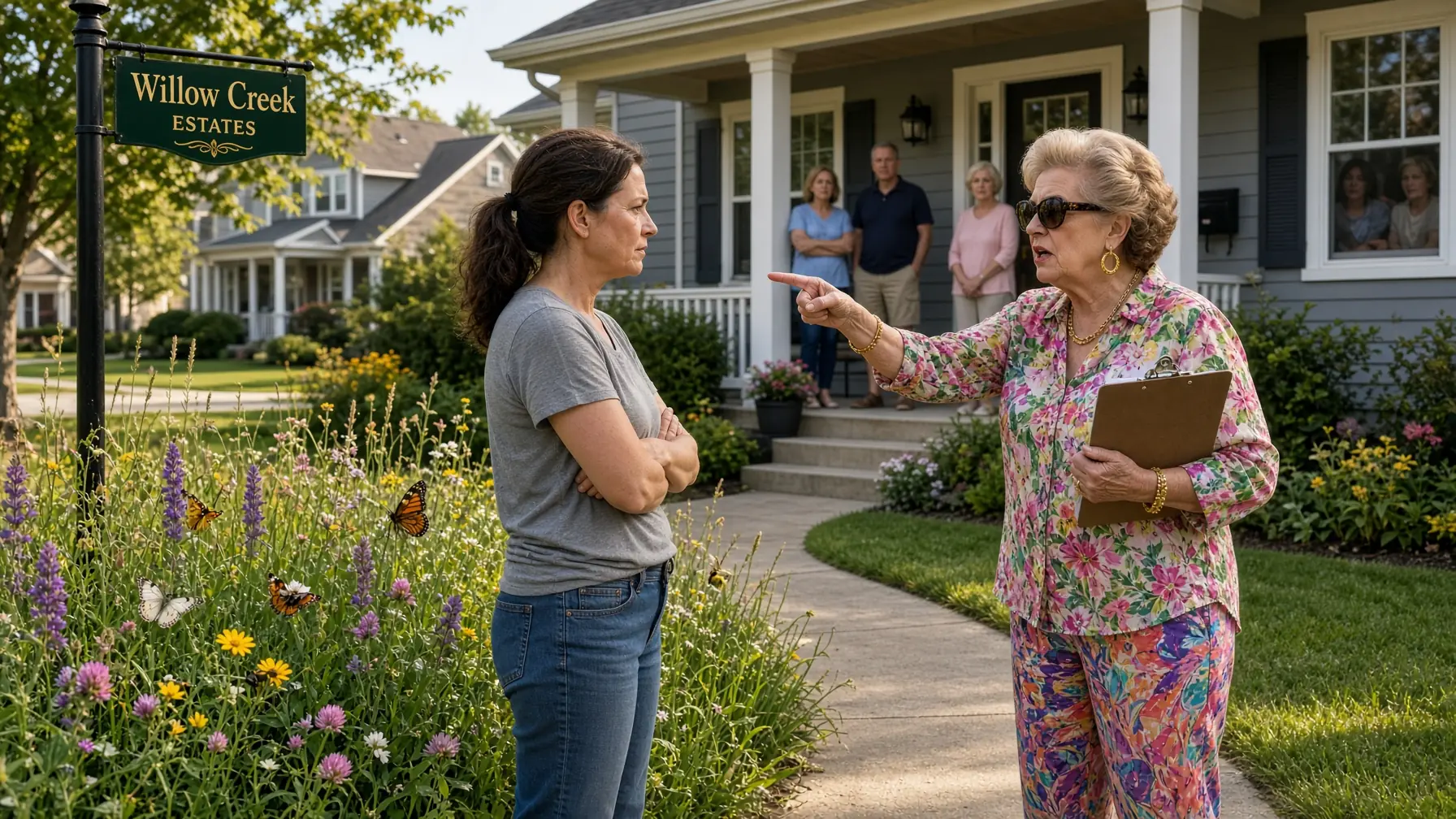
And she just shrugged and said, "Oh, that's just Mr. Dempsey's new policy. He's He's strict lately." And that name stuck with me. Richard Dempsey, HOA president, retired accountant, self-appointed guardian of lawn aesthetics and neighborhood morality. At least that's what people whispered, and suddenly it wasn't about weeds anymore. It was about control, because when I actually looked around, I realized nobody's yard looked like a yard anymore.
They looked like display pieces, identical, controlled, almost sterile, like the whole neighborhood had been sandblasted into compliance. And mine mine just had three tiny yellow flowers refusing to disappear, and that apparently was unacceptable. So, I tried to do the reasonable thing. I called the HOA office first, left a message, no response, waited 2 days, nothing. Then I went to the next board meeting held in the community clubhouse, a building that smelled like old carpet and lemon disinfectant.
And I remember sitting in that folding chair, listening to people complain about fence heights and mailbox paint colors, until finally I stood up when it was my turn and said calmly, "Look, I think there's been a mistake. I'm getting fined for weeds, but my yard is maintained. I'm mowed regularly. I take care of everything." And I wasn't even angry at that point, just confused. But before I could finish my sentence, Richard Dempsey leaned back in his chair, folded his arms, and gave me this small tight smile like he'd already decided the outcome before I even walked in.
And he said, "Mr. Cole, the rules are very clear. No visible weeds, no exceptions. Maybe if yard maintenance is too difficult for you, you should consider hiring a professional." And the way he said it wasn't loud, wasn't aggressive, it was worse. It was dismissive, like I was a problem he'd already categorized. And I felt something shift in me right there.
Not anger, exactly, more like that quiet moment when you realize the system isn't broken. It's working exactly how the people in charge want it to work. And I remember was around the room expecting someone, anyone, to say this was ridiculous, but nobody did. They just sat there nodding like this was normal, like $100 a day for a dandelion was just part of life in Willow Creek. So, I sat back down, signed nothing, agreed to nothing, and drove home with that weird silence in my head that only shows up when something crosses a line you didn't know existed.
And when I got back to my house, I stood in my driveway for a long time just staring at my yard, thinking about those three weeds like they were suddenly important, like they weren't weeds anymore, but proof of something. And that's when the idea first started forming, not fully shaped yet, just a thought sitting in the back of my mind saying, "If they want perfect control, maybe I'll show them what happens when control disappears." But, I didn't act on it immediately. I'm not the kind of person who explodes over something like this. I actually spent the next few days doing research, reading through HOA bylaws, county landscaping codes, even state environmental guidelines. And that's when I found something interesting buried deep in a conservation program document, something about certified wildlife habitats, areas that qualify for ecological preservation even in residential zones.
And the more I read, the more I realized there was a completely different rule book existing right under theirs, one they didn't seem to talk about at their meetings. And I remember sitting at my kitchen table late at night with a cup of coffee going cold, thinking this isn't just about weeds anymore. This is about what kind of yard is allowed to exist, and who gets to decide that. And by the end of that week, I made a decision that honestly surprised even me. I wasn't going to fight them by cleaning up.
I was going to fight them by changing the entire definition of what clean even meant. So, the next morning I walked outside again, looked at my lawn, and instead of seeing a violation, I saw a blank canvas. And I said out loud, almost to myself, "All right, let's see how far your rules really go. And that was the moment everything started to shift because what I was about to do wasn't just landscaping anymore. It was going to become something nobody in Willow Creek Estates was prepared for.
And I didn't realize it yet, but I had just stepped into a conflict that was going to pull in the entire neighborhood, the HOA board, and eventually even the state itself. And all because of three tiny dandelions they probably thought nobody would ever defend. I didn't sleep much that night. Not because I was anxious in a dramatic way, but because my mind just wouldn't stop turning over what I was about to do. Like once you see the system clearly, you can't unsee it.
And Willow Creek Estates suddenly didn't feel like a neighborhood anymore. It felt like a controlled experiment where everyone had agreed to pretend grass mattered more than people. And by sunrise I already knew I wasn't going to fix my yard. I was going to rewrite it completely. So I started small that first morning.
I didn't call a landscaper. I didn't ask permission. I just walked out with a shovel and pulled up the first square of that perfect HOA approved grass. And I remember pausing for a second, holding that patch of uniform green in my hand, thinking how strange it was that something so carefully maintained could feel so lifeless. Like it wasn't nature at all.
More like fabric stretched over dirt. And then I kept going section by section until the front yard looked like someone had taken a bite out of it. And I could already feel eyes on me from across the street. Curtains shifting. Someone's coffee cup probably frozen midair behind a window.
But nobody came out yet. They were just watching. Always watching in places like this. And that silence was honestly louder than any complaint could have been. But I wasn't finished.
I had already made up my mind that if they wanted no weeds, I was going to show them what happens when you remove their definition of order entirely. So I went to the local nursery that afternoon. And this is where things started to feel like I was crossing into something irreversible. I didn't buy neat little boxed plants or symmetrical shrubs. I bought wildflowers, seeds mostly, everything labeled native mix, pollinator blend, things that didn't promise control.
They promised life. And the cashier actually looked at me twice and said, "You doing a restoration project?" And I just nodded because in a way I was, just not the kind she probably imagined. And when I got home I started planting like I had no plan at all. Red blossoms, purple clusters, yellow bursts scattered across the torn-up lawn. No symmetry, no design pattern, just instinct.
And for the first time in years my yard didn't look quiet anymore. It looked like it was breathing. But the real shift came about a week later when the first wildflowers started to bloom because that's when people really noticed. Mrs. Callahan across the street stopped watering her lawn mid-sprinkle and just stared. Then I heard someone say, "Is that allowed?" Like my yard had become a legal question instead of a piece of land.
And by the second week bees started showing up, not a few, a lot, like they had been waiting for permission to return. And butterflies followed soon after. And I know that sounds poetic, but I remember standing there one morning with coffee in my hand watching a yellow swallowtail land on a flower I hadn't even remember planting. And I realized something had changed in a way I couldn't reverse even if I wanted to because this wasn't just my yard anymore. It was becoming an ecosystem, messy, loud in its own quiet way, alive in a way that made the rest of the neighborhood feel even more artificial by comparison.
And that's when the HOA escalation started. First another yellow envelope, then a second one within days. This time saying, "Out of compliance with community aesthetic standards." And I actually laughed when I read it because aesthetic standards sounded so fragile compared to what was growing outside my door. But Richard Dempsey didn't laugh because 2 days later I got a personal visit. I remember hearing the knock, slow and controlled, not the friendly kind.
And when I opened the door, there he was standing with a clipboard like it was a weapon, looking past me before even making eye contact. And he said, "Mr. Cole, this needs to be corrected immediately." And I stepped outside with him, not because I was intimidated, but because I wanted him to see it up close. The wildflowers now waste the clover spreading like a green tide, bees moving between blossoms like traffic with no rules. And he shook his head and said, "This is exactly what the community agreed to prevent." And I remember replying almost casually, "Funny, I don't remember agreeing to anything that required me to sterilize my land." And that's when his expression tightened because he wasn't used to push back that didn't come with fear. And he said something like, "You'll be fined daily until compliance is restored." And I just nodded like I was listening to weather I couldn't control because by then I wasn't thinking about compliance anymore.
I was thinking about structure, legality, leverage. So that night I went back to the research I had started earlier, deeper this time, pulling county records, environmental designations, state habitat programs. And I found it, the certification pathway for residential wildlife habitats. Not easy, not automatic, but possible and more importantly, legally recognized. And I remember sitting there at my desk long past midnight thinking if I can make this official, they don't just lose an argument, they lose authority.
So I filled out every form, documented everything, soil composition, plant types, pollinator activity, even photos of early growth. And I submitted it to the state conservation office without telling a single person in the neighborhood. And the days after that felt different, like I was waiting for something larger than a response from an HOA. And meanwhile, the yard kept growing on its own schedule, bamboo shoots beginning to rise along the fence line, ivy starting to creep where I didn't even plan it, like nature was responding faster than bureaucracy could react. And that contrast alone started to unsettle people because nothing in Willow Creek Estates was supposed to be unpredictable.
And yet my yard was becoming exactly that, unpredictable, unmanageable in their terms, but completely alive in mine. And then one afternoon, I came home to find a third notice, this one thicker, more formal, almost angry in tone, threatening legal action if the vegetation violation wasn't corrected within 7 days. And I remember just standing there on my porch reading it while a butterfly landed on my shoulder like it belonged there more than I did. And that's when I knew the second phase of this wasn't about plants anymore. It was about who had the final word over what land is allowed to become.
And I had already handed my answer to the state. I just didn't know yet how loud it was about to get. I still remember the day everything stopped being just my problem. It was a late afternoon, the kind where the light in Willow Creek Estates turns soft and golden, but everything still feels tense underneath it, like the neighborhood is holding its breath. And I was standing in my front yard watching the wind move through the wildflowers when a white county vehicle pulled up slowly along the curb, not speeding, not dramatic, just quiet and official in a way that instantly made a few curtains twitch across the street.
And out stepped a woman in a plain field jacket holding a folder. And behind her, another man with a camera. And for the first time in weeks, I saw something different in their presence, not judgment like the HOA, but observation, careful and neutral. And she introduced herself as being from the state environmental compliance division. And I remember Richard Dempsey appearing almost immediately from next door like he He been waiting for this exact moment, clipboard in hand again, but this time his confidence looked slightly rehearsed, like he wasn't sure which version of authority he was supposed to perform, and he started talking before she even reached my gate, saying things like, "This property is in violation of community standards, ongoing nuisance conditions, uncontrolled vegetation." But she just raised a hand gently and said, "We're not here on behalf of the HOA." And that one sentence changed the entire temperature of the scene, because suddenly Dempsey wasn't the center of it anymore, and I could see that realization hit him slowly, like a door closing he didn't know was attached to him.
And the inspector walked into my yard without hesitation, stepping through the wildflowers, pausing near the clover patches, taking notes, asking me calm questions about when I started the habitat, what species I had introduced, whether I had applied for certification, and I answered everything honestly, no performance, no defense, just facts. And behind her the camera man was quietly documenting everything, and I remember Dempsey trying again, louder this time, saying, "This is exactly what we've been trying to prevent." And the inspector finally turned to him and said, "Sir, local aesthetic guidelines do not override state conservation protections." And there was a silence after that, not dramatic, just heavy, like the air itself had shifted ownership, and I watched his expression change in real time, because that was the moment he understood he wasn't negotiating anymore. He was being evaluated, and over the next hour they walked the perimeter, checked my documentation, reviewed the plant registry I had submitted, and eventually the inspector closed the folder and said the words I had been waiting weeks to hear, that the property qualified as a protected residential wildlife habitat under state guidelines, and that any attempt to force removal or alteration could constitute interference with a protected ecological zone. And I remember just exhaling without realizing I had been holding my breath for days. And across the street, I saw Mrs. Callahan slowly step back from her window, like she didn't want to be seen watching anymore.
And Dempsey just stood there frozen, clipboard lowered now, the authority he had built his entire identity around suddenly reduced to paper that didn't matter here. And the next few days were almost surreal. The HOA sent notices, but they felt different now, weaker somehow, like they were shouting into a room that no longer recognized their voice. And then came the final letter, not from the HOA, but from the county, stating that enforcement actions against the certified habitat would be reviewed as potential violations of state environmental protections. And after that, silence, real silence, not the kind filled with tension, but the kind that comes after something ends and nobody knows what to say about it.
And my yard just kept growing, unchecked by design. Sunflowers leaning slightly over the fence, bees moving like they belonged to the air itself, birds nesting where trimmed hedges used to be. And what surprised me most wasn't the victory, it was how quickly people adapted. Kids started calling it the butterfly yard again. Neighbors who once complained started slowing down when they walked past.
Even Dempsey stopped issuing comments. Though I could still see him sometimes standing by his window looking out like someone trying to understand a rule book that had stopped applying. And I won't pretend it didn't feel good, because it did. But it also made me think about how fragile all of it was, how quickly a community can turn order into something that feels like control instead of care. And one evening, I was standing in that same yard when a kid from down the street asked if he could show his little brother the flowers.
And I said, "Sure." And as they ran through the clover laughing, I realized something simple. Maybe the yard was never the real argument. Maybe it was always about who gets to decide what living well looks like on a piece of land. And now I just live with that question sitting in the background of everything. Because even though the fines are gone and the HOA is quiet, I still catch myself wondering what would have happened if I had just pulled those three weeds out on day one.
END