The Poor Boy Shared His Only Lunch—Weeks Later, the Principal Called Him Into the Office
Fourteen-year-old Samuel Carter knew exactly how long a person could stare at an empty lunchbox before pretending not to be hungry.
He had learned that skill years ago.
On good days, his mother packed him a piece of bread with a boiled egg.
On difficult days, there was only bread.
On the worst days, she filled his bottle with water and told him she had accidentally forgotten his lunch.
Samuel always pretended to believe her.
He knew the truth.
His mother never forgot anything concerning him.
She worked as a cleaner in two office buildings and sometimes accepted extra work washing clothes for families in their neighborhood.
She left home before sunrise and returned long after dark.
Still, there was rarely enough money.
Rent came first.
Then electricity.
Then Samuel’s school fees.
Food received whatever remained.
Some nights, that meant one simple meal shared between them.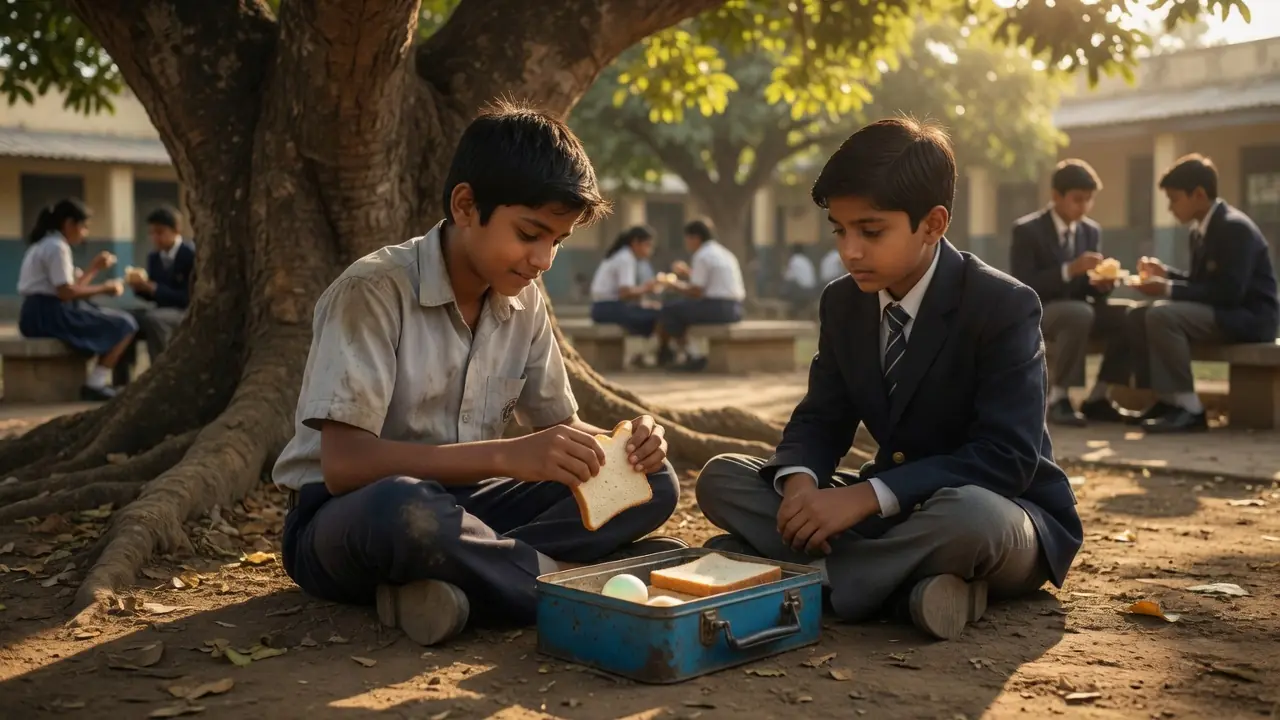
Samuel never complained.
He knew his mother already carried enough guilt.
“Education is the one thing poverty cannot take from you,” she often told him.
So Samuel studied hard.
He arrived early.
Completed every assignment.
Kept his uniform clean even when the fabric became thin and the knees began to fade.
Most students never noticed how poor he was.
Those who did rarely said anything kind.
Samuel had become skilled at appearing invisible.
Then one afternoon, a new student sat alone beneath a tree.
And Samuel made a choice that changed both of their lives.
The lunch bell rang at twelve thirty.
Students rushed from their classrooms toward the courtyard.
Some carried lunchboxes filled with sandwiches, fruit, cakes, and juice.
Others bought hot food from the school cafeteria.
Samuel walked slowly.
He waited until most students had found places to sit before choosing a quiet bench near the far fence.
He placed his old blue lunchbox on his knees.
The broken latch was held together by a rubber band.
When he opened it, he found one slice of bread and a boiled egg.
His mother had cut the egg in half and arranged both pieces carefully on the bread.
A tiny packet of salt rested beside it.
Samuel smiled.
It was more than he expected.
That morning, he had noticed only a small amount of food in the kitchen.
His mother must have skipped breakfast again.
He peeled away the thin paper wrapped around the bread.
Before taking the first bite, he noticed a boy sitting beneath the large tree near the football field.
The boy was new.
Samuel had seen him introduced in mathematics class that morning.
His name was Daniel.
His uniform looked new.
His shoes were polished.
His backpack was expensive.
Yet he sat alone with no lunchbox and no cafeteria tray.
He watched the other students eating.
Then he looked away whenever anyone passed.
Samuel recognized that expression.
It was the face of someone trying to make hunger look like a choice.
He closed his lunchbox.
For several seconds, he argued with himself.
He had eaten nothing since the previous evening.
The bread and egg were supposed to last until dinner.
His stomach already hurt.
But the new boy looked miserable.
Samuel stood and walked toward him.
“Hi,” he said.
Daniel looked up.
“Hi.”
“Why aren’t you eating?”
Daniel glanced toward the cafeteria.
“I’m not hungry.”
Samuel knew the lie because he had used it many times.
“You’ve been staring at that boy’s sandwich for five minutes.”
Daniel’s face reddened.
“I forgot my lunch.”
“You can buy something.”
Daniel looked down.
“I don’t have any money.”
Samuel sat beside him.
For a moment, neither boy spoke.
Then Samuel opened his lunchbox.
“Then we’ll share mine.”
Daniel stared at the single piece of bread.
“That’s all you have.”
“It’s enough.”
“No, it isn’t.”
Samuel broke the bread into two uneven pieces.
He handed Daniel the larger one.
Daniel shook his head.
“But you’ll still be hungry.”
Samuel laughed softly.
“I was going to be hungry anyway.”
Daniel did not smile.
Samuel added, “Half a meal is better than watching a friend have nothing.”
“We’re not friends.”
“We can fix that.”
Daniel finally accepted the bread.
They ate beneath the tree.
Neither piece was large enough to satisfy them.
Still, Daniel’s shoulders relaxed.
When he finished, he carefully folded the paper wrapper and placed it inside Samuel’s lunchbox.
“Thank you.”
“It was only bread.”
“No,” Daniel said. “It wasn’t.”
Samuel did not understand what he meant.
Not yet.
Daniel began sitting beside Samuel in class.
At first, their friendship surprised everyone.
Daniel arrived each morning in a large black car driven by a man in a suit.
Samuel walked nearly three miles because bus fare cost too much.
Daniel’s notebooks were new.
Samuel wrote between old answers in secondhand exercise books.
Daniel owned the latest phone.
Samuel used an old device with a cracked screen that worked only when connected to a charger.
But beneath those differences, the boys had much in common.
They both loved science.
They both hated football.
They both preferred quiet places to crowded groups.
Daniel was new because his family had recently moved to the city.
His father traveled constantly for work.
His mother had died when he was young.
Although Daniel had everything money could buy, he often ate dinner alone with household staff while his father attended meetings.
Samuel listened without judging.
Daniel did the same when Samuel eventually spoke about his life.
“You only eat once a day?” Daniel asked one afternoon.
“Not always.”
“But sometimes?”
Samuel shrugged.
“My mother makes sure I have enough.”
Daniel noticed Samuel had not answered the question.
The following day, he brought two large lunches.
“My cook packed too much,” he said.
Samuel looked inside.
There were sandwiches, fruit, chicken, and small cakes.
“This isn’t too much. This is food for four people.”
“Then help me.”
Samuel hesitated.
He did not want charity.
Daniel seemed to understand.
“You shared when I needed something,” he said. “Now I’m sharing.”
Samuel accepted.
From then on, they ate beneath the tree nearly every day.
Sometimes Daniel brought food.
Sometimes Samuel brought bread.
Neither boy counted who contributed more.
At home, Samuel’s mother noticed the change.
“You look happier,” she said one evening.
They sat at their small kitchen table sharing rice and beans.
“I made a friend.”
“That is good.”
“He’s new.”
“Then he probably needs one.”
Samuel smiled.
His mother’s name was Grace.
She was thirty-nine but looked older from years of physical work.
Her hands were always dry from cleaning chemicals.
Her back often hurt.
Still, she rarely allowed Samuel to see her weakness.
She wanted him to believe everything would be fine.
For a while, it almost was.
Then Grace lost her main job.
The office building changed cleaning companies without warning.
Grace and six other workers were told not to return after Friday.
There was no compensation.
No final bonus.
Only one week’s wages and a letter thanking them for their service.
Grace came home early carrying her cleaning shoes inside a plastic bag.
Samuel was studying at the table.
He knew something was wrong the moment he saw her face.
“Why are you home?”
“The company changed our schedule.”
Grace placed the bag near the door.
“What happened?”
“Nothing you need to worry about.”
“Mom.”
She sat opposite him.
For several seconds, she tried to smile.
Then the smile collapsed.
“I lost the office job.”
Samuel looked toward the unpaid electricity bill beside the sink.
“How much do we have?”
“I will find something.”
“How much?”
“Samuel.”
“School fees are due next week.”
Grace’s eyes filled with tears.
“I know.”
His school was not expensive compared with many private institutions, but it was known for strong academic results.
Samuel attended on a partial scholarship.
Even so, the remaining fees were more than Grace could now afford.
“If we don’t pay, what happens?”
Grace looked away.
“I will speak to the principal.”
“And if he says no?”
“I will find another school.”
The nearest public school was overcrowded and several miles farther away.
Its students often shared textbooks.
Many left before graduation.
Samuel had worked for years to remain at his current school.
He was at the top of his class.
Teachers believed he could earn a university scholarship one day.
Losing his place now felt like watching a door close inches before he reached it.
“I can work,” he said.
“You already study.”
“I can work after school.”
“No.”
“You cannot pay rent alone.”
“I said no.”
“I can help at the market.”
Grace struck the table with her palm.
“You will not leave school to save me.”
The room became silent.
She immediately softened.
“Your job is to learn.”
“And yours is to do everything until you collapse?”
Her expression changed.
Samuel regretted the words as soon as he said them.
Grace stood and began washing the two plates.
Her shoulders trembled.
Samuel walked behind her and wrapped his arms around her waist.
“I’m sorry.”
She covered his hands with hers.
“I will find a way.”
He wanted to believe her.
But that night, he heard her crying in the bedroom.
For the next week, Samuel carried fear everywhere.
He could not concentrate in class.
Numbers blurred on the board.
During lunch, he told Daniel his mother had lost her job.
Daniel immediately said, “My father could help.”
“No.”
“He helps people all the time.”
“I said no.”
“Why?”
“Because I don’t want your father’s money.”
“You might have to leave school.”
Samuel closed his lunchbox.
“That isn’t your problem.”
Daniel looked hurt.
“I thought we were friends.”
“We are.”
“Then your problem is allowed to matter to me.”
Samuel stood.
“I have to go.”
He spent the rest of lunch inside the library.
He was not angry with Daniel.
He was ashamed.
Sharing half a meal had felt equal.
Accepting school fees from a wealthy parent felt different.
It felt like admitting he could not survive without being rescued.
Grace found temporary work cleaning homes.
The pay was inconsistent.
Some clients treated her badly.
One woman inspected every surface with a white cloth before paying.
Another accused her of breaking a vase that had already been cracked.
Grace accepted everything because rent was due.
She began returning home after midnight.
Samuel cooked when food was available.
He studied beside the window to save electricity.
Then the school sent a final payment notice.
If the fees were not paid by Monday, Samuel would be suspended from classes.
He folded the letter and placed it beneath his mattress.
Grace found it while changing the sheets.
“Why didn’t you show me?”
“Because you already know.”
“I can ask for more time.”
“They already gave us time.”
Grace sat on the bed.
Samuel had never seen her look so defeated.
“I’m sorry.”
He knelt before her.
“You didn’t do anything wrong.”
“I promised you an education.”
“You gave me one.”
“Not enough.”
“It is enough.”
“No,” she whispered. “Not for what you can become.”
Samuel wanted to tell her that he no longer cared.
But that would have been another lie.
He cared deeply.
He wanted to become an engineer.
He wanted to build clean water systems for poor communities.
He wanted to earn enough money that his mother never needed to clean another floor.
He was terrified those dreams would disappear because of one unpaid bill.
On Monday morning, Samuel put on his uniform.
Grace watched from the kitchen doorway.
“You may be sent home.”
“I know.”
“I will come with you.”
“You have work.”
“You are more important.”
Samuel shook his head.
“If you miss today, they may replace you.”
Grace hated that he understood such things at fourteen.
She kissed his forehead.
“Come straight home if they suspend you.”
He nodded.
Then he walked to school.
Every step felt heavier.
When he entered the classroom, several students were already seated.
Daniel waved.
Samuel gave a small nod and sat down.
Before the lesson began, a school secretary appeared at the door.
“Samuel Carter?”
His stomach dropped.
“Yes?”
“The principal would like to see you.”
The room became quiet.
Samuel collected his bag.
A few students whispered.
He kept his head down as he followed the secretary.
Daniel stood.
“Can I come?”
“No,” the secretary said.
Samuel looked back.
Daniel seemed strangely nervous.
That confused him.
The principal’s office door was closed.
Samuel waited outside while the secretary entered.
Through the wall, he heard a man speaking.
Then the door opened.
“Come in, Samuel,” Principal Harris said.
Samuel stepped inside.
His mother was already there.
Grace sat near the desk wearing her cleaning uniform.
She must have come directly from work.
Beside her stood a tall man in a dark suit.
Samuel recognized him from photographs on Daniel’s phone.
Mr. Jonathan Reed.
Daniel’s father.
Samuel’s fear became confusion.
“Mom?”
Grace stood and held his hand.
“I was called here too.”
Principal Harris gestured toward a chair.
“Sit down, Samuel.”
He remained standing.
“Am I being suspended?”
The principal looked surprised.
“No.”
“My fees haven’t been paid.”
“We will discuss that.”
Mr. Reed stepped forward.
He held himself like someone accustomed to controlling rooms.
But his expression was gentle.
“My son told me about you.”
Samuel looked at him.
“Daniel?”
“He told me what happened on his first day.”
Samuel said nothing.
Mr. Reed continued.
“He forgot his lunch and had no money because the school payment system had not yet been activated. He was embarrassed. Other students ignored him.”
“He was new.”
“You gave him half of the only food you had.”
Samuel looked toward his mother.
Grace’s eyes were wet.
“It was only bread and an egg,” he said.
Mr. Reed shook his head.
“My son later learned it was probably your only meal that day.”
Samuel’s face became warm.
“Daniel talks too much.”
For the first time, Mr. Reed smiled.
“Yes. He does.”
Mr. Reed explained that Daniel had come home after their argument near the library.
He told his father Grace had lost her job and Samuel might leave school.
Daniel asked whether they could help.
Mr. Reed initially planned to pay only the overdue fees.
Then he contacted the school.
He learned Samuel ranked first in several subjects.
He learned about Samuel’s attendance record.
His teachers described him as hardworking, respectful, and unusually generous with other students.
Mr. Reed also spoke to Grace.
“I don’t want charity,” Grace said quietly.
Mr. Reed nodded.
“Neither do I.”
He placed a document on the principal’s desk.
“This is a scholarship.”
Samuel stared at it.
Mr. Reed had established a small educational fund through his company.
The fund would cover Samuel’s tuition, books, uniforms, transportation, and examination fees until graduation.
If Samuel maintained strong grades, the company would also support his university applications.
Samuel could not speak.
Grace covered her mouth.
Mr. Reed continued.
“This is not payment for sharing lunch.”
“Then why are you doing it?” Samuel asked.
“Because sharing lunch showed me who you are.”
Samuel looked confused.
Mr. Reed pulled out another chair and sat opposite him.
“I spend my life meeting adults who have more than they need and still refuse to share. You had almost nothing, yet your first instinct was to divide it.”
Samuel looked down.
“I didn’t want him to feel alone.”
“That is exactly why.”
Grace began crying.
Not quietly.
Years of fear and exhaustion seemed to leave her at once.
Samuel moved toward her.
She pulled him into her arms.
“I told you,” she whispered. “Kindness is never wasted.”
Samuel cried too.
He had tried not to.
He was fourteen.
He believed boys at school would laugh if they saw him.
But in that office, none of that mattered.
The fear that had been sitting inside his chest for weeks finally loosened.
He was not leaving school.
His mother did not need to choose between rent and tuition.
The future had reopened.
Then Mr. Reed surprised them again.
“My company also needs a new cleaning supervisor at one of our smaller offices.”
Grace pulled away from Samuel.
“I’m not qualified to supervise.”
“You managed multiple floors and trained new workers at your previous job.”
“How do you know?”
“I called your former supervisor.”
Grace looked alarmed.
“With your permission,” Principal Harris added.
Mr. Reed continued.
“The position includes regular hours, benefits, and better pay. There will be an interview. Nothing is guaranteed.”
Grace wiped her eyes.
“You are offering this because of Samuel.”
“I am offering an interview because you have ten years of experience and excellent references.”
He glanced at Samuel.
“Your son only made sure I noticed.”
Grace accepted the interview.
She received the job two weeks later.
News of Samuel’s scholarship spread through the school.
Samuel hated the attention.
Some students congratulated him.
Others whispered that he had become friends with Daniel only because his father was wealthy.
One boy called him a charity student.
Daniel punched him.
Both boys were sent to the principal.
Samuel sat beside Daniel outside the office.
“You shouldn’t have done that.”
“He insulted you.”
“You still shouldn’t hit him.”
“He deserved it.”
Samuel handed Daniel half of a biscuit.
“You’re terrible at solving problems.”
Daniel accepted it.
“You share food when you’re angry?”
“I’m trying to improve you.”
They both laughed.
The scholarship changed Samuel’s education.
It did not make life easy overnight.
Grace still watched every expense.
Samuel still studied for hours.
He still walked when he wanted to save transportation money.
But fear no longer controlled every decision.
He joined the science club.
Entered a regional engineering competition.
With Daniel and two classmates, he designed a low-cost water filter using sand, charcoal, and locally available materials.
Their project won first place.
Mr. Reed attended the presentation.
Grace sat in the front row wearing her new work uniform because she had come directly from the office.
When Samuel’s name was announced, she applauded louder than anyone.
Years passed.
Samuel graduated at the top of his class.
Mr. Reed kept his promise.
The scholarship fund helped him attend university, but Samuel also earned academic awards of his own.
He studied civil and environmental engineering.
Daniel attended a different university but remained his closest friend.
They still argued.
Still shared meals.
Still sat beneath the old tree whenever they returned to visit the school.
Grace became a respected supervisor.
Later, she managed cleaning operations across several buildings.
She never allowed employees to be dismissed without notice.
“I remember what that feels like,” she said.
After university, Samuel began working on water systems in low-income communities.
He helped build wells and filtration networks in rural villages.
Years later, he established a nonprofit that funded school meals.
The program began at his old school.
No student had to sit beneath a tree pretending not to be hungry.
At the opening ceremony, Samuel stood beside Daniel, Grace, Principal Harris, and Mr. Reed.
The same blue lunchbox rested inside a glass case near the entrance.
The rubber band still held the broken latch together.
A small sign beneath it explained:
One shared lunch inspired a program that has served thousands of meals.
Mr. Reed looked at the lunchbox.
“You kept it?”
“My mother keeps everything.”
Grace smiled proudly.
“You were hungry that day,” Mr. Reed said.
“Yes.”
“And you still shared.”
Samuel looked toward the students eating together in the courtyard.
“I knew what it felt like to have nothing.”
Mr. Reed nodded.
“Many people use that feeling as a reason to keep everything for themselves.”
Samuel smiled.
“My mother taught me differently.”
Later, a student approached Samuel.
The boy was thin and nervous.
“Sir?”
“Yes?”
“Is it true you were poor?”
Samuel crouched so they were at eye level.
“Yes.”
“Were you embarrassed?”
“Sometimes.”
The boy looked toward the meal hall.
“My mother lost her job.”
Samuel understood immediately.
He placed a hand on the child’s shoulder.
“You will continue school.”
“How do you know?”
“Because you don’t have to carry this alone.”
The same sentence Daniel had once tried to teach him.
A friend’s problem was allowed to matter.
Samuel finally understood that accepting help had never made him weak.
It had given him the strength to help someone else later.
People often described Samuel’s story as luck.
A poor boy shared lunch with the son of a wealthy businessman and received a scholarship.
But Samuel never thought of it that way.
Luck explained the meeting.
It did not explain the choice.
He could have remained on the bench.
He could have protected the only meal he had.
No one would have blamed him.
Instead, he noticed another boy’s hunger.
He stood.
Walked across the courtyard.
And divided one piece of bread.
The food lasted only minutes.
The kindness traveled for years.
It reached Daniel.
Then Mr. Reed.
Then Grace.
Then students Samuel had never met.
On the day Samuel opened the school meal program, Grace whispered the same words she had spoken inside the principal’s office many years earlier.
“Kindness is never wasted.”
Samuel looked at the hundreds of children eating together.
“No,” he said. “Sometimes it just takes time to return.”
He had given away half of his lunch when he could least afford it.
In return, he did not simply receive school fees.
He received a chance.
Then he spent the rest of his life passing that chance forward.
A small act of kindness did not magically remove poverty.
It did something equally powerful.
It opened a door.
And Samuel made sure it remained open for everyone who came after him.