The summer of 1879 came to Red Hollow, Montana like it always did, hot, dry, and indifferent to suffering. Evelyn Harper had learned to move quietly through a town that had never learned to see her. She was 25 years old, and she walked like someone who had long ago accepted that the space she occupied was something she had to apologize for. Her steps were small.
Her eyes stayed down. Her hands roughened by three years of stitching other people's clothes from before the sun came up until well after it went down. Stayed folded at her sides even when they ached. She was the daughter of a man who had borrowed money he could not repay.
And in Red Hollow, Montana in the summer of 1879, that was all anyone needed to know about a woman to decide what she was worth. Her father, Thomas Harper, had come to Montana with a dream the size of the territory itself. He was going to raise cattle. He was going to build something that would last.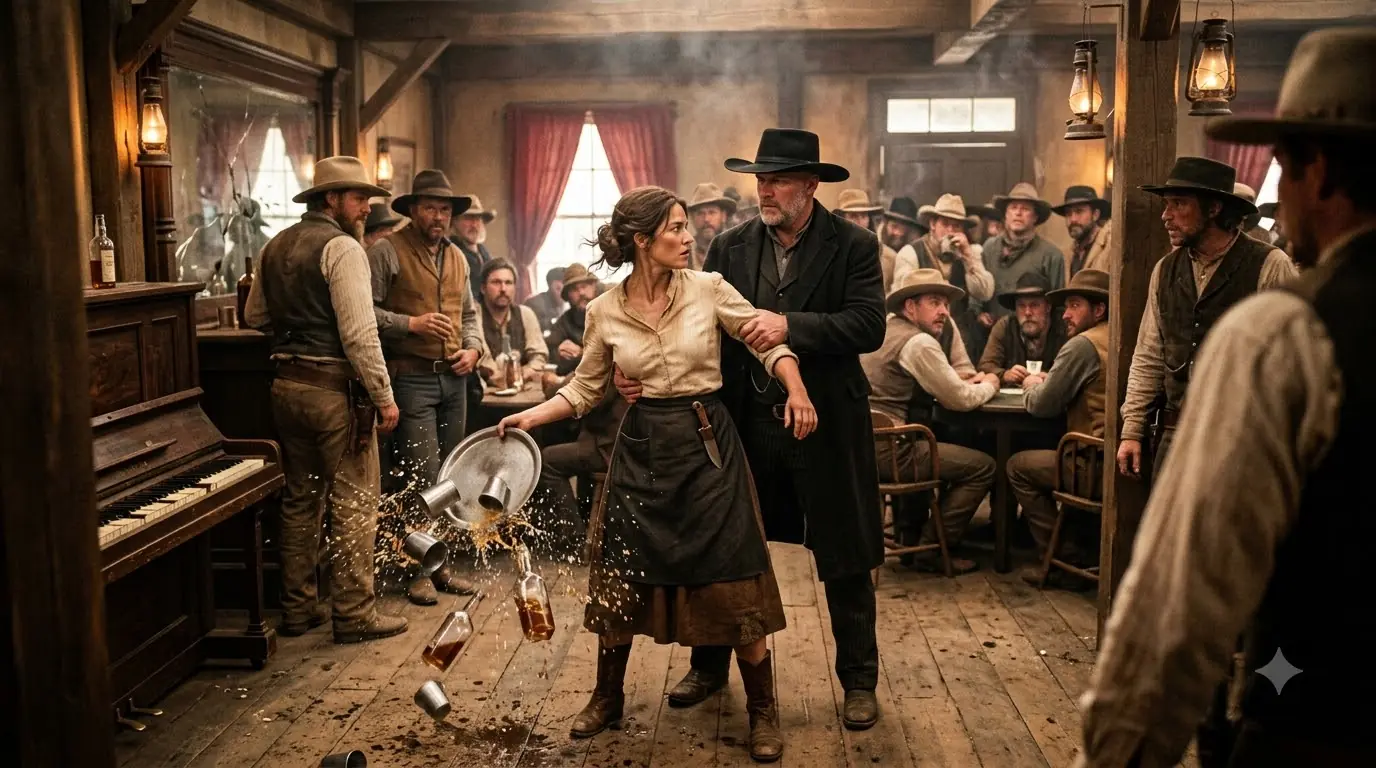
He had shaken hands with Marcus Bell, the most powerful rancher in the county, on a loan agreement that Thomas had not fully understood, and Marcus had known it. Within 14 months, Thomas Harper was dead. Heart failure, the doctor said. Debt, said everyone who knew the truth.
And the debt, according to Marcus Bell's paperwork. Paperwork that Evelyn had never been allowed to read in full transferred to her. She was 22 years old when Marcus sat across from her at the kitchen table in the house that was no longer hers and explained with the patience of a man explaining something to a child that she would work off what her father owed. "It's only fair," he said.
She had nodded. Because what else do you do when you are 22 alone and the man speaking to you owns the sheriff, the bank, and half the buildings on Main Street. Three years later, she could sew a dress in her sleep. She mended saddle leather.
She stitched curtains for the hotel. She hemmed trousers for men who never looked at her face when they handed over their coins. And the coins went directly to Marcus applied against a debt that never seemed to get smaller, no matter how many hours she worked. She had done the math once late at night by a single candle.
At the rate Marcus had set, she would be working for him until she was 41. She had blown out the candle and not done the math again. The evening it all changed began like every other evening in Red Hollow. Evelyn was crossing the main street after delivering a finished dress to Mrs.
Caldwell at the hotel. Her payment receipt folded in her pocket. Not that it was really hers. It never was.
That was when Marcus Bell stepped out of the general store directly into her path. He was a big man, not tall, but wide through the shoulders with hands that looked like they'd been built for breaking things. He was 5three years old, and he wore that age-like armor, like every year had only made him harder and more certain of his right to take up space. Evelyn.
His voice was flat. Not a greeting, a command. She stopped. "Mr.
Bell. " "Mrs. Caldwell paid you today? " It wasn't a question.
He had eyes in every corner of this town. "She did," Evelyn said carefully. "I have the receipt. " "I didn't ask about the receipt.
" He held out his hand. "I asked about the payment. " She reached into her pocket and placed the coins in his palm without letting her fingers shake. She had practiced that.
She had gotten very good at not letting her fingers shake. He counted the coins twice. Then he pocketed them and looked at her the way a man looks at a fence post present, useful, and otherwise beneath consideration. "You've got the Morrison order to finish by Thursday," he said.
"I know. " "See that you don't forget. " He walked away. Evelyn stood in the middle of the street and breathed.
Just breathed. She allowed herself exactly five seconds of standing still, which was the most she ever allowed herself. And then she began walking again because standing still in Red Hollow had a way of inviting people to fill the stillness with things you didn't want to hear. She was nearly to the end of the block when she heard it.
"There goes Bell's little seamstress. " She didn't turn around. She knew the voice. Hattie Drummond, the milliner's wife, standing outside the dry good store with two of her friends.
Women who had grown up in this town, married into it and built their comfort on the careful maintenance of a hierarchy that required someone to be at the bottom. Does she even own a decent dress? One of the others said she makes them for everyone else and walks around in that same brown rag. Laughter light and easy the way laughter is when it costs you nothing.
Evelyn kept walking. She had learned somewhere in the first year of working for Marcus Bell that reacting was a luxury she could not afford. Anger cost energy. Tears cost dignity.
Even looking up cost something because once you made eye contact, you had admitted that the words had landed. And she refused to give anyone in Red Hollow that particular satisfaction. She turned the corner and pressed her back against the wooden wall of the alley between the tailor's shop and the post office. And she stayed there for a moment in the thin strip of shade, eyes closed, chin up, jaw tight.
"Don't you dare," she told herself. Don't you dare. She didn't. She straightened her skirt, adjusted the empty cloth bag over her arm, and went back to work.
The Silver Horse Saloon was not a place Evelyn went. It was a place for men cowboys trailing cattle herds up from Texas and Wyoming. Railroad workers passing through the local ranchers and their hired hands who came in on Friday evenings to drink away the dust of the week. Women of a certain kind went there too, but not women like Evelyn, not women who had anything left to protect.
She had no reason to be near it, which was why when Marcus Bell appeared at the door of her workshop at 6 that evening and told her to come with him, she felt the first real spike of fear she'd felt in weeks. "Where? " she asked. "Silver.
" Morrison wants to discuss the order in person. He looked at her workbench at the half-finished coat spread across it. "Leave that. " I can finish it by "I said leave it.
" She left it. The silver horse was loud even from outside. Through the swinging doors, she could hear laughter and the clunk of glass and the low rolling sound of men talking over each other the way men did when they felt safe. She followed Marcus through those doors and immediately felt the shift in the room.
The way a few heads turned. The way conversations fractured and reformed around her presence. The way some men looked at her with curiosity and some with something worse than curiosity. She kept her eyes on Marcus's back.
He led her to a table near the bar where Glenn Morrison, a barrel-chested man who ran a dry goods business on the county's eastern edge, was sitting with two other men Evelyn didn't recognize. Morrison had hired her to make four formal coats for a business trip he was taking to Helena. The order was nearly finished. She couldn't understand why it required a meeting here in this place at this hour.
She understood within two minutes. "Miss Harper," Morrison said, leaning back in his chair with the particular comfort of a man who knew he was on familiar ground. Marcus here tells me you've been slow on the order. Evelyn went very still.
"The order is due Thursday, Mr. Morrison. Today is Tuesday. " He says, "You've been taking on other work on the side.
My time, my materials. " She looked at Marcus. He was watching her with the expression of a man waiting to see what a cornered animal does. "That isn't true," she said.
And she was careful, so careful to keep her voice level and clear. "I have the work log. Every hour I've spent on your coats is documented. " "Work log?
" Morrison smiled at the men beside him. She keeps a log. The men chuckled. "Mr.
Morrison," she said, "I can bring you the log tomorrow morning. Every stitch is accounted for. " Or, Marcus said, pulling out the chair beside her and sitting down uninvited. We settle this simply.
The order gets done by Wednesday morning. No charge for the materials. Her stomach dropped. The materials alone had cost her two weeks of work.
"That wasn't the agreement," she said. "The agreement," Marcus said quietly, leaning in just enough that only she could hear him. "is whatever I say it is. You know that.
" She did know that. She had known that for three years. "Sit down, girl. " Morrison said louder now.
The way men speak when they want an audience. "You're making a scene. " She hadn't moved. She was standing exactly where she had stood when she walked in.
She always did think she was something, said one of the men at the table. She didn't know him, had never seen him before, but he spoke about her with the ease of a man who had always had the right to speak about women that way. The nearest table had gone quiet. Then the one behind it, "Sit down," Morrison said again.
"Or walk out and explain to Marcus why you're in breach of contract. " "Breach of contract? " She had no contract. She had never been given anything in writing that she was allowed to keep.
She knew that. Marcus knew it. Morrison knew it. The whole room slowly going quiet around her.
Knew it or didn't care. She was 25 years old and she was standing in the middle of a saloon in Red Hollow, Montana, and she had nowhere to go. She was so tired, not just tired from the work. Though the work was relentless, tired in a way that went down into her bones, into the part of her that had once a long time ago, believed that if she just worked hard enough and was quiet enough and stayed small enough, she would eventually be left in peace.
She had been so sure at 22 that this would be temporary. "She had been wrong. " "Sit down, girl," Morrison said a third time. And this time there was laughter in it, loose and careless, and several men in the saloon laughed along with him.
The way people do when they've decided that cruelty is entertainment. Evelyn's hands at her sides were absolutely still. She would not shake. She would not cry.
She would not give them a single thing. She lifted her chin. And then the front door of the Silver Horse Saloon swung open. I didn't make an entrance.
That was the thing she would remember later when she had the distance to remember anything about that night with something other than the raw shaking feeling of it. He didn't push the doors open dramatically. He didn't stop and survey the room like a man who knew he was being watched. He just walked in.
A man somewhere in his mid-30s, lean and broad shouldered in the way of someone who had worked with his body for years without thinking about it. Dark brown hair. A few days of dark, stubble eyes that were a startling shade of blue, and that moved through the room, the way a man's eyes move when he's learned to assess a space quickly and quietly, and without calling attention to himself. His clothes were plain, a white shirt rolled to the elbows, a worn brown vest, dark trousers tucked into boots that had seen a great deal of road.
His hat was off, held at his side, and the absence of it somehow made him look more present rather than less, like he'd walked in without armor and didn't need any. He crossed to the bar, set his hat on the counter, and said to the barkeep, "Whiskey, please. " Not a demand, a please. Evelyn noticed that.
She noticed, too, that he'd heard Morrison. The doors had been half open, and the room had been quiet, and Morrison had a loud voice. She could tell by the way the man's posture had shifted almost imperceptibly when he reached the bar. Shoulders settling slightly, the stillness in him that preceded rather than followed attention.
He picked up his glass. He turned around and he looked at her not the way the other men in the room had looked at her with appetite or amusement or the bored assessment of someone estimating worth. He looked at her the way a person looks at another person when they actually want to see them. His eyes moved to the marks on her wrist, the ones Marcus' grip had left that morning.
She had forgotten to keep her sleeve pulled down, and something in his face went very quiet. Then he looked at Marcus Bell, then at Glenn Morrison. "Is there a problem here? " He said.
His voice was easy, unhurried. The voice of a man who genuinely wanted information rather than a fight. "No problem," Marcus said. "Private business.
" Morrison blinked. He was not accustomed to being redirected. "Who the hell are you? " "Jackson Reed.
" He said it the way you say the weather, just a fact. "I've got a small spread up past Garrison Creek. " Just came through for supplies. He took a slow sip of his whiskey.
"And I'm asking the lady a question. " The lady? Evelyn could not remember the last time someone in Red Hollow had called her that. She swallowed.
Her throat was very tight. I She stopped. "You don't have to answer him," Marcus said. "She can speak for herself," Jackson said.
And there was nothing threatening in his tone. It was simply a correction offered the way you correct a wrong note in a song. Matter-of-fact, certain. Marcus turned in his chair to face Jackson fully.
He was a man accustomed to rooms deferring to him. And he was recalibrating trying to determine what category this new person fell into. "You don't know what you're walking into, friend. " "That's possible," Jackson said.
He set his glass on the bar and picked up his hat. He didn't look away from Marcus. "But I know what I'm looking at. " The room was silent now, completely.
She had nowhere to sit down, Morrison said with the air of a man explaining something obvious. We were just reminding her of her place. Her place? Jackson repeated.
That's right. Jackson was quiet for a moment. He looked down at his hat, turning it once in his hands. And Evelyn had the peculiar sense that he was choosing something not what to do, but how to do it.
How to be the thing that this moment needed without becoming something else in the process. He walked forward. He stopped at Evelyn's side and he looked at Marcus Bell and said in a voice that was completely level and completely calm and completely without theater, "She belongs to herself. " The silence that followed was the kind that has weight.
Marcus Bell stood up slowly from his chair. He was shorter than Jackson by several inches, but he filled space differently the way powerful men do, like the room had been organized around them before they arrived. "Son," he said, "You have no idea who you're talking to. " "I know exactly who I'm talking to," Jackson said.
"A man who's used to everyone in the room agreeing with him. " "And you're not going to? " "No," Jackson said. "I'm not.
" Morrison had leaned back in his chair with the expression of a man who had shifted from participant to audience, which was its own kind of cowardice. The other men at his table were very still. Across the room, nobody moved. Marcus looked at Evelyn.
His eyes were cold in a way she knew well the specific cold of a man whose pride had been touched and who was filing the debt away for later. "This man means nothing to you," Marcus said to her. "And he won't be here tomorrow. " "It was true.
She knew it was true. " Jackson Reed with his worn vest and his honest eyes would ride on, and she would still be here, still be in this town, still be working off a debt that had no real bottom. And Marcus would still own everything that mattered. She knew all of that.
She looked at Jackson. He was watching her steadily, not with expectation, not the way men watch women when they want something, but with a patience that she didn't know what to do with because she had never encountered it before. Like he was simply waiting to see what she decided. Like her decision was hers to make and he would respect it either way.
And something she had not felt in three years shifted in her chest. Just slightly, just enough. "My name," she said to Marcus Bell, "is Miss Harper. " Marcus' jaw tightened.
"Not girl," she continued, and her voice was low, but it was clear, clear as water, clear as the evening air outside the saloon. Not Bell's seamstress, not your employee or your debtor or your property. "My name is Evelyn Harper, and you do not get to tell me to sit down. " The silence stretched.
Then Marcus Bell smiled the dangerous kind. The kind that means I will remember this and he straightened his coat and said, "We'll speak in the morning, Evelyn. " And walked out through the swinging doors. Morrison and his companions followed without a word, making a point of not looking at anyone.
The room exhaled. Evelyn stood absolutely still, her heart battering against her ribs, her hands finally just barely beginning to shake. She pressed them flat against her skirt so no one would see. Jackson Reed stepped back to the to the bar, retrieved his hat, and placed it on his head.
He looked at the barkeep. "I'll take another whiskey, please. " Then he looked at Evelyn. "Can I get you something?
Coffee, maybe, if they've got it? " Maybe if they've got it. She stared at him. "They've got coffee," the barkeep said with the tone of a man who had seen a great deal and was genuinely relieved by this particular development.
"Miss Harper," Jackson said. She realized she had been staring for several seconds. "Yes," she said. "Thank you," "Coffee would.
"Yes. " She sat down at the bar three stools from him because she didn't know yet if he was what he appeared to be, and because three years of Red Hollow had taught her that the distance between what men appeared and what they were could be very large indeed. Jackson sat at his stool and picked up his whiskey and said nothing. He did not ask her what her situation was.
He did not tell her what she should do. He didn't look at her with pity, which she thought she might have hated more than all the rest of it. He just sat there easy in his own skin, letting the room slowly return to its own business. After a while, the barkeep set a tin cup in front of her.
She wrapped her hands around it. "Why did you do that? " she asked quietly, not looking at him. She heard him set his glass down.
"Because you were in a room full of people who had all decided it wasn't their business," he said. "And I couldn't make myself decide the same. " "You don't know anything about me. " "No," he agreed.
"I don't. " You don't know what you walked into, "Mr. Bell. " I heard enough to know what was happening, he said.
A man doesn't need the full history to recognize when someone's being treated wrong. She looked at him then directly for the first time. His eyes were tired in the way of a man who had seen hard things. But they were honest.
She had spent three years reading the eyes of men who wanted something from her. And she knew what that looked like. And this wasn't it. "He'll make it worse for me," she said.
Not an accusation, just the truth. "I know," Jackson said. "I'm sorry. " "Are you?
" She didn't mean it to be sharp. It came out sharper than she intended. He didn't flinch from it. "Yes," he said simply.
"I am. " She looked back at her coffee. "Do you have somewhere to go tonight? " He asked.
"Somewhere he can't get to you. " She almost laughed. There was nowhere in Red Hollow that Marcus Bell couldn't get to. He owned the boarding house.
He was friendly with the sheriff. The families who might have helped her had learned over three years that helping Evelyn Harper had costs that most of them weren't willing to pay. "I have my workshop," she said. "I stay there.
" "And he has access to it. " She was quiet. "Miss Harper," he has a key," she said. "He has keys to most things in this town.
" Jackson was quiet for a long moment. She could feel him thinking, not impulsively, but carefully. The way someone thinks when they're genuinely trying to work something through. "I'm camped about a mile east of town," he said finally.
"That's not a" He seemed to choose his words with care. "I'm not suggesting anything improper. " I just want you to know that if you need somewhere to be tonight that isn't his, my camp is there and I will be on the other side of it. She looked at him.
"I've got a good horse," he added as if that were a relevant credential. "And a decent amount of coffee. " Something happened in her throat that was not quite a laugh and not quite a sob and was something in between that she hadn't felt in so long she'd forgotten the name of it. "I don't know you," she said.
"That's fair," he said. My name is Jackson Reed. I'm 35 years old. I've been running a small cattle ranch north of here for four years.
Before that, I was a ranch hand in Wyoming for six years. Before that, I was in Texas. He looked down at his glass. I've got no family left.
I don't drink much. I pay my debts. He glanced at her. And I've never in my life told a woman to sit down.
She studied him for a very long moment. The saloon moved around them, glass and low voices, and the familiar sounds of a frontier night, and outside red. Hollow continued in its usual indifference, and somewhere Marcus Bell was settling into whatever he was planning for tomorrow morning. Evelyn Harper had stopped believing in luck a long time ago.
She had stopped believing in much of anything, if she was honest, except for the small, quiet discipline of surviving one day and then the next and then the next. But she was 25 years old and her hands were still shaking slightly around a tin cup of hot coffee and a man she had never seen before had walked into the worst moment she'd had in months and done the one thing nobody in this town had managed to do in three years. He had said her name, "Not girl," not Bell's seamstress, not anyone's anything. Miss Harper.
"I'll get my things," she said and set the cup down. Jackson Reed nodded once and picked up his hat and waited. Outside the Montana summer night was full of stars and the smell of dry grass and distance, and Evelyn stepped out of the Silver Horse Saloon and felt for the first time in three years the very first breath of something that might might be the beginning of being found. She didn't know yet what it would cost her.
She didn't know yet what it would save. But she walked forward, and for tonight, that was enough. The night air hit Evelyn like a slap the moment she stepped outside the silver horse, not cold. Nothing in a Montana summer was cold at this hour, but sharp enough to cut through the cotton thick haze of everything that had just happened inside that saloon.
Her legs were moving, and she was carrying her cloth bag, and her heart was doing something irregular and too fast. And for a moment, she couldn't quite locate herself in the sequence of events that had led to this particular moment on this particular street. She had just told Marcus Bell that her name was Evelyn Harper to his face in front of witnesses. She had done that.
The realization didn't feel triumphant. It felt like stepping off a ledge in the dark and not yet knowing how far the ground was. Jackson Reed walked beside her, not close, not crowding her, keeping a precise and deliberate distance that she understood was intentional and was grateful for. He hadn't said anything since they left.
He seemed to understand that she needed a moment to be inside her own head without having to perform composure for anyone. She had spent three years performing composure for people who mistook it for weakness. He didn't seem to be one of those people. "I need to go to my workshop first," she said.
"There are things I need. " "Of course," he said it won't take long. "Take whatever time you need, Miss Harper. I'm not in a hurry.
" She glanced at him sideways. He was walking with his hat tilted against the last thin light on the western edge of the sky and his hands were easy at his sides and he looked. She searched for the right word and landed on it. After a moment settled like a man who existed inside himself rather than performing for the people around him, she didn't trust it yet, but she noted it.
Her workshop was a single room attached to the back of the post office building, accessible by a narrow alley between the buildings. It was small enough that in winter the body heat of working kept it warm, and in summer the single high window became her only real source of breathing. She had made it as much hers as she could. A shelf of thread and needles, a worn patchwork curtain across the one window, a small iron stove in the corner, and against the back wall, a cot narrow enough that she could only sleep on her side.
This was where she had lived for three years. She pushed open the unlocked door. She had no key of her own. The key belonged to Marcus and went to the small wooden crate she kept beneath the workbench.
Jackson stayed outside. She hadn't asked him to, but he had read the situation and done it anyway, and she filed that away alongside the other things she was noting about him. Inside the crate, a change of dress, her sewing kit, the worklog she had kept since her first week in Marcus' employee, every order, every hour, every payment delivered and applied. She had written it in the smallest hand she could manage to fit as much as possible on each page.
And she had kept it because she had known somewhere in the practical center of herself that the day would come when she would need proof that she was not what Marcus said she was. She also took the single photograph she owned wrapped in a square of muslin at the bottom of the crate. Her parents on their wedding day. Her mother was laughing in it.
Evelyn had stared at that laugh so many times she had it memorized the particular shape of her mother's happiness before the years, and the hardship had worn the edges of it smooth. She put everything into her cloth bag, stood up, took one last look at the cot and the shelf and the patchwork curtain. Then she walked out and pulled the door shut behind her, and she did not look back. Because if she looked back, she would think about the fact that she was leaving the only shelter she'd had in three years with no certainty of what came next.
And that thought was the kind that could stop a person entirely if they let it. She was not going to let it. "Ready," she said. Jackson looked at her bag, then at her face.
Whatever he saw there, he simply nodded. "This way," he said, and led her east. His camp was exactly what he had said. It was a mile east of town on a flat stretch of ground just off the main road where a stand of cottonwood trees broke the wind.
A bed roll, a saddle bag, a small fire with a coffee pot already going, and a dark bay horse tethered to one of the cottonwoods, who regarded Evelyn's arrival with the profound indifference of an animal that had seen many things and found most of them underwhelming. "That's Abel," Jackson said, nodding at the horse. "He's not much for greeting people, but he's reliable. " "He looks reliable," she said.
"High praise from a horse's perspective. " She almost smiled. She caught it before it quite formed and set her bag down near the fire. "You can take the bedroll," Jackson said.
"I'll be on the other side of the trees. You'll be able to hear me if something happens. " But he gestured at the cottonwoods distance. "I meant what I said.
" "I know you did," she said. And she did know. She hadn't quite arrived at trust yet, but she was operating on the evidence available to her. And the evidence was that this man had done nothing in the past 2 hours, except offer her exactly what he said he was offering, and nothing more.
She sat down near the fire because her legs had been shaking for a while now, and she was tired of making them stop. Jackson crouched down on the other side and poured two cups of coffee. He set one in front of her on a flat stone well within her reach without requiring her to take it from his hand. And she registered that too.
The small and constant thoughtfulness of someone who understood what it was to be wary. "How long? " He asked she looked up. "How long has Bell had that kind of hold on the town?
" She wrapped her hands around the cup. The coffee was better than she expected. Strong and dark with no bitterness. "He's always had money," she said.
But it got worse after the rail line came through 5 years ago. He was the one who brokered the land deal for the station. After that, she paused. After that, there wasn't much in Red Hollow that didn't have his fingerprints on it.
And your father's debt? My father was trusting, she said. It wasn't an excuse. It was a fact.
He was a good man who believed other people were too. "What happened to him? " She looked at the fire. He died 14 months after he signed the papers.
The doctor said heart failure. She paused. I think he just ran out of fight. Jackson said nothing for a moment, then quietly.
"I'm sorry. " He left me everything, she said, which wasn't much by then, just the debt and Marcus' goodwill, which turns out to be worth about the same as nothing. Jackson turned his cup in his hands. He had long capable hands with calluses along the palm lines that spoke to years of rope and fence post and real work.
"You've been carrying that alone for three years," he said. "Most people carry things alone," she said. "I'm not special in that. " "No," he agreed.
"But three years is a long time. " "It is," she said. The fire settled between them. Somewhere in the cottonwoods, Abel shifted and blew out a long breath, and the Montana knights spread out in every direction, and Evelyn sat with her coffee, and the strange, disorienting sensation of being somewhere that Marcus Bell was not.
"Can I ask you something? " she said. "Yes. " "Why Montana?
" you said before that. "Wyoming, Texas. " She looked at him across the fire. Men with a working ranch don't usually just show up in strange towns on a Tuesday evening.
Something moved through his expression. Not evasion, but the specific quality of a person deciding how much to give. I had business in garrison, he said. "Buying a bull.
" The seller fell through, so I was heading back. He looked at the fire and I needed supplies, so I stopped. "That's all. " He glanced at her.
"What else would it be? " "I don't know," she said. I just, she stopped, organized her thoughts. "I've learned to look for reasons.
" When men do things, there are usually reasons underneath the ones they say. He nodded slowly. "That's a fair way to think," he said. "Given what you've been living with.
" "And your reason? " The one I said is the one there is, Jackson said. I stopped for supplies. I walked into a room where a woman was being told to sit down and stay down and nobody was doing a thing about it.
He looked at her directly. "I couldn't walk past that. " "That's the whole of it. " She studied him.
"You think I'm lying? " He said it wasn't an accusation, just an observation. "I think you believe you're telling the truth," she said. "I'm not sure yet if that's the same thing.
" I was quiet for a moment, then he nodded. "That's fair," too, he said. They sat with that for a while. The fire burned down to a steady low heat, and the stars above the cottonwoods were the particular brightness of stars seen far from any lamplit town.
And eventually Evelyn finished her coffee and set the cup down. "Tell me about your ranch," she said. Not because she was curious about cattle, she wasn't especially, but because she wanted to hear him talk about something real. People revealed themselves in the things they loved.
And Jackson Reed, when he talked about the land north of Garrison Creek, became someone slightly different than the contained, careful man who had stood in the Silver Horse Saloon. His voice stayed quiet, but something in it opened up. He talked about the way the creek flooded in early spring and how he'd spent two seasons digging drainage channels to redirect it. He talked about the particular red of the Montana soil and how it stained everything and never quite came out of denim.
He talked about a difficult winter four years ago when he'd lost seven head of cattle to a blizzard and had stayed up for three nights straight trying to save the rest. "Did they make it? " She asked. "The rest of them mostly," he said.
Lost two more in the spring, but the herd recovered. A pause. "The land is good. It just takes time to understand it.
" "Is that how you think about most things? " She asked. "That they take time to understand? " He looked at her.
"Most things worth understanding do," he said. She thought about that for longer than she meant to. She woke before dawn to the sound of Abel moving and Jackson's voice murmuring something to the horse in the low, unconcerned way, "You talk to animals you trust. " She lay still for a moment on the bed roll with the cotton gray pre-dawn light coming through the cottonwood leaves and she did the calculation that she had been too exhausted and overwhelmed to do the night before.
Marcus would come for her this morning. He wouldn't wait. He never waited. Marcus Bell's particular genius was speed.
He moved on problems fast before they had a chance to grow into something he couldn't contain. By now, he would know she hadn't slept in her workshop. He would know she had left. He might not know where she had gone, but he would know she was gone, and that would be enough to make him move.
She sat up. Jackson was crouched near the revived fire with his back partly to her, giving her the privacy of waking up. And she pulled herself to her feet and straightened her dress and walked to the edge of the cottonwoods and back, working the stiffness out of her legs. "Coffee's hot," he said without turning around.
"Thank you. " She poured herself a cup and stood drinking it while the sky went from gray to the particular luminous blue of Montana summer mornings. And she thought about Marcus Bell and his cold eyes and the way he'd looked at her last night when she said her name. "He'll come after me," she said.
"I know," Jackson said. "He'll say I've stolen from him or broken the contract. " She paused. "He'll make something up.
" He's good at that. Jackson straightened up and turned around. He had his own cup of coffee and his expression was thoughtful in a way that meant he'd already been thinking about this. "Do you have the worklog with you?
" "Yes. " "Good. " He nodded. What exactly is the nature of the debt?
Is it written down anywhere? She had told him the general shape of it the night before, but now she laid out the specifics. The original loan amount her father had borrowed the interest rate Marcus had applied without discussion. The way the repayment had been structured so that interest accumulated faster than she could work it off the verbal adjustments Marcus had made to the terms whenever she came close to making real progress.
Jackson listened without interrupting. He had the particular quality of attention that feels different from regular listening like the information was actually landing being sorted and considered rather than simply received. "That's not a debt. " He said when she finished that's a trap.
"I know that," she said. "I've known that for a long time. " "The question is whether you can prove it. " "The work log shows the hours.
It shows the payments I handed over. " But Marcus, she stopped. Marcus' version of the original agreement doesn't match what my father understood it to be. And my father is dead.
And Marcus has lawyers in Helena. What about the original loan document? He has it. I've never been allowed to see it.
Jackson was quiet for a moment. Is there anyone in town who was present when your father signed? She thought about it. Dr.
Ambrose was there, she said slowly. He mentioned it once a year after my father died. He was at the bank when the papers were signed. She paused.
But Dr. Ambrose has been Marcus' physician for 20 years. He won't say anything that puts him on the wrong side of that man. Maybe not voluntarily, Jackson said.
She looked at him. I'm not suggesting anything improper, he said quickly. But there are ways to ask questions that make it difficult for people to lie comfortably. A lawyer in Helena.
"I can't afford a lawyer in Helena. " "You might not need to. " He said there's a man in Garrison, Thomas Whitfield. He's a territorial land attorney.
He's been working cases against large landholders for 2 years. Pro bono mostly. He met her eyes. "He'd want to see your worklog.
" Something moved in her chest. Cautious, unsteady. The dangerous feeling of a door opening in a wall she had believed was solid. You know him, she said.
I've met him, Jackson said. He helped a family near my spread last year. A widow who'd had her land deed rewritten without her knowledge. A pause.
He won. Evelyn stood very still with her coffee cup in both hands and the morning light coming up around them and the practical frightening, breath-shortening possibility of this settling into her like cold water. "You're saying I might have a legal case," she said. "I'm saying it's worth finding out," Jackson said carefully.
"I'm not making promises I can't keep. " "Nobody has said anything like that to me in three years," she said. He looked at her steadily. "I know," he said.
"And I'm sorry for that, too. " The sound came before she had time to respond to that hoofbeats on the road. Fast. More than one horse, she turned.
Three riders coming up the east road out of Red Hollow. She knew them. She knew the first one by his size and the way he rode upright and deliberate as a man who expected the road to accommodate him. Marcus Bell.
And beside him his ranch foreman Pete Crawley, who had once grabbed her arm in the street to deliver a message and had left a bruise she'd hidden under a long sleeve for a week. And the third man, the sheriff Amos Cord, 60 years old and long ago, converted to the particular religion of doing whatever Marcus Bell needed done. They were coming fast. She felt the fear like a physical thing cold and sudden in her stomach, lifting the hair on her arms.
Three years of conditioning don't disappear in one night, and her body remembered every time she'd flinched from Marcus Bell's voice, every time she'd gone small and compliant to get through a moment safely. She breathed. Jackson stepped forward, not in front of her, beside her. There was a difference.
She noticed it. The riders pulled up at the edge of the cottonwoods. Marcus Bell's horse blew hard and stamped. And Marcus looked down at Evelyn with an expression that was perfectly composed and perfectly furious underneath the composure, the way he always was when he had decided that someone had made an error and he was about to explain the consequences of it.
Evelyn, he said, "Come with me. " "No," she said. The word came out steady. She was almost surprised.
Marcus glanced at Jackson with the particular kind of contempt reserved for people who have inconvenienced you by having principles. "Mr. Reed, was it? This doesn't concern you.
" "She's made her position clear. " Jackson said that makes it my concern if she wants it to be. "You're a stranger passing through. " Marcus said you don't know this woman.
You don't know this town. And you have interfered in a private business matter that you have no standing in whatsoever. He looked back at Evelyn. "Come home, Evelyn.
We'll discuss last night's unpleasantness and move past it. " "Move past it," she repeated. "You've had an upsetting evening. " I understand.
But there are obligations involved. " "Obligations," she said, and something she had kept very carefully pressed down for three years was beginning to push against its lid. "You want to talk to me about obligations? " Evelyn, you took every payment I made for three years.
She said, "Every single one. I have the records. " I have the hours and the amounts and the dates. And "I know," "Mr.
Bell," I know exactly how much I've paid against that debt. And I know that the number doesn't match what you tell me I still owe. And I know that there are men in Garrison who would be very interested to see those records. " The silence was sharp.
Pete Crawley looked at Marcus. Sheriff Cord looked at his saddle horn. Marcus Bell's face did something complicated. A rapid sequence of emotions.
He was too controlled a man to fully display, but not controlled enough to fully hide. Surprise, calculation. And underneath both of them, the cold ember of something that Evelyn recognized as genuine anger. Not the performative anger he used to manage people, but the real kind.
The kind that meant she had found something he cared about protecting. "You've been talking to someone," Marcus said. "I've been thinking. " Evelyn said, "I'm sorry that surprises you.
" Sheriff, Marcus said without looking away from her. She's in breach of a labor agreement. You can compel her return. Amos Cord shifted in his saddle.
He was a man who had coasted for years on the fact that being aligned with Marcus Bell made most situations resolve without requiring much of him, and this was not one of those situations. He looked at Jackson Reed and at Evelyn Harper and at Marcus Bell and he did the arithmetic of the moment in a way that was plainly visible on his face. "Now, Marcus," he said carefully, "a labor agreement ain't exactly criminal business. "That'd be a matter for the civil courts.
" Marcus turned to look at him. Cord met his eyes for about 2 seconds and then looked away. "The civil courts," Marcus repeated, "Dangerously soft. "That's how it would have to work.
" Cord said properly. I mean, there'd have to be paperwork, filings. He cleared his throat. It would take some time.
Jackson Reed said nothing. He simply stood where he was, one thumb hooked in his belt, and watched cord the way you watch a scale trying to find its balance point. Marcus Bell looked at Evelyn one more time. That look that she knew.
The one that said, "This conversation is not over. It is merely postponed. "You'll regret this," he said. "I've been regretting things for three years," she said.
"I reckon I can manage one more. " He turned his horse and rode back toward Red Hollow. And after a moment, Crawley followed, and after another moment, Cord followed too, pulling his hat down as if he could hide inside it. Evelyn stood in the summer morning and watched them go and did not allow herself to do the thing she desperately wanted to do, which was collapse directly onto the ground.
Jackson put a hand on her arm just briefly, just the lightest contact. "You all right? " "No," she said honestly. "But I will be," he nodded.
He understood the difference. They broke camp within the hour. Jackson didn't push her. He asked once quietly whether she wanted to go to Garrison to speak to Thomas Whitfield and she said yes and that was the conversation.
They didn't negotiate and they didn't belabor it. She helped him douse the fire and roll the bed roll and saddle Abel working alongside him in the practical way of two people who have moved past the need to be polite about efficiency. The road to Garrison was a half-day's ride north. Jackson walked Abel at a pace that accounted for the fact that Evelyn was on foot and she walked beside the horse with her cloth bag over her shoulder and the morning opening up around them.
And they were quiet for the first few miles in the comfortable way, not the uncomfortable way, not the silence of people who don't know what to say, but the silence of people who have already said enough for now and are content with what they've established. It was Evelyn who broke it. You said you've got no family left, she said. He looked at her.
That's right. "What happened? " He was quiet for a moment. Abel's hooves made a steady rhythm on the packed earth.
"My wife died," he said. "six years ago. Our son with her. " He paused.
Fever in the summer. It moved fast. She said nothing for a moment because there was nothing that answered that. "I'm sorry," she said.
"Thank you," he said. Just that no performance around it. Is that why you came to Montana? Partly, he said, I needed to be somewhere I hadn't been with them.
You can grieve in a place you love and it's still grieving, but it's he seemed to choose his words. It's easier when the land doesn't remember them better than you do. She thought about that for a long time. My mother died when I was 16, she said.
Before everything with Marcus, before my father's dream turned into all of this, she adjusted her bag on her shoulder. She was the one who taught me to sew. She said, "A woman who could make something from nothing would never be completely without resource. " "She was right," Jackson said.
"She was. " Evelyn agreed. "She was right about most things. I just wish I'd understood that sooner.
We always do," he said. And there was something in his voice, not bitterness, but the particular weight of a man who had had the same thought about someone he'd lost. The road climbed a gentle rise, and the vista opened on the other side. Rolling grass, the distant thread of a creek line, the sky that enormous Montana blew, and Evelyn felt something shift very slightly in the hard architecture of the past three years.
Not collapse, not dissolve, just shift. A hairline crack and something that had been sealed very tight for a very long time. She was not going to cry. She was absolutely not going to cry on the side of a road in front of a man she had met 16 hours ago.
She breathed through it and it passed. "How much further to Garrison? " she asked. "4 hours if we keep this pace," he said.
"Three if you want to ride. " She looked at Abel. Abel looked back at her with the dignified neutrality of a well-managed horse. "I haven't ridden since I was a girl," she said.
Abel's patient, Jackson said. "He won't tell anyone. " This time, the almost smile broke through. Just briefly, just a flicker at the corner of her mouth.
Jackson noticed it. She could tell he noticed it by the way he carefully didn't react to it, which was somehow better than if he had. "All right," she said. But if I fall off, I'm blaming the horse.
He<unk>ll accept that. Jackson said he helped her mount impersonally, practically boosting her up, as he would have helped anyone who was unfamiliar with the process. And then he took Abel's lead, and they went on, and the sun climbed higher, and the grass on either side of the road moved in the dry summer wind. And for the first time in three years, Evelyn Harper was moving towards something instead of simply enduring it.
Garrison was larger than Red Hollow, which was not saying a great deal, but it had a proper main street with a bank and a hotel and a dry good store and a newspaper office, and importantly, a small building near the courthouse square with a painted board outside that read Thomas Whitfield, Esq., Land and Property Law. Thomas Whitfield turned out to be a compact, sharp-eyed man of about 50, with ink-stained fingers and the slightly rumpled quality of someone who spent more time in documents than in air. He shook Evelyn's hand as though she were a business associate, which was the most respectful thing anyone in professional capacity had done for her in years, and he sat across from her at his desk while Jackson waited outside, and he listened. He listened for a long time.
He asked questions, precise technical questions about dates and amounts, and the specific language Marcus had used in verbal amendments to the agreement. He looked at the work log with close attention, turning the pages carefully, making notes. Then he sat back in his chair. "Miss Harper," he said, "I want to be honest with you.
" "Please," she said. "The original loan document is the central problem. Without seeing it, I can't know exactly what it says. Marcus Bell may have kept it deliberately obscure.
" He tapped his pen against his notepad. However, your work log is remarkably detailed. The pattern of payments recorded here, if these numbers are accurate, and I have no reason to believe they aren't, suggests an effective interest rate nearly three times the legal maximum under territorial law. She had not known there was a legal maximum.
She had never been told. "That's fraud," she said carefully. "It's potentially fraud," Whitfield said. Proving it requires the original document, but there are legal mechanisms to compel disclosure of that document if we can establish sufficient cause.
He looked at her. Your log is cause. Your testimony is cause. And if Dr.
Ambrose was present at the signing, he was, then his testimony could be compelled as well, regardless of his relationship with Bell. He paused. I want to be clear that this will not be fast or easy. Bell will fight.
He has resources. He will make your life uncomfortable in the meantime. My life has been uncomfortable for three years," she said. "I've gotten used to it.
" Whitfield looked at her for a moment, and something in his expression shifted from professional to simply human. "I believe you," he said. He agreed to take the case. She walked out of Thomas Whitfield's office into the garrison afternoon with the particular sensation of someone who has just done something irreversible and isn't yet sure if that's terrifying or the best decision they've ever made.
Jackson was sitting on the bench outside hat on his knee. He stood when she came out. "Well," he said he's taking the case, she said. Something happened in Jackson Reed's expression.
Not surprise, but relief, which was different and somehow more affecting, like he had been more uncertain of the outcome than he had let on. "Good," he said. "He says it will be hard," she said. That Marcus will fight it and make things difficult.
That it won't be quick. "No," Jackson said. "Things worth having usually aren't. " She stood there on the garrison boardwalk in the afternoon heat and thought about what came next, where she would stay, how she would work, what Marcus Bell would do the moment he found out she had been to see a lawyer.
And it was a great deal to think about all at once. "I need to find somewhere to stay," she said. "I can't go back to Red Hollow. " "Not tonight.
Maybe not. " She stopped. "Not for a while. " "No.
" Jackson agreed. "Not until Whitfield has something formal in place. " He turned his hat in his hands. The woman who runs the hotel here, Mrs.
Garfield. She's a decent sort. She'd give you a fair rate. "I have almost no money," Evelyn said.
"Everything I earned went to Marcus. " "I know," Jackson said. He said it without preamble. He reached into his coat and held out a folded set of bills.
Not a large amount, but enough for a week. She looked at it. She looked at him. "I don't take charity," she said.
"It's not charity," he said. "It's a loan. " You can pay me back whenever Whitfield settles your case. He met her eyes.
It would be a genuine insult to my intelligence if you refused on principal right now, Miss Harper. She looked at the money. She looked at the man who was offering it. A man she had met less than a day ago.
A man she still didn't fully know. A man who had walked into the worst night of her last three years and hadn't asked for a single thing in return. She took the money. "Thank you," she said.
"You're welcome," he said. She looked down at the bills in her hand. "I still don't entirely trust you," she said. "I want you to know that.
" "I know," he said. "I'm not asking you to, but I'm "I'm glad," she said carefully that you stopped for supplies. He looked at her for a long moment, and the afternoon light was doing something golden and merciless on his face, and he said, "So am I, "Miss Harper," and that was all. " And it was, she thought, "Exactly enough.
" The long summer evening was just beginning to stretch itself out over Garrison, Montana, and somewhere north of this town, a small ranch waited on land that had taken four years to learn. And somewhere south of it, Red Hollow sat in its own dust with Marcus Bell and his cold eyes and his lawyers. And somewhere in a small, tidy office, a man named Whitfield was already reading her worklog for the second time. The threads of all of it were alive and pulling, and nothing was resolved.
Nothing was safe. Nothing was certain. But she was standing on her own two feet with her own cloth bag over her shoulder. And her name was Evelyn Harper, and she had not forgotten it.
Three days passed in garrison before Marcus Bell made his next move. Evelyn had known he would. The only question was how and when and from which direction he'd choose to come at her. Marcus Bell was not a man who charged straight at a problem.
He was a man who circled it, who tested its edges, who found the places where it was softest and pressed there first. She had spent three years learning the particular grammar of how he operated. She used those three days well. She met with Whitfield twice more, going through the work log page by page, building a timeline that documented every order completed every hour, logged every payment handed over.
Whitfield had a young clerk named Samuel, who made a clean copy in a formal hand, while Evelyn watched over his shoulder, correcting him twice on amounts she remembered down to the penny, because she had nothing else in those years to spend her memory on. She wrote out a full account of every verbal amendment Marcus had made to the original agreement, every time he had added conditions or shifted the terms. And Whitfield had her sign and date it, and he had Samuel witness it. This is your sworn statement, Whitfield told her.
It has weight. "Will it be enough? " she asked. "It's a beginning," he said.
"The document is still the center of it, but every piece we put in place now makes the center harder to hide. " Jackson had rented a room at the far end of the hotel's second floor, giving her the nearer rooms, the ones closer to the stairs, which she understood was a practical consideration rather than a gesture, and appreciated it as such. He came and went on his own business during those three days, riding out to check on his ranch, returning by evening. He didn't report to her, and she didn't expect him to.
They ate dinner together at the hotel's small dining room on two of the three nights. And those meals were easy in a way she hadn't expected conversation that moved naturally between practical things and larger things. His observations and hers without the performance that meal time conversation had required in Red Hollow, where every word had to be weighed for how it might be used against you. On the second evening, he told her about his son.
He didn't do it on purpose, she thought. They had been talking about something else entirely. She'd asked about the flooding issue. He'd mentioned the drainage channels and he had been explaining the seasonal patterns of the creek.
And then he said, "My boy used to call it the dragon creek in the spring because of the way the water came roaring over the north bank. " And then he stopped. Just stopped. She let the silence sit for a moment.
Then she said, "How old was he? " "Four," Jackson said. "He was looking at his coffee cup. He would have been 10 this past April.
What was his name? William, he said. We called him Will. She nodded.
She didn't say anything else because she'd learned long ago that sometimes the most respectful thing you can offer someone carrying grief is simply to sit with them in it and not try to move them out of it before they're ready. After a while, he looked up. "Thank you," he said, for not saying he's in a better place. I've never found that particularly comforting myself," she said.
He almost smiled. "No," he said. "Neither have I. " They finished their coffee, and outside the garrison evening was warm and dry, and the stars were beginning to appear, and she thought that she was three days from Red Hollow and 200 miles from anything that resembled her old life, and she had no guarantee of anything, and she was less frightened than she had been in three years.
That was when the letter arrived. It came the next morning, delivered to the hotel front desk, addressed to Miss Evelyn Harper in handwriting. She recognized immediately because she had spent three years reading notes written in it, instructions for orders, adjustments to schedules, reminders of obligations, Marcus Bell's handwriting. She stood at the front desk and held it for a moment without opening it, feeling the weight of it, the particular way a thing can carry menace in its envelope before you've read a word inside.
Then she opened it. It was brief. Three sentences. Your father's debt with accrued interest and penalties for contract abandonment now stands at $840.
You have 14 days to remit payment in full or I will pursue legal remedy for the full amount plus damages. My attorney in Helena has been notified. $840. She had earned perhaps $60 in three years of unceasing work.
The entire currency of her labor, every stitch and every seam and every hour before dawn and after dark, had been applied to a debt that had now somehow more than doubled. She folded the letter. She walked upstairs to Jackson's door and knocked. He opened it in a shirt with the collar undone, clearly having just returned from an early ride.
And he read her expression before she said a word. "What happened? " he said. She held out the letter.
He read it. His jaw tightened, not dramatically, just slightly. The specific physical restraint of a man who has something strong to say and is choosing carefully whether to say it. He handed the letter back.
"Get dressed," she said. "We need to go see Whitfield. " Whitfield read the letter twice. He set it down on his desk with the careful precision of a man who was managing his own reaction to it.
And he looked at Evelyn and he said, "This is aggressive. " "Yes," she said. "He's escalating," Jackson said from his position near the window. "He's panicking," Whitfield said.
And something in his voice had shifted become more focused, almost alert. A man who believes he's on solid legal ground doesn't do this. He waits. He lets the machinery work.
This he tapped the letter. This is pressure. It's meant to frighten you into paying or disappearing before I can get the original document into a courtroom. "Can he collect on it?
" Evelyn asked. "Legally. " Not without the original agreement, Whitfield said, which I have now filed a formal motion to compel disclosure of. He'll have received notification of that motion from the territorial court 3 days ago.
He looked at her. That motion is why this letter exists. She understood. "He found out I came to you.
" He found out you came to me and that you have documentation, Whitfield said. And now he knows the court is asking questions he doesn't want to answer. He leaned back. "This is good news, Miss Harper.
" I know it doesn't feel that way. "It feels like $840," she said flatly. "It feels like a man who is afraid," Whitfield said. Which is what we want.
She breathed. She sat with that. The reframing of it, the way the same letter could mean two different things depending on which side of it you were standing on. She had been reading Marcus Bell's communications from one side for three years.
She was learning slowly to read them from the other. "What do we do now? " She asked. "I need Dr.
Ambrose. " Whitfield said his testimony about the original signing is significant. I've drafted a subpoena, but I want to attempt a voluntary statement first. Sometimes people choose cooperation when they understand the alternative.
He paused. I'd like to go to Red Hollow. "He won't come here," Evelyn said. Ambrose.
He'll go straight to Marcus. He might, Whitfield said. But I'd like to try. He looked at her.
It would help if you were there. You know this man. You know this town. I'd be walking in blind without you.
She had known somewhere in the practical center of herself that she was going to have to go back to Red Hollow. She had been hoping it would be later. "When? " She asked.
"Tomorrow morning," Whitfield said. "Early, before Bell has time to anticipate. " She nodded. Jackson said nothing until they were outside.
And then he said simply and directly, "I'm coming with you. " You've already done. "I'm coming with you. " He said again, "Just that no argument attached to it.
Just the fact of it stated with the quiet certainty of a man who has made a decision and isn't looking to be talked out of it. " She looked at him. "All right," she said. They rode back into Red Hollow the next morning at a quarter to seven.
Evelyn noticed the town the way you notice a place you've left and returned to with fresh eyes and old knowledge at the same time. The two things running alongside each other and not quite reconciling. The main street looked the same. Of course it did.
3 days was not enough time for a town to change. But she was different and the difference made everything look slightly altered the way a picture frame changes when you adjust the painting inside it. People saw her. She watched them see her.
Hattie Drummond outside the milliner's shop looked up and then looked quickly away which told Evelyn exactly what she needed to know about which direction the social wind was blowing. The barkeep at the silver horse sweeping his step gave her a small nod. A woman she'd made curtains for the previous winter stopped on the boardwalk with her mouth slightly open and then seemed to realize she was staring and moved on. Red Hollow was watching.
Jackson rode beside her and Whitfield rode on her other side, and they went directly to Dr. Ambrose's office, which occupied the front room of a modest building near the bank. Ambrose was in. He was a dry-looking man of sixty-something with spectacles and a careful, meticulous way of existing in the world, the kind of man who measured everything twice, and still worried he'd gotten it wrong.
He looked at Evelyn. He looked at Whitfield and the leather case he was carrying. He looked at Jackson Reed's height and his expression and the way Jackson was standing and he looked at all of this for about 3 seconds and then he said, "I see," to no one in particular. " "Dr.
Ambrose," Whitfield said pleasantly. "My name is Thomas Whitfield. " I'm an attorney representing Miss Harper in a matter relating to her father's estate. I wonder if I could ask you a few questions.
" "I'm a busy man," Ambrose said. "Of course," Whitfield said. "This shouldn't take long. " I understand you were present at the bank in September of 1876 when Thomas Harper signed a loan agreement with Marcus Bell.
Ambrose was very still. "I may have been," he said. The bank ledger from that date shows your name as a witness to the transaction. Whitfield said he opened his case and produced a document, a copy Evelyn realized of a bank record she had never known existed.
Ambrose looked at the document for a long time. "I witnessed a signature," he said carefully. "That's all. " "Of course," Whitfield said, I'm only asking what you observed at the time, the terms as they were presented to Mr.
Harper, the specific language used. That was three years ago. "Yes," Whitfield said. But I think a man of your precision remembers significant events clearly.
A beat of silence. Thomas Harper was told. Ambrose said very slowly, choosing each word with the care of a man picking his footing on uncertain ground that the interest rate was standard for the territory. He was told the term was 5 years.
And what was the actual interest rate written in the document? Ambrose took off his spectacles. He cleaned them. He put them back on.
I don't recall the exact figure. That's fine. Whitfield said, "A territorial court will be able to calculate it from the document once it's disclosed. I'm more interested in what was said aloud, what Mr.
Harper was told versus what was written down. I'm not certain I'm the right person. " "Dr. Ambrose," Evelyn said.
He looked at her. "My father trusted you," she said. "He trusted Marcus Bell. He trusted the bank.
He came to Red Hollow with everything he had. And he put it on a table in front of people he believed were honest. And he died three years later with nothing and left me in a situation that I have now spent three more years trying to survive. She paused.
Her voice was steady. She had rehearsed none of this. It was simply what was true. I'm not asking you to do anything except tell what you know.
I'm not asking you to be brave on my behalf. I'm asking you to be honest. Ambrose looked at her for a very long moment. "The rate in the document," he said finally, was not what Marcus described.
Whitfield wrote it down. They were outside 1two minutes later. Whitfield was moving quickly with the barely contained energy of a man who has just received something significant and is already thinking about what to do with it. "He'll go to Bell the moment we're out of sight," he said.
"I know," Evelyn said. "It doesn't matter. " What he said is already written down and he knows it and that changes his calculation about what to say if he's ever called to testify. Whitfield looked at her.
"You did that, Miss Harper. " "I couldn't have gotten that from him alone. " She nodded. She felt strange, not triumphant, not relieved, but something more complicated than either, like a machine that had been locked in one position for a very long time and was slowly, painfully beginning to turn again.
Then she heard boots on the boardwalk behind her. She turned. Pete Crawley was standing 20 feet away with his thumbs in his belt and the particular kind of stillness that meant he had been sent rather than arrived on his own. Behind him, further up the street, she could see two men she didn't recognize.
Not local, not cowboys. Something harder and more deliberate in the way they carried themselves. "Miss Harper," Crawley said. "Mr.
Bell would like a word. " "Mr. Bell," she said, "can speak to my attorney. " "He'd like a word now," Crawley said, and looked past her at Whitfield with an expression that communicated precisely and without words that the invitation did not extend to him.
Jackson stepped forward, not aggressively. He didn't move toward Crawley, didn't reach for anything, didn't change his expression. He simply repositioned himself so that he was between Crawley and Evelyn. And he said, she said what she said.
Crawley looked at Jackson, the way men look at other men when they are deciding something. He was taller than Jackson by an inch, but not broader. And Jackson Reed had the particular stillness of a man who is neither looking for trouble nor afraid of it. And the combination was difficult to push against.
"You've made yourself a problem, Reed. " Crawley said. "That seems to be the consensus," Jackson said. The two men further up the street hadn't moved.
Evelyn kept them in her peripheral vision. Hired guns, she thought with the cold certainty of someone who had lived near violence long enough to recognize its shape. Not local men. Men Marcus had brought in specifically for this for her.
The understanding of that hit her in the stomach, not with fear, but with a specific clarifying fury. She had been working her fingers to the bone for three years in a room the size of a closet. And Marcus Bell had paid men to come in from wherever he'd found them to drag her back to it. Tell "Mr.
Bell," she said clearly stepping around Jackson so that she was visible that the territorial court has his name on a filing. Tell him that Dr. Ambrose has been interviewed. Tell him that every day he delays disclosing that original document is another day his lawyers will have to explain to a judge why he's hiding it.
She looked at Crawley directly and tell him that I am done being afraid of him. Crawley stared at her. Then he looked at Jackson. Then he looked back at her.
"You've changed," he said. And it wasn't a compliment, but it wasn't quite an insult either. It was something closer to a recognition, the reluctant acknowledgement of a man who has just realized that the situation is not what he was told it was. "Yes," she said.
"I have. " They walked away first. It was important that they walked away first. Jackson didn't say anything for a full block.
Then he said, "The two men at the end of the street. " "I saw them," Evelyn said. "They're not local. " "No," she said.
Whitfield, who had missed nothing despite his focus on his case, said quietly. "How long does Bell usually take before he acts? " "Fast," Evelyn said. "He acts fast when he thinks he's losing ground.
" "Then we need to be faster," Whitfield said. They were. Whitfield went directly to the sheriff's office. Not Cord, who was Bell's creature, but to the territorial marshal substation on the eastern edge of town.
A small office that Evelyn had never had occasion to visit, but that she had known existed the way you know things about a town you've survived in for years without ever needing to use them. Marshal Dan Hess was 42 methodical and deeply uninterested in local politics. Whitfield laid the situation out in front of him with the precise efficiency of a man who bills by the hour and has learned to say the most in the fewest words. The compelled disclosure motion.
Dr. Ambrose's statement. The letter demanding $840. The two unidentified men who had appeared on Red Hollow's main street that morning.
Hess asked three questions. Then he stood up and got his badge and said, "All right. " The next hour moved in the strange compressed way of hours that contained more than their actual time. Hess went to Marcus Bell's ranch house directly.
Evelyn knew this because Whitfield had asked her to wait at the marshal's office, which she had refused, and Jackson had not tried to talk her out of it, and so she had walked the three-quarters of a mile to the edge of Bell's property and stood at the gate beside Jackson and watched Hess ride up the long drive to the main house. She could not hear what was said from that distance, but she watched Marcus Bell come out onto his front porch in his shirt sleeves. He had not expected a federal marshal before noon, and the unpreparedness showed in the way he carried himself, the slight disorientation of a man who controls his environment and has just discovered that he controls it less than he thought. The conversation lasted 20 minutes.
When Hess came back down the drive, he was carrying something. I was carrying a document. Whitfield was beside her before Hess had dismounted, and he took the document with both hands and opened it with a care that Evelyn understood immediately was not caution, but reverence. The way a man handles something he's been hunting for.
He read it. His face told her everything she needed to know before he said a word. The interest rate, he said quietly, is three times the legal maximum. The repayment structure has a compounding clause buried in the third paragraph that was never verbally disclosed.
He looked up at her and the original loan amount was $60 less than what Bell has been telling you for three years. She stood absolutely still. He's been adding to the principal, Whitfield said. Not just the interest.
The number was wrong from the beginning. Three years three years of her father's debt. Her father's name. Her father's trust being used as a machine to extract labor from her, and the engine of it had been a lie she'd never been allowed to see.
Something rose in her chest that was not grief and not anger, and was somehow both at once a wave of feeling so large she wasn't sure for a moment that she was going to be able to stay on the right side of it. Jackson's hand found her arm. The same light touch as before, just present, just there, she breathed. He can't collect it, she said.
It wasn't a question. Not a dollar of it, Whitfield said. In fact, given what's documented here, he may owe you three years of labor at market rate minus the legal loan amount and legal interest. He was already calculating.
She could see it in his eyes. This changes the case significantly, Miss Harper. What does that mean specifically? It means we're no longer just defending against his claim.
Whitfield said, "We're filing our own. " Marcus Bell came to find her that afternoon. She had known he would. He would not send Crawley for this.
This he would do himself because it was the kind of thing Marcus Bell did himself. The things that mattered enough that he needed to look at them directly and put his own hands on them. He found her outside the hotel where she and Whitfield and Jackson had returned to regroup. She was sitting on the bench outside the front door with the work log in her lap going through it one more time because thorowness was the only weapon she'd ever had that Marcus couldn't take away.
She heard him coming before she saw him. She knew his footsteps. She did not stand up. He stopped in front of her.
He was alone. No Crawley, no hired men, just Marcus Bell in his good coat and his careful face and three years of believing he owned her. You've made a serious mistake, he said. "No," she said.
She did not look up from the log. I don't think "I have. " Whatever Whitfield has told you. Mr.
Whitfield has told me the truth, she said, which is a different experience than what I've had dealing with you. You don't understand how these things work. Marcus said, "The court process, the time, the expense. " He paused.
"You don't have the resources to sustain a legal fight. I do. Even if Whitfield wins every argument, you'll be 2 years older before it's settled, and you'll have nothing to live on while you wait. " She looked up at him then.
"You're trying to frighten me," she said. "I'm telling you the truth," he said. "Are you? " She held his gaze.
She did not look away. Because you haven't told me the truth once in three years. You didn't tell my father the truth. You didn't tell the bank the truth.
You told everyone what you needed them to believe to keep them in place and it worked. And you got very comfortable with it working. She paused. I think you're surprised that it stopped.
Something moved in Marcus Bell's face. Something that was not composure. Evelyn. Miss Harper.
She said. He stared at her. We are not on a firstname basis, she said. We never were.
You simply decided we were, and I let you decide because I didn't have another option at the time. She closed the work log. I have other options now. One man with a ranch, Marcus said, and the contempt in it was thin, almost brittle.
One ambulance chasing attorney. That's what you're counting on. "No," she said, "I'm counting on three years of documented evidence and a territorial court and a legal system that doesn't belong to you, "Mr. Bell.
" She stood up. She was not as tall as him. It didn't matter. And I'm counting on myself, which I should have started doing a long time ago.
Marcus Bell looked at her for a long time. She did not know what he was going to do. She did not know what he was capable of when the careful performance fell away. She had seen him cold.
She had seen him threatening. She had never seen him backed into a corner. And she was aware in a way that kept her spine very straight and her voice very steady. That cornered men are different from men who believe they have room to move.
"You'll regret this," he said. She had said that to him once herself in the Silver Horse Saloon. The echo of it was not lost on her. "You've said that before," she said.
And here I stand. He turned and walked away. She watched him go. Her legs under the calm surface of her were shaking.
Not from fear, or not only from fear, from the sheer expenditure of everything it had taken to sit still and look Marcus Bell in the eye and say true things to him without flinching. Three years of swallowed words, three years of performance and survival, and small, quiet endurance, and she had just spent some of it out loud in public in the afternoon sun, and it was done, and she could not take it back. She didn't want to take it back. Jackson came out of the hotel behind her.
She hadn't known he was there, hadn't known he had seen it. "You heard that," she said. "I didn't mean to," he said. "I was coming out and he paused.
I didn't want to interrupt. She turned around. I was looking at her with an expression she hadn't seen on his face before. Not admiration exactly, which would have felt too bright, too much.
Something quieter. Something more like the recognition of one person by another person who genuinely understands what they're looking at. You didn't need me there, he said. "No," she said.
I didn't. "I know. " But I'm glad you were, she said. He nodded just once, and something between them shifted small and irreversible.
The way things shift when two people arrive at the same moment, and both know it, and neither makes it larger than it needs to be, because this was not the end of anything. Marcus Bell would not stop. The court was not settled. The hired men were still somewhere in Red Hollow, and Whitfield had warned her that there were likely to be more moves before this was finished, more pressure applied in the ways that Marcus Bell knew how to apply it.
There was more road ahead. But she had stood in the afternoon sun and looked Marcus Bell in the face and told him her name, and the earth was still under her feet, and Jackson Reed was standing 3 ft away from her with his hat in his hands. And she had a lawyer and a case and three years of evidence and her own two hands and a name that was hers. It would have to be enough.
For now, it was. The hearing was set for the second Tuesday of August, Whitfield told her on a Friday evening, sitting across from her at the small desk in his office with the lamp burning low between them and a stack of documents that had grown significantly in the 3 weeks since they'd retrieved the original loan agreement from Marcus Bell's front porch. The territorial court and Helena had reviewed the compelled disclosure motion, reviewed the document, reviewed Whitfield's formal complaint, and had scheduled a preliminary hearing before Judge Clarence Morrow, a man Whitfield described as meticulous, impatient with theater, and completely unimpressed by money. "Is that good?
" Evelyn asked. "For us," Whitfield said. "Yes," for Bell's lawyers, less so. " She had been in garrison for three weeks by then, and the shape of her days had reorganized itself around the case in the way that crises, when they go on long enough, eventually become ordinary.
She had taken in sewing work for two of the garrison households word had spread the way. Word always spreads in a small town, and Mrs. Garfield at the hotel had mentioned her to the right people, and the work had come. Not enough to fully sustain her, but enough to keep her from feeling entirely at the mercy of borrowed money.
She had paid Jackson back 40 of the $60 he'd given her. He had tried to refuse it. She had set it on the table in front of him at dinner and put her hand over his before he could pick it up to return it and said, "Don't. " And he had looked at her hand on his for a moment and then left the money on the table.
They hadn't discussed it after that, but something in the air between them had changed again. Another small increment in the ongoing unannounced recalibration of what they were to each other. She was aware of it the way you're aware of a change in barometric pressure. Not visible, not dramatic, but felt in the body, in the way you breathe.
She was not ready to name it. She wasn't sure she trusted herself to name it yet. Jackson had ridden out to his ranch twice during those three weeks to manage the work he'd left behind, returning each time within 2 days. He didn't explain his returns beyond the practical garrison has better supply prices than I've been using on the first occasion.
Wanted to see how Whitfield was getting on on the second. She didn't press him for explanations she knew he wouldn't give falsely. What she noticed was that he came back and she noticed that she had noticed 10. The trouble came on a Wednesday 10 days before the hearing.
She was at the hotel finishing alterations on a coat for the garrison postmaster's wife when Samuel Whitfield's young clerk came in at a near run and stopped in front of her with his hat in his hand and his face carrying the specific tight expression of a young man trying to deliver bad news calmly. Mr. Whitfield needs you, he said. Right now, Miss Harper.
She set the coat down and followed him. Whitfield was standing at his window when she came in. Jackson was already there, which meant Samuel had gone to him first or simultaneously. And the fact of that told her something about how Whitfield ranked the urgency of their respective presences in a crisis.
"Sit down, both of you," Whitfield said. He turned from the window. His face was doing the thing it did when he was managing anger. Very controlled, very precise, the emotion visible only in the set of his jaw.
Dr. Ambrose has recanted. The word landed in the room like something dropped from a height. "What do you mean recanted?
" Evelyn said. "He sent a written statement to the court this morning," Whitfield said. In it, he says that he misremeers the details of the original signing that his earlier statement to me was made under duress and that he cannot in good conscience confirm any discrepancy between what Marcus Bell stated verbally and what was written in the agreement. Evelyn stared at him.
Duress, she said. That's what he claims. He was sitting in his own office. She said, in a chair with a cup of tea.
"I know that," Whitfield said. He's lying, she said. "I know that," too, Whitfield said. And the court will know it, too, because I'm going to make sure of it.
But right now, it creates a problem because Ambrose was the only person who could speak to what was verbally represented at that signing. He sat down. Without him, we have the document itself, which is still damning. But Bell's lawyers are going to argue that the interest rate and compounding clause were fully disclosed and that your father signed with complete understanding.
My father barely read English at a technical level, Evelyn said. Legal language. "I know," Whitfield said. I'll put that before the judge, but Ambrose was the living corroboration.
He paused. Somebody got to him. She looked at Jackson. He was standing very still with his arms crossed and his expression closed in the way it got when he was working something through.
Bell moved fast, he said. He moved the moment he knew we were going to use Ambrose, Whitfield said, which means someone told him. Silence. It wasn't me, Samuel said from the doorway, his voice sharp with injured dignity.
I know it wasn't you, Samuel, Whitfield said. Small towns talk. We discussed Ambrose's statement in his office in his building with people moving past the window. He pressed his fingers to his forehead.
It doesn't matter how it happened. What matters is what we do now. Is there anyone else who was at that signing? Jackson asked.
Whitfield shook his head. Ambrose was the only named witness on the document. What about the bank? Evelyn said.
Whitfield looked at her. What about it? The bank manager was there," she said slowly. "Not as a witness.
He wasn't listed, but I remember because my father mentioned it afterward. He said there had been a young bank clerk who'd brought in the loan documents and then stood by the door the whole time. " She paused. He said the boy looked nervous.
"Do you know who it was? " "No," she said. "I was 16 and my father described him as young, maybe 20, 22. " She thought that would make him 24 or 25 now.
Someone who was 22 in 1876 and worked at the Red Hollow Bank, Whitfield said. And he was already reaching for paper. That's a specific enough description to find. Bel won't know about him, Jackson said.
If he wasn't a named witness, Bell had no reason to identify him. "No. " Whitfield agreed. He didn't.
He looked at Evelyn with the expression he got when the machinery of something was working. This is good thinking, Miss Harper. My father talked about that day often, she said. He thought it was the beginning of something.
He wanted me to know the details. Her throat tightened. I think he wanted me to be proud of him. Nobody said anything for a moment.
Then Whitfield said, "Samuel, I need the Red Hollow Banks employee records for 1876, and we need them today. " The clerk's name was Arthur Puit. He was 2six years old and he no longer lived in Red Hollow. He had left two years ago shortly after Evelyn noted with a cold specific understanding Marcus Bell had moved his primary banking operations to a different institution.
Arthur Puit now worked at the territorial land office in Helena, which was where Whitfield sent a wire by noon and received a response by 4:00 in the afternoon. "Yes," Arthur Puitit remembered the Harper loan signing. "Yes," he would speak to a territorial court attorney. "Yes," he had been nervous that day because even at 22, he had understood that something about what was being said in that room did not match what was written on the papers in his hands.
He had never said anything because he had been 22 years old and Marcus Bell had been the most powerful man in the county and he had needed his job. How is 26 now working for the territorial government and Marcus Bell had no reach into Helena. Whitfield had his statement by the following Friday. The case was rebuilt.
Evelyn did not sleep well in the week before the hearing. This was not unusual. She hadn't slept well in three years, but the quality of the sleeplessness was different now. Before it had been the sleeplessness of anxiety of a person, running calculations that never came out right, counting hours and payments and the distance between where she was and anywhere safe.
This was something else. This was the sleeplessness of someone who has set something large in motion and is lying awake listening to it move. She would win or she would lose. Those were the possibilities.
And she had looked at them both directly in the way she had learned to look at hard things, not flinching away, not pretending they weren't there, but not drowning in them either, just looking. If she won, the debt was erased. Better there would be damages. Money she had earned and never received calculated at market rate for three years of labor.
Whitfield had estimated the figure, and she had stared at it for a long time, because it was more than she had held in her head as a number that could ever belong to her. If she lost, she owed $840 she did not have, and Marcus Bell would have won, and she would have to start over from further back than she'd started from before. She lay in the dark on the hotel bed and breathed through both possibilities. Then, on the fifth night, she heard a sound outside in the hall, not alarming, just present footsteps that stopped outside her door, and then the specific soft sound of someone lowering themselves to sit against the wall in the corridor.
She lay still for a moment. She got up. She opened the door. Jackson was sitting on the floor in the hallway with his back against the wall opposite her room, his long legs stretched out in front of him and his arms loose across his knees.
He looked up at her without surprise. "Can't sleep either," she said. "Not particularly," he said. She stood in the doorway.
She considered the situation. Then she went back into her room and pulled the wooden chair from the writing desk and brought it out and set it against the wall beside him and sat down. They sat in the quiet corridor of the Garrison Hotel in the middle of the night and she said, "Tell me it's going to be all right. " "I don't know if it is," he said.
"I know you don't," she said. "Tell me anyway. " A pause. "It's going to be all right," he said.
And the way he said it, not with the hollow brightness of false reassurance, but with the quiet weight of a man who understood that sometimes the saying of a thing is its own kind of truth, a commitment rather than a prediction. Made her eyes sting in a way she had not allowed them to sting in a very long time. She blinked it back. My mother used to say that, she said when things were hard, she'd say it in this particular voice like she was sewing it into the air, making it hold.
She paused. I never believed her when I was young. I thought she just didn't want me to be scared. Maybe she did, Jackson said.
That's not a small thing. "No," she said it isn't. The hotel was quiet around them. Outside the Montana night was doing what Montana Knights did, being enormous and indifferent and full of stars that were beautiful whether or not anyone was looking.
I keep thinking about what happens after. Evelyn said, after the hearing, after all of it, if we win. She looked at her hands in her lap. I've spent three years thinking about surviving this.
I don't know what I think about after it. Jackson was quiet for a moment. What do you want? He asked.
Not after the case. Just in general. What do you actually want your life to look like? Nobody had asked her that in so long.
She couldn't immediately remember the last time. I want to sue, she said. Not for Marcus, not to pay down something. Just because I'm good at it and it makes things.
I want to make things. She paused. I want to live somewhere that the space is mine. My door, my key.
She paused again, and the next thing came out more quietly, less certain. I want I think I want to stop being afraid of what comes in the morning. He nodded. That's a reasonable set of wants, he said.
Is it? She said. It doesn't seem like much. It seems like a great deal, he said.
To someone who hasn't had it. She looked at him. I was looking at the opposite wall, not avoiding her gaze, just giving her room to look at him without it being a confrontation. "What do you want?
" she asked. After I was quiet for longer this time. "I want the ranch to work," he said. Really work, not just survive.
He turned his hat over once in his hands he'd brought it out with him into the hallway and she found that detail inexplicably affecting. And I want he stopped. Say it, she said. I want the mornings to mean something again.
He said, I've been getting up and doing the work and going to sleep and getting up again for four years and it's a life, but it's not. He paused. I want it to mean something. She understood that in a way she didn't have words for.
I think she said carefully that those two things might not be entirely separate problems. He looked at her. Then she held his gaze. The corridor was very quiet.
The lamp at the end of the hall threw a low gold light across the floor between them, and something that had been building in slow, careful increments, across three weeks of morning coffee and evening dinners, and the particular gravity of two people who have been through hard things, and recognized each other in the having been through it, that something arrived fully in the hallway of the Garrison Hotel at 2:00 in the morning. Neither of them moved toward the other, but it was there. "You should sleep," he said. His voice was somewhat lower than usual.
Probably, she said. She didn't move. "The hearing is in 4 days," he said. "I know you'll want to be sharp, Jackson," she said.
"Yes," stop being practical at me. " He looked at her for a moment. Then the corner of his mouth moved. Not quite a smile.
Something more internal than that. Something that lived behind the expression rather than on top of it. And he said, "Yes," ma'am. " She stood up.
She picked up her chair. She stood in the doorway. "Good night," she said. "Good night, "Miss Harper," he said.
She went inside. She closed the door. She stood with her back against it in the dark for a moment. Then she went to bed and she slept.
The hearing was held in the Garrison Courthouse, a solid, deliberate building that smelled of wood polish and paper, and the accumulated weight of decisions made inside it. Judge Clarence Morrow was exactly as Whitfield had described, a compact, silver-haired man in his 60s, who wore his authority without decoration, and had the eyes of someone who had heard every version of every story, and was interested only in the one that was true. Marcus Bell arrived with two lawyers from Helena, both of whom wore good suits and carried leather cases and had the practiced ease of men who were very expensive and knew it. Marcus himself was dressed carefully, not ostentatiously, which was a choice Evelyn recognized.
He was presenting himself as a reasonable man of business who had been inconvenienced by a misunderstanding. He did not look at her when he came in. That told her something. She sat at the table beside Whitfield with her hands folded in front of her and her back straight and her worklog in a leather folder that Whitfield had provided and she breathed and she did not look at Marcus Bell either.
The arguments took 3 hours. Bell's lawyers presented the loan document as straightforward, the interest rate as legal in its original construction, the compounding clause as standard language that any literate party to a contract should have understood. They argued that Thomas Harper had signed knowingly and that his daughter's subsequent inability to meet the obligations did not constitute fraud on Bell's part. Whitfield presented the interest rate calculation, the compounding clause, the market rate of Evelyn's three years of labor, and the sworn statement of Arthur Puit, who had been in the room, who had held the documents, and who stated clearly and specifically that the terms explained verbally to Thomas Harper, did not include the compounding provision, and that the effective interest rate presented orally was materially different from the one written in the document.
Bell's senior lawyer objected to Puit's statement on the grounds that he was not a named witness. Judge Morrow looked at him over his spectacles. He was present, the judge said. That makes him a witness regardless of what's written on the document.
Objection overruled. The senior lawyer sat down. The second major moment came when Bell's lawyers attempted to introduce character testimony against Evelyn. A statement from Clem Morrison suggesting that she had a history of making speurious complaints against business associates.
Whitfield stood and said with the precise pleasantness of a man who has been waiting for exactly this, your honor, the opposing party is attempting to introduce character testimony against a woman who is not on trial. The trial is about the conduct of Marcus Bell in the construction of a fraudulent financial instrument. I would be grateful if we could remain focused on that. Morrow looked at Bell's lawyers with an expression that communicated his agreement without requiring him to say it.
The character testimony was excluded. Evelyn sat through all of it with her hands folded and her breathing steady, and the particular controlled stillness she had built over three years inside a room where everything could be used against her. Except that now it was serving a different purpose. Not concealment, but composure.
Not hiding, but holding. Whitfield was extraordinary. She had known he was good. She had not fully understood until she watched him work what good actually looked like, the precision, the preparation, the way he built an argument, the way she built a garment, knowing where every seam was going to sit before he cut the first piece of cloth.
When it was done, Judge Morrow said he would deliberate and return a ruling by the following morning. Evelyn stood up from the table. Her legs were steady. She had not known if they would be.
The ruling came at 10:00 the following morning. She was at the hotel when Whitfield Samuel came running and she and Jackson walked to the courthouse together and found Whitfield already inside, already standing, already composed in the way of a man who was managing a very large feeling with a very small container. Judge Morrow read the ruling in a flat, steady voice that gave nothing away until the last paragraph. The loan agreement was found to constitute fraudulent misrepresentation.
The compounding clause had not been disclosed. The effective interest rate exceeded the territorial legal maximum by a factor of three. The debt as originally constituted was void. Furthermore, given three years of documented labor performed under the terms of a fraudulent agreement.
Marcus Bell was ordered to pay restitution in the amount of $412 calculated as the difference between Evelyn Harper's labor at market rate and the legal loan amount with legal interest applied. Bell's senior lawyer began to speak. Morrow looked at him. He stopped.
Marcus Bell sat very still. Evelyn stood with her hands at her sides and $412 and no debt and the sound of her own heartbeat very loud and even in her ears. And she thought about her father sitting at a kitchen table in a house that was already gone, shaking hands with a man he had believed was honest. And she thought about her mother's voice saying, "It's going to be all right in the particular way that meant it as a promise.
And she thought about a small workshop with a cot that was too narrow and a key she had never owned. " She did not cry. She had made a practice of not crying, and she was not going to break it now in this room in front of Marcus Bell. But her jaw was tight and her eyes were very bright.
And beside her, Jackson Reed put his hand over hers. Not lightly this time, not briefly, but fully. His hand over both of hers. And she turned her hand over and held on.
Just for a moment, just until she could breathe again. Then she let go and straightened her spine and looked at the front of the courtroom and said nothing because there was nothing that needed to be said. It was over. The real kind of over, not the temporary contingent.
Contingent Marcus Bell will find another way kind of over that she had spent three years surviving. The legal documented judge signed on the record kind that could not be undone or rewritten or reframed. She walked out of that courtroom into the August morning, and the air outside was warm and dry and smelled of the summer that had been going on around her all this time, indifferent, as all seasons are to human suffering and human relief. Alike.
Marcus Bell would appeal. Whitfield told her it was his right and he would exercise it. And she said, "And it'll go nowhere. " Whitfield said, "The ruling is solid.
An appeal is expensive and visible and likely to draw attention to exactly the kind of practices he doesn't want a court examining too closely. " He paused. I don't think he'll follow through. He didn't.
The appeal was filed 6 weeks later and quietly withdrawn three weeks after that. And that was the last official action Marcus Bell took in relation to Evelyn Harper. She heard much later that he had sold his Red Hollow properties and moved his operations east. She heard it secondhand the way you hear about the departure of a storm.
The news arriving after the danger is passed. The information less interesting than the fact of the clear sky. The afternoon after the ruling, she went back to Red Hollow for the last time. Not to stay, just to finish things properly in the way she had learned that some things needed to be finished with your feet on the ground and your eyes open and no pretending that it wasn't what it was.
She went to her workshop and she took everything that was hers and she left the key Marcus Bell had given her on the workbench. Just that nothing else, no note, nothing that could be read as either anger or forgiveness, just the return of thing that had never properly been lent. Hattie Drummond was outside the milliner's shop when she came back out to the street. She looked at Evelyn.
Evelyn looked at her. Hattie opened her mouth. She seemed to be searching for something, an acknowledgement, a small peace gesture, the currency of towns that need to go on existing after their dramas have resolved. "Miss Harper," she said, I heard about thee the court.
"Yes," Evelyn said a pause. That must be Hattie stopped. Started again. I should have.
We should have some of us. "Yes," Evelyn said. You should have. She said it without heat, without cruelty.
Just the plain fact of it offered directly and without apology, the way she had learned to offer true things. Hattie Drummond looked at her for a long moment, and then she nodded the small nod of a woman absorbing something she'd earned, and said nothing else. Evelyn picked up her bag and walked to where Jackson was waiting at the end of the block with Abel and a second horse he'd borrowed for her from the garrison livery. She put her foot in the stirrup and mounted without help.
She was getting better at that. "Ready," he said. She looked once more at Red Hollow, Montana at the main street she had walked for three years with her eyes down and her hands still and the performance of invisibility honed to an art. She looked at it and she took it in and she let it be what it was.
A place where hard things had happened, not the definition of her, not the end of anything except the part that needed to end. "Yes," she said. Let's go home. She said it without thinking.
She felt Jackson go still for just a moment beside her. Then he said, "Yes," ma'am. " In the quiet way that meant a great deal more than it said, and they rode north. The Reed Ranch sat north of Garrison Creek on land that had taken four years to understand, and Evelyn understood within the first week why Jackson had stayed.
It wasn't the land itself, though the land was good, the soil dark, and giving the grass the kind of thick that meant water somewhere close beneath. It was the quality of the silence, not the silence of Red Hollow, which had always felt to her like a held breath, like a town waiting to see what Marcus Bell would do next. This was a different kind of quiet, the kind that asked nothing of you, the kind you could exist inside without performing anything for anyone. She had her own room in the ranch house.
Jackson had made that clear before they arrived in the practical, unambiguous way. He handled things that mattered, walking her through the house on the first evening, showing her the room at the east end of the hall with its single window facing the morning light and saying, "This is yours. The key is on the inside. " He had looked at her when he said the last part.
She had understood. She locked the door that first night, not because she was afraid, because she could. She lay in the dark and listened to the ranch breathe the horses in the far corral, the wind across the roof, the creek of the house settling into the cooler air of midnight. And she thought about the last time she had slept in a space that was genuinely legally unambiguously hers.
She had been 16 in her parents' house before the dream and the debt and the dying. 9 years. She had been 25 years old and carrying nine years of not mine in her body like a stone she'd gotten so used to that she'd forgotten it was there. She felt it shift that first night, just slightly, just the beginning of it.
She did not expect it to be fast. Some things she had learned take the time they take. The first month was adjustment. There was more work on a working ranch than Evelyn had understood from the outside, and she was not the kind of person who observed work being done while she stood still.
She learned the rhythms, what needed doing before dawn, what waited until midday, what couldn't be left until tomorrow. Jackson taught her none of it directly. He simply did things, and she watched and asked questions, and he answered them without talking down or explaining more than she needed. And within three weeks she had a working knowledge of the daily machinery of the place.
She set up her suing in the front room near the window with the best light. Her first order came from Mrs. Hail, the garrison postmaster's wife, the same woman whose coat she'd been finishing when Samuel came running with news of Ambrose's recantation. Mrs.
Hail told two friends who told two more. And by the end of the first month, Evelyn had more work than she could finish in the available daylight hours. You're going to need help, Jackson said one evening, watching her squint at a seam by lamplight. I'm going to need better lamps, she said.
Those two, he said, but also help. She looked up at him. Are you offering? He held up both hands.
I've seen what it takes to sew a straight line, and I have my limitations. She laughed. It was a real laugh. Not the careful, controlled near smile she'd allowed herself in the Silver Horse Saloon that first night.
Not the fractured half-suppressed thing that had been her best attempt for three years, a real one and sudden. And it surprised her as much as it appeared to surprise him. And they both looked at each other for a moment with the startled quality of people who have discovered something new in a room they thought they knew. "You should do that more," he said.
"Laugh at your expense. " "Laugh," he said. She looked back at her sewing. "I'm getting there," she said.
And she was. The twist came 6 weeks after she arrived at the ranch and it came from a direction she hadn't thought to watch. A letter from Helena, not from Whitfield, from an office. She didn't recognize a name she didn't know.
She opened it at the kitchen table on a Tuesday morning with Jackson across from her drinking his coffee. And she read it once and then read it again because the first reading didn't make sense. It was from a woman named Clara Sims who identified herself as the director of a newly established territorial office for the documentation and legal support of labor disputes, a position created in the wake of several high-profile fraud cases, one of which, the letter noted had been the Bell matter. Clara Sims had read the court ruling.
She had read Whitfield's filings. She had tracked down Arthur Puit, who had given her Evelyn's name. She was writing to ask if Evelyn Harper would be willing to speak to a group of women in Helena who were currently in situations similar to the one she had survived. Evelyn set the letter down.
Jackson was watching her. Good news or bad, he said. She looked at the letter. She looked at him.
I don't know yet, she said. Read it. He read it. He set it down.
He picked up his coffee. He was quiet for a moment in the thinking way. What do you want to do? He said, "I don't know," she said.
I wasn't. This wasn't something I thought about being useful to someone else in this way. I was just trying to get through my own situation. You did more than get through it, he said.
You documented it. You fought it. You won it. He paused.
That means something to someone who hasn't done those things yet. She looked at the letter again. Helena is 3 days ride, she said. Two and a half if you push, he said.
The hail order isn't due until the end of the month. It isn't, he agreed. She looked at him. You'd come with me.
He looked back at her with the steady, uncomplicated directness that she had come to understand was the truest expression of who he was. "If you want me to," he said. She folded the letter. "Yes," she said.
I want you to. Helena was larger than anywhere Evelyn had been and noisier. And the office of Clara Sims turned out to be two rooms above a hardware store on the main commercial street with filing cabinets against every wall and a desk buried under so much paper that Clara herself seemed to emerge from it rather than sit behind it. Clara Sims was 48 broad shouldered direct as a hammer and had the energy of someone who has found the exact thing they are supposed to be doing and is doing it at full capacity.
She shook Evelyn's hand the way Whitfield had as a colleague, not a curiosity, and she said, "Thank you for coming. I know it wasn't a small thing to ask. " "No," Evelyn said, "but it was the right thing to ask. There were 11 women in the room Clara had arranged for the meeting.
Different ages is different circumstances, but the same essential story. Wearing different clothes, a debt that had grown rather than shrunk, a contract that had shifted after signing labor performed under terms that had been misrepresented. Some of them were still in their situations. Some had recently gotten out.
Some were trying to understand if getting out was even possible. Evelyn stood at the front of that room and she told her story. She told it simply in the chronological order of what had happened without minimizing the hard parts or dramatizing them. She talked about the worklog, how she had started keeping it, not because she knew it would matter legally, but because keeping count was the only form of control she had, and she had needed something to hold on to.
She talked about the moment in the silver horse saloon and what it had meant to have someone see her. She talked about Whitfield and Arthur Puit and the specific ordinary unglamorous work of building a case out of documents and testimony and persistence. She talked about being afraid. I was afraid most of the time.
She said, "I don't want to stand here and tell you that courage is not being frightened. I was frightened every day. What changed was what I did with it. " She paused.
I had help. I want to be honest about that. I had a man walk into my worst moment and stand beside me and a lawyer who took my case and a court that was willing to hear it. Not everyone has those things and I know that.
But the document I started this worklog, I started that alone before any of those things existed. She looked at the women in front of her. Start counting. Whatever you have, count it.
Write it down. Date it. That's where it begins. Afterward, three women came to speak with her privately.
One of them was 21 years old with a bruise she tried to conceal with her collar and a debt she owed to a man who was not her father and not her husband and had no legal right to what he was extracting from her. She told Evelyn her situation in a low fast voice, the voice of a person who has learned to say important things quickly before someone can interrupt them. Evelyn listened until she was done. Then she said, "Do you have paper?
" "What paper? " Evelyn said, "And something to write with. Do you have it? " I "Yes," I think.
Then tonight, Evelyn said, "You write down today's date, and then you write down everything you've done today that you weren't paid for. Everything, the hours, the tasks, all of it. " She paused. "That is the first page of your record.
Will you do that? " The young woman looked at her. Her eyes were the specific brightness of someone who is trying very hard not to cry in public and only just succeeding. "Yes," she said.
"Good," Evelyn said. "Come back and tell me how it goes. " She gave her Clara Sims address. She gave her Whitfield's name, and she gave her the only other thing she had, which was the truth, stated plainly.
"It is hard," she said. "But you are not without options, and you are not without value. Those two things are true, even when everything else makes it very difficult to believe them. The young woman nodded.
She pressed her lips together hard. She squared her shoulders the way people do when they're borrowing composure from somewhere they're not sure they have it. "Thank you," she said. Evelyn watched her go.
Jackson was at the back of the room. He had been there the whole time, quiet, present, not inserting himself into a space that wasn't his. He came to stand beside her now, and she didn't have to look at him to know that he had watched all of it and understood what it meant. "You're going to come back here," he said.
It wasn't a question. "Yes," she said. "Good," he said. They rode back to the ranch on a Friday and arrived late Saturday afternoon, and the quality of arriving somewhere you have begun to think of as home.
The specific chest deep relief of the familiar hit her unexpectedly hard. She had not known two months ago that she was capable of feeling that she had thought that whatever mechanism produced the sensation of home had been used up somewhere in the years between 16 and 25. She had been wrong about that. She unsaddled her horse with the efficiency of someone who had practiced it enough that it had become muscle memory 3 months ago.
She hadn't known how, and she brushed him down and gave him water. And she was aware of Jackson working beside her with the easy parallel competence of two people who have spent enough time in proximity to have developed a shared rhythm without discussing it. They walked back to the house in the early evening. At the door, she stopped.
He stopped beside her. She had been thinking about something for the last two days of writing. Ever since Helena, ever since the room full of women and the young woman with the bruise and the specific feeling of standing in front of people who needed to hear that their lives could be different and knowing knowing in the bone, not just believing that she was the right person to say it. She had been thinking about what she was building here, what this life was becoming, what she wanted it to be.
And she had been thinking about Jackson Reed, who had walked into the Silver Horse Saloon and said four words, and had not in the month since asked for a single thing in return, who had come with her to Helena because she wanted him to, who talked about his dead son in a hallway at 2:00 in the morning, and had not tried to make that mean less than it meant. Who had given her a key and let her use it. She turned to look at him. I was watching her with the patient settled quality that was the most characteristic thing about him.
A man who did not need to rush a moment who understood that some things had their own timing. I want to say something, she said. "All right. " He said, I came here.
She stopped. Started again. When I came to this ranch, I came because I needed somewhere to be that wasn't red hollow, and you were the only person offering. I want to be honest about that.
That's where it started. "I know," he said. But that's not where it is now, she said. And I think you know that, too.
He looked at her steadily. "Yes," he said. I do. I don't say things I don't mean, she said.
I made that decision a long time ago when I realized that saying things I didn't mean was the only language Marcus Bell's world operated in, and I didn't want to speak it. She paused. So when I tell you something, it's true. I know that about you.
He said, I'm not afraid of you. She said, I want you to know that specifically. I know that I've been careful with trust with everything. And that's not because of you.
It's because of what I came from. But I'm telling you now, clearly I am not afraid of you. And I'm not I don't want to be careful anymore. Not with you.
Something happened in his face. That interior thing, the expression that lived behind rather than on top, quiet and real and entirely unperformed. Evelyn, he said it was the first time he'd used her given name. She felt it land.
I have been, he said carefully, trying very hard not to move faster than what was right for you given everything you came through. He paused. I wasn't sure some days if what I was feeling was clear to you or if it was something I should keep to myself until you had more time. It was clear, she said.
It's been clear for a while. Then why didn't you? Because I needed to know I was choosing it, she said. Not falling into it because it was safe.
Not accepting it because it was kind. She held his gaze. I needed to know the difference between being grateful and being this. And and now you know.
"Yes," she said. Now "I know. " He reached out slowly with the same deliberate care he brought to everything and he took her hand. Both of hers in both of his the way he had in the courthouse when the ruling came down except that this time it was not comfort and it was not momentary.
This was a declaration made in the grammar of touch rather than words and they both knew it. I have been in love with you, he said. Since approximately the moment you told Marcus Bell that your name was Evelyn Harper, he paused. I didn't say it because it didn't seem like the right time.
She looked at him for a long moment. Jackson, she said. "Yes. " That was 4 months ago.
I know you waited 4 months. I did. She looked at their hands. She looked at him.
You are the most patient man I have ever met. She said I've been told that. He said usually as a complaint. She laughed again, the real laugh, the full one.
And he smiled. The full version she hadn't seen very many times. And that changed his face entirely. And she thought that four months ago she had been standing in the silver horse saloon with her heart battering and her hands still and nowhere to go.
And here she was. Here she was. They were married in October before the first hard frost came down from the north. Not a large wedding.
There was no one to make it large. She had no family left, and his was gone, and they were both people who had learned to exist without the scaffolding of a wide community. Whitfield came up from Garrison and stood as witness. Mrs.
Garfield from the hotel came and cried in the precise, dignified way of a woman who has seen enough of the world to know when something is genuinely worth crying over. Clara Sims sent a letter that arrived the morning of the ceremony and that Evelyn read at the kitchen table before she dressed because she had learned to take good things in the morning before the day could complicate them. The letter said, "You walked into my office two months ago and stood in front of 11 women and told them the truth about your life, and I have not stopped thinking about it since. Be happy, Miss Harper.
You have more than earned it. " She folded the letter and put it in the wooden box. She kept her important documents in her work log, the court ruling her parents' wedding photograph, Arthur Puit's sworn statement, and she went and got dressed. The year that followed was the kind of year that doesn't announce itself as significant while it's happening.
The significant ones rarely do. They reveal themselves only in retrospect when you look back and try to locate the place where your life became unrecognizable from what it had been and realize that it wasn't a single moment, but a hundred small ones accumulated into something you couldn't have imagined standing at the beginning of them. She went back to Helena three more times. Each time Clara Sims had more women, more cases, more need for someone who could stand in a room and say, "I was where you are, and here is what I did.
" She brought her work log the second time and passed it around the room and watched women hold it and feel the weight of three years of carefully documented hours, and she saw in their faces the same thing she had felt the first time. Whitfield told her it had legal weight. The specific reccalibrating shock of discovering that the thing you'd been doing just to survive had been building something real all along. Clara formally appointed her a consultant to the office in November.
She wrote to Whitfield to tell him. He wrote back, "I am not even slightly surprised. At the ranch, the herd grew. Not dramatically.
Jackson was not a man who grew things dramatically but steadily in the way of someone who makes decisions based on what the land can sustain rather than what he wants from it. He hired a hand in the spring. A young man from Wyoming named Cal, who was 18 and earnest and slightly terrified of Evelyn until the day she sat down next to him at the fence line while he was trying to figure out why a section of it was failing and talked him through the problem and then handed him the tools and let him fix it himself. After which he seemed to understand what kind of person she was and relaxed accordingly.
She expanded the sewing work into a proper business registered with the territorial office, a name above the door of the small room she'd had added to the east side of the ranch house specifically for it. Harper Needlework, not Reed. Harper. Jackson had suggested it without being asked with the simple logic that it was the name she'd built the work under and the name that meant something to the people she'd worked for and with.
You're sure? She'd said it's your name, he said. It should be on your work. She had looked at him with the specific feeling that she still had not entirely found words for the feeling of being known.
Not understood in the general way, not appreciated in the polite way, but actually seen by another person, the particular shape of you, recognized and met with something that fit it. "Thank you," she said. You don't have to thank me for the obvious, he said. "I know," she said, but I want to.
The hardest moment of the year came in February without warning the way the hardest moments do. She was working alone in the sewing room on a Wednesday afternoon when she found tucked into the back of the wooden crate she'd brought from Red Hollow, a piece of cloth she had forgotten was there. A small square of blue cotton badly hemmed her first attempt at sewing at age 8 under her mother's patient hands. She had kept it all those years without knowing why.
It had moved from home to workshop to cloth bag to this crate without her making any specific decision to keep it. It had just persisted the way some things do. She sat with it for a long time. She thought about her mother's hands, which had been strong and quick and always warm.
She thought about her father's face on the day he shook Marcus Bell's hand and believed something that wasn't true. She thought about 1six years old and the bottom falling out and the long grinding work of surviving what came after. She thought about all of it and she let herself feel it. Not the careful controlled feeling she had permitted herself for years.
Not the disciplined grief that was always on a leash, but the real thing allowed to take whatever shape it needed. She cried alone in her sewing room on a Wednesday afternoon. She cried for a long time for her father and his dream and his good heart and his terrible luck for her mother. And the laugh in the photograph that she had never gotten enough of for the 16-year-old girl who had kept a scrap of badly hemmed cotton because it was the last thing her mother had touched for the 25-year-old woman in a saloon who had stopped expecting anyone to see her.
She cried until it was done. Then she folded the blue cotton carefully and put it in the wooden box with the documents because it was as much a document as any of them. And she went out to the kitchen and put the kettle on and stood at the window and watched the February light do what February light does thin and honest and coming in low. Jackson came in from the cold at 4 with frost on his collar and saw her face.
He did not ask. He came and stood beside her at the window and put his arm around her and she leaned into him and they stood there in the kitchen in the February late afternoon without speaking and it was enough. It was more than enough. It was the specific irreplaceable thing that she had not known she was missing until she had it.
Not rescue, not someone to carry the weight, but someone to stand beside her while she carried it herself. A year and a half after the ruling, a letter came from Arthur Puit. Not a formal letter, not the careful legal language statement he'd given Whitfield, a personal one written on plain paper in the handwriting of a young man who had thought carefully about every word. He wrote that he had left the territorial land office and was studying law in Helena.
He wrote that the Bell case had been a turning point for him, that watching what Witfield had built from a worklog and a sworn statement, and the testimony of one person who had simply decided to tell the truth had made him understand what law was for when it was being used correctly. He wrote that he was sorry he had not spoken sooner. He wrote that he hoped she was well. She wrote back, "She told him she was well.
She told him she was glad he was studying law because the territory needed more people who understood what it was for. She told him that she had thought about him more than he probably knew this young man who had stood at the back of a room in 1876 holding documents that didn't match what was being said and had been too young and too afraid to say so and who had carried that for 9 years before finally saying it and whose saying it had mattered. She told him that timing in her experience was less important than the eventual arrival. Then she wrote one more thing.
She wrote, "You told the truth when it counted. That's what I needed and that's what you gave me. The rest is detail. " She sealed the letter and gave it to the garrison post and went back to work.
In the summer of the following year, 18 months after she had ridden north and said, "Let's go home without thinking. " Evelyn Harper. Reed stood on the low hill above the ranch and looked down at the place that was hers. Not in the way that Red Hollow had never been hers.
Not lent, not conditional, not held over her as leverage. Hers in the way that things are yours when you have chosen them. When you have built them with your hands, alongside someone who chose them, too. When your name is on the legal document alongside his, and both names mean something to the people who read them.
Below her, the ranch moved through its summer morning. Cal bringing the horses in from the far pasture, the sound of Jackson's voice as he directed something from the near barn, the ordinary everyday machinery of a life being lived on its own terms. She had come up here alone because sometimes she needed to look at the whole of it from outside it to understand what it was. This was one of those mornings.
She had been thinking about the young woman in Helena with the bruised collar and the borrowed composure. She had received a letter two weeks ago. Clara Sims had written enclosing a short note in another hand that the young woman had left her situation that Whitfield had taken her case that she was living with a cousin in Garrison and had found work in a dress shop and was keeping records. The dress shop, the letter said, was called Clara's Needlework because she had given it her own name.
Evelyn had read that and sat very still for a moment, and then she had folded the letter and put it in the wooden box with the others. She heard footsteps on the hill behind her. Jackson came and stood beside her in the particular way that meant he'd known she was up here and had decided she might want company without assuming she did. Clara wrote, she said.
Good news. "Yes," she said. The woman from Helena, she got out. She's working.
She named her shop after herself. He was quiet for a moment. That's good, he said. That's everything, she corrected.
He looked at her sidelong. She looked back. Four months ago, she had been afraid of what she felt. A year before that, she had been afraid to say her own name.
Three years before that, she had been a woman in a two small room counting hours that were being stolen from her. And the only thing she'd known how to do was keep counting, keep documenting, keep the record of herself intact against the day when someone might be willing to see it. She was 27 years old. She had a wooden box full of documents and a sewing room with her name on the door and a husband who knew the difference between standing beside someone and standing in front of them.
And a voice that she had learned to trust and work that meant something and mornings that meant something and a life that was entirely irrevocably legally and personally and in every way that counted hers. Jackson reached over and took her hand. She held on. Ready to go back down, he said.
She looked at the ranch below them one more time. The horses, the barn, the house with its east-facing window that caught the morning light, the whole ordinary extraordinary hard one thing. "Yes," she said, and they walked down together, and the summer morning opened up around them, and Evelyn Harper Reed walked forward into it without apology and without fear, knowing precisely who she was, and what she had built, and what she was worth knowing it. The way you know things that have been tested and held and proven true, the deepest and most unshakable kind of knowing there is.
She had stopped waiting to be found. She had found herself and that had made all the
END