People in Harlow called Isaac Merritt the junk mechanic because he fixed what everyone else had already decided was dead.
He fixed trucks with cracked blocks, tractors with seized hydraulic pumps, engines with stripped threads, bent valves, broken studs, and electrical systems that had been patched so many times no proper shop in the county wanted the liability of touching them.
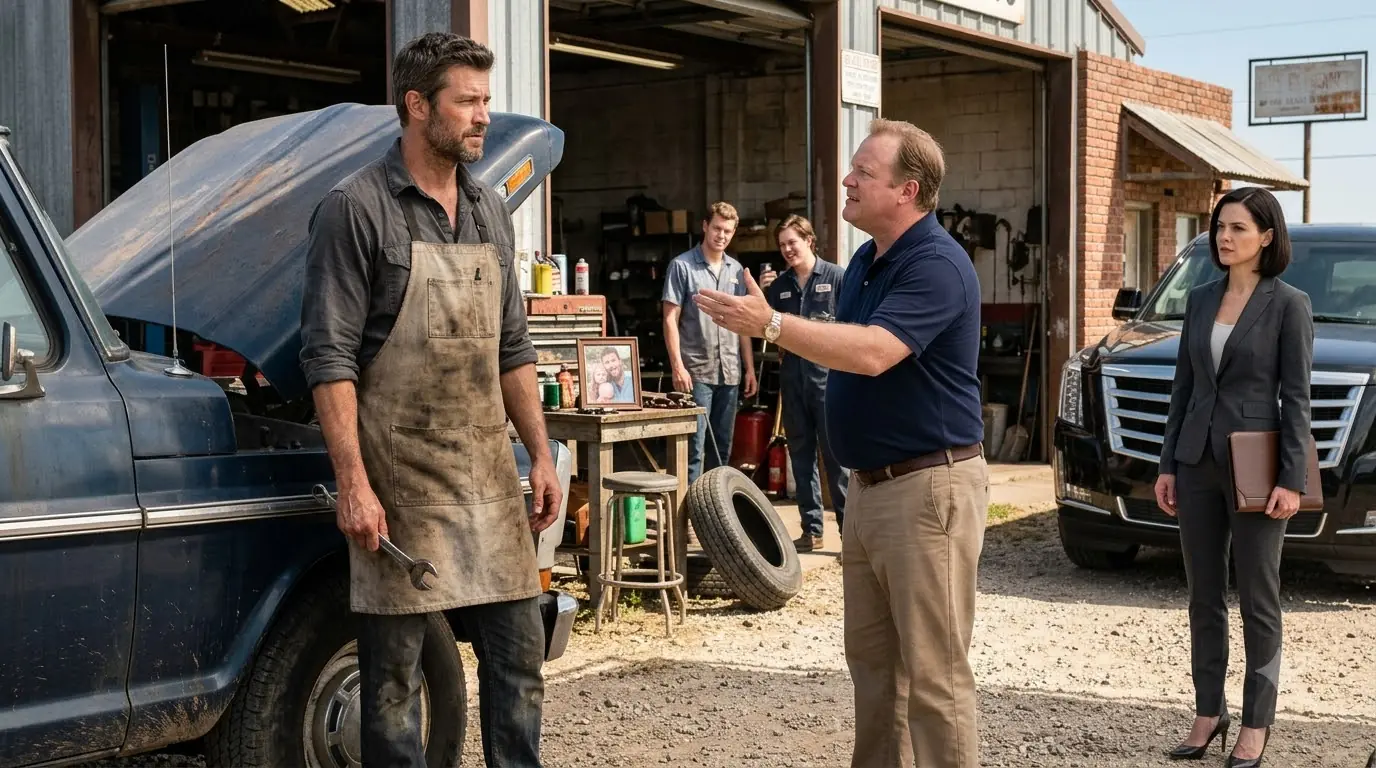
Isaac touched them anyway.
His garage stood at the southern edge of Harlow, Texas, where Route 12 narrowed from four lanes to two and the pavement began to buckle in long pale seams from summer heat. The building leaned slightly toward the east, as though thirty years of Gulf wind had been pushing against it one inch at a time.
His father had built the place with salvaged steel beams, secondhand lumber, and money borrowed from three relatives who had never asked to be repaid on schedule.
The sign above the entrance still said MERRITT MOTOR & MACHINE, though the white letters had faded almost completely into the blue paint beneath them.
There was no reception counter.
No online scheduling system.
No uniformed service advisors with tablets.
There was only Isaac, a workbench scarred by decades of welding sparks, rows of tools organized according to a system no one else understood, an ancient floor fan that rattled when turned to its highest setting, and a transistor radio permanently tuned to a jazz station out of San Antonio.
On most mornings, Isaac unlocked the doors before six.
By seven, he was already working.
That Tuesday in September began no differently.
He was flat on his back beneath a 1995 Ford F-150 belonging to Raymond Ellis, a retired history teacher who had taught half of Harlow before arthritis forced him out of the classroom.
Raymond’s truck had failed inspection because of an exhaust leak, a cracked manifold bolt, and what Harlow Premier Auto across the highway had described as “multiple age-related deficiencies not economically advisable to repair.”
Their estimate had been $4,800.
Raymond’s monthly pension check was barely half that.
So the truck ended up at Isaac’s garage.
“Tell me straight,” Raymond had said the previous afternoon. “Am I finally putting her down?”
Isaac had crouched near the front wheel and studied the rust beneath the frame.
“No.”
“That sounded too quick.”
“Frame’s ugly.”
“I know.”
“Transmission leaks.”
“I know that too.”
“Rear differential sounds like a coffee grinder.”
Raymond sighed.
“I was hoping you hadn’t noticed.”
Isaac looked up.
“You want the truck to be new?”
“No.”
“You want it safe?”
“Yes.”
“You want another two years?”
“If God allows.”
Isaac nodded.
“Then give me three days.”
Raymond had stared at him.
“How much?”
“I don’t know yet.”
“Isaac.”
“I haven’t fixed it yet.”
“You always say that.”
“Because you always ask too early.”
Now, the next morning, Isaac lay beneath the F-150 with a long extension bar in one hand and a magnetic work light stuck to the frame rail above him.
The manifold repair had taken longer than expected.
One bolt had snapped flush inside the cylinder head.
A dealership would have recommended replacing the assembly.
Isaac had drilled it, extracted it, chased the threads, inspected the casting, and reused everything that did not need to be thrown away.
That was why people called him the junk mechanic.
Some meant it kindly.
Some did not.
Across the service road sat Harlow Premier Auto, a newer building with six bays, polished signage, loaner vehicles, and employees wearing matching blue shirts with their names embroidered over the chest.
Its owner, Dale Hutchins, had known Isaac since they were teenagers.
They had never been friends.
Dale believed the future belonged to clean floors, computerized estimates, factory-certified parts, and customers willing to finance repairs.
Isaac believed a machine did not care how clean the invoice looked.
Dale appeared at the fence line around eight fifteen with three mechanics from his shop.
“Merritt working on Raymond’s death trap again,” he announced loudly enough to cross both parking lots.
One of the younger mechanics laughed.
Dale pointed toward the Ford.
“Man spends more time underneath garbage than a raccoon.”
Isaac heard every word.
He did not respond.
He adjusted the extension bar, leaned into the bolt, felt the threads move, and stopped exactly when resistance changed.
His father had taught him that reacting to mockery was like throwing tools at bad weather.
It wasted energy and changed nothing.
Isaac rolled out from beneath the truck, stood, and wiped his hands on a gray rag.
The morning was already warming.
September in that part of Texas often pretended summer would last forever.
He reached for his coffee.
That was when he heard tires on gravel.
Not one vehicle.
Several.
The sound came in sequence.
Heavy.
Controlled.
Synchronized closely enough that Isaac looked toward the road before the first SUV entered the lot.
Three black Chevrolet Suburbans turned in from Route 12.
No civilian plates.
Dark windows.
Identical spacing.
The lead vehicle stopped near the edge of the garage.
The second positioned itself behind it.
The third remained closer to the road.
Across the fence, Dale stopped talking.
Isaac set down the coffee.
The middle SUV’s rear door opened.
A woman stepped out.
She was somewhere in her early forties, medium height, dark hair cut sharply along her jaw, gray suit, low heels poorly suited to a gravel lot.
She paused just long enough to judge the ground before walking toward Isaac.
She carried a thick manila folder beneath one arm.
A man remained in the front passenger seat of the vehicle.
Another silhouette moved behind tinted glass.
The woman stopped several feet from Isaac.
“Isaac Merritt?”
“Yes.”