People in Harlow called Isaac Merritt the junk mechanic because he fixed the things everybody else had already decided were dead.
Cracked engine blocks. Stripped cylinder-head threads. Diesel pickups with half a million miles on them. Farm trucks that had spent twenty summers inhaling West Texas dust.
Engines so badly seized that reputable shops would tow them back into the parking lot rather than risk putting their name on the repair.
Isaac took them anyway.
His garage sat at the edge of Harlow, Texas, where Route 12 bent south toward open ranch country and the town thinned into mesquite, telephone poles, and sun-bleached fencing. The building was older than most of the businesses along the highway, built from salvaged steel beams, corrugated siding, and secondhand lumber by Isaac’s father in the late 1970s.
There was no polished reception desk.
No waiting room with bottled water.
No service adviser carrying a tablet.
There was an old Coca-Cola machine that had not worked since 2009, a metal fan that rattled above the parts shelf, and a hand-painted sign over the office door that still read MERRITT MOTOR & MACHINE even though Isaac had never bothered to restore the last three letters after a storm ripped them loose.
His customers did not care.
They came because Isaac could hear things other mechanics could not.
A loose wrist pin buried beneath valve noise.
A failing bearing before it began grinding.
A warped mating surface hidden beneath a gasket somebody else had replaced three times.
He approached engines the way some men approached chess boards, not looking at individual pieces but at relationships. Pressure, heat, timing, vibration, lubrication, tolerance. One small change altered everything downstream.
He had learned that from his father.
He had perfected it somewhere much farther away.
Six years earlier, Isaac Merritt had been sitting in a glass-walled boardroom twelve floors above downtown Houston explaining to the largest aerospace corporation in the country why one of its most important propulsion systems was eventually going to destroy itself.
By sunset, he was unemployed.
He packed one cardboard box.
A coffee mug.
Two engineering notebooks he legally owned.
A framed photograph of his father.
A small bronze model of a rocket engine someone had given him after his tenth patent.
Then he drove six hours south, unlocked the garage he had inherited, and never went back.
At least that was what he told himself.
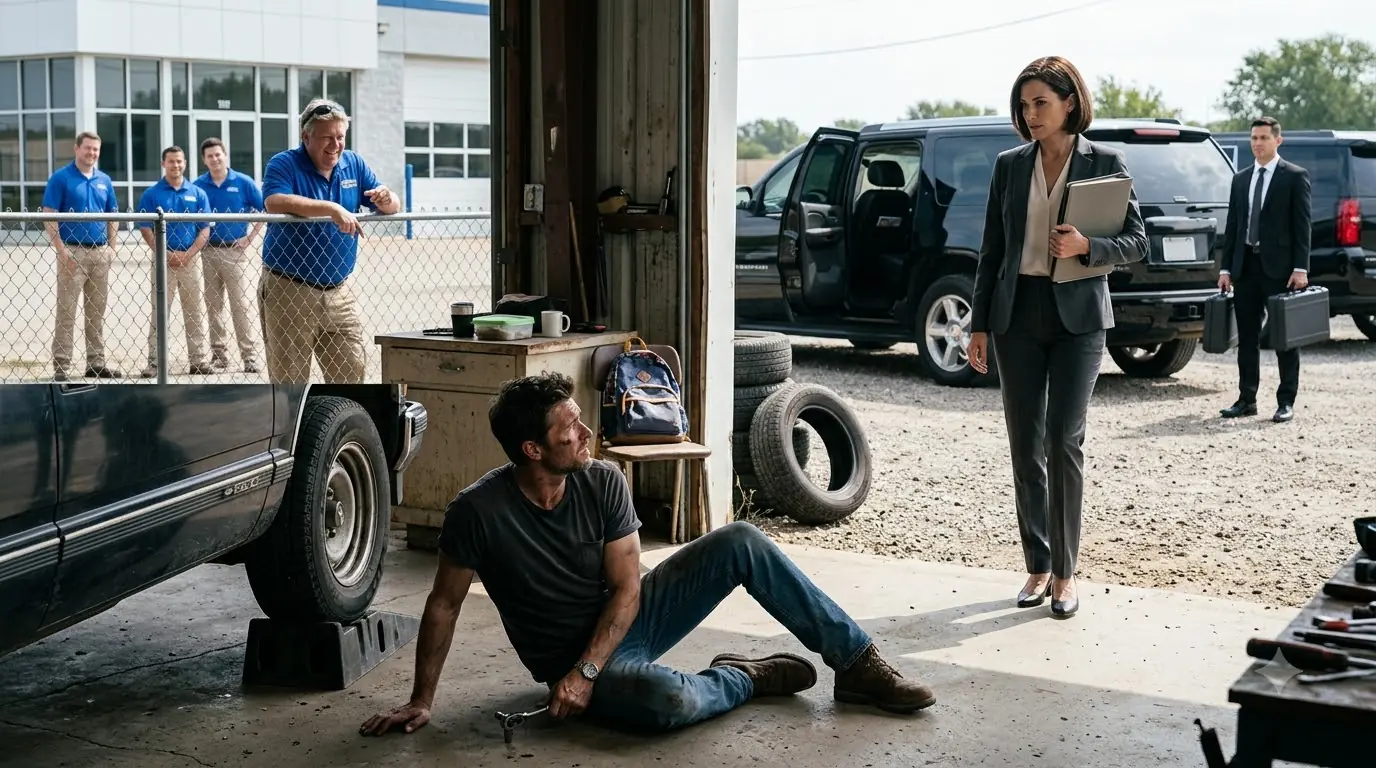
The truth arrived in Harlow on a Tuesday morning in September inside three black Chevrolet Suburbans with no ordinary licence plates.
The first vehicle turned into Isaac’s gravel lot at 9:17 a.m.
The second followed less than a car length behind it.
The third stopped near the road, positioned in a way that gave its occupants a clear view of the entire property.
Isaac was underneath Raymond Keene’s 1995 Ford F-150 when he heard them.
Raymond was a retired history teacher who had taught half the adults in Harlow how to write essays and the other half how to fear surprise quizzes. His truck had developed an exhaust leak and warped manifold flange that Harlow Premier Auto, the newer shop across the road, had quoted at a number higher than Raymond’s monthly pension.
Isaac told him to leave the keys.
He had been under the Ford since seven.
The garage smelled like hot oil, solvent, old rubber, and the faint metallic scent of ground steel. A jazz station out of San Antonio played quietly from a transistor radio on the parts shelf.
Across the neighbouring lot, Dale Hutchins had already made his daily comment.
Dale owned Harlow Premier Auto.
He employed eight mechanics, had six polished service bays, wore collared shirts with his business logo embroidered over the chest, and believed presentation was almost as important as repair quality.
Dale also considered Isaac’s garage an insult to modern business.
That morning, Dale had walked to the fence separating the lots with three employees behind him and said loudly, “Merritt’s under Raymond’s death trap again.”
One employee laughed.
Another looked uncomfortable.
Dale continued.
“Man spends more time under garbage than a raccoon.”
Isaac heard every word.
He tightened one bolt another quarter turn.
That was all.
He had not answered Dale Hutchins in six years.
Silence had become one of the easiest disciplines in Isaac’s life.
He was wiping residual oil from the manifold surface when the heavy tires arrived.
Three vehicles.
Coordinated.
Too deliberate for customers.
Isaac rolled out from beneath the truck.
He lay there for a moment with his shoulders against the creeper, looking toward the open bay.
Black Suburbans.
Dark glass.
Engines idling.
No county markings.
No dealership plates.
Nothing.
He rose slowly.
A rear door opened on the middle vehicle.
The woman who stepped out wore a slate-gray suit with practical low heels that immediately sank a quarter inch into the loose gravel. She was somewhere in her early forties, with dark hair cut close to her jaw and the posture of someone who had spent a career entering rooms where hesitation could be mistaken for uncertainty.
She crossed the lot directly.
No unnecessary glance at the garage.
No attempt to inspect his property.
No introduction from a security officer.
She stopped ten feet away and opened a credentials wallet.
Isaac looked at it without reaching.
The seal showed a blue globe crossed by an orbital arc.
The identification beneath it read:
ELEANOR VOSS
DIRECTOR, SYSTEMS ENGINEERING
OFFICE OF LAUNCH AND ORBITAL PROGRAMS
Isaac looked from the card to her face.
“Mr. Merritt?”
“That depends.”
“On what?”
“Who’s asking.”
She held the credentials steady.
“I think I’ve covered that.”
Isaac nodded toward the Suburbans.
“You bring three vehicles every time you want ten minutes with a mechanic?”
Eleanor glanced back once.
“The people in those vehicles are engineers, program security staff, and one communications specialist.”
“Not government agents?”
“Some of them have clearances you would probably consider excessive.”
“Comforting.”
She closed the credentials wallet.
“I need ten minutes.”
Isaac leaned against Raymond’s fender.