People in Harlow, Texas, called Isaac Merritt the junk mechanic because he fixed what everyone else had already decided was dead.
He took in engines with cracked blocks, stripped threads, warped heads, seized pistons, corroded harnesses, and transmissions that larger shops refused to open because the labor alone would cost more than the vehicle was worth.
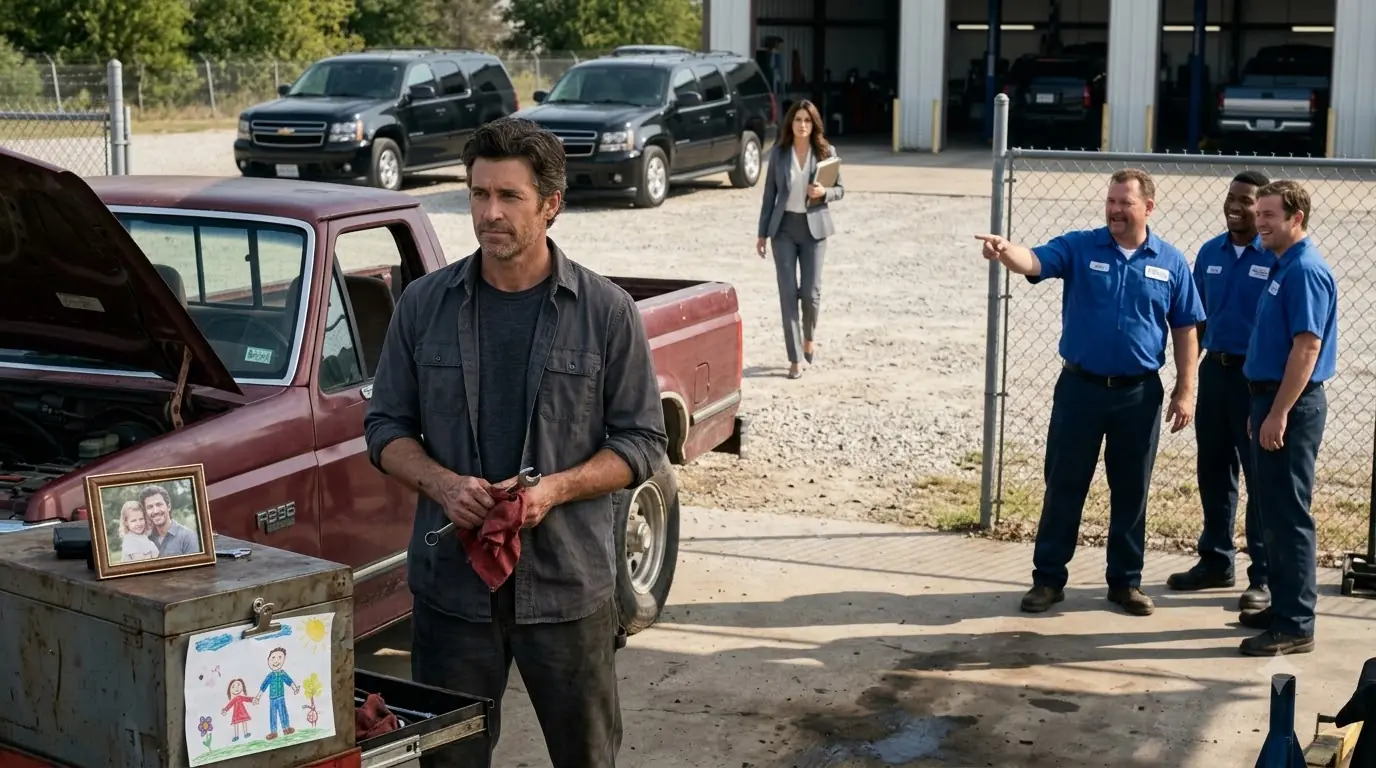
He did not perform miracles. Isaac hated that word. Miracles were what people called work when they did not understand how many hours had gone into learning how not to panic in front of a problem.
His garage sat on the edge of town beyond the last grocery store and before the county road narrowed into cattle land. The building had once been a farm-equipment shed. Isaac's father, Russell Merritt, had rebuilt it from salvaged steel beams, secondhand lumber, and a roof truss he bought from a demolished feed store in 1981. The floor was older than most of Isaac's customers, stained black in long shadows where oil and transmission fluid had soaked into the concrete over decades.
There was no polished reception area, no branded coffee machine, no service adviser behind a counter. A hand-painted sign near the road read MERRITT REPAIR, though the final T had faded so badly that strangers sometimes thought the place belonged to someone named Merri. Inside, tools hung on the walls in an arrangement that seemed chaotic until Isaac reached for one without looking and found it every time.
At seven on most mornings, a small transistor radio above the parts bins played jazz from San Antonio. Isaac kept the volume low. He said engines were easier to hear when nobody was trying to impress the room.
On the first Tuesday of September, Isaac was flat on his back beneath a 1995 Ford F-150 belonging to retired history teacher Raymond Ortiz. Raymond had taken the truck to Harlow Premier Auto across the road and been given an estimate high enough to make him consider selling it for scrap. The truck had belonged to Raymond's late brother. He had driven it to every high school football game for twenty-four years and was not ready to replace it with something newer simply because a shop computer said replacement made more financial sense.
Isaac had listened to the engine for less than two minutes before telling Raymond the problem was ugly but not fatal. A cracked exhaust manifold, two damaged studs, one vacuum leak, and a wiring fault that would take more patience than parts.
"How much?" Raymond had asked.
"Don't know yet."
"That's not how shops work."
"That's how this one works."
Raymond had squinted at him. "You're going to tell me after you've got me trapped."
"I'm going to tell you after I know what I actually used."
Three days later, Isaac was tightening the final manifold bolt when Dale Hutchins, owner of Harlow Premier Auto, drifted toward the chain-link fence dividing their properties. Dale had made a hobby of commenting on Isaac's business model, customer base, clothing, handwriting, lack of signage, and refusal to take financing plans.
That morning he brought an audience of three younger mechanics in matching blue shirts.
"Merritt's still under Raymond's death trap," Dale announced loud enough to cross the lot. "Man spends more time under garbage than a raccoon."
The three mechanics laughed because Dale was paying them and because laughter was cheaper than deciding whether he was funny.
Isaac heard every word. He rotated the torque wrench another quarter turn, checked the seating, and said nothing.
He had spent six years learning that silence was not surrender. Sometimes silence was simply refusing to let another person choose the subject of your day.
He slid from beneath the truck and wiped one forearm with a rag just as the sound of multiple heavy vehicles reached him from the county road.
The first thing he noticed was coordination. Most customers arrived one at a time, braking late because the entrance to Merritt Repair appeared suddenly after the curve. These vehicles slowed together. Three black Chevrolet Suburbans turned onto the gravel with equal spacing, tires crunching across the lot, engines idling in a low disciplined line.
They had dark windows and no standard civilian plates.
Dale stopped talking at the fence.
Isaac stood beside Raymond's truck, rag still in his hand.
The rear door of the middle Suburban opened. A woman stepped down in a gray suit and low heels that immediately sank half an inch into the loose gravel. She adjusted without looking down, crossed the lot, and stopped at conversational distance from Isaac.
She was somewhere in her early forties. Her dark hair was cut close to the jaw, and she had the posture of a person accustomed to walking into rooms where people had already decided whether to underestimate or dislike her.
She opened a credentials wallet.
Isaac looked at it without taking it.
The seal showed a blue globe crossed by an orbital arc. Beneath the photograph was the name Eleanor Voss and the title Director of Systems Engineering, NASA Office of Launch and Orbital Programs.
"Mr. Merritt," she said. "I need about ten minutes of your time."
Isaac glanced past her toward the two other Suburbans. No one had stepped out.
"You brought an escort for ten minutes."
"I brought engineers and security personnel who are waiting because I asked them to."
"That sounds like an escort."
"Fair enough."
He studied her face. She did not seem offended. That helped.
"I signed a nondisclosure agreement six years ago," he said. "Anything involving Nexora Aerospace is off the table."
"I'm aware of the agreement."
That answer changed the shape of the morning.
Eleanor drew a thick manila folder from under her arm and set it on the hood of Raymond's truck.
"I'm not here about a commercial dispute," she said. "I'm here about a satellite called OBSIDIAN-7. I believe you predicted its current failure mode before the first flight article was manufactured."
For the first time, Isaac looked at the folder rather than her.
"Who gave you my name?"
"You did. In a report dated March 14, 2017."
He felt something cold move under his ribs.
Six years earlier, that date had meant everything. Later, it meant nothing because no one had been willing to say the report existed.
"Leave it there," he said.
Eleanor's brow shifted slightly. "You don't want to look at it?"
"I didn't say that."
He walked into the garage, poured coffee from a machine that had been running since five, and stood with his back to her. He needed the physical routine. Cup. Coffee.
One spoon of sugar. Stir. Set the spoon down in the chipped ceramic tray his father had used for bolts before Isaac's mother objected.
Outside, nobody moved.