Behind him, several townspeople crowded into the passage, carrying blankets, bags, medicine, children wrapped in coats.
One by one, they reached the bottom.
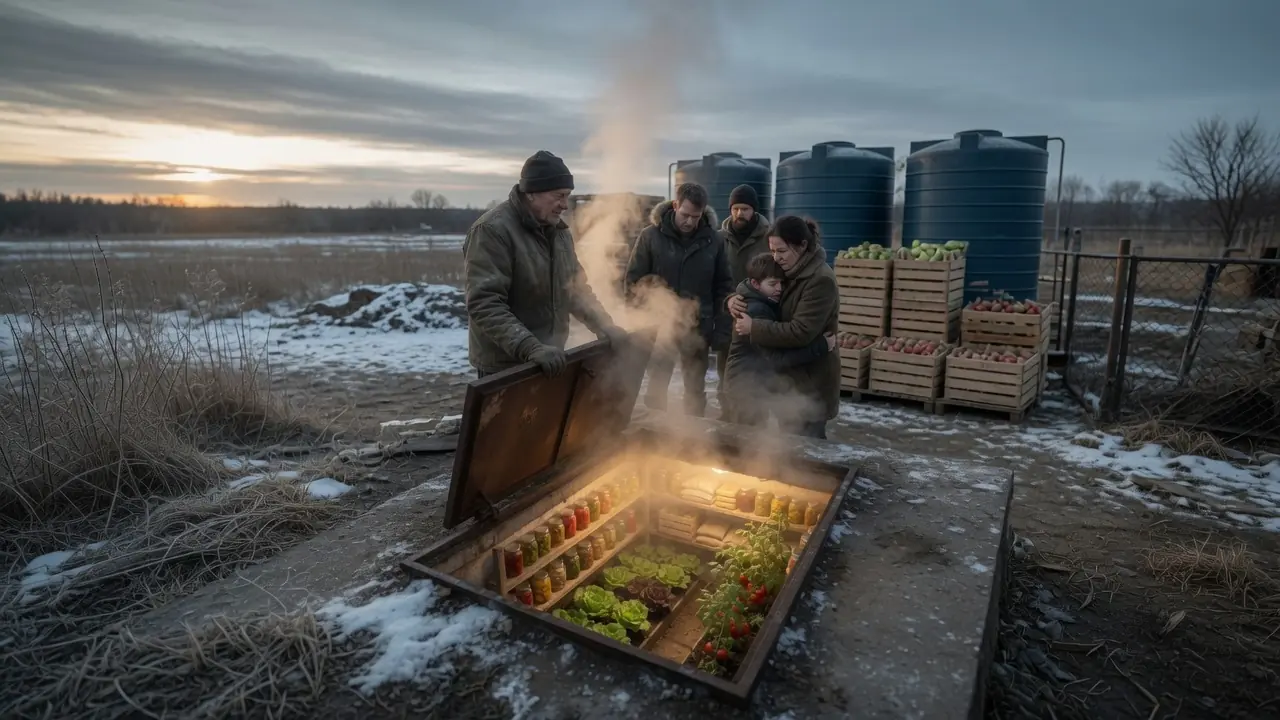
And one by one, they fell silent.
They had expected darkness.
A bunker.
Maybe canned food.
Maybe a strange old man's hiding place.
Instead, they saw rows of lettuce, beans, carrots, potatoes, herbs, tomatoes climbing strings beneath warm lights. They saw clean water, heat, stocked shelves, cots folded neatly against the wall, medical supplies organized by label, and walkways wide enough for families to move through safely.
A little boy whispered,
"It's summer down here."
His mother began to cry.
Dale stepped farther inside, unable to believe what his eyes were seeing.
"This..."
He swallowed hard.
"Earl, what is this?"
Earl did not answer right away.
He walked toward the wooden wall.
Toward the photograph.
Toward the date.
Dale followed.
When he saw the picture, his face changed.
"Who's the girl?"
Earl rested his hand beside her photograph.
"My sister."
The room quieted around them.
"Her name was Ruth."
For the first time in forty years, Earl Hadley told the story.
He spoke slowly, not because he wanted drama, but because some memories have to be carried carefully or they break open all over again.
In 1935, Earl had been twelve years old.
Ruth had been six.
That winter had begun like any other.
Cold.
Hard.
Manageable.
Then the snow stopped melting.
Roads disappeared.
Food ran low.
And fear entered Brockton before hunger did.
At first, neighbors helped one another.
That was how small towns survived.
Then rumors started.
A man named Silas Crayle, Dale's grandfather, told people the Hadley family was sick. Said their house wasn't safe. Said anyone who helped them might bring danger home to their own children.
It wasn't true.
But winter makes people afraid.
And fear makes lies sound practical.
Doors closed.
One by one.
Ruth became ill near the worst of the storm.
Earl's father went for help.
Nobody came.
Earl went himself, walking through snow from house to house, begging for someone to bring a doctor, a wagon, anything.
Every answer was polite.
Every door stayed closed.
Ruth died on January 22, 1935.
Not because the town had no food.
Not because nobody owned blankets.
Not because help did not exist.
She died because fear mattered more than a child.
Earl looked around the underground farm.
"I built this so no one in Brockton would ever have to knock on a closed door again."
Nobody spoke.
Dale stared at the date on the wall.
Then at the little girl's photograph.
His grandfather's name sat heavy in the silence between them.
"I'm sorry," Dale whispered.
Earl looked at him for a long moment.
Then nodded.
"Then help me carry soup."
For three weeks, Brockton lived beneath Earl Hadley's field.
Children slept warm.
Elderly neighbors received medicine.
Families ate vegetables grown under the same ground they had mocked for decades.
No one was turned away.
Not Dale.
Not his family.
Not the people who had laughed loudest.
Earl asked no one what they had said about him.
He already knew.
It simply no longer mattered.
When the roads finally opened and power returned, the town climbed back into daylight changed.
The diner grew quiet whenever Earl passed.
Not out of shame alone.
Out of understanding.
Spring came slowly that year.
Snow melted from the field.
Green returned above ground.
One morning, Dale Crayle walked to the cemetery outside town and found Ruth Hadley's small headstone.
He placed white flowers beside it.
Then he stood there a long time before saying,
"Forty years ago, we closed every door."
His voice broke.
"This time, your brother opened one for all of us."
That afternoon, Earl walked back to the hatch as he always did.
Only this time, nobody laughed.
People watched from porches.
From the diner windows.
From trucks parked along the road.
Earl unlocked the hatch, paused, and looked once toward town.
Then he went below.
Not to hide.
Not to escape.
But to keep tending the quiet, green miracle he had built beneath a frozen field.
Because some promises are not spoken for applause.
Some promises are carried in silence.
Year after year.
Winter after winter.
Until the day the whole world finally understands why they were kept.