At 10:17 that morning, nearly three hundred investors, farmers, dealers, collectors, mechanics, and equipment brokers stood beneath a hard Kansas sky waiting for several million dollars’ worth of machinery to change hands.
There were tractors worth more than houses.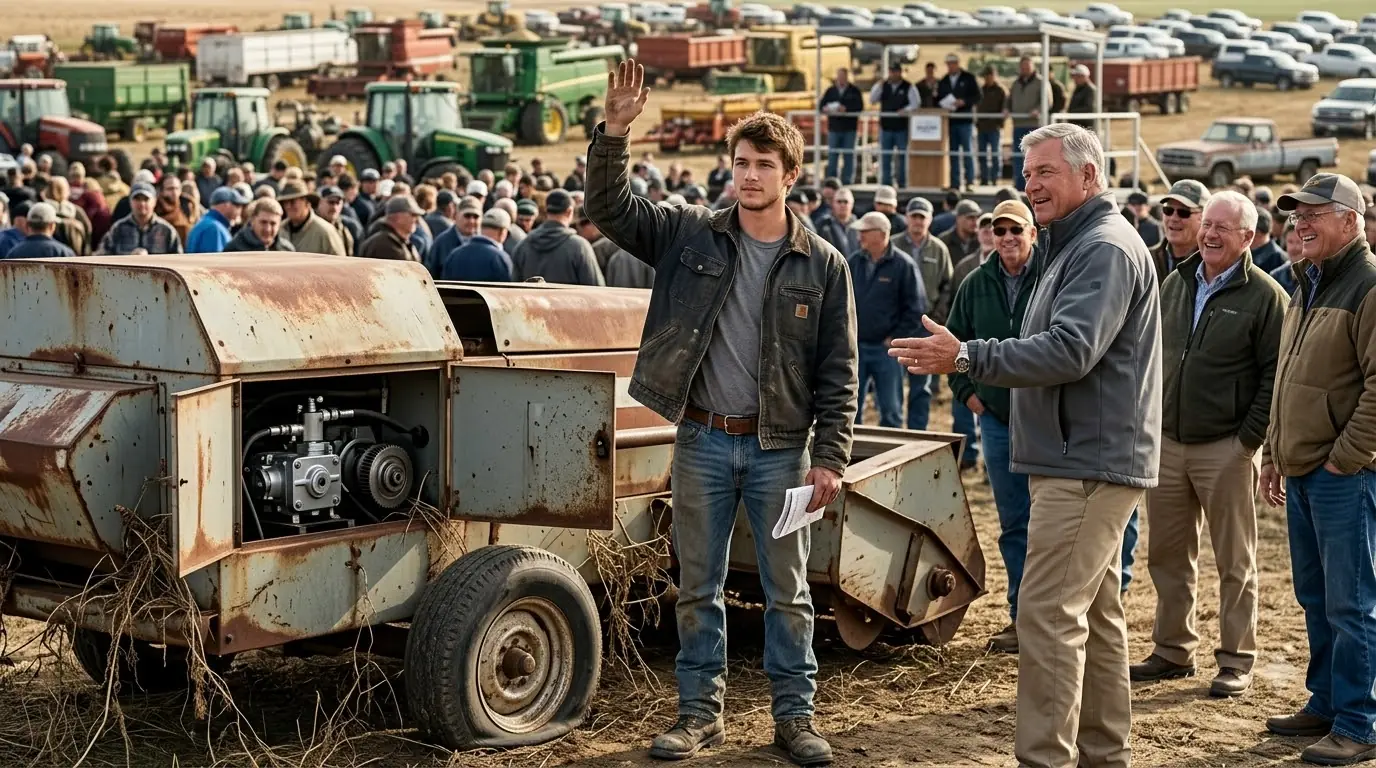
Combines with climate-controlled cabs and GPS guidance systems.
Self-propelled sprayers whose tires stood taller than Daniel Carter.
Rows of excavators, skid steers, grain carts, irrigation pumps, trailers, engines, and enough spare steel to fill a small town.
People had come from five states.
Some carried auction books covered in handwritten numbers.
Others walked around with tablets showing recent market prices.
Several were professional equipment dealers who could estimate the resale value of a tractor almost before reading its serial plate.
And near the far edge of the field, sitting by itself in waist-high grass, was the one machine nobody wanted.
It looked as if the auction company had dragged it there simply because throwing it away would have required more effort.
Rust covered most of its body.
One rear tire had gone nearly flat.
The windshield was cracked diagonally from top to bottom.
A hydraulic hose hung loose beneath the frame.
Its faded paint had once been some shade of industrial green, though years of weather had reduced it to patches surrounded by orange corrosion.
Someone had taken a white paint marker and written one word across the side panel.
SCRAP.
Nobody photographed it.
Nobody crawled underneath it.
Nobody made notes.
Nobody cared.
Then nineteen-year-old Daniel Carter walked toward it.
Daniel did not look like an investor.
His work jacket had a permanent dark stain near the left pocket from years of grease.
His boots were scuffed and dusty.
His jeans had a repaired tear at one knee.
He carried no tablet and no thick auction catalog full of bidding limits.
In his pocket was a folded envelope containing eight hundred dollars in cash.
That was almost every dollar he could afford to risk.
The old Ford F-150 he had driven to the auction was parked in the last row, far from the shiny diesel pickups surrounding the main field.
Daniel had not come searching for a miracle.
He had come searching for something broken enough that he could afford it and useful enough that he could repair it.
His father’s shop needed one good month.
Maybe two.
Then perhaps they could breathe again.
Carter Repair & Fabrication had been struggling since winter.
The shop stood six miles outside Salina in an old steel building Daniel’s father, Michael Carter, had rented for almost sixteen years.
There were three service bays.
Only one lift worked reliably.
The roof leaked above the parts room.
The office air conditioner had been dead since June.
A yellow bucket permanently sat beneath a crack in the ceiling because every serious rainstorm sent water dripping onto the floor.
The shop had never made Michael rich.
For most of Daniel’s childhood, it had made enough.
Farmers brought in pumps.
Landscaping companies brought in diesel equipment.
Small contractors brought generators, skid loaders, compressors, and trailers.
Michael repaired anything with an engine and most things without one.
He was honest to a fault.
That was part of the financial problem.
He undercharged people who were struggling.
He allowed old customers to pay late.
He repaired equipment for neighboring farmers knowing perfectly well that some would not settle the invoice until harvest.
When Daniel was younger, that generosity had seemed admirable.
At nineteen, after watching invoices accumulate beneath red PAST DUE stamps, he understood that kindness did not automatically keep lights on.
The previous month had been especially bad.
A transmission rebuild on a contractor’s loader had tied up one service bay for nine days.
The customer then filed bankruptcy.
A farm customer still owed them more than six thousand dollars.
Two major jobs had gone to a newer dealership in town because Carter Repair could not offer financing.
Then the compressor motor failed.
Michael replaced it using a credit card.
A week later, the second lift stopped halfway up with a truck on it.
Michael lowered it manually and taped a handwritten sign across the controls.
DO NOT USE.
Daniel found him one night sitting alone in the office after midnight.
The invoices were spread across the desk.
Michael did not realize his son had entered until Daniel turned on the hallway light.
“You staying here all night?”
Michael glanced up.
“Just finishing paperwork.”
Daniel looked at the stack.
“You’ve been staring at the same page for twenty minutes.”
Michael removed his glasses.
“I’m thinking.”
“That usually gets expensive.”
His father smiled tiredly.
Daniel sat across from him.
“How bad?”
“It’s fine.”
“That means bad.”
“It means I’m handling it.”
Daniel waited.
Michael finally sighed.
“We’re behind.”
“How far?”
“Daniel.”
“How far?”
His father looked toward the dark shop.
“Enough.”
That answer scared Daniel more than a number would have.
Carter Repair was not simply Michael’s business.
It was the place Daniel had grown up.
At six, he swept floors there.
At nine, he learned how to use a torque wrench.
At thirteen, he rebuilt a Briggs & Stratton engine under his father’s supervision.
At sixteen, he could diagnose hydraulic leaks faster than some grown mechanics Michael hired seasonally.
Daniel had planned to attend a technical college eventually.
Maybe study mechanical design.
Maybe work for a manufacturer.
But the shop came first.
That night he told his father:
“I’ll find something.”