Three men kicked in the door of Earl Dawson's Diner and started trashing the place, breaking chairs, smashing the counter glass, throwing an old man's life's work onto the floor. They grabbed his waitress and slammed her into the wall. The old man behind the counter just stood there, 67 years old, gray hair, hands that hadn't been in a fight in 40 years. He had one choice in that moment, stand down and let them wreck everything he'd built or do something he swore he'd never do again.
What those three men didn't know was who they'd just walked in on. 40 years ago, men twice their size used to go quiet when Earl Dawson's name came up. Nobody in this diner that morning had any idea what was about to happen or why a kid named Curtis Lane should never have sent his crew through that door. It started 30 seconds earlier than that.
The door hadn't even finished swinging when the first one, a thick-necked guy with a shaved head, put his boot through a chair just to announce they'd arrived. The second one walked straight down the counter, knocking over the ketchup bottles, the napkin holders, the little vase with the plastic flower Sarah had put there herself. Pure noise. Pure mess.
The kind of thing that's not about damage, it's about making sure everyone in the room understands who's in charge for the next few minutes. The third one was the one who grabbed Sarah. He didn't ask her to move. He just took her arm and threw her and she hit the edge of the counter hard enough that her knees went out from under her.
That's when Earl set the spatula down. He didn't say anything yet. He came around the end of the counter the way he did everything. Slow, unhurried, like a man who had all the time in the world, which was strange considering three armed strangers were tearing his diner apart in front of him.
The shaved-head one saw him coming and laughed. An old man in an apron walking toward three of them like he had any business doing that. He stopped laughing about 4 seconds later. Earl didn't throw the first punch.
He let it come to him, watched the kid wind up, watched the fist travel, and at the last possible second tilted his head maybe 3 in to the left. The punch went past his ear into nothing, and before that kid even understood he'd missed, Earl's hand was already closing around the back of his neck. One motion.
The kid's face met the edge of a table, and he didn't get back up. The other two stopped moving. For 1 full second, the only sound in that diner was a coffee pot still hissing on the burner, and a man on the floor who wasn't going anywhere. Then the second one picked up a chair because somebody had to do something, and Earl Dawson, 67 years old, gray hair, hands that supposedly hadn't thrown a punch in 40 years, shifted his weight the way a man does right before he stops waiting.
Earl Dawson opened that diner at 5:00 every morning, same time every day for 19 years. He'd flip on the lights, fire up the grill, and start the coffee before the sky outside had even decided what color it wanted to be that day. By the time the first trucker walked through the door, the place already smelled like bacon grease and burnt toast and coffee strong enough to strip paint.
In a town like Millbrook, Ohio, that smell was about the closest thing to church most men ever got. He was big, not Jim big, the kind of big that comes from 40 years of hard living settling into a man's bones and never quite leaving. Thick through the neck and the shoulders.
Hands like he'd spent a lifetime gripping something that didn't want to be held. He kept his gray hair cut short, his beard trimmed close, and he didn't say much. When he did talk, people tended to lean in and listen, and most of them couldn't have told you why.
Sarah Mills had walked into that diner eight months earlier looking for work, and Earl hadn't asked her many questions. He didn't need to. He could see it on her, the kind of tired that comes from running, not working. 24 years old, sharp, quick on her feet, the type who'd learned the hard way not to trust people too fast.
Earl gave her an apron, a key to the back door, and never once raised his voice at her in eight months. The regulars treated her like family because that was how Earl treated her, and in that diner, what Earl did, everybody else followed. For a long time, Millbrook had been a quiet sort of town, the kind of place where nothing much happened and everybody preferred it that way.
They were young, mean in that particular way young men get when they found a shortcut to feeling powerful, and they ran a simple operation. Walk into a small business, sit down like they already owned the place, and explain, real polite, that the neighborhood had gotten dangerous lately. A real shame if something happened to a man's shop, but for a modest weekly fee, they could make sure nothing did.
The hardware store paid first. Then the laundromat. The little tire shop on the corner held out for almost a month until somebody put a brick through their front window one night, and after that, they paid, too. One by one, every business on that stretch of road started leaving an envelope on the counter every Friday morning.
Nobody fought it. Fighting it got your windows broken, or worse, and in a town that's that size, or worse, was a phrase everybody understood without needing it spelled out. Their leader was a kid named Curtis Lane. 27 years old, tattoos climbing up both sides of his neck, a smile that never once reached his eyes.
He had a way of talking soft right before things got loud, and he'd built the whole operation out of nothing, which was a thing he was very proud of. He liked to walk down the center of the road, slow, like a man inspecting a kingdom he'd earned. People got out of his way. That was the point.
3 days before that morning at the diner, Curtis Lane walked through Earl's front door for the first time. He brought two of his guys with him. They sat down at the counter, spun the stools around like kids, and put their boots up where the coffee cups went. Curtis looked around, at the old photographs on the wall, the laminated menu gone soft at the corners, the regulars who'd all gone quiet the second he walked in.
Then he looked at Earl and smiled that smile of his. He told Earl the neighborhood had gotten dangerous. Said it would be a real shame if something happened to a nice old place like this one. Said that for $200 a week, he'd make sure nobody ever bothered Earl again.
Earl poured three cups of coffee, slid them across the counter, and didn't charge for any of it. Then he said one word, "No." The whole diner went still. Forks stopped halfway to mouths.
Curtis's smile flickered, just a for a second like a candle catching a draft it didn't expect. He wasn't used to that word. Most men, when they told Curtis Lane no, said it shaking. Earl wasn't shaking.
He just stood there with both hands flat on the counter, looking at the kid the way a man looks at a dog growling at a fence it doesn't understand size of. Curtis laughed it off. Said the old man had some nerve, he'd give him that. Said he'd come back in a few days, give Earl time to think it over properly.
Then he and his two boys walked out, and the whole diner let out a breath it had been holding since the door opened. Sarah came over once since they were gone. She was scared, and she didn't bother hiding it. She told Earl maybe they should just pay it.
$200 wasn't worth somebody getting hurt over. Wasn't worth the diner getting torn up. Earl wiped down the counter, slow, and told her not to worry about it. Said men like that talked a lot bigger than they hit.
He believed that. Mostly. But Earl Dawson was also a man who understood exactly what kind of storm was coming, long before the first drop of rain ever fell. He let Sarah go on believing it would blow over, because that's the kind of small mercy you offer somebody who's already scared enough for once in a lifetime.
What he didn't tell her was that he'd already made his decision 3 days before Curtis Lane ever walked through that door the second time. He just hoped, the way a man hopes against something he already knows is coming, that it wouldn't come to that. It came to that.
Three quiet days passed. Earl almost let himself believe Curtis had moved on to easier targets. Then that morning arrived. The boot through the glass, the chairs, the ketchup bottles rolling off the counter, Sarah hitting the floor.
Curtis hadn't come himself. He was smarter than that, too smart to be in the room for a message this size. He'd sent three of his crew instead. The ones who liked the work a little too much, and they came in loud because loud had worked on every other business on that strip.
They had no idea they'd just walked into the one place on that road where loud wasn't going to be enough. Earl walked around the end of the counter, slow, unhurried, the way he did everything. The shaved-head one, already on the floor from that first hit, wasn't getting up anytime soon.
The other two stood there a second too long, doing the kind of math men do when something they were promised turns out to be wrong. They'd been told this was an easy job. Walk in, scare an old man, collect an envelope. Nobody had warned them about the way he moved, or about the particular quiet on his face that wasn't fear and wasn't anger, either.
It was something closer to patience running out. The one with the chair swung first, a wide overhead arc meant to put Earl on the ground. Earl didn't block it. He stepped inside the swing instead, in close, so the chair came down across his back instead of his skull.
While the man was still finishing a swing that had already failed, Earl drove a fist up under his ribs, short and hard, and the chair clattered away from hands that had forgotten how to hold anything. The last one threw a wild punch, the kind that comes from panic more than training. Earl leaned away from it without even bothering to step, caught the man by the collar on the way past, and walked him straight through what was left of the front door.
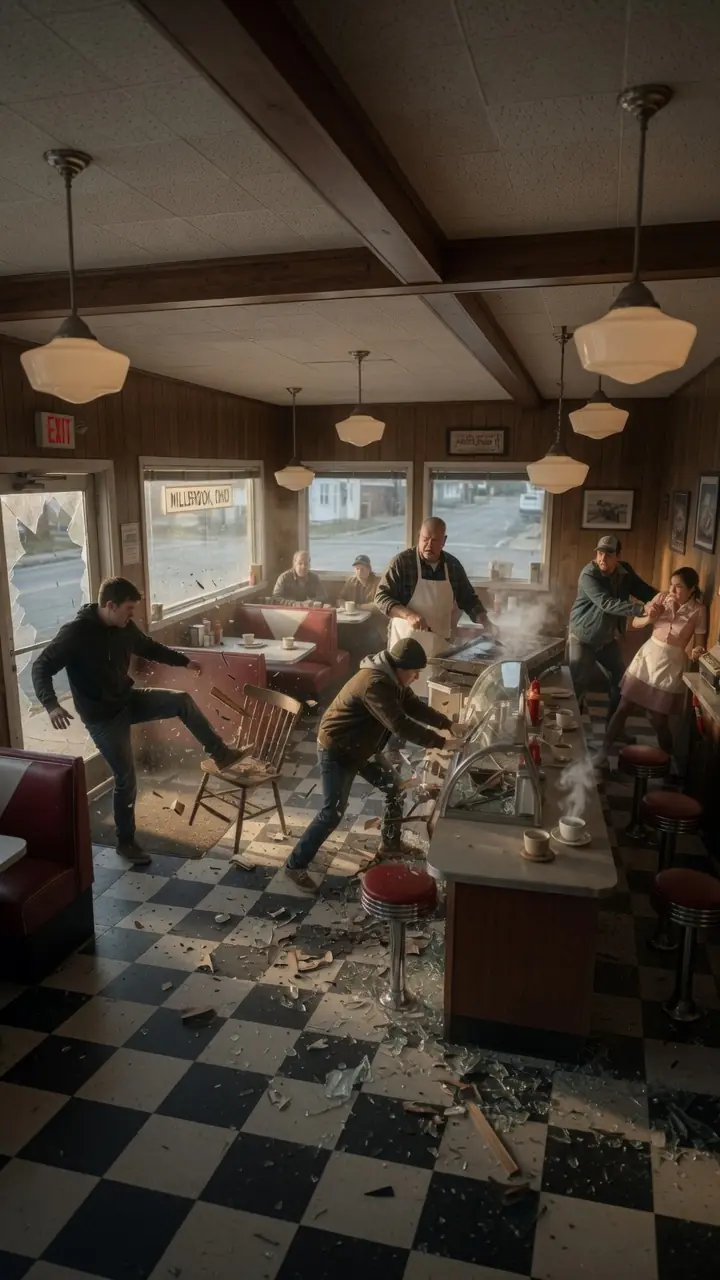
Glass that hadn't already come down came down then, 9 seconds, maybe 10. Three grown men on the floor or on the sidewalk, and an old man in a flour-dusted apron who wasn't even breathing hard. The diner stayed dead silent for a moment after that. Then somebody laughed.
The nervous kind. The kind that comes out when a body finally believes it's safe again. Earl helped Sarah up first, checked cut above her elbow, told her to sit down and breathe.
Then he looked at the three of them groaning on his floor and his sidewalk and told them quiet to crawl back to Curtis Lane and tell him the diner wasn't paying. Not that week. Not ever. They went limping, two of them holding up the one who'd taken the table to the face, none of them looking back.
Earl swept the glass himself, the way he did everything, slow and thorough. He told the regulars breakfast was on the house. That the police would have questions eventually, but he'd handle all of that. He sat Sarah down at the counter, poured her a cup of coffee she hadn't asked for, and put a slice of pie in front of her that she also hadn't asked for.
People started talking again in low voices, the words tripping over each other. Everybody already turning the last 9 seconds into a story they'd tell for years. An old trucker named Pete said he'd been coming to that diner for over a decade and never once guessed. Never once.
The danger was gone. The bad men were gone. And there was pie and free coffee. And the particular warm relief that comes after something terrible almost happens and then doesn't.
Earl finally poured himself a coffee, sat down on a stool for the first time all morning, rolled a shoulder that still ached from an old injury, and let out a long breath. For just a moment, he looked exactly like what he appeared to be most days. A tired man who ran a diner and had handled a little trouble and was ready to put it behind him.
Sarah asked him quiet where a man learns to move like that. Earl smiled just a little and said it was a long time ago. Said it didn't matter anymore. Said the important thing was that she was okay, and the coffee was still hot.
He believed that. He really did. He thought the worst part of the morning was already behind him. He was wrong. It hadn't even started yet.
The phone behind the counter rang. Earl let it ring twice before he picked it up. He listened for a moment, didn't say a word, and whatever easy tired look had been sitting on his face a minute earlier disappeared and didn't come back. A voice on the other end said his name, full name, Earl Dawson.
And then it said something that made him set his coffee cup down very, very slowly. "We know who you are now." Here's what had happened in the 20 minutes since those three men limped out of the diner. They'd made it back to Curtis Lane, and Curtis had Curtis furious.
Not at the beating, exactly, but at what the beating meant for business. And somewhere in the middle of that fury, one of the older guys in the crew, a man who'd been riding with rougher company long before Curtis was old enough to shave, heard the description of the diner and the old man behind the counter and went pale.
Because that older man remembered a name from a long time back. A name that used to mean something in a world Curtis Lane's little operation was only ever playing dress-up in. Back when the real clubs ran those highways, back when the wrong patch on a man's back could empty a bar in under 10 seconds.
There had been exactly one name people said quiet, like saying it too loud might summon him. Dawson. And just like that, the whole shape of the morning changed. This wasn't about $200 a week anymore.
It wasn't even really about Curtis Lane's wounded pride, though that was sitting in there, too, hot and ugly. The that crew realized who Earl Dawson actually was, it stopped being a shakedown gone wrong and became something colder. Because a name like that, alive and well, and pouring coffee where half the town see him, beat three of their men without breaking a sweat, was not a problem they could afford to leave standing.
If word got out that the Black Vipers got humiliated by one old man and did nothing about it, the whole operation was finished by Friday. Every business on that strip would stop paying within the week. So, it stopped being a shakedown. It became a cleanup.
The voice on the phone told Earl they were coming back. All of them, this time. And it told him there would be no witnesses left standing to tell anybody what happened. Then it hung up.
Earl stood there holding a dead phone, and for the first time since the morning started, he understood exactly how much time he had left, and exactly how little of it that actually was. He didn't panic. That was the thing about Earl Dawson. 40 years seemed to melt off him in about 3 seconds flat.
And what was left underneath was the man he'd spent two decades trying to bury under aprons and coffee pots and quiet Tuesday mornings. He moved fast now, faster than anybody in that diner had seen him move all day, faster than a 67-year-old man had any business moving. He went to the front of the room and told the regulars, in a voice that didn't leave space for arguing, that they needed to go out the back, right now, and head home, and not come back today, no matter what they heard.
Men who hadn't disobeyed Earl once in 19 years grabbed their coats and went. He didn't have to explain himself. They'd seen his face change, and that was explanation enough. Then there was Sarah.
He told her to go, too. Take the truck, drive to her cousin's place two towns over, and don't come back until he called her. She didn't move. She stood right there in the middle of the wrecked dining room.
Broken glass still on the floor, a chair still on its side by the jukebox and told him she wasn't leaving him alone with whatever was coming through that door next. Earl didn't argue with her. That's the part he thought about later, the not arguing.
He walked into the back office instead and he came out holding a small steel box. He set it on the counter in front of her, opened it, and took out a single object, a patch. Old leather, the edges gone soft and frayed, the colors faded down to something you'd have to know what you were looking at to recognize at all.
The kind of patch nobody buys, the kind you earn and bleed for and that some men have died over before they ever got to wear it. He didn't explain what it meant. He didn't have to. Sarah had grown up in this part of the country around men who talked about that world in low voices when they thought nobody was listening and she knew exactly what she was looking at.
She understood all at once that the quiet man who'd given her a job and a key and never once raised his voice to her had stood a long time ago near the very top of a world she'd only ever heard about in whispers. She looked from the patch to Earl and back again and something in her settled into place. The danger in that room had never been him. It never had been.
He told her gently that he needed her to leave. Not because he was afraid for himself but because he didn't want her to watch what he was about to become again. He'd spent 40 years walking away from that man, brick by brick, year by year, and now Curtis Lane's crew was about to make him pick that man back up for one more morning.
And Earl didn't want that to be the last image Sarah carried of him. Sarah took the truck keys. She didn't drive two towns over. She made it as far as the gas station across the road, parked under the awning, and sat there shaking, watching the diner through the windshield, because she couldn't make herself leave him completely.
Not really. Not all the way. Earl locked the back door. He pulled the blinds halfway down, set the broken chairs upright one at a time, slow, the way a man tidies a room before guests he doesn't particularly want to arrive anyway.
Then he reached underneath the counter, below the register, to a spot he'd checked every single morning for 19 years and never once needed. And he waited. Out on the road, you could already hear them coming. A line of engines, low at first, then growing.
The sound of a lot of men arriving at once with no more intention of leaving anybody behind to talk about it afterward. Earl stood behind his counter in his apron, hands flat on the wood, in the exact same spot he'd stood three days earlier, when he'd said one word and changed the whole shape of everything that followed. He was 67 years old.
He was about to be outnumbered by more than 10 to 1, and by a wide margin, he was still the most dangerous thing within 500 miles of that diner. The first engine cut out right outside the door. They came in slower than the first crew had.
That told Earl everything he needed to know before a single one of them said a word. The first wave had come in loud and stupid, because loud and stupid had worked on every other business on that strip for 6 months running. This crew was careful, spreading out along the walls the second they cleared the doorway, and that meant the older man's warning had gotten through to all of them.
They knew now, and men who know what they're walking into and come in anyway are a different kind of dangerous than men who don't. Curtis Lane came in last. He stepped over the broken glass still scattered across the threshold and looked around at the wreckage his own people had made 3 hours earlier.
Then he looked at Earl and the soft smile that usually sat on his face walls was gone. In its place was something tighter, something that belonged to a man who'd already decided the only way out of a mistake was straight through the middle of it. There were 11 of them.
Earl counted later going back over it with Sarah and a couple of the regulars who'd watched part of it through the gas station window across the street. 11 men crowded into a diner built to comfortably seat maybe 30, half of them carrying something, a bat, a length of chain, one of them with something heavier tucked into his waistband that he hadn't pulled out yet. And one old man behind a counter in a flower-dusted apron.
Curtis tried talking first. They almost always do. He told Earl he hadn't known that if he'd known who he was dealing with, none of this would have happened. Said maybe they could still work something out the two of them like reasonable men.
But even while he was saying it, his crew kept moving. Fanning out along the walls, boxing the room in from three directions at once. Earl watched them spread and understood that every word coming out of Curtis Lane's mouth right then was just noise meant to cover that spread.
So Earl didn't answer the words. He answered the spread. The man easing toward his right flank with a length of chain was the real threat in that first second. And Earl knew it before the man himself had finished deciding to move.
Earl came over the top of his own counter faster than any of them expected a man his age to move. And he was on the chain before it ever finished coming up. One short hard strike to the throat and that man folded to the floor gasping, done before he'd landed a single blow.
The room exploded after that. The first fight that morning had been fast, 9 seconds, maybe 10, over almost before it began. This one wasn't fast. This one was a war.
11 men couldn't all reach him at once in a room that narrow, and that single fact was the only thing keeping Earl alive through the next several minutes. He put his back against the counter, so they could only come at him from the front, forced them into coming one at a time, two at most, and made every single one of them pay full price for the privilege. A bat came down across his shoulder instead of his skull, and his whole arm went half numb, and he kept fighting anyway.
Somebody caught him across the jaw and split his lip open, and he kept fighting through that, too. He wasn't the man he'd been at 30 anymore. His body knew it with every joint screaming a little louder than the last.
But 40 years hadn't taken away the one thing that had always mattered most. Earl Dawson's, in a fight, simply did not stop. Other men had limits they respected. Earl had outlived his a long time ago.
He broke a man's forearm with that same chain he'd taken off the first one. He drove another man headfirst into the pastry case, glass and pie crust scattering everywhere. He caught wrist that had the knife in it, turned it the wrong direction, and the knife hit the floor while the man who'd been holding it went down clutching a hand.
That wasn't going to work right again for a long while. But Earl was bleeding now and tiring, and there were still six of them standing. That was when Curtis Lane, who'd been hanging back near the door the whole time, finally reached for the thing tucked into his waistband.
The gun came out, and everything in that diner stopped at once. A gun changes a fight. It doesn't matter how skilled a man is, how big, how willing. A gun changes the math completely, and Earl understood that better than almost anyone alive.
He stood there against his own counter, blood running down his chin, the chain still hanging loose from one hand, and he looked down the barrel pointed at him by a scared 27-year-old who'd never actually crossed that particular line before. Curtis's hand was shaking badly. He'd built an entire operation on noise and fear and other people's nerves, and in 6 months of running that strip, he'd never once had to actually pull a trigger on a man.
Now, here he was, facing the most dangerous person he was ever going to meet in his life, bleeding out in front of him, holding a gun that suddenly felt a great deal heavier than it had 10 seconds earlier. Earl spoke then. Quiet, the same quiet he'd used 3 days ago when he'd said one word and changed everything that came after it.
He told Curtis that if he was going to pull that trigger, he'd better not miss. Because the moment that bullet failed to put him down, Earl was going to take that gun out of his hand and use it. And there would be no more talking after that point.
Not for Curtis, not for any of the six men still standing in that room, and that was the moment the front door opened again. Sarah walked in. She'd been sitting in that truck across the road for the better part of 20 minutes, watching through the windshield, and when she saw the gun come out through the front window, something in her made a decision faster than her mind could argue with it.
She had a clear, easy path to staying exactly where she was, safe out of it entirely. Instead, she got out of the truck, crossed the road, and walked into a room full of armed men. She didn't say much at first. She just held up Earl's old patch, high enough that everyone in that room could see it clearly.
And she said one thing loud to the whole crowd of them at once. She told them they all knew exactly what that patch meant. She told them the man whose name belonged on the wall of that world was standing right there in front of them bleeding. And that the people who had given him that patch a long time ago were still out there somewhere.
And they did not forget their own. Not ever. It was a bluff and it wasn't a bluff. That was the strange genius of it.
Every man standing in that diner had grown up on stories about exactly that kind of loyalty. Exactly that kind of long memory. And not one of them could say with any certainty that she was wrong.
You could watch it land in real time. Six hard dangerous men doing the math all at once. And the math wasn't coming out the way any of them wanted. The gun came down first.
Curtis lowered it slow like the weight of it had finally won an argument his arm had been losing for the last several seconds. His hand was still shaking. And in that long terrible quiet that followed you could see him finally understand what the older man in his own crew had been trying to warn him about for the last hour.
There are some doors a man doesn't open. There are some men a man simply walks past on the street and counts himself lucky for it. Curtis Lane had kicked one of those doors in with his boot over $200 a week.
And it had cost him almost everything in the space of one morning. Earl stepped forward and took the gun out of his hand. Curtis let him. There wasn't a single thing left in that kid that wanted to find out what happened if he didn't.
It was over. Truly over this time. The men who could still walk walked. The ones who couldn't were helped out by the ones who could.
They didn't run exactly. They left the way people leave a funeral, quiet and careful, nobody looking back at what they were leaving behind. By the time the police finally arrived, called by half the regulars Earl had sent home earlier that morning, there was nothing left in that diner but broken glass, a few dark stains on the floor, and an old man sitting on a stool with a split lip and a bag of frozen peas pressed against his shoulder.
The questions started almost immediately, and that was fair. Eleven men had walked into a small business and torn it apart, and three of them needed real medical attention by the time officers arrived. But here's a small detail worth knowing, the kind of detail that mattered more than almost anything else that happened that day.
Every single regular who'd been in that diner that morning told the exact same story to the police independently, without comparing notes first. And the story they told was simple and entirely true. A gang of armed men had attacked an old veteran in his own place of business, and he had defended himself.
And he had defended a young woman who worked for him. That was the whole story. Earl never had to lie about a single piece of it. He just had to stand there while a town that had quietly loved him for 19 years made absolutely certain the truth was the only version that ever made it onto the record.
Curtis Lane was arrested at the scene along with six of his crew who were still able to be moved. The investigation that followed turned up far more than just one violent morning at a roadside diner. It turned up six months of extortion records, the laundromat owner's account, the hardware store owner's account, security footage from the night somebody put a brick through the tire shop's window.
The Black Vipers didn't just collapse from embarrassment. They collapsed because once people stopped being afraid enough to talk, there turned out to be a great deal to say. Curtis was charged with extortion, assault, and weapons charges that came with real prison time attached to them. Not the kind of consequence a kid with his particular ego had ever truly believed could land on him.
At his sentencing, almost a year later, Earl Dawson sat in the back of that courtroom because he'd been asked to be there and because some part of him wanted to see the end of it with his own eyes. Curtis didn't look like the same young man who'd walked down the middle of that road like he owned it. Prison does that to people. Sometimes faster than anything else can.
When he was finally given the chance to speak, he didn't try to explain his way out of anything. And he didn't blame the men who'd followed him into that diner, either. He said, in a voice a good deal smaller than the one he used to use, that he'd built the whole thing on the idea that fear was the same thing as respect.
And that he'd been wrong up about that in a way that had caused real people real harm. People who'd never done a single thing to deserve any of it. He said he understood now that an old man behind a counter who said no, quietly, without raising his voice, had more actual strength in him than every threat Curtis had ever made put together.
He asked specifically for Sarah to know that he was sorry for what he'd done to her by name on the record. He didn't ask Earl for anything. He said Earl didn't owe him an apology in return, and he didn't expect one. And he was right about that, too.
It wasn't a Hollywood redemption. Nobody in that courtroom mistook it for one. But it was something closer to honest than anybody expected to hear from him. And for a man like Curtis Lane, that turned out to be a genuinely new experience.
The Black Vipers didn't last a month after that morning at the diner. That part surprises people sometimes, but it really shouldn't. The whole operation had been built on exactly one foundation. The belief that nobody would ever push back.
Once word got around that one old man had put 11 of them on the floor and walked away with Curtis Lane's gun in his own hand, that foundation simply stopped existing. The hardware store stopped paying within a week. The laundromat stopped the same day.
The tire shop's owner walked down personally and told whoever was left running things that he was finished and got no argument back. As for who Earl Dawson really used to be, the town mostly let that lie exactly where it had always lain. They'd seen enough that morning to satisfy whatever curiosity they might have had.
A few of the older folks in Millbrook had recognized the name the moment it got mentioned, the way people sometimes recognize a name from a war they weren't part of, but had heard plenty about. They understood in their own quiet way why a man who'd once been what Earl Dawson had been might want to spend the second half of his life flipping eggs and pouring coffee and never once raising his voice as at anybody.
Sometimes the most dangerous people in the world want, more than almost anything else, to be left alone in peace. They've already seen exactly where the other road goes and they know better than anyone alive that it doesn't go anywhere good. Sarah stayed. She put the patch back into its steel box herself, closed the lid, and handed it to Earl with both hands like something that deserved that much care.
He put it back in the office in the same spot it had sat for 19 years before that morning. Neither of them talked about that day much after it happened, but something had shifted permanently between them in a way that didn't need words to be real. She'd seen the man underneath the apron now.
And instead of fear, what she felt afterward was something closer to what a daughter feels for a father who's finally let her see all of him. She understood, finally, why the regulars had always followed Earl's lead on everything without question. She understood why he'd never once asked her where she'd been running from when she first walked through that door eight months earlier.
A man like Earl didn't need to ask a question like that. He'd spent a good part of his own life running from something, too, long before she'd ever met him, and he'd finally found a place to stop running. The diner reopened 3 days after that morning. New glass in the front door, new chairs to replace the ones that hadn't survived.
The same faded photograph still hanging on the wall, the same smell of bacon and coffee drifting out before the sky had decided what color it wanted to be. The regulars came back, and this time they brought friends. And for a good long while, that little roadside diner in Millbrook, Ohio, was busier than it had ever been in 19 years, full of people who just wanted to shake the hand of the old man behind the counter.
Earl never much cared for the fuss. He poured their coffee, waved off their thanks the same way he always had, and slowly, the way these things tend to go, the fuss quieted down to something more like normal. Life went back to being quiet, the way Earl preferred it.
Think back for a second to where this whole story started. A boot through the glass, a young woman thrown to the floor, an old man setting down a coffee pot, slow and careful like it mattered. It looked, in that first moment, like a mismatch nobody could survive.
It looked like the world doing exactly what the world does too often. The strong taking from the weak, the young rolling straight over the old, and one tired, quiet man standing there with nothing left to stop any of it. But, that's the thing about quiet men that the world keeps forgetting and keeps having to learn all over again.
The quiet isn't weakness. Sometimes the quiet is a choice made by somebody who's already been everywhere violence can take a person and decided, deliberately, to come back from it and pour coffee instead. Curtis Lane looked at Earl Dawson that first morning and saw an easy mark, an old man who'd run out of road.
What he should have seen, if he'd known how to look, was a man who'd set down a heavy burden a long time ago and who would pick it back up exactly once, for exactly the right reason, and then set it down again for good the moment it was no longer needed. Earl Dawson ran that roadside diner for another 11 years after that morning. He passed away quietly in his sleep in the small apartment above the diner, where he'd lived the whole time.
Half the town turned out for his funeral, by every account. Sarah, who by then had taken over running the place herself, kept his stool empty behind the counter for years afterward and never let a single person sit in it. And somewhere in a steel box in the back office, there's still an old leather patch, frayed at every edge, that nobody ever needed to take out again because by then everyone who needed to know already knew exactly who Earl Dawson had been and exactly who he'd chosen to become instead.
11 years passed and Earl Dawson never raised his voice at another living soul. He flipped eggs. He poured coffee before the sky picked a color. He listened to Sarah talk about her day and never once brought up Curtis Lane's name unless she brought it up first.
The steel box went back in the office and the patch went back in the box and it sat there year after year untouched the way a fire extinguisher sits behind glass. Not forgotten, just no longer needed. Millbrook kept its quiet roadside diner. Earl kept his stool, his apron, and his mornings.
That was the whole second half of his life, I did, and he never once wanted it any other way.