Colt Banister grabbed Dana Pruitt by the collar and slammed her into his truck, the delivery crate flying from her arms, oranges bursting across the gravel. He wrenched her arm back and forced her to her knees, one boot planted between her shoulder blades. Behind him, three men swung a tire iron into the hand-painted sign over Hargrove Auto, splitting the wood through Nell’s name. Nell Hargrove stood exactly where she had been standing, still as the workbench beside her. Colt straightened, grinning, and jerked his chin toward Dana kneeling in the gravel. “Old lady, you wanna end up like her?”
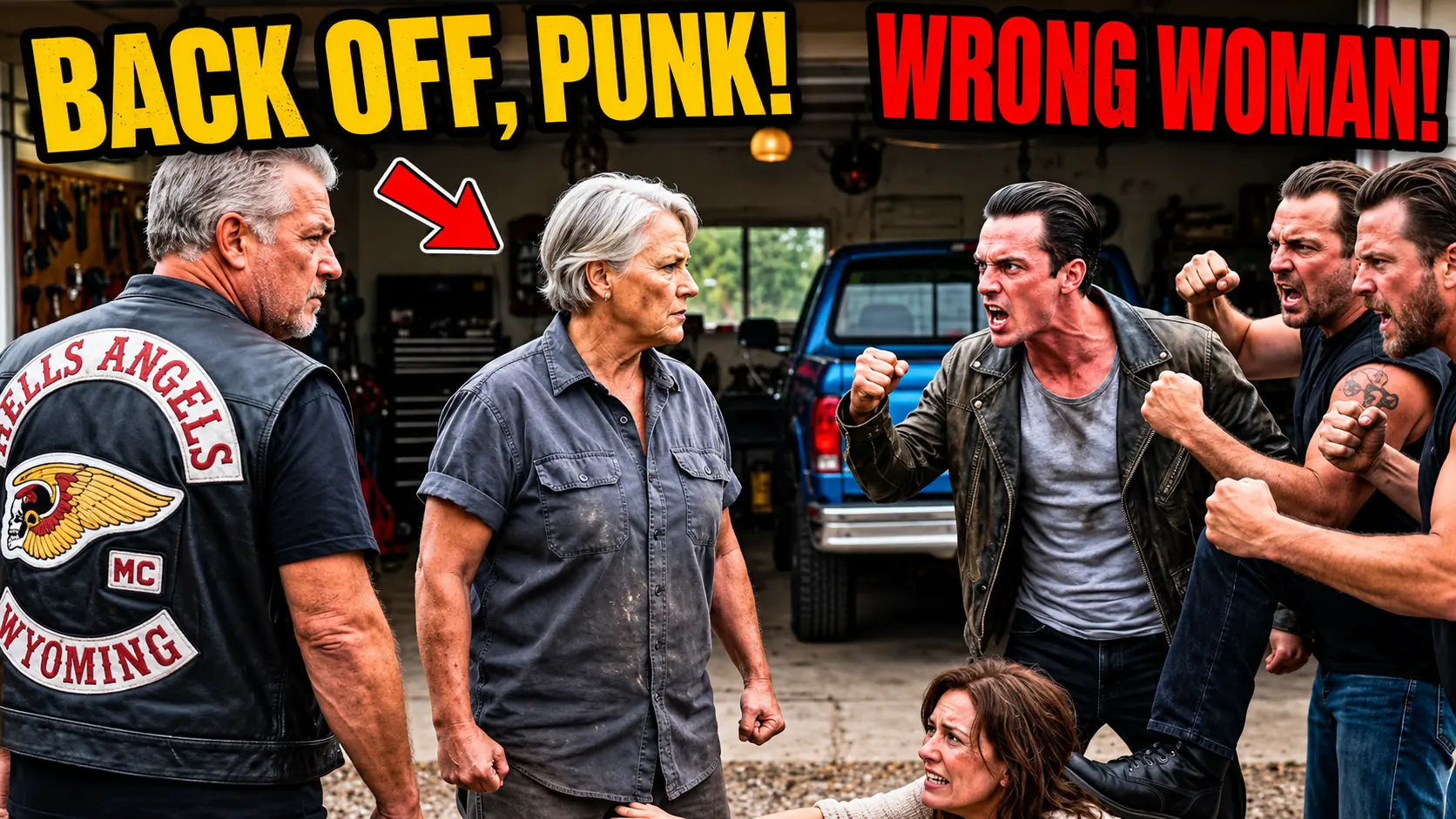
Nell set down her wrench. She had already counted the men, already marked which one would move first if this went wrong. Thirty years she had carried a different kind of stillness, the kind soldiers carry, and nobody in that lot knew what they were standing in front of. “Walk away before this gets worse,” Nell said. Six words. Nothing more. Stay with us. It took one phone call for forty members of the Hells Angels to bring an entire Wyoming county to a standstill.
Cedar Hollow, Wyoming, was the kind of town where the mountains did most of the talking. Snow sat on the peaks even in late spring, and the wind carried the smell of pine down through the valley. Every morning before the sun cleared the ridge, the diner on Prairie Street opened at six, and by a quarter past the same handful of regulars sat in the same chairs drinking coffee strong enough to strip paint, talking about weather that never quite changed. At the edge of town, past the old grain elevator and a stand of lodgepole pine, sat a garage with a hand-painted sign that read Hargrove Auto.
Everybody in Cedar Hollow knew Nell Hargrove. She was sixty-eight years old, built like a woman who had spent her whole life using her hands for something. Forearms corded with the kind of strength that came from decades of labor rather than any gym. Her hair had gone fully silver, cut short and practical. Her knuckles were permanently stained with engine grease that no amount of scrubbing had ever managed to lift. She fixed trucks. She fixed tractors. She kept half the farm equipment in the county running past the point most mechanics would have called it dead. And in eleven years of running that shop, she had never once charged a struggling family more than they could afford. Sometimes she charged them nothing at all.
“Nell, you can’t keep doing that,” Dana Pruitt told her one morning, leaning against the frame of the open garage door with two coffees in her hands, one for herself and one she had brought without being asked. Dana ran the general store two blocks over, a steady, plain-spoken woman a little younger than Nell, with a laugh that carried down the whole street and a stubborn streak that matched it. “You fixed the Coopers’ brakes for free last week. That’s the third free job this month.” “They’re struggling,” Nell said, not looking up from the engine in front of her. “Everybody’s struggling. You’re struggling too.” “I’m fine.” Dana studied her for a long moment, the way she had studied her a hundred times before without ever quite finding the words for what she saw. There was something underneath Nell’s gentleness, something still, something that watched. She had noticed it years ago, the first week she met her, when a truck backfired on Prairie Street and every person on the sidewalk flinched except Nell. Nell had simply turned her head toward the sound, assessed it in half a second, and gone back to what she was doing before anyone else finished startling. She had asked about it once. Nell had smiled and said, “Old habits,” and never elaborated. Dana, respecting her too much to push, had never asked again.
That morning nothing about the day felt different. The sky was clear. Nell had two vehicles scheduled, an oil change and a transmission problem on old Ray Coburn’s pickup, and she was humming an old tune under her breath when the sound of engines came rolling down the highway. Not one engine. Several. Nell’s humming stopped. She set the wrench down slowly, deliberately, the way a person sets something down when they want both hands free. Four trucks rounded the bend, tires kicking gravel as they swung into the lot with no regard for the cones marking customer parking. They parked at hard angles, blocking the entrance. It was not about convenience. It was a message. Five men climbed out. At the front walked a man in his early thirties, lean, sharp-jawed, a leather jacket despite the warm morning, a smirk fixed on his face like he had rehearsed it in a mirror. This was Colt Banister. Nell did not know his name yet. She would.