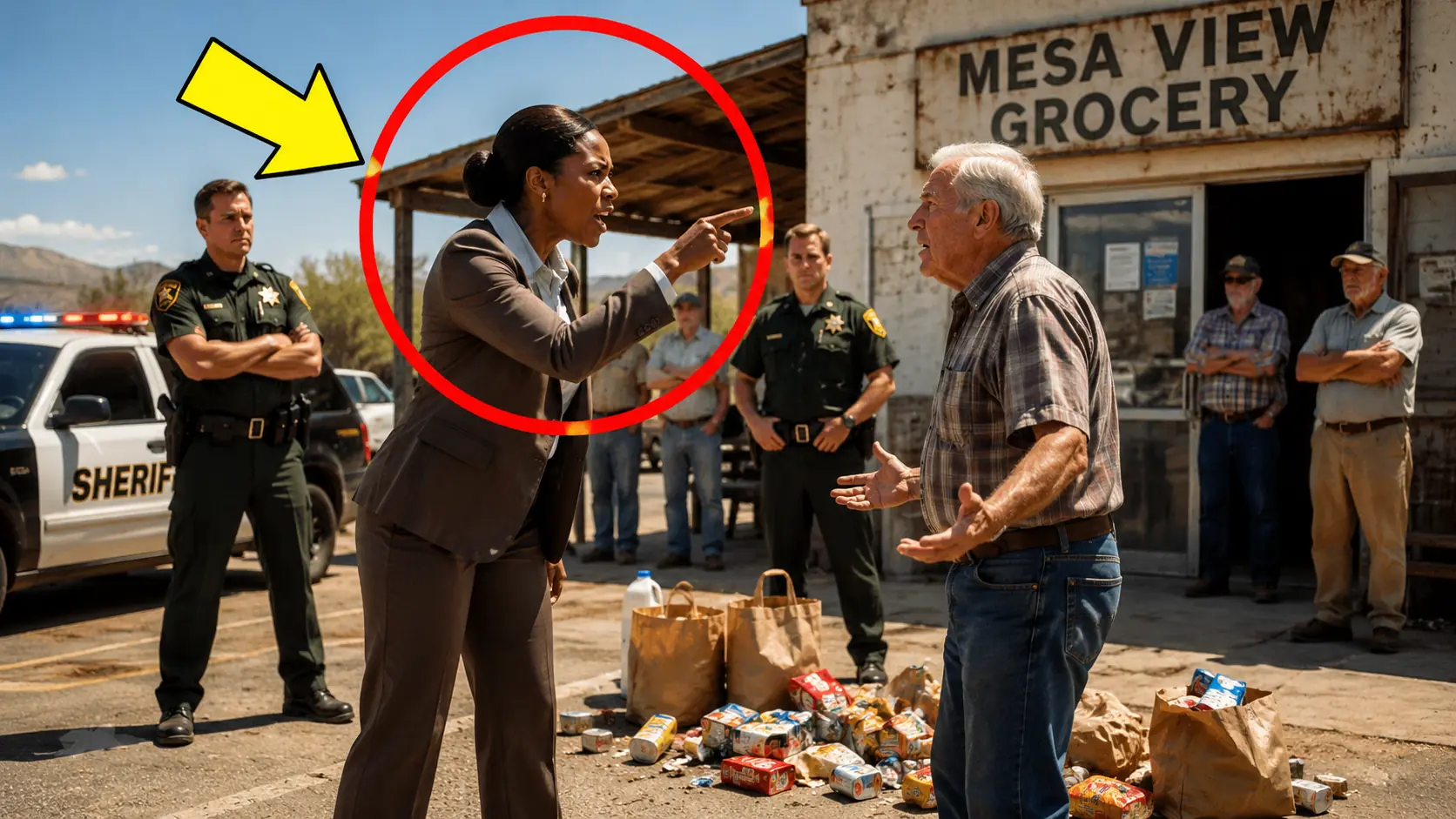
Sometimes the biggest mistake criminals make is underestimating their victims. On a scorching Tuesday afternoon in Desert Springs, Arizona, two police officers handcuffed a black woman outside Miller’s Corner grocery store, convinced they’d caught another shoplifter. The theft alarm had sounded. Drugs were found in her purse. Case closed. Just another day of easy arrests in their corrupt little kingdom.
But as the handcuffs clicked shut, Beverly Shaw didn’t panic. She didn’t protest. She simply noted the officer’s badge numbers, memorized their faces, and activated the recording device hidden in her phone. Because Beverly Shaw wasn’t just another victim of small-town racism—she was an FBI agent with twenty years of federal law enforcement experience, and she’d just walked into the biggest corruption case of her career.
The fluorescent lights buzzed overhead as Beverly Shaw moved through the narrow aisles of Miller’s Corner, her cart containing nothing more suspicious than bottled water, protein bars, and a local newspaper. She’d been in Desert Springs for three days, maintaining her cover as a freelance consultant while gathering intelligence on what the FBI suspected was a major drug trafficking operation. Behind the counter, store owner Pete Miller watched her every move through the convex security mirror, his weathered fingers drumming nervously against the register. His eyes tracked her with the kind of intensity reserved for someone he’d already decided was guilty.
Beverly noticed the surveillance but kept her movements casual and professional. Twenty years with the bureau had taught her to read a room, and this room screamed of something deeper than simple prejudice. The way Miller’s hand hovered near his phone, the suspicious glances toward the back office, the fact that this particular store sat directly on the route she’d identified as a key smuggling corridor. She approached the counter with her items, offering a polite smile. “Just these, please.”
Miller’s hands shook slightly as he rang up her purchases. “$37.43.” Beverly handed him exact change, thanked him, and headed for the exit. The theft alarm shrieked the moment she crossed the threshold. Beverly stopped, genuinely confused. She knew with absolute certainty she hadn’t taken anything. But as she turned back toward the store, she saw Miller already reaching for his phone, and she realized this wasn’t an accident. This was a setup.
The police cruiser arrived with suspicious speed, as if it had been waiting around the corner. Officer Davis stepped out first, a thick-set man whose uniform strained against his gut, followed by his partner, Deputy Miller, a younger officer whose nervous energy suggested he was new to whatever game they were playing. Beverly raised her hand slightly, keeping them visible. “Officers, I think there’s been a misunderstanding. The alarm went off, but I didn’t take anything.”
“Ma’am, we need you to step away from your vehicle,” Davis commanded, his hand resting on his belt near his weapon. His tone carried the weight of someone accustomed to being obeyed without question. Of course, Beverly complied immediately, her FBI training kicking in. De-escalate, gather information, document everything. “I’m happy to cooperate. Would you like to search my bags? You’ll see I only have what I paid for.”
Deputy Miller shifted uncomfortably, glancing between his partner and Beverly. “Maybe we should just—” “We’ll handle this, Miller,” Davis cut him off sharply. He stepped closer to Beverly, invading her personal space. “Ma’am, we’re going to need to search your bags and your vehicle, and we’re going to need to see some identification.”
Beverly reached slowly for her purse, every movement deliberate and non-threatening. But as she pulled out her wallet, she caught Davis exchanging a look with store owner Pete Miller, who was watching from his doorway. A look that said they’d done this before. “Ma’am, I’m going to need you to turn around and place your hands on the vehicle.”
The metal of the patrol car hood burned against Beverly’s palms as Officer Davis pressed her forward, the desert heat radiating through the steel. She kept her breathing steady, her mind cataloging every detail—the way Davis positioned himself to block the security camera’s view, how Deputy Miller kept glancing nervously at the store, the fact that neither officer had actually examined her receipt or the items she’d purchased. “You carrying anything illegal, weapons, drugs, anything that’s going to stick me?” Davis asked, his hands already moving toward her purse.
“No, sir. Nothing like that.” Davis dumped the contents of her purse onto the hood with unnecessary force. Wallet, keys, phone, lip balm, breath mints. The mundane contents of a woman’s everyday life. But as he rifled through her wallet, Beverly noticed something that made her blood run cold. A small plastic baggie fell from between her credit cards. “Well, well, well,” Davis said loudly, holding up the baggie for his partner to see. “Look what we have here, Miller. Looks like crystal meth to me.”
Beverly’s mind raced. She knew that baggie hadn’t been in her wallet, which meant they’d planted it during the search. Probably palmed it from Davis’s pocket when he’d crowded against her. “That’s not mine,” she said calmly. “I’ve never seen that before in my life.” “That’s what they all say,” Davis replied with practiced indifference. “Ma’am, you’re under arrest for possession of a controlled substance and theft. You have the right to remain silent.”
As the handcuffs clicked around her wrists, Beverly made mental notes of everything. The badge numbers, the patrol car’s unit designation, the way Deputy Miller couldn’t meet her eyes, the fact that this entire encounter had taken less than fifteen minutes from start to finish. They’d done this before—probably many times—but they had no idea who they were dealing with.
The Desert Springs Police Station looked exactly like what it was: a small-town operation that had grown too comfortable with its own power. Faded motivational posters about community service hung next to newer ones about drug interdiction, creating an ironic juxtaposition that wasn’t lost on Beverly. During the booking process, she observed everything with the trained eye of a federal agent. The way officers moved through the building with the casual confidence of people who knew they wouldn’t be questioned. The expensive equipment that seemed out of place in a department serving a town of 8,000 people. The multiple phones on the desk sergeant’s table, including what looked like encrypted satellite communication devices.
“One phone call,” Officer Davis said, pushing a grimy handset toward her. “Make it count.” Beverly dialed her cover contact, a Phoenix attorney named Janet Coleman, who served as her emergency backup. But after three rings, the call went to voicemail. “Problem with your lawyer?” The voice came from behind her, deep and gravelly with the confidence of three decades in law enforcement.
Beverly turned to see Sheriff Duncan Stone approaching, a man who commanded attention without trying—tall, silver-haired, with the kind of presence that filled a room. His uniform was perfectly pressed, his boots gleamed, and his badge caught the fluorescent light like it was made of real gold. “Sheriff Stone,” Davis said, straightening unconsciously. “We brought in a suspect for possession and theft.”