**Undercover Black CEO Walks Into His Own Store, He Freezes When an Employee Refuses to Serve Him**
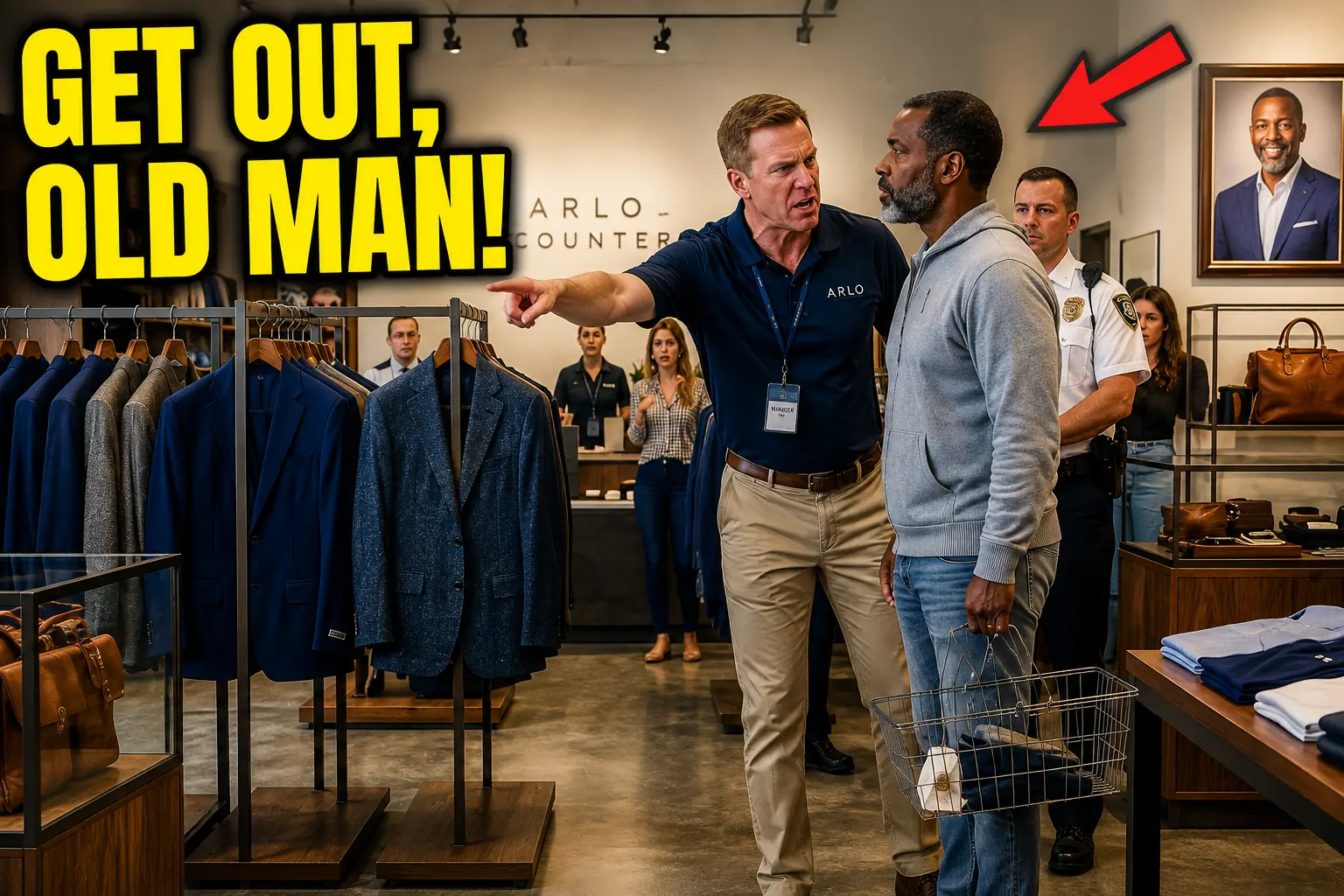
Craig Donovan stepped forward, finger pointed at him. “No way. Get out. Are you deaf? I said get out. This store doesn’t serve people like you.”
The man in the gray hoodie stood still. “I just wanted to look at a jacket.”
Craig clicked his tongue. “A jacket? You can’t even afford a hanger in here. Understand?”
He stepped closer. “You stink like garbage. You look like you crawled out of a refugee camp. Get your filthy hands off my merchandise before I drag you out.”
“I’m a customer. That’s all. A customer.”
Craig snapped. “Poor, destitute, self-righteous black people. Get out. I’m not selling to you.”
The man didn’t leave. He didn’t argue. He just stood there.
As for the manager, he had no idea what consequences his actions would bring.
But before we get to what happened next, you need to understand who this man really is. Because trust me, when you find out, everything Craig just said is going to hit different.
His name is Harold Sullivan. He grew up in a single-wide trailer outside Raleigh, North Carolina. No father in the picture—just him, his older sister, and their mother, Lorraine. A woman who cleaned office buildings six nights a week and sold sweet potato pies on the weekends to keep the lights on.
Harold remembers the smell of bleach on his mother’s hands when she tucked him in at night. He remembers eating cereal for dinner three days in a row because the paycheck hadn’t cleared. He remembers wearing the same pair of sneakers for two school years straight until the sole peeled off and he had to duct-tape it shut.
That kid, the one with the taped-up shoes, is now worth over $600 million.
He earned a full scholarship to Howard University, worked two campus jobs, graduated top of his class in business, and at 26 years old took the $12,000 he’d saved—every penny—and opened a tiny men’s wear boutique in Durham, North Carolina. He called it Apex Collective.
Within five years, that one small store turned into 10, then 20, then 42 locations across the country. Apex Collective became one of the most respected luxury retail brands in America. Known for blending streetwear culture with high-end fashion, Harold’s face landed on the cover of Forbes twice.
But here’s the thing about Harold that most CEOs would never do. Every single quarter he picks a store at random. He puts on old clothes—no watch, no jewelry, no entourage—and walks in like any regular customer off the street. He calls them floor walks. No one knows he’s coming. No manager gets a heads-up. The only person with him is Tom Archer, his regional operations director, also dressed down, pretending to be a friend tagging along.
Why does he do it? Because Harold believes the only way to know the truth about your company is to experience it the way your customers do—not through reports, not through dashboards, but through the front door.
He’s caught inventory fraud on these walks. He’s promoted associates who impressed him. He once shut down an entire store in Dallas and rebuilt the team from scratch after watching a manager ignore a disabled customer for 15 minutes.
Harold doesn’t play when it comes to how people are treated inside his stores.
Today’s target was the Charlotte flagship—Apex Collective’s largest location, the crown jewel of the brand, highest revenue.
Saturday afternoon, the store was alive. Polished concrete floors gleamed under gallery-style track lighting. A DJ in the corner booth spun low neo-soul. The bass hummed through the walls just enough to feel it in your chest. The air smelled like cedar and sandalwood from the signature diffusers placed near every entrance. Racks of tailored jackets lined the east wall. Handcrafted leather goods sat under glass near the registers.
Everything was curated. Everything had a purpose.
Harold had approved every single detail of this floor plan himself.
He walked in wearing a plain gray hoodie, faded jeans, and a pair of old sneakers. No logo, no flash, nothing that said money. Tom walked beside him, equally unremarkable. Two guys on a Saturday afternoon—that’s all anyone would see.
Harold picked up a shopping basket, started browsing cashmere knitwear near the front. He touched the fabric, checked the stitching, ran his thumb along the seam, the way someone who actually knows textiles would.
And that’s when he noticed Craig Donovan. Mid-40s, tall, khaki pants a half-size too tight, store lanyard swinging from his neck like a badge of honor. Standing behind the concierge counter, scrolling his phone, barely looking up.
A young white couple walked by. Craig’s head snapped up instantly. Bright smile. “Welcome in, folks. Let me know if I can help you find anything.”
The couple moved on. Craig went back to his phone. Then he looked up again and saw Harold. The smile vanished. His eyes traveled down the hoodie, the jeans, the sneakers, back up again. And something shifted behind those eyes—something cold, something familiar.
Harold had seen that look before, a thousand times in a thousand different places. He kept browsing, kept his head down, and waited.
He didn’t have to wait long.
Craig moved fast. He cut across the floor before Harold could even reach the jacket display.
“No way. Get out,” his voice was loud—not just loud enough for Harold to hear, but loud enough for the entire floor. Six customers turned their heads. A woman near the shoe wall froze mid-step.
Craig pointed his finger straight at Harold’s chest. His voice bounced off the glass displays and polished walls. Everyone on the floor could hear him. He wanted them to. “Are you deaf? I said get out. This store doesn’t serve people like you.”
Harold stood still. His grip tightened on the basket handle, but his face didn’t change.
“I just wanted to look at a jacket.”
Craig clicked his tongue and tilted his chin up. “A jacket? You can’t even afford a hanger in here. Understand.”
He took another step forward—close enough now that Harold could smell the cheap cologne rolling off his collar. Close enough that it wasn’t customer service anymore. It was intimidation.
“You stink like garbage. You look like you crawled out of a refugee camp. Get your filthy hands off my merchandise before I drag you out.”
Harold lowered his eyes—not from weakness, but from control. He took a slow breath through his nose and said very quietly, “I’m a customer. That’s all. A customer.”
Craig’s lip curled upward. “Poor, destitute, self-righteous black people who think they’re gods. Get out. I’m not selling to you.”
The words echoed off the concrete and glass. A man near the register looked away. A woman grabbed her daughter’s hand and pulled her toward the exit.
Nobody said a single word.
Harold didn’t leave. He set the basket on the nearest display table and looked Craig in the eye. “Can you check if this jacket comes in a large? That’s all I’m asking.”
Craig stared at him like he’d lost his mind. Then he laughed—not a real laugh, a performance. A loud theatrical bark aimed at the crowd. “Did you hear that? He wants me to check sizes for him.”
Craig scanned the floor for approval. Nobody laughed back. “I’ve been here 10 years. I know who buys and who browses. You’re not even a browser. You’re a liability waiting to happen.”
That’s when Tom Archer stepped in. Tom had been watching from three racks away, pretending to examine polo shirts. He walked over calmly, hands in his pockets, and stood beside Harold.
“Hey, we’re together. Can you help us both?”
Craig’s eyes moved to Tom. White guy, casual but clean. His posture shifted just slightly. The hostility didn’t vanish, but it softened by a degree—enough to notice, enough to prove the point.
“Your buddy here isn’t really our demographic,” Craig said. He dropped his voice and leaned toward Tom with a conspiratorial smirk, like they were on the same team. “You know what I mean?”
Tom kept his face neutral. “What demographic is that exactly?”
Craig shrugged, crossed his arms. “Look, I’m not the bad guy here. Loss prevention flagged a profile. Okay, I’m being proactive, doing my job.”
There was no flagged profile. No loss prevention alert. Nothing in any system. Craig invented it on the spot and delivered it with the confidence of a man who had done this a hundred times and never been challenged.
Tom glanced at Harold. Harold gave the smallest shake of his head. Not yet.
Tom turned back. “We’d like to speak to a manager, please.”
Craig laughed again—shorter this time, sharper. “A manager? Bro, I’ve been running this floor for a decade. I am the manager, and I’m telling you, your friend needs to leave now.”
From across the floor, someone had been watching every second of this exchange. Denise Caldwell, mid-30s, black, four years at this location. She’d been helping a customer with a return near the back registers when Craig’s voice first cut through the music. She heard every word. Her jaw was tight. Her hands gripped the counter edge so hard her knuckles had gone pale.
She excused herself from her customer, straightened her lanyard, and walked over. Her heels clicked against the concrete floor—sharp, steady, deliberate. Each step sounded like a decision being made in real time.
“Sir, I’d be happy to help you,” she said to Harold. Her voice was warm, professional.
Then she turned to Craig. “I’ll take over from here.”
Craig stepped sideways to block her path. He physically positioned his body between Denise and Harold, his shoulder squared toward hers like a wall going up. “Denise, stay in your lane. I already told this guy we can’t help him.”
She didn’t step back. Not an inch. “Craig, you can’t refuse service to someone based on how they look. That is not our policy.”
Craig leaned in closer. His voice dropped low, but not low enough—everyone within 10 feet heard every syllable. “I’m not refusing service. I’m using judgment. You want to ring this guy up? Fine. And when that jacket comes back in two days with the tags ripped off and a fake receipt, that’s on your numbers. Be my guest.”
Denise’s nostrils flared. Her eyes glistened under the track lighting. But she held herself together.
“That’s a disgusting thing to say. You don’t know anything about this man.”
Craig’s expression changed. The smirk disappeared. His face went flat, cold, empty.
“Keep pushing this, Denise. I’ll write you up for insubordination.”
He paused. Let the silence hang like a blade. The track lighting hummed above. Then he added softly again, “That one word again cracked the whole thing open.”
This wasn’t new. Denise had pushed back before. And every single time she did, Craig punished her for it—write-ups, schedule changes, shifted responsibilities. A pattern so quiet and so consistent that no one above ever noticed. Or maybe they simply never wanted to.
Denise’s chin trembled. She looked at Harold and he could see it in her eyes—the deep, worn-out exhaustion of fighting a war that nobody around her acknowledged existed. She stepped back, not because she agreed, but because she’d learned what happened when she didn’t.
Harold watched her walk away, his chest tightened—not for himself, for her.
Craig turned back to Harold with a satisfied grin. The grin of a man who always won, who had never once faced a consequence for any of it.
“Now, where were we? Oh, right. You were leaving.”
Harold didn’t move. Didn’t blink.
Craig’s grin faded. He unclipped the radio from his belt, lifted it to his mouth, and pressed the button. “Hey, Brad, got a possible 1040 near men’s wear. Can you swing by?”
Thirty seconds later, Officer Bradley Moore appeared from the back hallway—off-duty cop, weekend security hire. 6’2”, broad shoulders, buzzcut. His boots thudded heavy against the concrete. His utility belt creaked with each step. His right hand rested near his holster, not on his weapon, but close enough to send a message that didn’t need words. He looked at Harold first, then at Craig, then back at Harold.
“Sir, is there a problem here?”
Harold’s voice stayed calm. “No problem at all. I’m shopping.”
Craig jumped in before Moore could respond. “He’s been handling high-value merchandise and refusing to leave after being asked multiple times. I need him removed from the store.”
Every single word was a lie. Harold had touched one rack of cashmere. He had never been asked to leave. He’d been attacked from the moment he walked in. He had simply existed—a black man in a hoodie in a space Craig decided wasn’t his.
Officer Moore squared his stance toward Harold. Not overtly aggressive, but not neutral either. His body language said everything his mouth hadn’t yet.
“Sir, I’m going to need to see some ID.”
Harold looked at him evenly. “Am I being accused of a crime?”
Moore hesitated, his tongue pressed against the inside of his cheek. He knew the law. He knew the line. But Craig was already pushing from behind. “Come on, Brad. Just walk him out. I don’t have time for this.”
Moore looked at Craig, then back at Harold. The hesitation lasted three full seconds. It should have lasted longer.
“Sir, I’m going to need you to step outside.”
The floor had gone completely silent. The DJ’s baseline still pulsed through the walls, low and soulful, almost mocking against the heaviness of the moment. A teenage girl near the fitting rooms held her phone up, recording. Her hand trembled. A mother by the entrance gripped her son’s shoulders and whispered something in his ear. An older white man in a blazer stood frozen near the sunglasses display, mouth half open.
Nobody moved. Nobody spoke.
And Harold Sullivan—the man who designed this floor, who chose every fabric on every rack, who approved every light fixture, who built this company from $12,000 and a dream—was being told to leave his own store.
Harold didn’t move. He stood exactly where he was, feet planted, hands at his sides. His breathing was steady. His eyes were clear. He looked at Officer Moore the way you look at someone who is about to make the worst decision of their life.
“I haven’t stolen anything,” Harold said. “I haven’t threatened anyone. I’m standing in a store that’s open to the public, so I’ll ask you again. Am I being accused of a crime?”
Moore’s jaw tightened. He didn’t answer the question. He couldn’t, because the answer was no and they both knew it. The silence that followed was deafening. Two men standing face to face in a luxury store on a Saturday afternoon—one with a badge and a holster, one with a shopping basket and a hoodie. And the only crime committed was the color of one man’s skin.
Craig stepped forward from behind Moore’s shoulder. “Brad, why are we still talking? Just grab him and walk him out. I’ve got customers to deal with.”
Moore shifted his weight. He looked uncomfortable—not because he thought Craig was wrong, but because he knew how this looked. Two authority figures cornering a black man who hadn’t done anything. In a store full of witnesses, with a teenage girl pointing a phone at them. But he didn’t step back. He didn’t question Craig. He didn’t ask for a second opinion.
Instead, he moved closer to Harold and lowered his voice. “Sir, I’m going to give you one more chance. Walk out on your own or I’ll escort you out. Your choice.”
His tone had shifted. It wasn’t a suggestion anymore. It was an ultimatum delivered by a man with a badge who was used to being obeyed without question.
Harold looked at him. “And if I don’t leave?”
Moore didn’t blink. “Then we have a different kind of conversation.”
The threat was quiet, but it was real. Harold could feel it in the air. The shift from suggestion to force. The temperature in the room seemed to drop. The music from the DJ booth felt distant now, like it was playing in another building.
Tom Archer stepped forward. His phone was in his hand, camera facing out, recording. “For the record, this man has committed no crime. He’s asked to shop. He’s been refused service, and now he’s being threatened with physical removal. I just want to make sure that’s all on the record.”
Craig’s head snapped toward the phone. His face twisted. “Turn that off. You can’t film in here. Store policy.”
Tom didn’t lower the phone. “There’s no such policy.”
Craig lunged for the phone. His hands shot out fast, fingers reaching for the screen. Tom pulled back just in time. Moore stepped between them, but he positioned himself facing Harold and Tom, not Craig. The positioning told the whole story. Craig was the accuser. Harold was the accused. And Moore had already chosen a side.
“Put the phone away,” Moore said to Tom. “Or I’ll confiscate it.”
“On what grounds?” Tom asked.
Moore didn’t answer. He just stared.
The teenage girl near the fitting rooms kept recording. Her friend whispered to her, “Are you getting this?” She nodded without looking away from the screen.
Craig had regained his composure. He straightened his lanyard, tugged at the bottom of his shirt, and turned back toward the customers on the floor. He raised his voice—not to Harold this time, but to the crowd, to his audience. “Folks, I apologize for the disruption. This is exactly what I deal with every single weekend. People come in here dressed like that.” He gestured at Harold without looking at him. “Touch everything, buy nothing, and half the time merchandise goes missing. I’m done being polite about it. Somebody has to say what everyone’s thinking.”
He paused, scanning the room, expecting nods, expecting agreement, expecting the silent majority to back him up the way they always had. Nobody agreed. Not a single head moved.
A woman near the candle display shook her head and walked toward the exit. She didn’t look back.
The older man in the blazer spoke up from across the floor. “Hey, this doesn’t seem right.”
Craig didn’t even look at him. “Sir, please. I’m handling a security matter. Stay out of it.”
The man went quiet—not because he agreed, but because he didn’t know what else to do. He looked around the floor for backup. Nobody met his eyes. That silence, that bystander silence, was louder than anything Craig had said. It filled the room like smoke.
Craig turned back to Harold, stepped close—too close. Harold could see the veins in Craig’s neck. He could smell the stale coffee on his breath.
“You want to prove me wrong?” Craig said. “Then buy something right now. Pull out a card and pay for that jacket. Show me you belong here.”
Harold’s voice was low, steady. “I don’t need to prove anything to you.”
Craig smirked. “That’s what I thought.”
He turned to Moore. “Brad, we’re done here. Walk him out.”