What Doctors Found Beneath Lucy’s Faded Blue Blanket
PART 2 — CURRENT CONDITION UPDATE
Lucy is now recovering in a quiet medical foster home after surgery to remove a mast cell tumor near her right shoulder. She is eating consistently, sleeping comfortably, and walking more easily with treatment for arthritis.
Her urinary infection has cleared, and the surgical incision is healing. However, the pathology report showed that Lucy’s tumor requires continued monitoring and additional treatment planning.
The faded blue blanket remains with her.
It is washed only when necessary, using a predictable routine that ensures Lucy always has another familiar item while it is unavailable.
Lucy entered the shelter after her previous owner moved into long-term nursing care. Family members brought her to the facility with veterinary records, a bag of food, a collar, and the blue blanket she had apparently used for years.
The surrender was not described as casual abandonment. The owner’s health had deteriorated, and no relative was able to provide permanent care.
One family member wrote a short list of Lucy’s routines. She ate twice daily, disliked thunderstorms, moved slowly on stairs, and slept with the blanket.
The shelter preserved that information instead of treating Lucy as a dog without a past.
During her intake examination, Lucy appeared quiet but socially tolerant. She allowed staff to place a leash over her head and followed them into the kennel hallway.
She did not pull toward other dogs or attempt to retreat through the entrance.
Once inside the kennel, she stood beside the gate and watched the family leave.
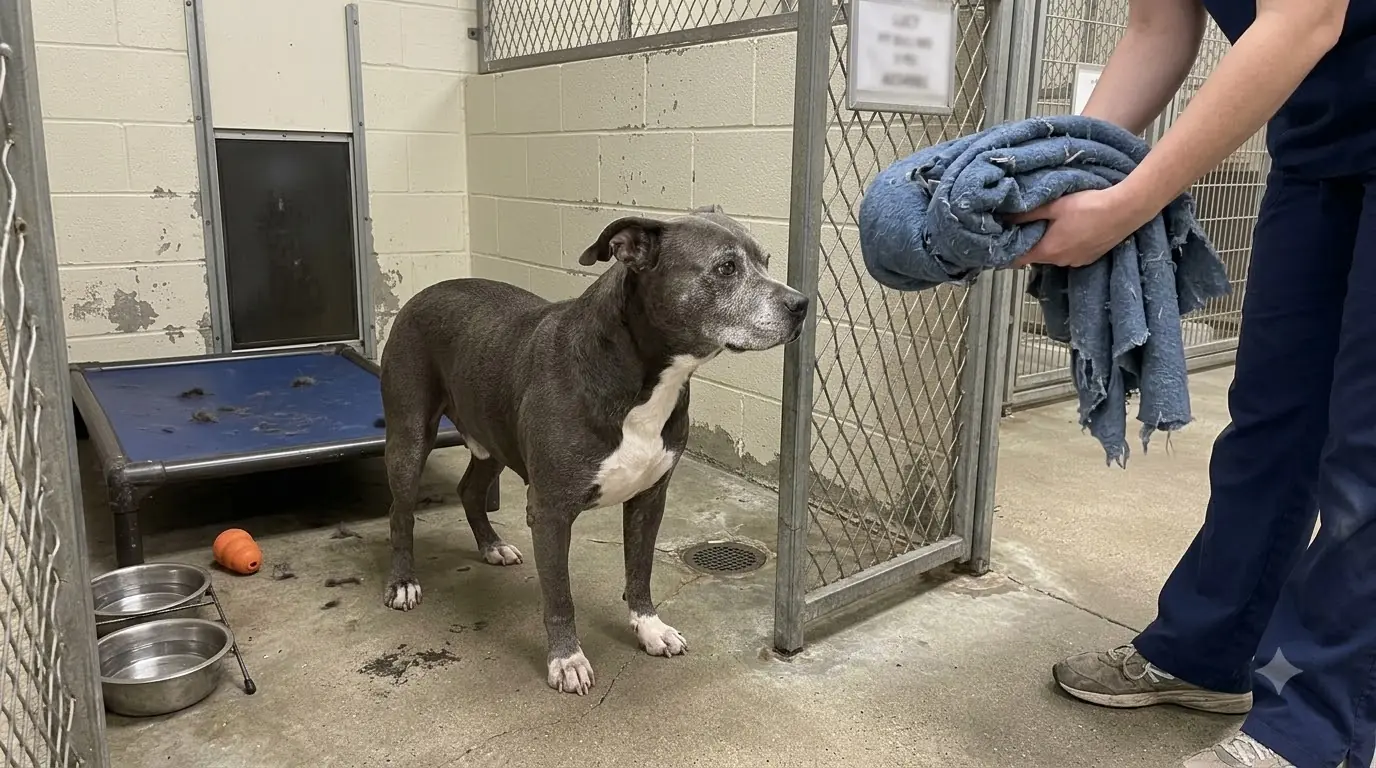
Staff placed the blue blanket on a raised bed. Lucy smelled it immediately, stepped onto the mattress, and turned in two slow circles.
She then lowered herself and pressed her nose into one folded corner.
For the first several days, Lucy left the bed only for bathroom walks, meals, and brief interactions with caregivers.
She did not bark for attention. Visitors often overlooked her because she remained curled on the blanket while younger dogs jumped at their kennel doors.
When someone stopped, Lucy lifted her head but rarely stood.
Her age and quiet behavior made her appear less engaging in a crowded adoption environment. Pain was also influencing how often she moved.
The shelter’s initial medical examination found reduced range of motion in both hips and stiffness through the lower spine.
Lucy shifted her weight forward before standing. Her hind feet occasionally slipped on smooth flooring.
She did not cry when the veterinarian manipulated her joints, but she tightened her muscles, closed her mouth, and turned her head away.
These subtle responses were treated as evidence of discomfort.
Dogs do not need to vocalize for pain to be medically important.
X-rays showed moderate arthritis in both hips, both knees, and several areas of the lower spine. There was no recent fracture or dislocation.
The changes had developed over years.
A pain-management plan was started after bloodwork and urine testing were collected.
Lucy’s kidney and liver measurements were within acceptable ranges for carefully selected medication. Repeat testing would still be required because senior dogs can develop changes over time.
Her weight was slightly above ideal. Extra body fat increased pressure on already painful joints, while months or years of reduced movement had caused muscle loss over her hindquarters.
The goal was gradual fat reduction without sacrificing nutrition or accelerating muscle loss.
Her food was measured, and treats used for medication were included in the daily total.
Shelter staff placed nonslip mats inside and outside her kennel. Lucy immediately moved more confidently when her paws no longer slid.
Her bed remained low enough that she could step onto it without climbing.
Bathroom walks were short and took place on level ground.
During the first week, Lucy stopped several times before reaching the outdoor area. Staff initially believed she was reluctant to leave the blanket.
Closer observation showed that she also squatted frequently and passed only small amounts of urine.
A urine test identified blood, inflammation, and bacteria. A laboratory culture confirmed a urinary tract infection and identified an effective antibiotic.
Painful urination can cause restlessness, accidents, reluctance to walk, repeated squatting, and changes in sleep.
Lucy began treatment and tolerated the medication well.
Her water remained available at all times. No one restricted it to reduce bathroom trips.
Staff increased opportunities to go outside, particularly after meals, waking, and medication.
Within several days, Lucy stopped straining. Her urine became clearer, and she could complete the short walk without repeated squatting.
A follow-up culture later confirmed that the infection had cleared.
The firm lump near Lucy’s shoulder was discovered during the same examination.
It was partly hidden beneath loose skin and thick fur. From the outside, it looked like a small rounded swelling.
Senior dogs commonly develop benign fatty tumors, but appearance and touch cannot reliably identify every mass.
The veterinarian measured the lump, photographed its location for the medical record, and collected a needle sample.
The sample contained mast cells with abnormal features.
Mast cells are normal immune cells found throughout the body, especially in the skin. They participate in allergic and inflammatory responses by releasing substances including histamine.
A mast cell tumor develops when these cells grow abnormally.
Some mast cell tumors behave slowly and remain local. Others invade surrounding tissue, recur after removal, or spread to lymph nodes and internal organs.
A needle sample can identify mast cells, but the complete tumor often needs laboratory examination to determine grade and other features associated with behavior.
The result did not prove that Lucy had widespread cancer. It established that the mass needed prompt evaluation and surgical planning.
The veterinary team examined Lucy for additional skin masses.
Several small soft lumps appeared consistent with fatty tissue, but each was documented. One was sampled and showed only mature fat cells.
Her local lymph node did not feel dramatically enlarged. Palpation alone, however, cannot rule out microscopic spread.
Bloodwork showed no severe anemia, organ failure, or abnormal cell pattern that prevented surgery.
Chest X-rays did not reveal obvious metastatic disease. Abdominal ultrasound showed age-related changes but no large internal mass strongly suggestive of spread.
The liver and spleen were assessed carefully because mast cell disease may involve internal organs in advanced cases.
No definite metastatic lesions were found.
A sample from the lymph node draining the shoulder region was recommended. The results did not clearly identify metastatic mast cells.
This was reassuring but not an absolute guarantee. Cancer staging reduces uncertainty; it does not eliminate every possibility.
The surgeon evaluated the shoulder mass and surrounding tissue.
Mast cell tumors often extend microscopically beyond what can be seen or felt. Removing only the visible lump may leave abnormal cells behind.
A wider margin of apparently normal tissue improves the chance of complete removal.
Lucy’s tumor sat near an area where skin movement is important for the shoulder and front leg.
Taking a very wide margin could create difficulty closing the incision and might affect movement. Taking too little tissue could increase recurrence risk.
The surgical team discussed these competing concerns with the rescue organization.
A specialist planned the procedure. Options for reconstructing the skin were prepared in case the wound could not close normally.
Lucy’s arthritis, age, previous infection, and emotional stress were considered in the anesthesia plan.
Preoperative bloodwork was repeated. Her urinary infection had responded, and her organ measurements remained acceptable.
The team did not postpone necessary cancer surgery simply because Lucy was nine. Age alone does not determine anesthesia safety.
Risk is assessed through the individual dog’s heart, lungs, laboratory results, disease, medication, physical condition, and procedure.
Lucy’s heart rhythm was normal during the examination. Chest imaging showed no congestive heart failure.
An intravenous catheter was placed, and monitoring included blood pressure, oxygen, carbon dioxide, heart rhythm, temperature, and respiratory status.
The blue blanket could not remain beneath Lucy during the sterile operation.
A shelter caregiver carried it with her to the hospital, and staff stored it safely outside the surgical area.
Lucy received medication for pain and anxiety before the procedure.
The surgeon removed the visible mass with a planned margin of surrounding tissue. The deeper layer extended close to connective tissue over the shoulder muscles.
The tissue was removed as one specimen and marked so the laboratory could evaluate the edges accurately.
The wound closed without a major skin flap, but the incision was longer than the original lump.
A temporary drain was not required. The tissue was handled carefully to reduce unnecessary inflammation.
Mast cells can release histamine and other substances when disturbed. Veterinary teams prepare for potential swelling, changes in blood pressure, stomach irritation, or allergic-type reactions.
Lucy remained stable throughout the procedure.
She recovered in a warmed, padded area. Her breathing and heart rate remained appropriate, though she was disoriented when first waking.
A technician placed the blue blanket beside her once there was no risk of contaminating the incision.
Lucy smelled it, moved her head several inches, and rested her muzzle on the fabric.
She did not attempt to stand immediately. Her body gradually relaxed, and she slept.
The blanket did not treat pain or replace medical care. It provided a familiar scent and texture during an unfamiliar experience.
Pain medication was given on schedule. The team did not wait for Lucy to cry.
Her posture, facial tension, breathing, appetite, willingness to stand, and reaction near the incision were used to assess comfort.
The shoulder location meant movement could pull on the healing skin. Lucy’s activity needed to remain controlled.
She wore a recovery garment selected to prevent licking without pressing tightly against the incision.
A rigid plastic collar was available if she could reach the area. Staff tested the garment under supervision before relying on it.
Lucy spent the first night in the hospital.
She ate a few bites of softened food and drank a small amount. She did not vomit.
Her blood pressure remained stable, and the incision showed only expected mild swelling.
Short leash trips allowed her to urinate. A support harness helped because her hips were stiff after anesthesia and rest.
The blue blanket was carried near her bed but kept from dragging across hospital floors.
The surgical specimen was sent to a pathology laboratory.
That period of waiting created uncertainty. The visible tumor had been removed, but no one could determine its full behavior by looking at the incision.
The pathology report identified an intermediate-grade cutaneous mast cell tumor.
The tumor showed features requiring respect and monitoring, but it was not placed in the most aggressive category.
One tissue margin was clear with an acceptable distance. Another contained tumor cells closer to the edge than the team preferred.
The deep margin was narrow because of the structures beneath the mass.
The report did not state that cancer would definitely return. It indicated that microscopic cells might remain near part of the surgical site.
The team now had several options.
A second surgery could remove additional tissue around the narrow margin. Radiation therapy could treat microscopic disease while preserving more surrounding structure.
Careful monitoring alone might be reasonable in selected circumstances, especially if additional procedures created greater risk or if the tumor’s biological markers appeared favorable.
An oncology consultation was arranged before choosing.
The oncologist reviewed the pathology, original photographs, surgical notes, imaging, lymph-node sample, Lucy’s overall health, and the exact location.
Additional staining and analysis provided more information about how actively the cells were dividing and whether certain mutations were present.
The results did not show the highest-risk pattern. However, the narrow margin remained a valid concern.
A second surgery was considered technically possible but would require removing more skin over the shoulder. Closure could be difficult, and restricted movement during healing might worsen Lucy’s arthritis.
Radiation therapy offered another way to target microscopic cells but would involve repeated visits and anesthesia or sedation, depending on the protocol.
Lucy experienced significant stress during transport and medical handling. This did not automatically exclude radiation, but it belonged in the welfare assessment.
The rescue and oncology team chose a plan based on Lucy’s complete situation rather than pursuing the most aggressive option reflexively.
A smaller revision surgery was recommended after the first incision had healed sufficiently and the surgeon confirmed that closure could be achieved safely.
The goal was to remove additional tissue from the concerning side and improve the margin without creating a wound too large for comfortable recovery.
Lucy returned for the procedure after repeat bloodwork and examination.
Her foster caregiver brought the blue blanket again.
The revision removed a strip of scar and surrounding tissue. The new specimen contained no visible remaining tumor at the examined margins.
This was the result the team had hoped for.
It still did not create a lifetime guarantee. No laboratory can examine every cell in the body, and mast cell tumors can recur or develop at another location.
Lucy’s prognosis became more favorable, but monitoring remained necessary.
The oncology team did not recommend systemic chemotherapy at that stage.
If future evidence of spread, recurrence, or aggressive disease appears, treatment options will be reconsidered.
Lucy will receive regular skin examinations. Her caregiver runs both hands gently over her body and records any new lump.
New masses are not assumed to be cancer, but they are not ignored because she already had one mast cell tumor.
A lump that appears, grows, changes size, becomes red, causes itching, or feels firm should be examined promptly.
Mast cell tumors can sometimes swell and shrink because the cells release inflammatory substances. A changing lump should not be dismissed simply because it becomes smaller.
The surgical area is photographed and measured during rechecks.
Warning signs include renewed swelling, a firm nodule beneath the scar, skin breakdown, persistent licking, discharge, or pain.
Lucy’s lymph nodes, bloodwork, and abdominal organs will be reassessed according to the oncologist’s schedule.
Her incision healed without infection. The recovery garment prevented licking, and activity restriction protected the shoulder.
She could take only brief leash walks during early healing.
Running, jumping onto furniture, climbing stairs, wrestling, and abrupt turns were prohibited.
This restriction overlapped with what her arthritis required, though prolonged inactivity also risked additional muscle loss.
The rehabilitation team created a conservative plan.
Lucy practiced slow controlled walking on nonslip surfaces. The duration increased only after the incision became strong enough.
Gentle weight shifts helped maintain stability without pulling excessively on the shoulder.
The therapist watched her stride and stopped if she shortened the front step, leaned away from the surgical side, or became tired.
Her hip arthritis continued receiving treatment.
The pain plan reduced her hesitation when standing. She still moved slowly after rest, but she no longer required several attempts every morning.
Nonslip rugs covered the foster home’s primary paths. A ramp replaced the steps into the yard.
Lucy learned the ramp gradually. Her caregiver walked beside her without pulling.
An orthopedic bed supported her hips and elbows. The blue blanket rested on top.
During the first foster night, Lucy performed the same two circles she had completed in the shelter. Then she pressed her nose into the blanket and lay down.
The foster caregiver, Maria, slept on a couch nearby so Lucy would not wake alone in an unfamiliar room.
Lucy lifted her head several times to watch Maria. Each time, Maria remained still and allowed her to settle.
By morning, Lucy had moved from the far edge of the bed to the side closest to the couch.
The blanket became part of every major transition.
It traveled to the shelter, hospital, and foster home. It was present during car rides and rechecks when sanitation rules allowed.
No one described Lucy’s relationship with it as proof that she remembered one exact person or event.
Scent, texture, routine, and repeated association may all contribute to its importance.
Dogs often rely on familiar sensory cues when environments change.
The shelter incident during laundering demonstrated that removing the blanket abruptly caused significant distress.
Staff had taken it after evening cleaning. They expected Lucy to use the clean bed temporarily.
Instead, she stood beside the mattress and stared toward the area where the blanket had disappeared.
She did not eat the meal placed nearby. She repeatedly smelled the empty bed but did not lie down.
After several hours, a staff member checked the laundry and found that the blanket was already dry enough to return.
Lucy smelled it carefully, circled twice, and slept.
The team changed its procedure.
When the blanket required washing, another piece of bedding carrying Lucy’s scent remained with her. The original was returned promptly.
The foster caregiver follows the same approach.
Maria does not wash the blanket on a fixed frequent schedule simply to make it smell pleasant to people.
It is cleaned when soiled, medically necessary, or unhygienic.
A gentle unscented detergent is used. Strong fragrance could alter the familiar sensory qualities and irritate Lucy’s skin.
Before washing, a smaller cloth rests on top of the blanket for several nights. That cloth stays with Lucy while the blanket is unavailable.
The first foster-home wash produced mild restlessness. Lucy walked to the laundry-room gate and lay nearby.
Maria placed the familiar cloth on the orthopedic bed and sat beside it.
After several minutes, Lucy stepped onto the bed and rested her chin on the cloth.
She did not sleep deeply until the blanket returned, but she remained calmer than during the shelter incident.
The goal is not to force her to stop caring about the blanket.
The care team wants Lucy to develop additional sources of safety: predictable people, stable routines, comfortable spaces, and the ability to settle with more than one familiar item.
Removing the blanket to make her “move on” would create distress without teaching a safer alternative.
Lucy’s emotional adjustment has advanced gradually.
During the first week, she remained on the bed whenever Maria moved through the house. She accepted food and medication but rarely followed.
Pain, fatigue, surgery, and uncertainty all influenced her behavior.
Maria spent time in the same room without constantly calling Lucy.
She read, worked, and prepared simple enrichment while allowing the dog to observe.
Lucy began lifting her head when Maria entered.
One morning, Maria carried the food bowl into the kitchen instead of serving it beside the bed. Lucy watched from the doorway.
Maria placed the bowl on a nonslip mat and moved away.
After several minutes, Lucy stood and walked into the kitchen.
She ate the full meal, then returned to the blanket.
This became part of the morning routine.
Lucy now follows Maria to the kitchen for breakfast and medication. She waits on the same rug while food is prepared.
Her appetite remains consistent.
Meals are measured to support gradual weight reduction while preserving muscle and healing tissue.
She eats a complete diet rather than an unbalanced collection of table food and supplements.
Maria asked about several products advertised as cancer cures. The oncology team explained that no unproven supplement should replace surgery, monitoring, or prescribed treatment.
Some products may interact with medication, affect clotting, irritate the stomach, or add unnecessary calories.
Every supplement is reviewed before use.
Lucy’s weight has decreased slowly toward a healthier range.
Her ribs are easier to feel beneath the skin, but she is not becoming thin.
Muscle restoration remains limited by arthritis and postoperative restrictions. It will continue through controlled rehabilitation.
Her urinary infection has not returned. Repeat culture after treatment was negative.
Lucy urinates without straining and no longer stops repeatedly during walks.
Her water intake remains stable and is never restricted.
The foster caregiver watches for increased thirst, accidents, blood in urine, strong odor, repeated squatting, or licking around the urinary opening.
Senior dogs may develop recurrent infections, stones, kidney problems, diabetes, or other conditions that create similar symptoms.
A behavior change is not assumed to be emotional until medical causes are considered.
Lucy’s dental health also requires attention.
She has moderate tartar, gum inflammation, and one damaged tooth.
The veterinary team delayed nonurgent dental anesthesia while cancer surgery and recovery took priority.
The tooth does not currently have a severe abscess, but dental X-rays will be needed to evaluate the roots.
A cleaning and possible extraction are planned after oncology and surgical teams confirm that another procedure is appropriate.
Until then, Lucy receives food she can chew comfortably. Hard bones, antlers, and rigid chews are avoided.
Her mouth is monitored for swelling, bleeding, odor, dropping food, chewing on one side, or sudden appetite loss.
Lucy’s hearing is mildly reduced. She does not always respond when called from another room.
Maria approaches within her field of vision and avoids touching her unexpectedly while she sleeps.
This has reduced startled reactions.
Her eyes show age-related lens clouding, but she retains useful vision. She follows movement and navigates the house during daylight.
Low-light vision appears less reliable. Small night-lights illuminate the path between the bed, water bowl, and back door.
Furniture remains in consistent positions.
Lucy’s nighttime sleep improved after pain and urinary treatment.
At the shelter, she woke frequently because of barking and hallway movement. She remained curled tightly around the blanket.
In foster care, she initially slept with her nose pressed into the fabric and her body facing the door.
After several weeks, Maria found her asleep on her side with one hind leg extended beyond the blanket.
On another night, Lucy moved to a rug beside Maria’s chair and fell asleep while the blue blanket remained across the room.
She woke after approximately twenty minutes, returned to the bed, and completed her usual two circles.
That brief choice was meaningful.
It showed that Lucy could rest away from the blanket when another trusted source of safety was nearby.
Maria did not use the moment as an opportunity to hide the blanket.
The next step in confidence should not be created through deception.
Visitors are introduced quietly.
They sit sideways, avoid staring, and allow Lucy to approach. No one reaches immediately over her head or touches the surgical area.
Lucy usually remains on the bed during the first several minutes.
If a visitor ignores her, she may stand, smell their shoes, and return to Maria.
She has accepted gentle chest rubs from two familiar volunteers.
Her body stays relaxed when contact is brief. If she turns her head away or shifts backward, the person stops.
Lucy has shown no aggression around her blanket. She allows Maria to straighten or inspect it while she is standing nearby.
However, Maria does not repeatedly take it away to test for possessiveness.
Resource guarding cannot be evaluated responsibly by provoking a dog until she reacts.
Lucy’s behavior indicates attachment and distress during absence, not a demonstrated intent to defend the blanket with aggression.
She does position herself on top of it during thunderstorms.
Maria respects the space and uses calm environmental support.
Storms remain difficult. Lucy hears thunder, stands, and gathers part of the blanket beneath her chin.
The foster room has closed curtains, steady background sound, and a safe interior location away from windows.
Medication for severe storm anxiety has been discussed and used according to veterinary guidance when weather forecasts indicate a significant event.
The medication was tested on a calm day before being relied upon during a storm.
Lucy tolerated it without dangerous sedation or agitation.
During a recent storm, she remained on the bed but did not pant continuously or attempt to push beneath furniture.
Maria sat nearby without restraining her.
Once the thunder stopped, Lucy followed Maria into the kitchen and drank water.
Her history with other dogs is being assessed after surgical healing.
At the shelter, she passed kennels without barking or lunging but showed little interest in greeting.
Pain and stress may have suppressed her social behavior.
A controlled parallel walk was arranged with a calm senior dog. Both animals wore secure equipment and began at a comfortable distance.
Lucy noticed the other dog, smelled the ground, and continued walking.
The distance decreased gradually. She remained loose and did not fixate.
A brief greeting lasted only several seconds before handlers guided both dogs forward.
Lucy returned to smelling the grass.
This was a promising interaction, but it did not prove compatibility with every dog.
Future meetings will consider size, energy, play style, and the need to protect Lucy’s hips and surgical area.
Her history with cats is unknown. She has not been tested through unsafe direct exposure.
Her suitability for a home with cats would require careful assessment and management.
Young children may accidentally climb on her, pull the blanket, or touch painful areas. A home with adults or older respectful children may be more appropriate.
Lucy’s adoption status remains on medical hold while the rescue establishes her oncology follow-up, dental plan, arthritis treatment, and behavioral needs.
Maria has expressed interest in adopting her permanently.
The foster-to-adopt process will ensure that the home can sustain ongoing monitoring and medical costs.
Maria understands that complete tumor margins reduce recurrence risk but do not make future cancer impossible.
She has learned how to examine Lucy’s skin and surgical scar without squeezing or repeatedly irritating tissue.
A body map records every existing lump.
Lucy will receive scheduled veterinary skin checks even if Maria finds nothing new.
Senior dogs often develop multiple masses. Some are benign, and some are not.
Every new lump deserves identification rather than assumption.
The oncology team will reassess the regional lymph node and consider repeat imaging if clinical changes appear.
Warning signs include sudden swelling, repeated vomiting, dark stool, appetite loss, weakness, collapse, unexplained bruising, enlarged lymph nodes, or new skin masses.
These symptoms can have several causes, but Lucy’s mast cell history makes prompt evaluation particularly important.
The foster home keeps emergency contact information and a current medication list accessible.
Lucy’s arthritis plan will also require lifelong adjustment.
Pain may change with weather, activity, body weight, muscle strength, and disease progression.
Maria records difficulty rising, stair hesitation, limping, posture, sleep quality, and willingness to walk.
Short videos taken periodically allow the rehabilitation team to compare movement over time.
One active morning does not prove that arthritis has disappeared. One stiff evening does not necessarily mean treatment has failed.
Patterns guide decisions.
Lucy now completes several short walks each day on level ground. The purpose is comfortable movement, elimination, scent exploration, and gradual conditioning.
She chooses the pace.
Maria turns home before Lucy begins dragging her feet or shifting excessive weight forward.
Long walks on weekends do not replace consistent controlled activity.
A support harness remains available for difficult days.
Lucy practices slow sit-to-stand movements only when her posture remains comfortable. Repetitions stay low.
She also performs gentle weight shifts and controlled turns on a nonslip mat.
The rehabilitation team stops sessions before fatigue creates poor movement.
There is no attempt to make a 9-year-old arthritic dog exercise like a young athlete.
Quality of life is evaluated regularly.
The care team considers pain, appetite, hydration, hygiene, mobility, sleep, interest, social connection, and whether comfortable days continue to outnumber difficult ones.
Lucy currently eats well, seeks familiar people, explores outdoors, sleeps deeply, and participates in daily routines.
Her cancer monitoring creates uncertainty, but uncertainty does not erase her present quality of life.
She is not treated as though her future diagnosis has already happened.
At her most recent oncology visit, the surgical scar felt flat and flexible. No new nodule was present.
The regional lymph node remained normal in size on examination.
Bloodwork showed stable organ values and improvement in the mild inflammation seen around surgery.
No current evidence suggested spread.
The oncologist described the result as encouraging and continued the monitoring schedule.
Lucy’s next medical milestone will be dental treatment if her pre-anesthetic evaluation remains acceptable.
After that, the rescue expects to finalize her long-term care plan.
Maria has already purchased a second orthopedic bed for the bedroom.
The original blue blanket moves between the beds depending on where Lucy chooses to sleep.
A newer blanket remains nearby, but Lucy still prefers the faded one.
The fabric has thinned along several edges. Small repairs are completed before loose threads become a swallowing hazard.
Maria uses soft backing material and avoids changing the familiar surface more than necessary.
If the blanket eventually becomes too fragile for normal use, the team will preserve a safe section inside a durable cover.
They will not wait until it tears completely or becomes dangerous.
The goal is to respect Lucy’s attachment while adapting responsibly.
One afternoon, Maria returned from an appointment and found Lucy lying on the living-room rug.
The blue blanket remained in the bedroom.
Lucy raised her head, stood slowly, and walked toward the door. Instead of turning back to retrieve the blanket, she placed one paw on Maria’s shoe.
Maria knelt and rubbed her chest.
Lucy followed her into the kitchen and waited while dinner was prepared.
Later, she returned to the bedroom, circled the blanket twice, and fell asleep.
Her connection to the blanket had not disappeared. It no longer needed to hold every moment of security by itself.
Lucy’s story is sometimes reduced to the night she refused to sleep without a piece of fabric.
That moment mattered, but it was not stubbornness or a sentimental performance.
The blanket was the only familiar object carried from a home she had known into a loud shelter where people and dogs changed around her.
It smelled like her own body, her old rooms, and routines no one else could recreate.
When it disappeared without warning, Lucy lost the one predictable part of the kennel.
Staff learned from her response. They returned it and changed how they handled future cleaning.
The same principle guides her medical and foster care.
People cannot explain surgery, cancer margins, foster placement, or why an owner never returned. They can make procedures predictable, preserve familiar objects, reduce pain, and allow Lucy to build trust without demanding that she abandon the past.
The blue blanket rests on her bed tonight.
The surgical scar beneath her shoulder is closed. Her urine culture is clear, her arthritis is better controlled, and no current test shows that the mast cell tumor has spread.
She still circles twice before lying down.
But she no longer spends every hour on the blanket.
Some mornings, she follows Maria into the kitchen before remembering to carry part of it with her. Some afternoons, she sleeps beside the chair while it remains in another room.
Every evening, Lucy returns to it.
The difference is that when she lifts her head now, someone familiar is still there.
The blanket came from her previous home.
Safety is slowly becoming something she can find in the new one.