What Happened After Penny Was Lifted from the Flooded Drain
PART 2 — CURRENT CONDITION UPDATE
Penny is now recovering in a medical foster home after several days of treatment for aspiration pneumonia, soft-tissue injuries, exposure to contaminated water, and severe stress following her rescue from the flooded drainage channel.
She is eating, walking, and breathing without supplemental oxygen, but her recovery is not yet considered complete.
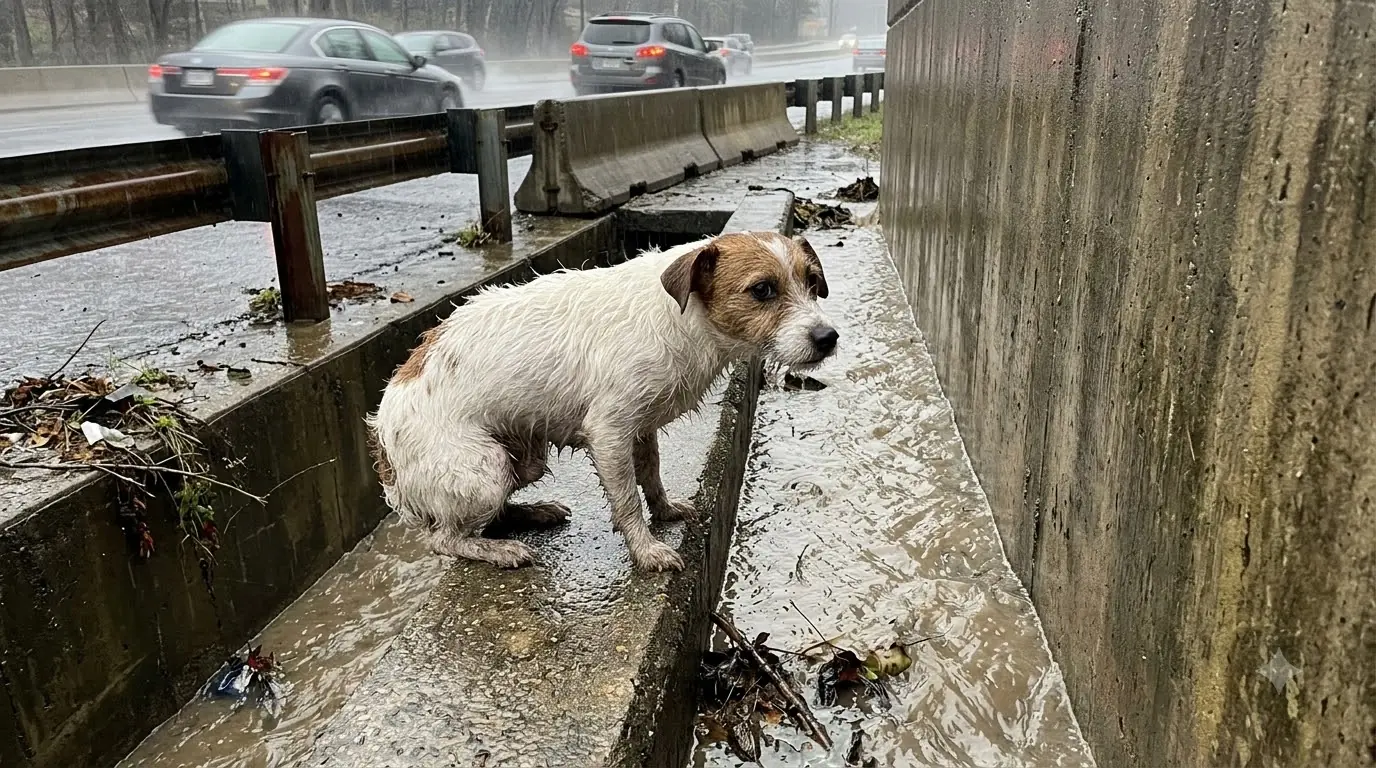
The morning Penny was found, heavy rain had overwhelmed the drainage system beside a busy roadway. Water carrying mud, trash, leaves, oil, and roadside debris moved rapidly through the concrete channel.
A driver noticed a small white-and-brown dog crouched on a narrow maintenance ledge just above the water. The driver pulled into a safe area and contacted local animal control rather than attempting to enter the channel alone.
By the time rescuers arrived, Penny’s entire underside was wet. Her front paws clung to the edge while one hind leg remained folded awkwardly beneath her.
Every passing vehicle sent spray over the retaining wall. The vibration caused Penny to flatten herself against the concrete.
The rescuers could not determine how long she had been trapped. No one reported seeing her enter the channel, and the amount of mud dried beneath the fresh water on her coat offered no reliable timeline.
She may have fallen during the storm, been swept through another section of the drainage system, or entered while attempting to escape traffic.
A rescuer wearing protective equipment descended with a safety line. Another team member remained above to control the line and monitor the water level.
Penny initially tried to move away. The ledge narrowed in the direction she chose, and her back paw slipped over the edge.
The rescuer stopped advancing. He lowered his body, turned partly sideways, and avoided reaching directly for her face.
Penny’s breathing was rapid. Her eyes moved between the rescuer, the traffic above, and the water below.
The team could not wait indefinitely because the rain continued and the channel level was rising. However, rushing toward her could have caused her to jump or fall.
The rescuer placed a loop of soft equipment ahead of her and allowed her to smell it. When Penny stopped retreating, he moved close enough to secure her body.
A towel was wrapped around her chest and abdomen before she was lifted. This protected her from slipping and reduced contact with contaminated water.
Penny did not bite. She remained rigid until the team reached level ground, then began trembling so strongly that her legs could not support her.
She was placed inside a warmed transport crate. The rescuers did not allow her to run loose beside the road or walk across the wet pavement.
Her temperature was below the normal range when she reached the emergency clinic. Cold water, wind, shock, and prolonged immobility had all contributed.
The veterinary team began warming her gradually. Blankets, controlled external heat, and warmed medical support were used while her temperature was checked frequently.
Rapid uncontrolled heating can create additional problems, so the staff did not place her directly against an extremely hot surface.
Penny’s coat was covered with muddy residue and smelled strongly of roadway runoff. Staff needed to remove contaminants, but a full bath was delayed until her body temperature and circulation improved.
Her eyes, mouth, paws, and exposed skin were gently rinsed first. The team wore gloves because floodwater may contain bacteria, chemicals, waste, and sharp debris.
Penny received an initial physical examination while remaining on a padded surface. Her gums were pale pink but became a healthier color as she warmed.
Her heart rate was elevated, which could have resulted from fear, pain, cold stress, or early respiratory difficulty.
She had superficial scrapes along both front paws and one elbow. The injuries were dirty but did not extend deeply into the joint.
Her left hind leg was swollen around the thigh and knee. Penny avoided placing full weight on it when she attempted to stand.
The veterinarian also noticed a small cut beneath her chin and several areas where fur had been rubbed away, possibly from struggling against the concrete wall.
More concerning than the visible injuries was her cough.
Penny coughed several times during the examination. The sound was moist, and each episode was followed by repeated swallowing.
When her chest was listened to, the veterinarian heard harsher breathing sounds in portions of the lungs.
Penny may have been submerged or partially submerged before climbing onto the ledge. If she inhaled water while struggling, contaminated material could have entered the airways.
The term “secondary drowning” is sometimes used casually to describe later breathing complications after water exposure, but the medical concern for Penny was aspiration injury and pneumonia.
Water, bacteria, silt, or debris inside the lungs can irritate delicate tissue, interfere with oxygen exchange, and create infection.
A dog may initially appear stable and then worsen over the following hours as inflammation develops.
Penny’s first oxygen measurement was lower than ideal but not immediately catastrophic. She could breathe with her mouth closed and did not yet require a breathing tube.
Chest X-rays revealed faint, patchy changes in several lung regions. The pattern was compatible with early aspiration, though imaging soon after an incident may underestimate the eventual severity.
The veterinary team collected blood for a complete blood count and chemistry panel. Her initial results showed stress-related changes, mild dehydration, and an elevated white blood cell count.
Her kidney and liver measurements were not consistent with advanced organ failure. Electrolyte changes were present but manageable.
A blood gas test helped the team assess how effectively Penny’s lungs were moving oxygen into her bloodstream.
The results supported the decision to provide supplemental oxygen and close monitoring.
Penny was placed inside an oxygen-supported enclosure. The clear front allowed staff to observe her without repeatedly opening the door and increasing stress.
Her temperature, breathing rate, breathing effort, oxygen level, heart rate, and mental state were recorded throughout the day.
Intravenous access was established so medication and fluids could be given safely. Fluid therapy was calculated carefully.
Penny needed support for dehydration and circulation, but excessive fluid could worsen lung problems. Her rate was adjusted according to repeated examinations, urine production, blood pressure, and laboratory values.
Broad assumptions were avoided. The team did not treat her as though every water-exposed dog automatically required the same amount of fluid or medication.
Because Penny had inhaled visibly contaminated floodwater and began showing clinical and imaging changes consistent with pneumonia, the veterinarian selected antibiotics appropriate for the likely infection.
Treatment was adjusted based on her clinical response and additional test information.
Antibiotics are not harmless, and they are not required for every brief contact with water. In Penny’s case, her cough, declining oxygen level, lung sounds, radiographs, and contaminated exposure created a stronger medical indication.
She also received pain relief for the abrasions and hind-leg injury.
Medication choices were based on her hydration, bloodwork, respiratory status, and potential interactions. No human medication was used.
During the first afternoon, Penny’s body temperature returned to normal. Her trembling decreased, and she lifted her head when a technician entered.
These changes were encouraging, but her breathing rate remained high.
That evening, Penny became more restless inside the oxygen enclosure. She changed positions repeatedly and extended her neck while breathing.
Her oxygen level fell when the enclosure was opened for care.
Repeat chest X-rays showed that the cloudy regions had become more visible. This progression was consistent with inflammation developing after aspiration.
The team increased her oxygen support and minimized unnecessary handling. Medication for nausea was given because coughing and swallowing water can upset the stomach, and vomiting would have created another aspiration risk.
Penny did not require mechanical ventilation, but the possibility was discussed with the rescue organization. If she became unable to maintain oxygen despite intensive support, a breathing tube and ventilator might have been necessary.
The rescue approved escalation if the critical-care team believed it offered a reasonable chance of recovery.
Staff contacted the rescue’s coordinator during the night to explain that Penny had worsened. She remained responsive, but the next 12 to 24 hours would be important.
Her sleeping position was adjusted to support comfortable breathing. She was allowed to choose whether to rest on her chest or side rather than being forced into one posture for long periods.
Gentle repositioning helped prevent dependent areas of the lungs from remaining compressed.
Nebulization and coupage were considered as part of airway care. Any treatment was performed only when Penny could tolerate it without severe distress.
Nebulization provided moisture to the airways, while gentle chest physiotherapy could help loosen secretions. It was not used as forceful pounding on an already frightened dog.
A trained technician cupped her hand and applied controlled, gentle movements over appropriate areas of the chest for brief periods.
Penny coughed afterward and swallowed several times. Her oxygen level remained stable during the session.
The veterinary team collected an airway sample only after weighing the diagnostic benefit against the risks of sedation and stress.
The sample identified bacterial growth consistent with exposure to contaminated environmental water. Laboratory sensitivity testing helped confirm that the chosen medication was appropriate.
No single result explained every change. Pneumonia severity was assessed using Penny’s breathing, oxygen needs, imaging, temperature, bloodwork, and overall response.
During the first night, she refused food. This was not unexpected given her fear, respiratory effort, nausea, and unfamiliar surroundings.
The team did not place a large meal inside the oxygen enclosure and assume that refusal was behavioral.
A small amount of warmed, aromatic veterinary food was offered once her breathing settled. Penny smelled it but turned away.
Nausea medication and pain control were continued. Several hours later, she licked a small amount from a spoon.
Eating requires coordination between breathing and swallowing. A dog working hard to breathe may not be able to consume a normal meal safely.
Penny was offered very small portions rather than one full bowl. Staff watched for coughing during or immediately after swallowing.
She kept the food down and did not show evidence of another aspiration event.
By the following morning, her oxygen requirement had stopped increasing. Her breathing remained faster than normal, but she no longer stretched her neck continuously.
Her gums stayed pink, and she rested for longer periods.
Repeat bloodwork showed continued inflammation but stable organ measurements. Her hydration improved, and her electrolyte values moved closer to the desired range.
The team remained cautious. Stabilization was not the same as recovery, and removing oxygen too soon could have forced Penny to work harder.
The oxygen concentration was reduced in small steps while her response was monitored.
When the enclosure door opened, Penny initially became frightened and breathed faster. Staff learned to distinguish this temporary stress response from a sustained medical decline.
Care was grouped whenever possible. Rather than opening the enclosure repeatedly for separate tasks, technicians coordinated medication, bedding checks, temperature assessment, and brief examination.
This allowed longer uninterrupted rest.
Sleep became an important part of Penny’s progress. During the first night, she woke at every movement outside the enclosure.
On the second day, she slept on her side for almost an hour while maintaining an acceptable oxygen level.
Her breathing rate gradually decreased.
She began eating small meals without hand-feeding. The bowl was placed near the front of the enclosure, and staff moved away.
Penny appeared more comfortable eating when no one watched her directly.
By the third day, she could remain outside the oxygen enclosure for short periods while connected to monitoring equipment.
The first trial lasted only several minutes. Her oxygen level stayed acceptable, though her breathing rate increased when she heard a metal cart.
The trial ended before she became exhausted.
Later trials were longer. Penny eventually rested in normal room air without a significant drop in oxygen.
She still coughed occasionally. The cough was expected to continue while the airways cleared and inflammation resolved.
A sudden increase in frequency, effort, fever, weakness, or refusal of food would have required reassessment.
Penny’s left hind leg was evaluated more thoroughly once her respiratory condition became stable.
Initial X-rays showed no fracture or dislocation. The hip, femur, knee, and lower leg remained aligned.
Ultrasound identified swelling and bruising within several muscles, consistent with a strain or impact injury.
She may have struck the concrete while being swept through the drain or strained the leg while trying to climb onto the ledge.
Her knee ligaments appeared stable during examination, though pain and tension can limit the accuracy of an early assessment.
The team prescribed rest, controlled movement, and pain medication compatible with her other treatment.
Penny was not allowed to run through the clinic as soon as she could stand. Soft-tissue injuries can worsen if a dog returns to unrestricted activity before inflammation decreases.
Her first walking attempt involved only a few supported steps on a nonslip surface.
She placed the toes of the left hind foot down but avoided full weight. A technician used a support sling beneath her abdomen without lifting her completely.
Penny reached a small elimination area, urinated, and immediately turned toward the hospital door.
The walk ended there. She was not asked to complete extra distance for exercise.
Over the next several days, she placed more weight on the leg. Her stride remained short, but she no longer held the foot entirely above the ground.
The rehabilitation team recommended gentle range-of-motion work only after the veterinarian confirmed that no unstable injury was present.
Exercises were performed slowly and stopped if Penny tightened her muscles or attempted to withdraw.
Her paw injuries required separate care. Mud and tiny particles were embedded in the abrasions.
The wounds were flushed thoroughly, and loose damaged tissue was removed conservatively. No deep tendon injury was found.
A light protective covering was used initially, then removed when it was safe to allow airflow and frequent inspection.
Bandages can trap moisture or create pressure if left unchanged, so staff checked them according to schedule.
Penny’s paw pads are now closed and dry. She still walks on smooth, clean ground rather than gravel or hot pavement.
The cut beneath her chin healed without sutures. Her skin abrasions remain visible but show no infection.
Once Penny’s temperature and breathing stabilized, the contaminated residue was removed from her coat.
The cleaning took place in stages. A long, stressful bath could have increased her respiratory effort and undermined the trust staff were beginning to build.
Warm water and a veterinary cleansing product were used. Her eyes, ears, and mouth were protected.
The team did not use strong household chemicals to remove the oily smell.
Afterward, Penny was dried thoroughly and returned to a warm enclosure.
Her coat appeared brighter, but the medical team continued watching for skin irritation. Road runoff can contain substances that cause delayed redness or inflammation.
No chemical burns developed.
Testing for illnesses associated with contaminated water was discussed. Floodwater can expose animals to bacteria and parasites through the mouth, skin, or urine-contaminated environments.
The team evaluated Penny’s vaccination status, kidney and liver values, urine, gastrointestinal signs, and regional disease risks.
Because no reliable records accompanied her, preventive care was planned cautiously around her immediate illness.
The priority was stabilizing her breathing. Nonurgent vaccines and procedures were delayed until her condition improved.
Penny’s urine testing did not initially show evidence of acute kidney injury. Her kidney values remained stable on repeat bloodwork.
The family caring for her has been instructed to watch for increased thirst, decreased urination, vomiting, fever, weakness, yellow discoloration of the eyes or gums, or sudden appetite loss.
These signs can have many causes but require prompt veterinary evaluation after contaminated-water exposure.
Her stool was loose during the first hospital days. Stress, antibiotics, diet change, swallowed water, and infection could all contribute.
A fecal test identified a common intestinal parasite, and treatment was selected according to her overall condition.
Penny did not develop severe or bloody diarrhea. Her stool gradually became more formed as her meals stabilized.
She received a veterinary probiotic at the team’s discretion, separated appropriately from other medications when necessary.
Her weight at admission was below the expected range for her frame. Her ribs and hip bones were easy to feel, and muscle over her back was limited.
This suggested that she may have been without consistent care before the storm.
The flood did not create all of her physical problems in a single morning.
Penny’s nails were overgrown, her coat contained older dirt beneath the fresh mud, and she had callused areas on her elbows.
No microchip was detected during the first scan. The scan was repeated because chips can migrate from their original position.
No identification was found.
The rescue followed local reporting and holding requirements. Notices were shared without disclosing every identifying detail, allowing a legitimate owner to provide proof.
No one came forward during the required period.
It remains unknown whether Penny was lost during the storm, had been living as a stray, or had been left near the road earlier.
The rescue does not invent a cruel owner to make the story more emotional. There is no verified history explaining how she reached the drainage channel.
What can be documented is that she was frightened, underweight, medically vulnerable, and alone when the water rose.
Penny’s emotional condition required attention from the beginning.
Inside the hospital, she did not solicit affection. When a hand moved toward her head, she lowered her body and turned her face away.
She accepted necessary handling without growling, but her stillness remained consistent with fear.
Staff avoided describing her as “sweet because she lets us do anything.” A frightened dog who does not resist may be overwhelmed.
Caregivers approached from the side, kept their hands low, and paused when she turned away.
Food was placed near her rather than repeatedly pushed toward her mouth.
One technician became Penny’s primary caregiver whenever scheduling allowed. Predictable handling reduced the number of unfamiliar people entering her space.
The technician used the same soft phrase before opening the enclosure and the same towel for brief chin-rest exercises.
Penny began lifting her head when she heard the familiar voice.
On the third morning, she smelled the technician’s fingers without retreating. No one attempted to pet her immediately.
Later that day, Penny allowed a brief touch along the chest.
Her response to traffic sounds remained intense. Even inside the clinic, the distant noise of a truck caused her to flatten herself and scan the room.
The team could not determine whether traffic had frightened her before the rescue or whether the sounds had become associated with the drainage channel.
Her foster placement was chosen partly because the home sits on a quiet residential street away from heavy vehicles.
Transport from the hospital required planning. Penny wore a secure harness connected to two points, and she traveled inside a crate.
The vehicle was parked in a protected area so she did not need to walk beside traffic.
Medication for anxiety was discussed and used according to veterinary instructions. The goal was not to sedate her into immobility but to prevent panic during a necessary transition.
Penny remained curled at the rear of the crate during the drive. She did not bark or scratch, but her eyes stayed open.
When the vehicle stopped at the foster home, the crate was carried into a closed room before the door was opened.
This prevented a frightened escape into an unfamiliar neighborhood.
Penny did not leave the crate for nearly an hour.
Her foster caregiver sat on the floor several feet away, turned sideways, and read quietly. Water and a small portion of food were placed near the entrance.
Eventually, Penny extended her head, smelled the floor, and stepped out with her front paws.
A distant car passed. She immediately moved back inside.
The caregiver did not block the crate or pull her forward. It remained available as a safe resting space.
Later that evening, Penny walked into the room and drank water. She ate several bites after the caregiver moved farther away.
Her first bathroom trip took place in a securely fenced yard. A leash remained attached because a fence alone does not eliminate escape risk.
Penny froze at the doorway. The open space, wet ground, and outdoor sounds appeared overwhelming.
The caregiver waited on the ramp and scattered several pieces of food within easy reach. Penny did not eat, which indicated that her fear was too high for training at that moment.
She was allowed to return inside. Another attempt occurred when the neighborhood was quieter.
During the second attempt, Penny crossed the doorway and moved directly beneath a covered porch area. She urinated there and immediately turned back.
The caregiver treated this as success. Penny did not need to explore the entire yard on her first night.
For the next several days, bathroom trips followed the same short route. Predictability helped her understand where she was going and how she could return.
Her foster home uses nonslip rugs because the injured hind leg remains weak. Smooth flooring caused Penny to shorten her steps and lower her body.
A supportive bed sits inside an open pen near the caregiver’s desk. The pen is never used as punishment.
Penny can rest without being approached from every direction. A blanket partially covers one side, but she can see the doorway.
During her first night, she slept inside the transport crate. The bed remained untouched.
On the second night, she placed her front feet on the bed and lowered her chest while keeping her hindquarters on the floor.
By the fourth night, she slept entirely on it.
Her breathing is monitored while she sleeps. The foster caregiver counts chest movements for a full minute and records the number.
Penny’s resting rate has remained within the range established by the veterinary team. It rises temporarily after a frightening sound but returns to baseline.
She no longer needs oxygen. Her gums remain pink, and she can walk to the yard without open-mouth breathing.
The cough has decreased significantly but has not vanished. She may cough once or twice after waking or drinking quickly.
Her water is offered in a wide bowl, and the caregiver prevents her from consuming an excessive amount at once after activity.
Water is never restricted overall. If Penny drinks too quickly, smaller refills are offered more frequently while ensuring that adequate water remains available.
Her antibiotics are given exactly as prescribed. The course will not be shortened because she appears better.
The foster caregiver watches for vomiting, severe diarrhea, appetite loss, facial swelling, hives, collapse, or other potential medication reactions.
Penny has tolerated treatment well. Her stool is normalizing, and she finishes most meals.
Her food remains divided into multiple portions. This supports digestion and makes medication easier to administer.
She initially ate only when alone. The caregiver placed the bowl down and left the immediate area.
By the end of the first week, Penny ate while the caregiver sat across the room. She occasionally looked up but returned to the food.
She now enters the kitchen during meal preparation and waits near the doorway.
Her weight has increased modestly. The team wants gradual progress rather than rapid gain.
As her respiratory condition and leg improve, controlled activity will help rebuild muscle. Extra calories without movement could add unnecessary strain.
Penny’s leg is now strong enough for several short walks inside the fenced yard. She bears weight on it but shows a slight limp after rest.
The rehabilitation plan includes controlled leash walking, gentle weight shifts, and careful sit-to-stand exercises on a nonslip surface.
She is not asked to jump, chase balls, climb stairs, or run.
The family records her movement before and after activity. If limping worsens later in the day, the next session is shortened.
Soft-tissue injuries may require weeks to heal even when a dog appears eager to move.
Penny’s pain medication has been adjusted as the swelling decreases. It is not stopped abruptly or increased without direction.
Repeat examination found improved range of motion and less tenderness in the thigh. Her knee remains stable.
If progress stops or the limp worsens, advanced imaging may be recommended to identify an injury not visible on initial X-rays.
Her paw pads tolerate grass and smooth pavement. She does not walk beside the busy roadway where she was found.
Traffic desensitization will begin only after her medical recovery is more advanced and her baseline anxiety is lower.
The foster caregiver currently plays recordings of distant traffic at a barely audible level while Penny eats or works on a simple scent activity.
The volume remains low enough that she can stay relaxed.
No one takes her directly to an overpass to “show her nothing bad will happen.” Overwhelming exposure can intensify fear.
Penny’s response determines the pace.
She enjoys searching for food inside folded towels and cardboard boxes. Every item is checked for staples, tape, or pieces she might swallow.
The games encourage her to use her nose and make choices without requiring fast movement.
At first, Penny watched the caregiver hide food but would not search until the room was empty.
She now investigates while the caregiver remains seated nearby.
Toys were introduced slowly. A squeaking toy caused her to retreat, so it was removed.
She showed more interest in a soft, silent rubber toy. She carried it to her bed and rested with one paw across it.
The toy remains intact and is used under supervision.
Penny has not shown aggression around food, toys, bedding, or handling. The foster family still respects signs of discomfort.
A closed mouth, lowered posture, head turn, lip lick, visible eye white, tucked tail, freezing, or attempt to leave all communicate that she needs space.
Waiting for a growl would mean missing earlier signals.
Visitors are limited. Those who enter sit quietly and ignore Penny until she approaches.
During the first visit from a rescue volunteer, Penny stayed inside her open crate for the entire half hour.
The volunteer did not reach inside. Before leaving, she placed a treat several feet away.
Penny collected it after the door closed.
On the volunteer’s second visit, Penny remained on her bed outside the crate. She watched but did not retreat.
During the third visit, she approached long enough to smell the volunteer’s shoe, then returned to the caregiver.
These small choices show growing confidence.
Penny has observed a calm adult dog through a secure barrier. She initially froze and lowered her tail.
The other dog turned away and smelled the ground rather than approaching directly.
After several minutes, Penny also began smelling the ground. She did not bark, lunge, or attempt to hide.
No direct introduction occurred. Her medical recovery and emotional stability remain the priorities.
Her history with cats and children is unknown. The rescue will not describe her as safe with every animal or child based only on her quiet behavior.
A frightened dog’s responses can change as she becomes stronger and more comfortable.
Any future placement will involve careful introductions and realistic management.
Penny’s next veterinary recheck will include chest X-rays, a complete blood count, and respiratory evaluation.
The team wants to confirm that the cloudy lung areas have continued clearing and that her white blood cell count is returning toward normal.
If her cough persists or imaging remains abnormal, additional diagnostics may be needed. These could include repeat airway sampling, culture, or advanced chest imaging.
Some dogs recover completely from aspiration pneumonia. Others develop lingering inflammation, scarring, or recurrent infection.
Penny’s current progress is encouraging, but the rescue does not call the condition resolved solely because she looks brighter.
The veterinarian will determine when antibiotics can safely end. Her breathing will continue to be monitored afterward for recurrence.
The contaminated-water exposure also justifies follow-up blood and urine testing. Delayed organ changes are not expected at present, but monitoring provides an opportunity to identify them early.
Her parasite treatment will be followed by another fecal test.
Preventive care will be completed once her medical team believes her body can handle it comfortably.
Penny has not yet been spayed. The procedure will wait until her lungs have healed and anesthesia is considered appropriately safe.
The rescue avoids stacking nonurgent procedures during recovery from serious respiratory illness.
Her adoption status remains on medical hold. This does not mean no one is interested in her.
The foster family has already received several inquiries after photographs of her rescue were shared. Emotional images often attract immediate attention.
The rescue asks potential adopters to look beyond the moment on the ledge.
Penny may need long-term support for traffic fear, careful introductions, continued rehabilitation, and patient handling. She is not ready to become a public symbol passed among frequent visitors.
Her future home should be quiet and secure. A neighborhood away from heavy traffic would be preferable.
Doors and gates must be managed carefully because sudden sounds may cause her to bolt.
A securely fenced yard would help, but Penny should not be left outside unattended.
Her identification and microchip will be updated before adoption. A fitted harness and backup safety connection are recommended during walks.
Her family will need to continue gradual exposure rather than forcing her into noisy environments.
Penny’s progress will not always move in a straight line. Storms may be particularly difficult.
During the first heavy rain in foster care, water struck the windows and gutters loudly. Penny left her bed and pressed herself behind the caregiver’s chair.
The caregiver closed the curtains, turned on steady background sound, and sat without restraining her.
Penny refused food for nearly twenty minutes. She remained close to the chair and watched the doorway.
When the rain softened, she accepted one piece. She then placed her chin on the caregiver’s foot.
No one carried her to a window or forced her to observe the storm.
Future rain events will be managed with a prepared safe area, background sound, medication if prescribed, and calm company.
The team will observe whether her storm response decreases as she gains distance from the rescue experience.
Her foster caregiver has begun cooperative-care training. Penny learns to stand on a mat while her paws are checked.
A hand moves toward one paw, then stops. Penny receives food for remaining relaxed.
Gradually, she allows each foot to be lifted briefly. This will make veterinary care, nail trimming, and injury monitoring less frightening.
Sessions last only a few minutes.
Penny also practices entering her transport crate without a car trip following every time. Food is placed inside, and the door remains open.
She now chooses to nap there occasionally.
This prevents the crate from predicting only hospitals, storms, or frightening transportation.
Car travel remains challenging. Penny lowers herself when the engine starts and refuses food during movement.
The vehicle stays quiet, and trips are limited to necessary appointments. She rides secured inside the crate rather than loose.
Short practice sessions occur while the vehicle is parked. The engine is introduced only after she can relax.
Her caregivers do not allow her to ride with her head outside a window. Debris can injure the eyes and airways, and an unsecured dog can be thrown during sudden braking.
Penny’s personality is becoming more visible as fear and illness decrease.
She is observant and gentle. She tilts her head slightly when the caregiver opens a food container.
She prefers lying beneath the desk while the caregiver works and occasionally touches a foot with her nose.
In the yard, she follows insect movement through the grass but does not chase for long.
One morning, Penny picked up the silent rubber toy and carried it from her bed to the kitchen. She placed it behind the caregiver and waited.
When the toy was rolled only a few feet, Penny walked after it, picked it up, and returned halfway.
She did not yet bring it directly back. The caregiver allowed the game to end without pursuing her.
Later that day, Penny carried the toy to the same place again.
Her sleep has improved significantly. She now rests on her side and sometimes exposes part of her abdomen.
During her first foster nights, she woke at every vehicle sound. She remained curled tightly with her feet beneath her body.
Now she occasionally sleeps through ordinary neighborhood traffic.
Large trucks still cause her to raise her head. She looks toward the caregiver, listens, and usually settles again.
The difference is not that she has forgotten the road. She has begun learning that every engine sound does not end with her trapped above rising water.
The rescue worker who lifted Penny from the channel visited after she became medically stable.
He entered the foster home wearing ordinary clothes rather than rescue equipment. Penny did not recognize him in any way that could be confirmed.
She watched from her bed while he sat on the floor and spoke quietly with the foster caregiver.
After several minutes, she approached and smelled his hand.
He did not reach for her. Penny moved around him, smelled his shoes, and returned to her bed.
Before he left, she walked forward once more and stood beside him.
The meeting was not presented as a dramatic reunion. Penny may have remembered his scent, voice, movement, or nothing specific at all.
What mattered was that she could approach a person connected with a frightening day and leave the interaction on her own terms.
The rescuer saw her breathing comfortably and bearing weight on the injured leg.
At the drainage channel, he had not known whether she would survive the trip to the clinic. Her trembling had continued even after she reached dry ground, and her cough had begun before the transport vehicle moved.
Seeing her walk across a quiet room provided a different ending to that part of the rescue.
Penny still has work ahead. Her lungs need follow-up imaging, her leg needs continued rehabilitation, and her fear of traffic and storms requires patient support.
No one can guarantee that she will become comfortable in every environment.
She does not need to.
A successful outcome is not turning Penny into a dog who can stand beside a highway without fear. It is giving her a life in which she does not have to.
Her medical team is cautiously optimistic. The most recent examination found clear improvement in lung sounds.
Her sleeping respiratory rate remains stable, her cough is uncommon, and her energy increases each week.
She has gained weight, her wounds have closed, and the swelling in her hind leg has nearly resolved.
She continues choosing contact in small ways. She rests nearer to her caregiver, eats while someone remains in the room, and enters the yard without freezing at the doorway.
During a recent light rain, Penny stood beneath the covered porch and watched drops strike the grass.
She stayed close to the open door, but she did not retreat immediately.
The caregiver sat inside where Penny could see her. No leash pressure pulled the dog farther into the yard.
After less than a minute, Penny turned and walked inside on her own.
She went directly to the bed, circled twice, and lay down.
That choice seemed ordinary. For Penny, it represented something she had not possessed while trapped in the drain.
She could leave the water.
She could return to shelter.
On the morning she was found, traffic moved above her and muddy runoff rose beneath her. The ledge was barely wide enough for her body, and every direction carried danger.
Her survival depended on remaining completely still until someone noticed.
Now Penny’s world contains secure floors, dry bedding, measured meals, medical care, and people who notice changes before she has to become desperate.
She is no longer balanced between a concrete wall and floodwater.
The storm has passed, but recovery continues in quieter moments: one full breath, one careful step, one meal finished, and one night of sleep without waking to the sound of the road.