Cigarette smoke hung beneath the low ceiling of the Rusty Anchor thick enough to turn the afternoon light gray.
Pool balls cracked together near the back wall. Heavy boots scraped old floorboards darkened by years of spilled beer and cigarette ash.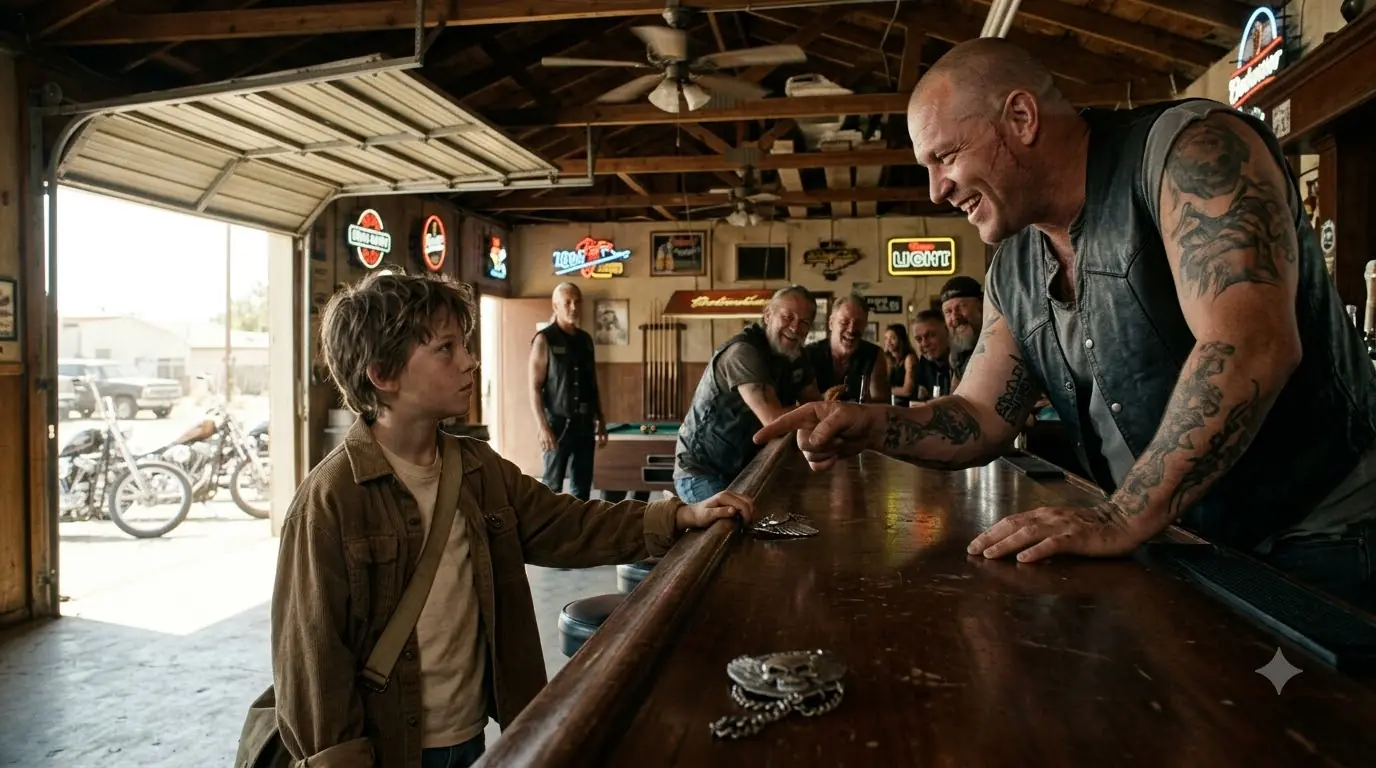
A jukebox near the bathrooms pushed a ZZ Top song through blown speakers while men in denim and leather shouted over one another, laughing with the harsh, gravelly confidence of people who were accustomed to taking up every inch of whatever room they entered.
Then a ten-year-old boy placed a tarnished silver lighter on the sticky mahogany bar.
Thirty hardened men stopped talking.
The silence did not happen gradually.
One second, the Rusty Anchor was loud enough to make the glasses tremble behind the bar.
The next, all anyone could hear was the slow mechanical turning of the ceiling fan.
The silver lighter rested beside an old brass compass, a pocket watch that no longer worked, and a heavy gold ring worn nearly smooth around its edges.
Arthur “Bones” Harrison had one massive hand hovering above it.
He did not touch the lighter again.
His scarred face had gone pale.
At the other side of the bar stood Toby Harris.
Ten years old.
Dusty sneakers.
Too-large corduroy jacket.
A narrow face that looked younger when he was frightened and older when he clenched his jaw the way he was doing now.
He had walked nearly four miles beneath the brutal Bakersfield sun because his mother needed money.
He had no idea he had just placed a fifteen-year-old ghost on the counter.
Six hours earlier, Toby had been standing on a wooden kitchen chair trying to reach the top shelf of a cabinet in the small beige bungalow he shared with his mother.
The house sat at the end of a dead-end street south of downtown Bakersfield, where the lawns had long ago surrendered to heat and water restrictions and the paint on most of the houses had faded into tired shades of cream, brown, and yellow.
On the kitchen table below him sat three envelopes.
One was from the electric company.
One came from St. Joseph’s Medical Center.
The third had a red stripe across the top.
FINAL NOTICE.
Toby knew what those words meant even though his mother had tried to hide them.
Sarah Harris had spent the previous eleven years doing everything she could to make sure her son did not understand how close they were always living to disaster.
When Toby was five, she called overdue bills “adult homework.”
When he was seven, she told him the electricity had gone out because the company was repairing something.
At eight, when dinner became canned soup three nights in a row, she said she was experimenting with easy recipes.
At ten, Toby understood.
His mother could no longer hide the oxygen concentrator humming beside her chair.
She could no longer hide the hospital statements.
And she could not hide the foreclosure notice she had left beneath a grocery circular because she had fallen asleep before putting it away.
Two weeks.
That was what Toby understood.
Two weeks before the bank could begin taking the house.
He did not understand every legal word.
He understood enough.
Sarah had been healthy most of Toby’s life.
She worked breakfast shifts at Miller’s Diner near the highway, came home long enough to change, then picked up evening hours at a motel laundry several nights a week.
She was thirty-two, though the previous year had aged her visibly.
First came the cough.
Then exhaustion.
Then infections that would not go away.
Doctors eventually diagnosed a severe lung disease that had probably been developing for years.
By the spring of 1988, Sarah could not work.
By summer, she needed supplemental oxygen most of the day.
Her savings disappeared first.
Then the small emergency fund.
Then the money she had quietly kept in an envelope behind a flour canister.
Toby noticed each stage of their decline because children noticed far more than adults wanted to believe.
He noticed when the refrigerator became emptier.
He noticed when his mother began cutting her own portions smaller.
He noticed when she stopped buying medicine on the exact day it ran out and started stretching it for two or three more days.
He noticed her sitting at the kitchen table late at night with a calculator, pressing numbers, erasing them, pressing them again as if mathematics might eventually become merciful.
And Toby decided, with the dangerous confidence available only to a frightened child, that if adults could not solve the problem, he would.
That Saturday morning, Sarah had fallen asleep in her chair after taking medication.
Toby climbed into the attic.
He knew she had stored boxes there after his father died.
His father was named Richard Harris.
That was almost everything Toby knew about him.
Richard had been a mechanic.
He could fix any engine.
He laughed loudly.
He drank coffee black.
He had died in a car crash when Toby was an infant.
Sarah kept exactly three photographs of him in the house.
In one, Richard stood beside an old pickup wearing a white T-shirt stained with grease.
In another, he was holding baby Toby and looking terrified.
The last showed Sarah and Richard standing outside the bungalow shortly after they married.
Toby had asked about him hundreds of times when he was younger.
Eventually he learned not to.
Every question seemed to cost Sarah something.
Her smile changed.
Her eyes moved somewhere far away.
Then she always found a reason to clean something.
So Toby allowed his father to become a collection of fragments.
A mechanic.
A husband.
A dead man.
A name.
That morning, Toby climbed between boxes beneath the attic rafters searching for forgotten money.
Loose coins.
Old savings bonds.
Anything.
He found twenty-three cents beneath a stack of magazines.
Then seventy-five cents in an old coffee tin.
He kept searching.
Near the far wall, one floorboard sat slightly higher than the others.
Toby noticed because his sneaker caught the edge.
He knelt.
The board was not nailed down.