Cigarette smoke hung thick enough inside the Rusty Anchor to make the ceiling lights look underwater.
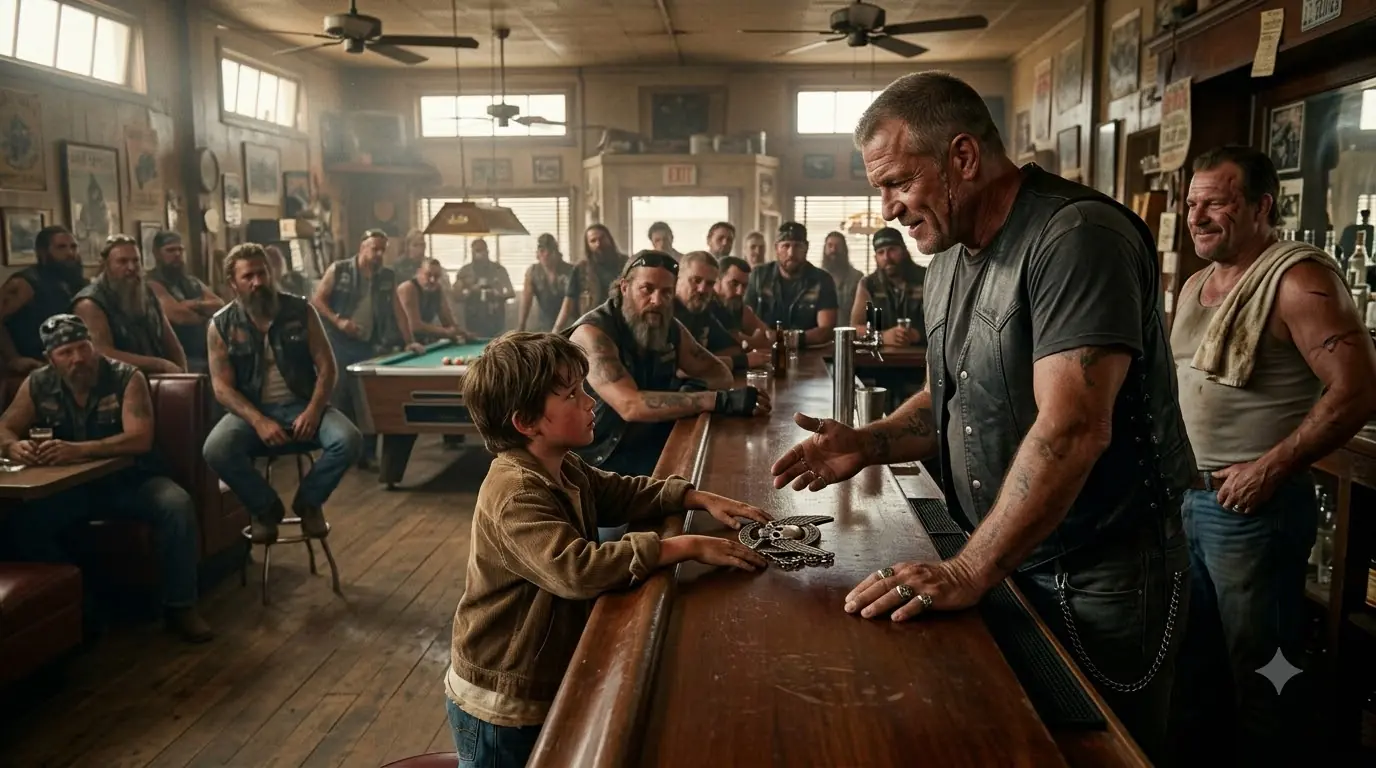
Pool balls cracked against one another in the back room, heavy boots scraped across scarred floorboards, and laughter rolled through the place in low, gritty waves.
The room was built for men who took up space without apologizing for it, men in leather cuts and faded denim who looked like they had spent more nights under highway lights than beneath bedroom ceilings. Then a ten-year-old boy walked to the bar, reached into the pocket of a corduroy jacket three sizes too big, and placed a tarnished silver lighter on the sticky mahogany.
In a heartbeat, thirty hardened bikers went silent.
The silence came so quickly that Toby Harris thought he had done something terrible. One moment a ZZ Top song was dragging through the jukebox speakers, somebody near the pool table was arguing about a bad break, and the bartender was laughing at a joke Toby had not heard.
The next, every face in the Rusty Anchor had turned toward the same small object resting beneath the amber bar light. Toby did not know why a scratched silver lighter could stop grown men in their tracks, and that ignorance frightened him more than shouting would have.
He had not come looking for trouble. He had come looking for money.
Earlier that afternoon, dust had swirled around Toby's battered sneakers as he trudged along the sun-baked shoulder of Route 99 outside Bakersfield, California. It was the summer of 1988, the kind of Central Valley afternoon when the heat seemed to rise from the asphalt as fiercely as it fell from the sky.
Toby was small for ten, narrow through the shoulders, with sharp collarbones showing beneath a washed-out T-shirt and a brown corduroy jacket left over from a cousin who had been much bigger. He wore the jacket despite the heat because its inside pocket held the most valuable things he had ever possessed.
The canvas pouch inside that pocket made a soft metallic clink with every step. Toby heard each sound as a reminder of the kitchen table at home, where overdue notices had begun forming a stack beside an unopened jar of instant coffee.
There was a final notice from the mortgage company, two hospital statements, a utility warning, and a handwritten total his mother had tried to hide beneath a diner receipt. Toby had seen all of it anyway. Children who lived in houses without enough money learned to read paper even when adults tried to turn the important side facedown.
Sarah Harris had once been able to hide hard times from him better. She had worked breakfast shifts at Miller's Diner and late shifts at a twenty-four-hour coffee shop near the highway, sometimes leaving before dawn and coming home after Toby had gone to sleep.
She was thirty-two, still young enough that people sometimes mistook her for Toby's older sister from a distance, but the past year had carved exhaustion into her face. A respiratory illness that began as what she called a stubborn chest cold had worsened until she could no longer make it through a shift without stopping to breathe.
By June, she needed an oxygen concentrator in the living room and portable tanks for the days she had to leave the house. Her doctor had told her she needed rest, medication, and follow-up care. Rest did not pay the mortgage. Medication did not arrive free. Follow-up care had the same problem as groceries: every appointment seemed to generate another envelope stamped with numbers Sarah did not have.
Toby understood only pieces of the medical language, but he understood the sound his mother's breathing made at night. He understood the way she paused halfway from the couch to the kitchen, one hand pressed against the wall while she waited for enough air to continue.
He understood that the refrigerator contained more condiments than food and that the jar where Sarah once kept emergency cash now held three nickels, two pennies, and a folded grocery coupon that had expired in April. Most of all, he understood the letter that said they had two weeks before the lender moved forward with foreclosure.
Sarah had not told him that directly. Toby had found the notice beneath the sugar bowl while looking for a pencil.
For three nights after that, he lay awake in the small bedroom at the back of the bungalow and listened to the oxygen machine sigh in the living room. The bungalow was rented from a cousin for less than market value, but years earlier Sarah and Richard had entered into an informal purchase agreement, paying the mortgage through the cousin's name while slowly building an ownership interest.
The arrangement had never been elegant, but it had kept a roof over them. Now missed payments threatened to erase even that fragile claim.
Toby tried to think like an adult because there did not seem to be enough adults available to solve the problem. He counted the money in his coffee can: seventeen dollars and forty-three cents. He considered mowing lawns, but most yards on their block were dead from heat and water restrictions. He asked Mr. Velasquez two streets over if he needed help unloading produce from his truck and earned five dollars, then learned with crushing clarity that twenty-two dollars did not look much different from seventeen when the problem was measured in thousands.
That was what sent him into the attic.
The attic was not really an attic so much as a low, unfinished crawlspace above the hallway, reachable by pulling down a wooden ladder that complained loudly at every hinge. Sarah almost never went up there. The space held Christmas decorations, an old fan, boxes of Toby's baby clothes, a broken lamp, and the last surviving pieces of Richard Harris that Sarah had not thrown away but could not bear to keep downstairs.
Toby had been told his father died when he was a baby. There was a framed photograph of Richard on the bedroom dresser, though Sarah kept it turned slightly away from the door as if even a picture could surprise her. In the photograph, Richard was broad-shouldered and dark-haired, leaning against an old motorcycle in work clothes, grease on one forearm and a smile that seemed almost mischievous. Toby had asked many questions over the years. Sarah answered the easy ones and quietly ended the difficult ones.
Was Dad nice?
“Yes.”
Was he funny?
“Very.”
Did he love me?
“With everything he had.”
What happened in the crash?
“That is enough for tonight, sweetheart.”
Toby had learned where the line was, though he never stopped wondering what existed beyond it.
On the afternoon he climbed into the attic, he was looking for anything he could sell. He had already found an old radio with one missing knob and two boxes of vinyl records, but even at ten he knew they were not worth enough. Near the far wall, beneath a warped floorboard, he saw the corner of something dark. The board came up after several minutes of prying with the flat end of a screwdriver.
Beneath it sat a small iron-bound lockbox wrapped in a faded shop towel. The lock had rusted almost through, and one hard twist with the screwdriver snapped it open. Toby lifted the lid expecting cash, documents, maybe jewelry. Instead he found a man's life reduced to four objects and a handful of yellowed papers.
There was a brass compass with a cracked glass face, an ornate pocket watch that had stopped at 2:17, a heavy gold ring engraved inside with the initials E.C., and a thick silver lighter that felt strangely heavy in Toby's palm. It was not a normal drugstore lighter. The case had been custom cast, its edges rounded from years of handling, its front engraved with a winged skull whose lower jaw was missing and a broken chain threaded through the eye sockets. Beneath the design were the same initials: E.C.
Toby turned the lighter over and over. Richard Harris's initials were R.H. The mismatch registered, but he did not have enough context to know what it meant. He assumed perhaps the lighter had belonged to a friend or had been bought secondhand. The important thing was that it looked valuable.
He wrapped the objects in the canvas pouch and took them downtown.
The first pawn shop refused to deal with him at all. The man behind the reinforced window looked at Toby, looked at the pouch, and said, “Come back with your mother.”
The second shop was worse. A narrow-faced clerk examined the pocket watch for less than five seconds, declared it broken, and offered eight dollars for everything in the bag. Toby stared at him in disbelief.
“The ring is gold,” Toby said.