Why Teddy Collapsed When Archie Finally Returned
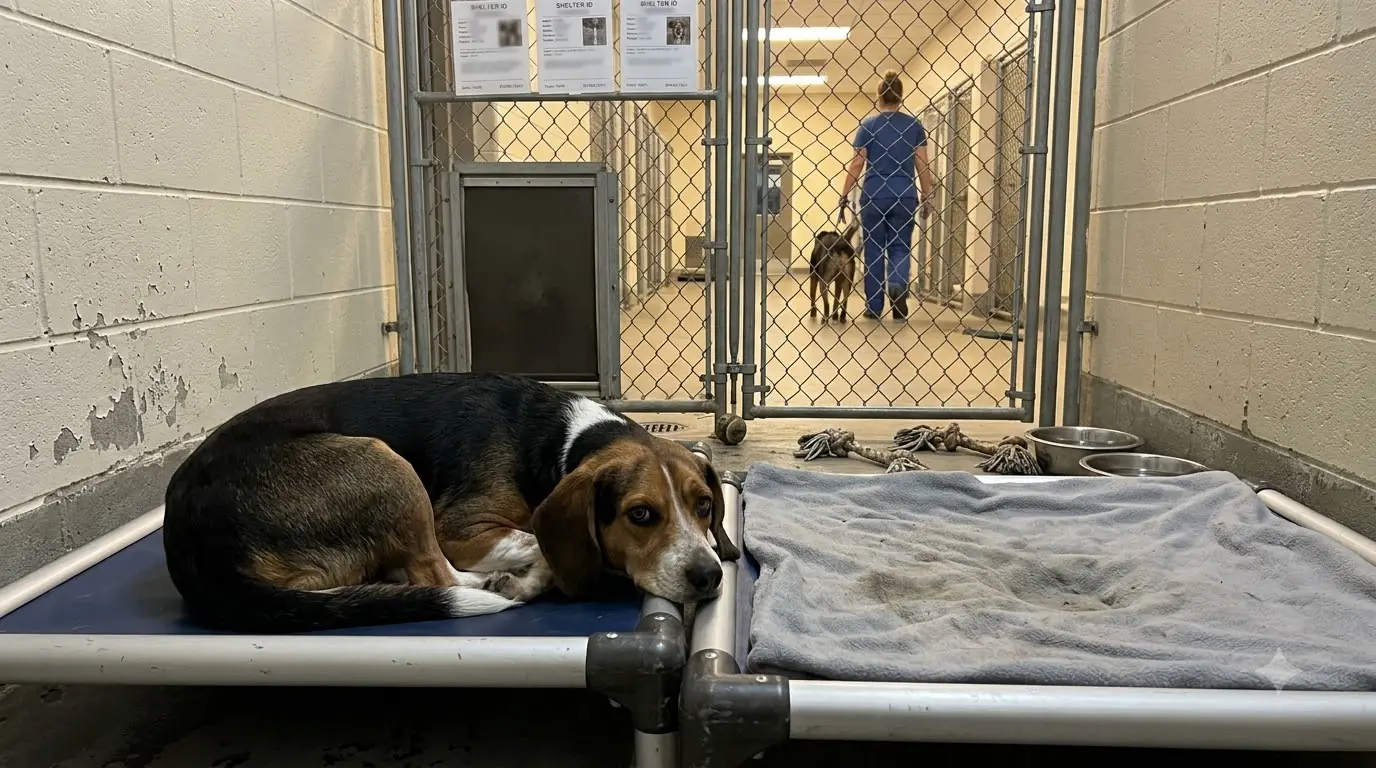
PART 2 — CURRENT CONDITION UPDATE
Teddy is now living in the same home as Archie under a medical foster-to-adopt agreement after being diagnosed with primary Addison’s disease. His condition has stabilized with hormone-replacement treatment, his appetite has returned, and he is beginning to play again.
Archie remains physically healthy and has adjusted well to sharing his new home. However, Teddy will require medication and veterinary monitoring for the rest of his life.
The dogs’ reunion at the shelter was emotional, but it was not the treatment that saved Teddy.
His improvement came from emergency fluid therapy, correction of dangerous electrolyte changes, hormone replacement, nausea control, careful monitoring, and a long-term medical plan.
Archie’s presence appeared to help Teddy settle, but the veterinary team is careful not to describe companionship as a cure for endocrine disease.
Teddy and Archie arrived at the shelter together after animal control found them near a closed gas station. Neither dog wore identification, and repeated microchip scans found no registered chip.
Witnesses reported seeing the two dogs moving together along the edge of the parking lot. Teddy followed Archie closely and stopped whenever Archie stopped.
They were transported in separate crates for safety, but Teddy remained restless during the drive. Archie stayed near the front of his crate and watched him through the space between them.
Once they completed intake examinations and the shelter confirmed that they interacted safely, they were housed together in a larger kennel.
The arrangement immediately reduced Teddy’s pacing.
He followed Archie to the water bowl, ate when Archie began eating, and rested only after the other dog lay down.
Shelter staff provided two beds, two food bowls, two water bowls, and multiple toys. The dogs frequently chose to share, but separate resources remained available.
Sharing can reflect comfort and familiarity, but dogs should not be forced to compete for one essential item.
During the first several weeks, Teddy appeared physically healthy. He was slightly underweight but alert, social, and interested in food.
His stool was occasionally soft, which staff attributed initially to shelter stress and diet transition. Fecal testing identified common intestinal parasites, and both dogs received appropriate treatment.
Teddy’s stool improved after medication.
His bloodwork at intake showed no dramatic emergency, although his sodium level sat near the lower end of the expected range and potassium was near the upper end.
Those values alone did not establish Addison’s disease. Mild variations can result from hydration, sampling, laboratory differences, diet, gastrointestinal illness, or other factors.
Teddy had no collapse, severe vomiting, or marked weakness at that time.
Archie was outgoing with visitors. He stood at the gate, carried toys, and quickly accepted attention from unfamiliar adults.
Teddy was friendly but more hesitant. He usually approached only after Archie moved forward.
When Archie played, Teddy joined. When Archie rested, Teddy settled close enough for their bodies to touch.
Adoption counselors described them as strongly bonded but continued assessing whether joint placement was necessary.
The rescue’s goal was to preserve meaningful relationships without making unsupported promises. Some dogs share a kennel peacefully but can live comfortably apart. Others experience significant distress when separated.
Short individual walks offered useful information.
Archie left the kennel willingly. Teddy watched the hallway and remained standing until he returned.
When Teddy went alone, he repeatedly looked behind him but completed the walk and accepted food.
The team believed a joint adoption would be ideal if an appropriate home appeared, but separate adoption remained possible with careful planning.
Then a family met Archie.
They had recently lost an older dog and were seeking a calm, social companion. Archie approached them immediately and rested beside their teenage son.
The family also met Teddy. He remained near Archie but did not seek much contact.
The counselors discussed both dogs, their relationship, and the possibility of adoption together.
The family’s housing agreement allowed only one dog. They could provide a stable home for Archie but not legally take Teddy.
The shelter considered the dogs’ behavior, medical status, and available options. Holding Archie indefinitely in the hope of a joint placement could also harm his welfare.
A plan was made for Archie’s adoption with additional observation and support for Teddy.
On the morning Archie left, Teddy stood beside him while staff attached the leash. Archie moved toward the hallway, then looked back once.
Teddy followed until the kennel gate closed between them.
He watched Archie disappear around the corner.
For the rest of the day, Teddy remained near the front of the kennel. He smelled the door and listened whenever footsteps approached.
He ate less than half of his evening meal.
Staff placed a blanket carrying Archie’s scent on the bed. Teddy smelled it, circled once, and lay along one side.
The following morning, he stood when a dog returned from a walk. He looked behind the handler, then returned to the bed when Archie did not appear.
This pattern continued.
Teddy stopped carrying toys. He still went outside, but he moved more slowly and turned toward the building sooner.
His appetite remained inconsistent. Some meals were partly eaten after a caregiver sat nearby. Others were untouched.
The shelter treated the behavior as a potential emotional response while continuing medical observation.
Grief, separation stress, and environmental disruption can affect appetite, sleep, activity, and social behavior.
However, those explanations should not prevent medical evaluation.
On the third day, Teddy vomited a small amount of yellow fluid. His stool softened again.
He remained responsive and drank water, so the event did not initially resemble a complete emergency.
The medical team performed an examination. Teddy’s abdomen was mildly uncomfortable but not severely swollen.
His temperature was normal. His gums felt slightly tacky, suggesting early dehydration.
Supportive care began, and bloodwork was collected.
The results showed that Teddy’s sodium level had fallen while potassium had risen. The ratio between the two values raised concern for Addison’s disease, though other illnesses can create similar changes.
His kidney measurements also appeared elevated, potentially because dehydration reduced blood flow and made the values look worse.
Teddy received carefully calculated fluids and medication for nausea. Further testing was scheduled.
That evening, he seemed brighter and ate a small portion. Staff continued monitoring.
The next morning, Teddy refused food completely. He vomited water and appeared weak when standing.
His heart rate was lower than expected for a dehydrated, stressed dog. This combination increased concern.
Teddy was transferred to the emergency veterinary hospital.
Repeat bloodwork showed worsening sodium and potassium abnormalities, dehydration, low blood sugar, and changes consistent with reduced circulation.
An electrocardiogram detected effects associated with the elevated potassium. Dangerous potassium levels can interfere with the heart’s electrical activity and lead to life-threatening rhythm changes.
The team began emergency stabilization immediately.
Intravenous fluids supported circulation and helped correct dehydration. The fluid choice and rate were based on Teddy’s electrolyte values, blood pressure, heart rhythm, kidney measurements, and response.
The veterinarian did not attempt to normalize every value instantly.
Correcting severe sodium abnormalities too rapidly can create neurological complications. Changes were measured repeatedly and managed in controlled stages.
Teddy received medication to address the hormone deficiency suspected in an Addisonian crisis.
Glucose support was provided for his low blood sugar. Additional treatment helped protect the heart while potassium declined.
His blood pressure was monitored continuously during the most unstable period.
Addison’s disease, also called hypoadrenocorticism, occurs when the adrenal glands do not produce adequate levels of certain hormones.
The adrenal glands are small structures located near the kidneys. Their hormones help regulate blood pressure, circulation, electrolyte balance, metabolism, stress response, gastrointestinal function, and many other essential processes.
In primary Addison’s disease, immune-mediated destruction is a common suspected cause, though the exact trigger is not always identified.
Dogs with classic primary Addison’s disease often lack both glucocorticoid and mineralocorticoid hormones.
The glucocorticoid deficiency contributes to weakness, poor appetite, vomiting, diarrhea, low blood sugar, and inability to handle physiological stress.
Mineralocorticoid deficiency disrupts sodium, potassium, fluid balance, and circulation.
Symptoms may appear intermittently before a severe crisis occurs.
A dog might have occasional digestive problems, unexplained fatigue, weight loss, trembling, or reduced appetite that improves temporarily with fluids or nonspecific treatment.
This inconsistency can make the disease difficult to recognize.
Teddy’s earlier soft stool and borderline electrolytes may have represented mild signs, but the shelter could not prove that every previous change came from Addison’s disease.
The separation from Archie created stress, but it did not cause Teddy’s adrenal glands to fail within several days.
The disease was already developing.
Stress may have increased his body’s demand for hormones he could not produce adequately, making the underlying problem more visible.
The diagnostic team performed an ACTH stimulation test once emergency considerations were addressed.
This test measures cortisol before and after administration of a synthetic hormone that should stimulate the adrenal glands.
A healthy adrenal response produces a rise in cortisol. Teddy’s cortisol remained inappropriately low.
Together with his clinical signs, electrolyte abnormalities, and other test results, the response supported a diagnosis of primary Addison’s disease.
Additional testing helped exclude several conditions that can mimic parts of the same pattern.
The team evaluated kidney function, gastrointestinal disease, infection, blood loss, pancreatic illness, liver disease, and exposure to certain medications.
Abdominal ultrasound showed small adrenal glands but no large abdominal mass or obstruction.
Teddy’s kidneys looked structurally acceptable, and the initially elevated kidney values improved as circulation and hydration were restored.
This indicated that reduced blood flow during the crisis had contributed more than irreversible kidney failure.
His heart rhythm improved as potassium declined.
Teddy remained hospitalized for continuous observation. His temperature, blood pressure, heart rate, urine output, glucose, electrolytes, hydration, and mental state were checked repeatedly.
During the first night, he remained weak and spent most of the time lying on his chest.
He lifted his head when people entered but showed little interest in food.
Medication controlled vomiting, and his abdomen became less tense.
By the following morning, Teddy’s sodium and potassium were moving toward safer levels.
His blood pressure stabilized without increasingly aggressive support. He urinated normally, and his kidney measurements continued improving.
The medical team began offering small amounts of easily digestible food.
Teddy smelled the first portion but did not eat.
A technician placed the bowl down and moved away. After several minutes, he licked a small amount.
No one interpreted one bite as complete recovery. Nutritional intake, vomiting, hydration, and laboratory changes all required continued observation.
The shelter contacted Archie’s adoptive family to explain Teddy’s diagnosis and hospitalization.
The purpose was not to blame the family for taking Archie. They had adopted responsibly within their housing rules and could not have known that Teddy was developing an endocrine crisis.
Staff asked whether they could provide a recently used blanket or toy carrying Archie’s scent.
The family brought a small blanket to the hospital. Teddy smelled it and rested his chin across one edge.
The family also asked whether Archie could visit when Teddy became stable enough.
The veterinary team considered infection control, stress, handling, space, and Teddy’s cardiopulmonary condition.
A reunion during the height of the crisis would have created unnecessary activity. It was postponed until Teddy could stand, maintain blood pressure, and tolerate a controlled interaction.
Two days later, Archie arrived with his family.
The meeting took place in a quiet consultation room rather than a busy hallway.
Teddy wore a secure harness and remained connected to hospital support as required. Archie entered on a loose leash with an experienced handler.
Archie noticed Teddy immediately. His body loosened, and his tail moved broadly.
Teddy attempted to stand.
A technician supported his abdomen because his muscles remained weak after dehydration, electrolyte disruption, and hospitalization.
Teddy took several steps, reached Archie, and pressed his face against the side of his neck.
Archie smelled his ears, muzzle, hospital bandage, and legs.
For a short moment, both dogs remained still.
Then Teddy’s hind legs weakened. He lowered suddenly toward the floor.
The medical team responded immediately.
His heart rhythm and blood pressure were checked. The episode did not represent another full Addisonian crisis, but standing and emotional arousal had exceeded his limited strength.
Teddy was returned to his bed and allowed to rest.
Archie remained several feet away, lying on the floor with his body facing him.
The visit ended early. The family did not attempt to create a second dramatic greeting.
Teddy’s values remained stable after the event. He had not suffered a new dangerous electrolyte shift.
The collapse emphasized that outward interest can return before physical recovery is complete.
Archie’s presence appeared to increase Teddy’s engagement. He ate a small amount after settling.
Still, fluids, hormone replacement, nutritional support, and medical stabilization remained responsible for his recovery.
The reunion did not restore adrenal function.
The hospital began transitioning Teddy from emergency hormone treatment to a long-term plan.
Dogs with primary Addison’s disease typically require replacement of mineralocorticoid activity and glucocorticoid support.
Specific medication choices depend on veterinary judgment, availability, response, laboratory values, and caregiver ability.
Teddy began a scheduled injectable medication that replaces mineralocorticoid effects. The interval between injections would be adjusted according to electrolyte monitoring and clinical response.
He also received a low maintenance dose of oral glucocorticoid medication.
During periods of significant stress—such as illness, surgery, injury, or certain medical procedures—his veterinarian may recommend a temporary increase in glucocorticoid support.
This is sometimes called stress dosing.
The amount and timing must come from a veterinarian. Caregivers should not change the dose casually whenever Teddy appears worried or has an ordinary exciting day.
Too little hormone can leave him vulnerable. Unnecessary excessive medication can also cause side effects.
Teddy’s family received written guidance identifying situations that require a call to the veterinary team.
These include repeated vomiting, diarrhea, severe appetite loss, unusual weakness, trembling, collapse, marked lethargy, or inability to keep medication down.
A dog with Addison’s disease who vomits required oral medication may need urgent injectable support.
The family also learned that treatment cannot stop simply because Teddy looks normal.
Hormone replacement controls the disease. It does not repair adrenal glands or create a permanent cure.
Missing injections or discontinuing medication can lead to another crisis.
Teddy’s first long-term medication interval required frequent blood tests.
Electrolytes were checked after the injection and again near the expected end of its effect.
These results helped the veterinarian determine whether the dose and timing adequately controlled sodium and potassium.
The goal was not merely keeping values barely inside a laboratory range. Teddy’s appetite, energy, hydration, stool, vomiting, thirst, urination, weight, and overall behavior were also considered.
Some dogs need medication intervals adjusted over time.
Claire—Archie’s adopter was named Melissa—began attending these appointments after the family offered to foster Teddy medically.
Their housing agreement had originally allowed only one dog. After learning about Teddy’s diagnosis and seeing the dogs’ reunion, Melissa contacted the property manager.
She did not secretly bring Teddy into the home or assume the rule would be ignored.
The family provided veterinary information, shelter documentation, and a plan showing that Teddy would be medically supervised and both dogs had demonstrated peaceful behavior.
The property manager approved a temporary exception during the foster-to-adopt period, with conditions related to identification, vaccination, household management, and responsible care.
This approval made a joint placement legally possible.
The shelter still assessed whether it was the best choice for both dogs.
Archie had adjusted well to the family’s home. He ate, slept, walked, and interacted comfortably with every household member.
Reintroducing Teddy could change resource use, attention, space, and routine.
A positive shelter bond did not guarantee that the dogs would never experience conflict in a new environment.
The rescue arranged several controlled meetings after Teddy left the hospital.
The first occurred outdoors on neutral ground. Both dogs walked in the same direction at a comfortable distance.
Teddy tired quickly, so the session remained short.
Archie repeatedly looked toward him but did not pull continuously or crowd him.
When the distance decreased, the dogs smelled one another briefly and continued walking.
Their body language remained relaxed.
A second meeting took place in the family’s fenced yard. Toys and food bowls were removed initially to reduce competition.
Teddy entered first and explored slowly. Archie joined several minutes later.
They smelled the same areas, moved apart, and returned to each other without tension.
Inside the house, baby gates divided the main living space.
Each dog had a separate bed, food station, water access, and resting area.
The family did not immediately expect them to share everything as they had in the shelter.
A new environment can change behavior. Separate resources allow each dog to relax without being forced into constant contact.
During Teddy’s first evening, he walked behind Archie from room to room.
When Archie lay on his bed, Teddy stood nearby but did not climb onto it.
Melissa guided Teddy to a second bed placed several feet away.
He circled once, watched Archie, and eventually lay down.
During the night, the family used a secure gate between the beds. The dogs could see and smell each other but could not interfere with rest or medication.
Teddy slept facing Archie.
By the third night, he settled without pacing.
Direct sleeping contact was allowed only after caregivers observed repeated calm behavior.
When the gate was opened during a supervised afternoon rest, Teddy moved toward Archie’s bed.
Archie lifted his head, smelled Teddy’s face, and shifted sideways.
Teddy lay in the space created between Archie and the edge.
Neither dog stiffened or attempted to leave.
They slept together for almost an hour.
The family did not remove the second bed. Choice remained important.
Teddy now alternates between sleeping beside Archie and using his own bed.
He still leaves space when Archie is outside, but he no longer remains frozen while waiting.
The household also practices short, gradual separations.
Teddy’s dependence on Archie had been significant in the shelter, and his behavior after the adoption showed that sudden absence was difficult.
The goal is not to weaken their bond. It is to ensure that either dog can attend a veterinary appointment, walk separately, or rest in another room without severe distress.
At first, Archie left the room for only several seconds while Teddy remained with Melissa and a food puzzle.
Teddy ignored the food and watched the gate.
Archie returned calmly.
Later sessions began with a scent-search activity before Archie moved. The absence increased in very small steps.
Teddy can now continue eating while Archie walks to the mailbox with another family member.
He still listens toward the door, but he does not pace continuously.
Archie also practices independence. Although he appeared more adaptable, his needs should not disappear because Teddy has a medical diagnosis.
Archie receives individual walks, training, affection, and rest.
He is not expected to serve as Teddy’s permanent emotional support tool.
A relationship can be mutually important without one dog being responsible for regulating the other’s health.
Teddy’s appetite improved rapidly after medical stabilization and return to a quiet home.
He eats measured portions twice daily. Medication is given according to the written schedule.
Melissa offers the medicated bite first and confirms that it is swallowed.
Teddy’s maintenance glucocorticoid can increase appetite, thirst, and urination, especially if the dose is higher than needed.
The veterinary team aims for the lowest effective maintenance amount while maintaining safety.
Melissa records changes rather than adjusting medication herself.
Fresh water remains available at all times.
Teddy’s drinking has stabilized after the crisis. He no longer empties bowls rapidly or appears dehydrated.
He urinates normally and has had no recent accidents.
His stool is formed, and he has not vomited since leaving the hospital.
His weight, initially reduced by illness and poor intake, is increasing slowly.
The medical team wants restoration of body condition without excessive gain.
Beagle mixes can become overweight easily when appetite increases, and extra body fat would affect joints, heart health, and overall comfort.
Treats used for medication and training are counted within his daily intake.
Teddy’s physical activity increased gradually after hospital discharge.
He was weak from the crisis and several days of limited movement. Short leash walks began at the end of the driveway.
Melissa watched his posture, pace, breathing, and willingness to continue.
He did not have heartworm-related activity restrictions, but his body still needed time to recover from shock and electrolyte imbalance.
One longer walk during the second week left him tired for several hours. The family shortened the next outings.
Archie’s walks remained longer. This provided healthy exercise and continued independence practice.
Teddy now walks around the block at a relaxed pace. He stops frequently to smell.
No one forces him to match Archie’s faster movement.
A veterinary recheck found improved muscle strength and normal coordination.
Teddy’s heart rhythm returned to normal after potassium correction. No chronic structural heart disease was identified.
His kidney measurements also returned to an acceptable range.
This supported the conclusion that dehydration and poor circulation during the Addisonian crisis had caused the earlier changes.
His blood sugar remains stable on the long-term plan.
Regular monitoring will continue because illness, medication needs, and body condition can change.
Teddy’s adrenal disease does not make every future symptom an Addisonian crisis.
Dogs can still develop ordinary stomach upset, parasites, infections, dental disease, injury, and age-related conditions.
However, the threshold for contacting the veterinarian is lower when vomiting, diarrhea, weakness, or appetite loss threatens medication absorption and hormone balance.
Melissa keeps an emergency information card in her wallet and a copy attached to Teddy’s carrier.
The card identifies his diagnosis, medications, veterinarian, and need for urgent hormone support if he cannot take oral treatment.
A labeled emergency kit is maintained according to veterinary instructions.
The family does not improvise injections or medication without training and authorization.
They also keep a current list of every medication to prevent unsafe interactions during emergency care.
Teddy wears identification stating that he has a chronic medical condition.
His microchip has been registered to the rescue during foster care and will be updated after adoption finalization.
The family uses a secure harness and leash. An Addisonian dog who becomes suddenly weak outdoors must be handled safely.
Teddy has not collapsed again.
He has experienced one mild episode of reduced appetite after a thunderstorm.
Melissa monitored him closely, offered his regular medication, checked for vomiting or diarrhea, and contacted the clinic.
Because he remained alert, drank normally, and ate later, emergency hospitalization was not required.
The veterinary team reviewed whether situational stress support might help during severe weather.
Medication choices must account for Teddy’s endocrine condition and existing treatment.
The household also created a quiet storm area where both dogs can rest.
Curtains close, steady background sound plays, and family members remain calm.
Archie tends to sleep through storms. Teddy often lies beside him.
The family does not claim Archie’s presence replaces stress-dose guidance or veterinary care. It simply appears to provide familiarity.
Teddy’s dental examination found moderate tartar and mild gum inflammation but no urgent abscess.
A professional cleaning may be scheduled once his long-term hormone dose and stress protocol are well established.
Any procedure involving anesthesia requires planning because his body cannot mount a normal adrenal stress response.
The veterinary team will provide appropriate hormone support before, during, and after the procedure.
Melissa will never withhold Teddy’s diagnosis from another clinic, groomer, boarding facility, or emergency hospital.
Clear communication is part of keeping him safe.
Teddy’s coat and skin are healthy. Mild hair thinning present after hospitalization has begun filling in.
His ears require routine monitoring because Beagle mixes can develop infections within folded ear canals.
At intake, both ears contained wax but no severe infection.
Melissa checks for odor, redness, discharge, pain, or head shaking and cleans only as directed.
Overcleaning can irritate the canal.
Archie’s medical evaluation remains reassuring.
He has normal bloodwork, a negative heartworm test, healthy kidney and liver values, and no serious orthopedic disease.
His vaccinations and preventive care are current.
He gained a small amount of weight after adoption, so his food portions were adjusted.
The family ensures that Teddy’s increased medication-related appetite does not lead him to take Archie’s food.
Meals are served behind separate gates. Bowls are removed after eating.
This arrangement is practical rather than a response to aggression. Neither dog has guarded food, but separate feeding allows accurate measurement and prevents accidental medication sharing.
Water bowls remain available in more than one room.
Toy management is also thoughtful.
Teddy resumed interest in soft toys after returning home. The first toy he picked up was one Archie had used during the separation.
He carried it across the living room and placed it between their beds.
Archie smelled it and took another toy instead.
The family provides duplicates of favorite items when possible. Tug and chase games remain supervised.
Both dogs respond well to calm scent work.
Food is hidden inside folded towels or beneath lightweight cups. Teddy searches beside Archie but receives his own area to prevent crowding.
The games provide mental engagement without requiring frantic movement.
Teddy’s emotional behavior continues improving.
During the first foster week, every exterior door caused him to stand. If Archie left with a family member, Teddy remained near the entrance.
He now watches Archie depart but can return to the living room with Melissa.
When dogs pass the front window, Teddy sometimes raises his head and looks behind them, echoing the behavior he displayed at the shelter.
The reaction is less intense and ends quickly.
He no longer rushes to every sound in the hallway.
His sleep has changed most visibly.
At the shelter, after Archie’s adoption, Teddy used only half of the shared bed. Staff repeatedly found him curled against one edge.
In the new home, he initially preserved the same space even when Archie slept elsewhere.
After several weeks, Melissa entered the living room and found Teddy stretched diagonally across the entire second bed.
Archie slept on the rug nearby.
Teddy’s legs extended into the area he had once left empty.
Later that evening, Archie climbed onto the bed and rested against him.
The available space no longer appeared reserved for an absence.
Teddy has begun forming relationships with the human family independently of Archie.
He follows Melissa into the kitchen and rests beneath her desk while she works.
When her teenage son returns from school, Teddy carries a toy to the hallway.
He does not wait for Archie to greet first every time.
During one recent veterinary visit, Teddy entered the examination room while Archie remained home.
He looked toward the door several times but accepted food, stood on the scale, and completed blood sampling using a cooperative chin-rest behavior.
The appointment lasted less than an hour. When Teddy returned, his greeting with Archie was enthusiastic but controlled.
He smelled his face, moved his tail, and then walked toward the water bowl.
This was an important independence milestone.
Teddy had tolerated medical handling without his companion and returned without prolonged distress.
His electrolyte results were within the desired range.
The veterinarian adjusted the timing of his next injection by a small amount based on the trough measurements.
This refinement is part of routine long-term management.
A dog’s medication interval may not remain identical forever.
Melissa schedules the next appointment before leaving the clinic and sets multiple reminders.
The rescue also keeps a record during the foster period.
Teddy’s prognosis with consistent treatment is considered favorable.
Many properly managed dogs with Addison’s disease can enjoy active, comfortable lives.
The condition remains potentially life-threatening if medication is missed, vomiting prevents absorption, or a crisis is not recognized.
A favorable prognosis depends on reliability.
The family has demonstrated that reliability through appointments, records, medication administration, home preparation, and communication.
The shelter has approved the plan to finalize Teddy’s adoption after the next stable monitoring interval.
Archie’s original adoption agreement will remain unchanged, while Teddy receives his own records, identification, and medical disclosures.
The family understands that adopting Teddy is not simply reuniting two sad dogs.
It means accepting lifelong injections, oral medication, laboratory testing, emergency planning, and the financial responsibility of chronic care.
They have arranged backup caregivers. Two relatives know the medication schedule and warning signs.
The property manager’s two-dog approval has been documented rather than left as a verbal exception.
The family’s veterinarian has received the full hospital and shelter records.
These details are not as emotionally striking as Teddy searching behind every dog in the hallway.
They are what make the reunion sustainable.
The rescue has also reviewed what happened when Archie was adopted.
No one blames Archie’s family for Teddy’s crisis. The family acted within housing limits and followed shelter counseling.
The separation exposed a serious bond and may have increased stress, but it did not create Addison’s disease.
Holding every bonded-looking pair indefinitely can also leave animals in shelters longer and reduce their opportunities.
The experience reinforced the importance of gradual separation assessment, thorough medical evaluation, and communication after adoption.
It also demonstrated that significant withdrawal should never be dismissed as sadness without checking the body.
Teddy’s empty half of the bed was emotionally meaningful. His vomiting, weakness, electrolyte changes, and low cortisol were medical signs.
Both deserved attention.
His care team did not need to choose between compassion and science.
Compassion caused them to notice the change. Medical testing showed them what treatment he needed.
Archie continues supporting Teddy in ordinary ways. He lies nearby during storms, waits outside the bathroom during baths, and often starts play.
Teddy supports Archie too. He helps settle him when unfamiliar visitors enter and follows him during scent games.
Their relationship is not one-sided.
The family allows closeness without requiring constant contact.
Each dog has a separate bed, separate meals, individual walks, and time alone with family members.
Some nights they sleep pressed together. Other nights Archie chooses the couch rug while Teddy occupies the entire orthopedic bed.
The empty space no longer carries the same meaning.
At Teddy’s most recent recheck, his sodium, potassium, glucose, and kidney values were stable. He had gained an appropriate amount of weight and showed no vomiting, diarrhea, weakness, or collapse.
His maintenance medication remains at the veterinarian-directed dose.
The next injection is scheduled, and the family has already confirmed the appointment.
Archie waited at home during the visit.
When Teddy returned, Archie met him at the gate. Teddy pressed his nose briefly against his face.
Then both dogs walked into the kitchen and sat beside their separate food stations.
The greeting lasted only a few seconds.
They no longer needed to confirm each other’s return for several minutes.
That evening, Teddy carried a toy into the living room. He placed it beside Archie, circled the shared bed once, and lay down.
Archie joined him later.
For days at the shelter, Teddy had searched behind every dog entering the hallway. Each night, he left room for someone who did not come back.
Archie eventually did return.
But Teddy’s recovery required more than finding the missing dog. It required people who noticed that grief did not explain everything, veterinarians who recognized an endocrine crisis, and a family willing to build a lifelong plan around both love and medicine.
Teddy still sleeps close to Archie most nights.
He no longer leaves half the bed untouched.
Now, when Archie rises and walks away, Teddy may lift his head and watch.
Then he stretches into the warm space his friend left behind, knowing that this time, the door leads back home.