Chapter 1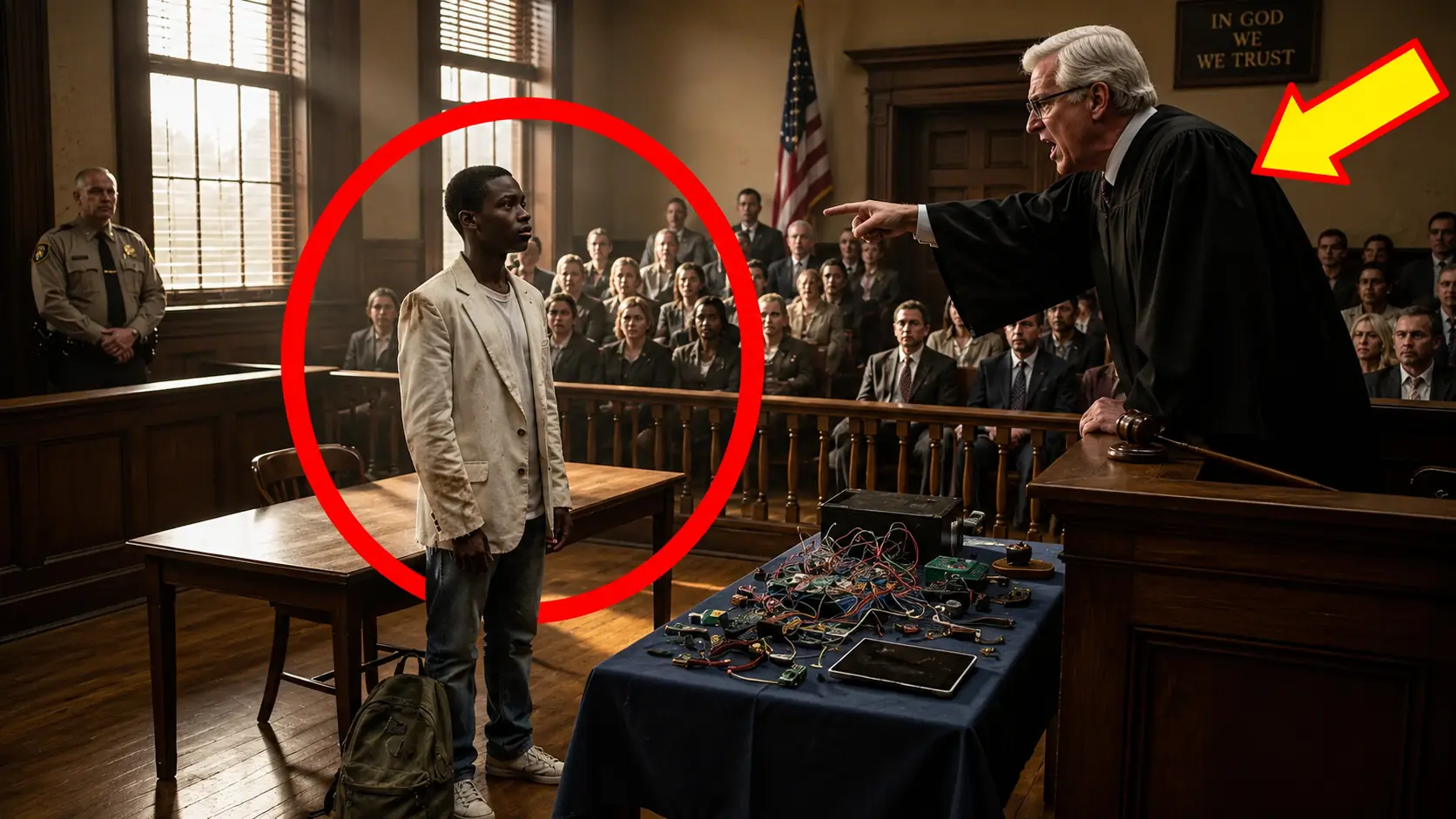
“My dad can’t afford a lawyer, so I’m here to speak for him.” A 10-year-old Black boy stood in the courtroom in an oversized white shirt, a leather briefcase dragging near the floor. Judge Preston Caldwell, the most powerful man in Hadley County for 22 years, stopped and stared.
“What is this filthy little Black rat doing in my courtroom? Somebody call the pound.” Victoria Ashton, the plaintiff’s attorney, crouched down. “Your daddy is nothing, boy. You are nothing. Nothing gets swept out with the trash.” Attorneys smirked. Drag this thing out. Recorded on her phone. This building is for civilized people. A bailiff leaned against the wall, arms crossed. Not one adult said, “Stop.”
Ten years old, alone against every person in that building. But none of them had any idea. Because before that afternoon was over, one question from this Black child would end Judge Caldwell’s career. A grown man in a judge’s robe just called a 10-year-old boy a rat. And nobody flinched.
Hadley, South Carolina. Population 9,000. One main street, a dollar store, two churches, a courthouse older than most of the people who walked through its doors. If you drove through Hadley on a Sunday afternoon, you might call it charming. You might notice the oak trees lining the road, the old brick storefronts, the American flags hanging from every porch. What you wouldn’t notice, unless you looked carefully, was the line.
Not a line drawn on any map. A line no one talked about. The line between the side of town where the potholes got fixed and the side where they didn’t. The side where new condos were going up and the side where buildings were being torn down. The side where code inspectors never visited and the side where they showed up every other month. Hadley was being developed. That was the word they used. Development, progress, revitalization. What it really meant was this: one by one, the small Black-owned businesses on the south side of town were disappearing.
A barber shop, a laundromat, a grocery store that had been there for 40 years. Each one sold, sometimes willingly, sometimes not, to a company called Whitmore Development Group. And every time a dispute arose, every time a Black family tried to fight back, the case landed on the same desk — the desk of Judge Preston Caldwell. Caldwell had been on the bench for 22 years. White, 63 years old, third-generation Hadley. His grandfather had been a judge. His father had been a judge. In this county, the Caldwell name didn’t just carry weight. It was the weight.
No attorney in Hadley would dare challenge him. No ruling of his had ever been overturned. And if you were Black and standing in his courtroom, the verdict was written before you opened your mouth. Everyone in Hadley knew this. Nobody said it out loud. Because the last person who did — a young Black attorney named James who filed a complaint about courtroom bias — found himself audited three times in one year, his office rent doubled, and his biggest client suddenly gone. The message was clear: In Hadley County, justice had a color, and it was white.
On the other side of that invisible line sat a small auto repair shop with a faded sign that read “Lewis and Sons Garage.” The paint was peeling. The parking lot had cracks running through it like veins, but the tools inside were organized with military precision. The floors were swept every night, and a framed photo of a woman with a warm smile hung on the wall near the cash register. That woman was Andre’s mother. She had been gone for five years now.
Clarence Lewis, Andre’s father, was a quiet man who fixed engines the way a surgeon fixes hearts. Carefully, patiently, with hands that knew exactly what they were doing. He had bought this land with his wife 22 years ago, back when they were young and full of plans. The garage was everything he had left of her. It was Andre’s inheritance. It was the last piece of a life that illness had stolen piece by piece. He was behind on taxes, not because he was careless, but because medical bills from his wife’s cancer treatment had swallowed everything — every savings account, every emergency fund, every dollar set aside for Andre’s future. On the wall behind the register next to the photo hung a framed document, a property deed. Clarence would point to it sometimes and say, “This paper means they can’t take what’s ours.”
Now, meet Andre. His bedroom looked nothing like a 10-year-old’s room. No posters, no toys scattered on the floor. Instead, a twin bed pushed against the wall, a desk stacked with books on property law, civil procedure, contract disputes, and sticky notes covering the wall above it like a detective’s evidence board. Lines of string connected one note to another. Names, dates, case numbers. Since his mother died when he was five, Andre had stopped being a normal child. Not by choice, by gravity. The weight of what he saw — his father working 16-hour days, the bills piling up, the notices arriving in the mail — pulled him somewhere most children never go.
His grandmother, Ruth, had given him her old paralegal textbooks when he was seven, thinking he’d flip through the pictures. Instead, he read them cover to cover. By eight, he taught himself legal terminology and case citation. By nine, he was reading civil procedure for fun. His school called him gifted but odd. His teachers said he was quiet. The truth was simpler than that: Andre wasn’t quiet. He was listening. Always listening and always writing. He carried a notebook everywhere. A worn spiral-bound notebook with a blue cover. Every conversation he overheard at the garage. Every notice his father received. Every name on every document that passed through the shop. Andre wrote it down. Names, numbers, dates, details no one asked him to remember. That notebook would become the most dangerous weapon in Hadley County.
The papers arrived on a Tuesday. Andre was sitting on a stool behind the counter at the garage doing math homework when the door opened and a man in a gray suit walked in. He didn’t need his car fixed. He handed Clarence a thick envelope, said, “You’ve been served,” and walked out without another word. Clarence opened the envelope. His hands were still black with engine grease. He read the first page, then the second. His lips moved, but no sound came out. Then his hands began to shake.
Whitmore Development Group was suing to claim the Lewis property. The lawsuit alleged that Clarence’s deed contained a boundary line error — that a strip of his land, including the western wall of the garage itself, actually belonged to a parcel Whitmore had recently purchased from the Henderson family next door. The company demanded that Clarence vacate within 60 days. If he refused, they would seek forced removal. Sixty days. Twenty-two years on this land, and they were giving him 60 days to disappear. Clarence stared at the papers for a long time. Then he said almost to himself, “I don’t understand half these words.” Andre put down his homework. He slid off the stool. He walked over to his father and gently took the papers from his hands. He read them slowly. Every word, every clause, every citation. His jaw tightened. His eyes moved faster. When he finished, he looked up at his father and said, “I do.”
That night, Andre didn’t sleep. He sat on the floor of his bedroom with the lawsuit papers spread out in front of him. He read the complaint four times. He highlighted every legal term he didn’t understand, then looked each one up in Ruth’s paralegal textbooks. By midnight, he understood the case better than Clarence ever would. And what he understood terrified him. This wasn’t just a lawsuit. It was a machine designed to crush people who couldn’t fight back.
Over the next two weeks, Clarence visited every attorney he could find. The first one, a man with a fancy office and a golf trophy on his desk, told him it was a losing case. “You’re going up against Whitmore in Caldwell’s courtroom,” he said. “That’s not a trial. That’s a sentencing.” The second charged a $10,000 retainer just to review the file. Clarence didn’t have $10,000. He barely had ten dollars. The third — the only Black attorney in the next town over, a man named James who wore kind eyes and a tired suit — leaned forward and spoke quietly. “Mr. Lewis, I took a case against Whitmore once. Caldwell threw it out in 40 minutes. After that, my office got audited three times in one year. My landlord raised my rent. A client I’d had for six years suddenly switched attorneys.” He paused. “I’m sorry. I want to help. But going against Caldwell in this county, it’s not just a case. It’s a sentence.”
Andre was in the back seat for every single visit. He said nothing, but his notebook was open on his lap, and his pen never stopped moving. He wrote down every name, every excuse, every reason these grown men gave for looking away. He was building something in that notebook. Not just notes, but a map. A map of how power worked in Hadley County — how one man’s name, Caldwell, could make three attorneys turn away a father begging for help.
The following Sunday, the family gathered at Grandma Ruth’s house for dinner. The table was crowded with collard greens, cornbread, sweet tea, and mason jars, but the mood was heavy. Everyone had heard about the lawsuit. Neighbors whispered. Some were sympathetic. Two of them — the Hendersons included — had already sold their homes to Whitmore under pressure. A third family was packing to leave. The pattern was obvious to everyone. The courage to name it out loud was not. Ruth Adams, 72 years old, retired school teacher, Andre’s grandmother, sat at the head of the table and listened to the adults talk about what couldn’t be done. She let them finish. Then she said, “They smile at you while they steal from you. That’s how it’s always been. Different names, same hands.” The room went quiet. Ruth had lived through things the younger generation only read about. When she spoke about injustice, it wasn’t theory — it was memory.
Then she said something else, something she didn’t think twice about. Something that would change everything. “You know,” she said, spooning greens onto Andre’s plate, “when Whitmore bought the Henderson place, the survey markers moved overnight. I saw it with my own eyes. One day, the marker was by my fence post. Next morning, it was three feet east. Three feet like magic. Bad magic.” Andre’s pen stopped. He looked up. “What do you mean they moved?” Ruth waved her hand. “I mean what I mean, baby. One day here, next day there. Nobody explains nothing to old women.” Andre didn’t say another word for the rest of dinner. But under the table in his notebook, he circled one word three times. Moved.
That night in his bedroom, the light stayed on past midnight, past 1, past 2. Ruth’s paralegal textbooks were spread across the floor. The lawsuit papers were pinned to his wall. The framed deed — he’d taken it off the garage wall and brought it home — sat propped against his desk lamp. Andre was copying numbers onto graph paper with colored pencils, drawing lines, comparing boundaries. His finger traced two different lines, one from the original deed, one from the lawsuit. They didn’t match. His eyes narrowed. At 2:15, Clarence knocked on the door. “Son, sleep.” “I will, Dad.” He didn’t. He stayed up until dawn, hunched over graph paper, checking and re-checking. And somewhere around 4 in the morning, in the silence of a house where a good man slept and worried and prayed, a 10-year-old boy found the thread that would unravel everything.
>>>NEXT CHAPTER 2 A Black Child Walked Into Court as His Dad's Lawyer — Then One Question Changed Everything<<<