Chapter 2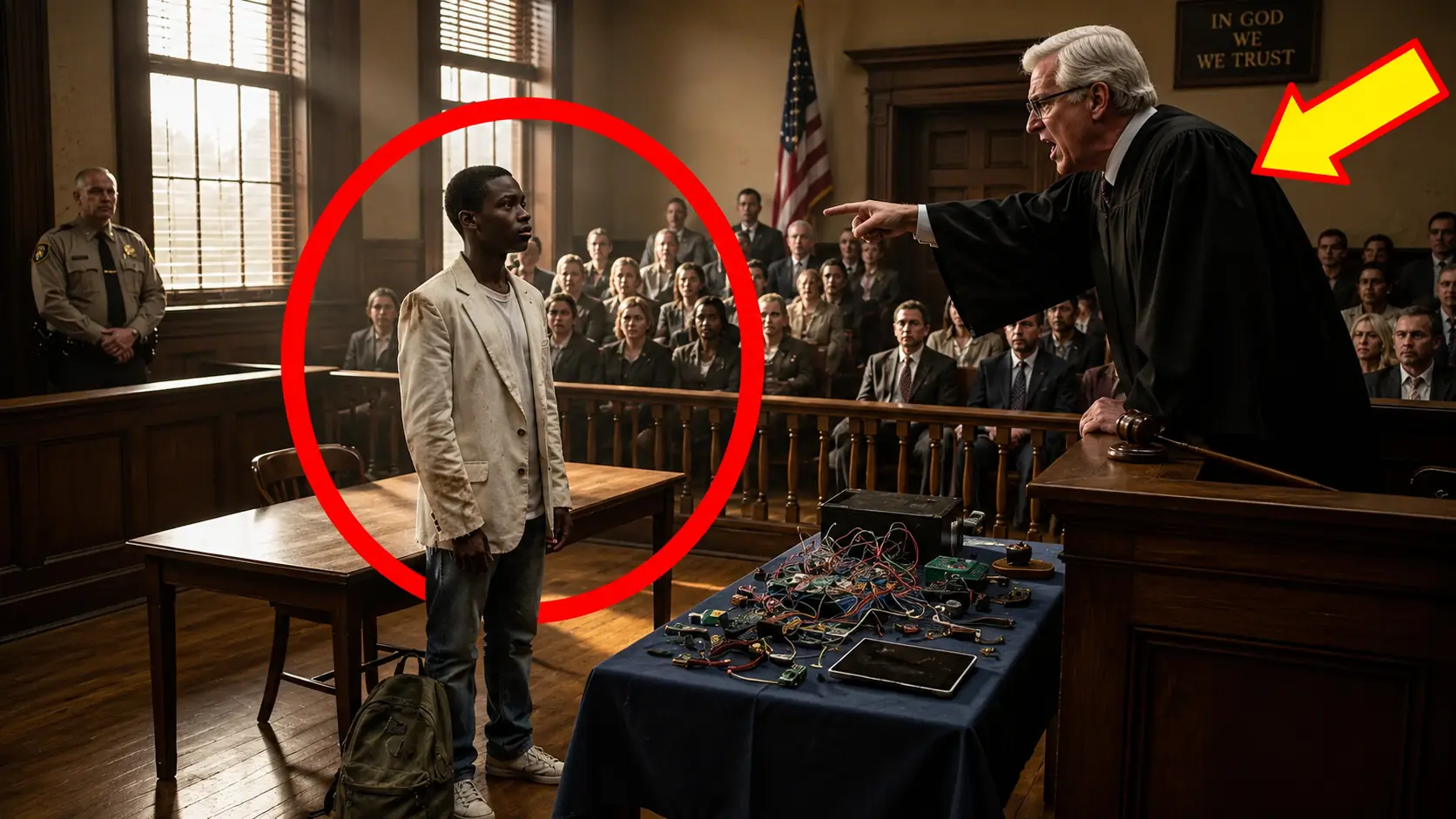
The next morning, Clarence sat at the kitchen table, staring at his coffee like it owed him something. He hadn’t slept either. Andre walked in carrying a folder. Not his school folder — a manila folder thick with papers. He placed it on the table in front of his father and opened it. Inside was a handwritten document, neat block letters, a child’s careful printing. The title at the top read: “Motion for Andre Lewis to appear as pro se representative on behalf of Clarence Lewis.” Clarence stared at it. “What is this?” “I looked it up, Dad. In South Carolina, if a person can’t afford representation, the court can permit a family member to assist in presenting their case. It’s unusual. Nobody’s done it with someone my age. But the law doesn’t say I can’t.” Clarence sat down. “Son, you’re ten.” “And they’re wrong, Dad. That’s all that matters.”
For a long moment, neither spoke. The refrigerator hummed. A bird sang outside the window. Clarence looked at the motion his 10-year-old son had written by hand with citations he didn’t understand, but that were formatted perfectly, and his eyes filled with something he hadn’t felt in weeks — hope. He didn’t say yes. Not yet. Instead, he drove Andre to Ruth’s house. He figured his mother would talk sense into the boy. Tell him this was foolish. Tell him to be a child and leave the fighting to adults, even if the adults had given up. Ruth listened. She sat on her porch in a rocking chair, hands folded in her lap, and she listened to every word Andre said. When he finished, she didn’t speak for a long time. Then she stood up, went inside, and came back carrying something Andre had never seen before — a leather briefcase, old, cracked at the edges, but solid. “This belonged to your grandfather,” Ruth said, holding it out with both hands. “Elliot Adams. He wanted to be a lawyer more than anything in this world. Applied to law school in 1961. They sent back a letter that said, ‘We regret to inform you that your application does not meet our current admissions criteria.’ That was the polite version. The real reason was the color of his skin.”
She opened the briefcase. Inside, tucked into the lining, was a handwritten note on yellowed paper. “The law belongs to those who study it.” “He carried this briefcase every single day of his life,” Ruth said, “to work, to church, to the grocery store. He never got to use it the way he wanted.” She looked at Andre. Her eyes were steady and bright. “You will.” Andre held the briefcase with both hands. It was heavy — not because of what was inside, because of what it carried. From that day, Andre had one week before the hearing, and he used every hour.
At the Hadley Public Library, he sat cross-legged on the floor between the shelves, surrounded by books on property law and land disputes. The librarian, a white woman named Mrs. Coleman, who had never once asked why a 10-year-old was reading court opinions, brought him printouts of case precedents. She didn’t ask why he needed them. She just helped. Once she leaned down and whispered, “If you need anything else, you come find me.” Andre looked up at her and said, “Thank you, ma’am.” It was the first time in two weeks anyone outside his family had offered to help. He walked the boundary of his father’s property with a measuring tape and his notebook, marking every survey stake he could find in the ground. Some had been there for decades, rusted, leaning, half buried. Some looked newer, cleaner, straighter. He wrote down every measurement, every position, every difference.
He went to the Hadley County Records Office. A 10-year-old boy standing at the counter asking for the original deed and survey records for both the Lewis property and the Henderson property, the one Whitmore had bought. The clerk behind the counter, Tanya Moore, hesitated. She was a Black woman in her 30s who had worked in this office for eight years. She knew what those files contained. She knew who they involved. She looked at the boy. She looked at the briefcase in his hands. She looked at the request form he’d filled out in perfect block letters, every field complete. Then she quietly pulled the file. She didn’t say a word, but the look she gave Andre said everything: Finally, someone is looking.
At Ruth’s kitchen table, index cards were laid out like a chessboard. Each card written in careful block letters — a fact, a question, a possible objection, a response. Andre rehearsed cross-examination questions out loud while Ruth played the opposing attorney. She was sharp. She didn’t go easy, not even on her 10-year-old grandson. “Objection, your honor. The respondent’s representative is a child.” “The law doesn’t have an age requirement for truth, ma’am.” Ruth smiled again, louder this time. They practiced every night for five days straight. Ruth threw every objection she could think of. She interrupted him. She talked over him. She mocked him. She wanted him ready — not for a fair courtroom, but for Caldwell’s courtroom. And by the end of the week, Andre could recite his argument, answer cross-examination, and present his evidence without looking at a single note.
On the last night, Ruth ironed Andre’s one good shirt. Andre polished the cracked shoes himself, tongue between his teeth, concentrating. He packed the leather briefcase. It was almost too big for him to carry. He carried it anyway. And inside that briefcase, among the folders and index cards and printed precedents, Andre had placed something he’d found in the county records that changed everything. Something no one — not Whitmore, not Ashton, and certainly not Judge Caldwell — expected anyone to find. But that comes later, the morning of the hearing.
Missed outside. The garage sign was visible through the kitchen window, still faded, still standing. Clarence wore his best suit, the one from his wife’s funeral. Andre wore his ironed shirt, the sleeves still a touch too long. Neither spoke much. At the front door, Clarence knelt down and put both hands on his son’s shoulders. “Whatever happens in there, I’m proud of you.” Andre looked at his father. “Nothing’s going to happen, Dad — except the truth.” The old car started on the second try. They drove through town in silence, past the dollar store, past the church where Andre’s mother was buried, past a Whitmore development billboard advertising luxury town homes. The future of Hadley. Andre stared at it. His grip on the briefcase tightened. They arrived at the courthouse. Andre stepped out of the car, briefcase in both hands, shirt ironed, shoes cracked but shining. This was the moment from the beginning — the lobby, the insult, the laughter. But now you know what Caldwell didn’t. Now you know what Ashton didn’t. Now you know what every smirking face in that building didn’t. The kid with the briefcase wasn’t lost. He was loaded.
The night before the hearing, hours before Andre polished his shoes and packed the briefcase, he made the discovery that would bring down the most powerful man in Hadley County. It started with the county records. Andre had been cross-referencing two documents. The original Lewis property deed filed 22 years ago when his parents bought the land, and the boundary survey that Whitmore Development submitted with the lawsuit. The survey claimed the Lewis property line was 14 feet east of where Clarence had always understood it to be — 14 feet. Just enough to place the western wall of the garage on Whitmore’s land. But when Andre overlaid the original county survey grid — the one recorded when the land was first platted — the numbers didn’t match. The starting reference point was different. Whitmore’s survey used GPS coordinates that were offset from the original reference monument, not by accident, by exactly 14 feet. The exact distance needed to steal a strip of the Lewis property.
Andre remembered what Ruth had said at dinner: The markers moved overnight, three feet east. So he checked the Henderson property survey next — the one Whitmore had used to acquire the land next door the previous year. Same surveyor, Walter Gibson. Same offset. Same direction. Same 14 feet. Two properties. Same surveyor. Same shift. Same company. Same result. This was not a mistake. This was a method. Andre wrote in his notebook: “Gibson moved the line. He moved it for Henderson. Now he’s moving it for us.” But that wasn’t the golden clue. The golden clue came 20 minutes later.
Andre was flipping through the county financial disclosure records — documents that every elected official in Hadley County was required to file annually. He’d requested these from Tanya Moore along with the property records. Most 10-year-olds wouldn’t know financial disclosures existed. Andre wasn’t most 10-year-olds. He had read about judicial conflicts of interest in one of Ruth’s textbooks, chapter 12, page 216. He’d underlined the key sentence. “A judge must recuse himself from any proceeding in which his impartiality might reasonably be questioned, including cases involving a party with whom the judge has a financial relationship.” He almost missed it. A single line buried on page nine of Judge Preston Caldwell’s most recent disclosure: “Investment interest: Whitmore Development Group LLC. Shares acquired. Value: $185,000.” Andre read it again and again and one more time.
Judge Preston Caldwell, the man assigned to preside over Whitmore’s case against the Lewis family, was an investor in Whitmore Development Group. He owned a financial stake in the very company that was suing Andre’s father. Every piece of land Whitmore acquired made Caldwell richer. Every ruling in Whitmore’s favor put money directly in Caldwell’s pocket. The judge was not neutral. The judge was the enemy — and he always had been. And it was all written down. Filed with the county. Public record. Sitting there for years, waiting for someone to look. Nobody looked. Not the attorneys. Not the other judges. Not the journalists. Not the politicians. A 10-year-old boy looked. Andre sat at his desk for a long time. His hands were shaking. Not from fear, from understanding. He finally understood why every Black family lost in Caldwell’s courtroom. Why no attorney would take their cases. Why the system worked so perfectly against them. It wasn’t just bias. It was profit. Then he picked up an index card, a single 3x5 card, and wrote one question on it. He underlined it twice. He placed it in the front pocket of the briefcase. That night, a 10-year-old child held the most powerful man in Hadley County in the palm of his hand — and Caldwell had no idea.
>>>NEXT CHAPTER 3 A Black Child Walked Into Court as His Dad's Lawyer — Then One Question Changed Everything<<<