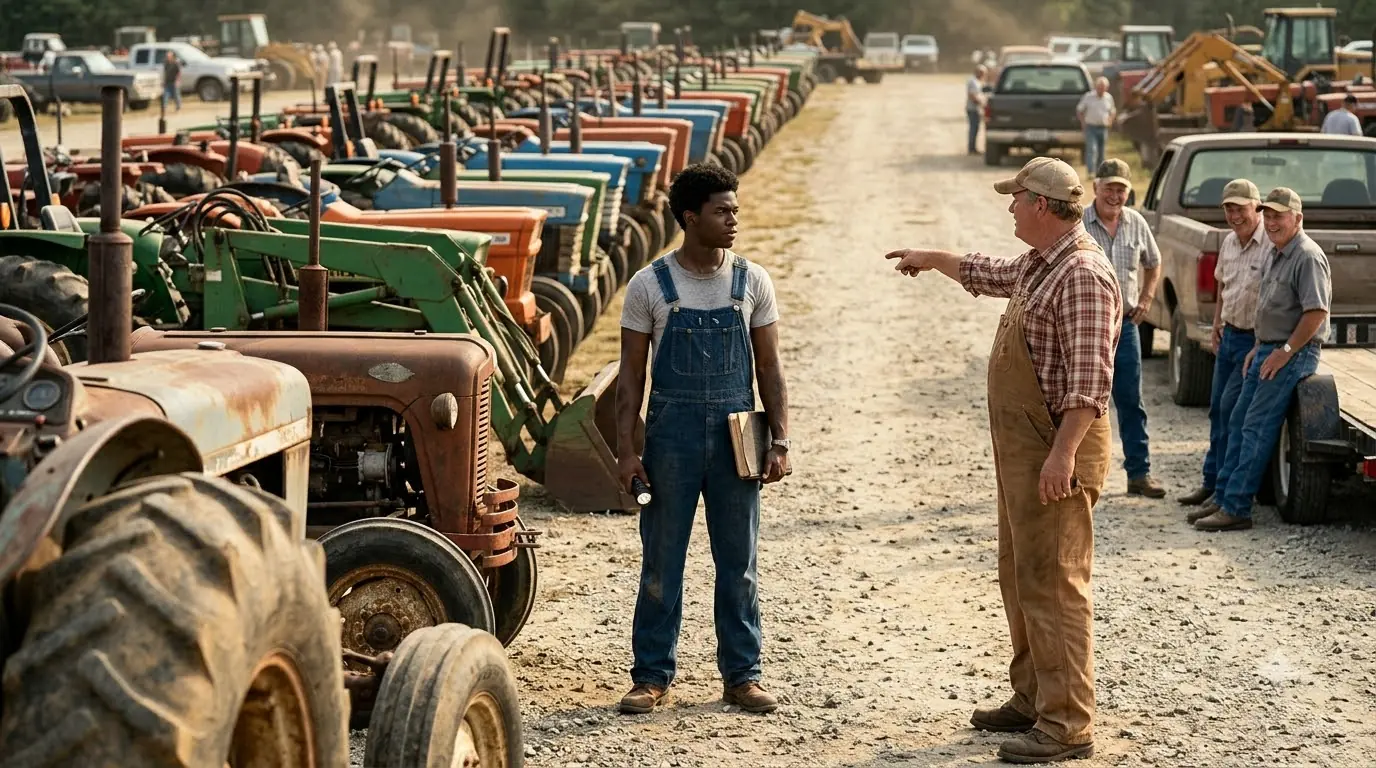
Fifty tractors sat in two crooked rows at the back of the Draymond Agricultural Auction yard, and not one of them was running.
Dale Pruitt walked the line with his hands buried in the front pockets of his faded coveralls, stopping at each hood just long enough to lift it, glance inside, and let the steel fall shut again.
He had been buying and selling farm equipment for more than thirty years, and his reputation around Harlow, Georgia, rested on two things: he could spot value faster than most people could read a serial plate, and he rarely paid for sentiment. Four seconds was enough for him to decide whether a machine was worth his time.
By the twelfth tractor, he had stopped pretending to inspect them carefully. By the twentieth, he had started talking loud enough for the buyers around him to hear. “Boys, you could melt this whole lot down and get more for the steel than anybody’s going to pay you for parts.”
A few men laughed. Nobody argued.
The tractors looked like evidence from a long mechanical war. Paint had faded into different shades of green, gray, blue, and primer. Hoods were dented, tires split at the sidewalls, loaders sat crooked, hydraulic hoses had cracked open like old leather, and more than one machine had an engine bay with the unmistakable look of something that had been scavenged before the auction ever started. The liquidation tag on each hood said COLD BROOK RENTALS, AS IS, NO WARRANTY.
Most buyers drifted away toward the equipment that could be started for demonstration. Loader tractors rumbled near the main barn. A baler went through a short test cycle. Somebody revved a diesel mower, and two buyers immediately started arguing over whether the smoke meant injector trouble or nothing more than a cold engine.
Nineteen-year-old Isaiah Callaway stayed at the back row.
He was younger than nearly everyone else bidding that morning, and one of the few Black faces in a yard full of farmers, equipment dealers, contractors, and resellers mostly twice his age. He wore work boots that had belonged to his grandfather before the soles were replaced, jeans darkened at the knees with grease, and a plain canvas jacket that had been washed enough times to lose its original color. Under one arm he carried a thick service ledger wrapped with an old rubber band.
Instead of lifting hoods, Isaiah crouched beside each tractor and aimed a flashlight at the small metal data plates riveted near the frame. He copied serial ranges, engine family codes, production years, transmission designations, and whatever part numbers he could see without removing panels. His handwriting filled one page, then a second.
Dale noticed him around tractor twenty-seven.
“You planning to write them back to life?” Dale called.
A few men laughed again.
Isaiah looked over his shoulder. “Just counting what’s here.”
“You got eyes, don’t you?” Dale asked. “Count fifty and save yourself the pencil lead.”
Isaiah smiled because arguing would cost him attention he needed for something else. “Yes, sir.”
Then he went back to the data plate.
What Dale saw was scrap. What Isaiah saw was repetition.
Thirty-three of the fifty tractors belonged to the same manufacturing family, built across seven model years before the company switched to an entirely different platform. Different decals covered the hoods, and horsepower ratings varied enough that a casual buyer might assume they were separate machines, but underneath the sheet metal the similarities were obvious if you knew where to look. The same basic three-cylinder diesel block appeared again and again. The hydrostatic transmission cases shared mounting patterns. Steering and hydraulic components repeated across the serial ranges.
Isaiah knew that engine family because his grandfather, Otis Callaway, had known it the way some men knew scripture.
For almost two decades Otis had repaired those tractors behind the Callaway house in a tin-roofed shed whose walls were patched with sheet metal from three different buildings. Dealers in the county had refused to put a Black mechanic on their service floors when Otis was young, so he had built a reputation outside their doors instead. Farmers who could not afford dealership rates brought him machines on flatbeds and waited in the yard while he listened, tested, opened, measured, and repaired.
He never claimed to know everything. He simply remembered what each failure taught him.
That memory eventually became the service ledger under Isaiah’s arm.
The first pages were written in blue fountain ink. Later pages used ballpoint, pencil, marker, whatever Otis had nearby. The notes were not organized like a factory manual.
They were organized like experience: “Check rear suction screen before condemning pump.” “Early seal compound hates wrong fluid.” “No oil pressure after rebuild? Look at pickup O-ring before pulling crank.” “Three-cylinder family 82-88, head bolt sequence matters more than people think.”
Isaiah had grown up reading those notes over his grandfather’s shoulder.
When he was six, he handed Otis sockets by number. At nine, he learned how to clean gasket surfaces without gouging aluminum. At twelve, he could tell a weak battery from a dragging starter by sound. At fifteen, Otis stopped answering every question immediately and started replying with one of his own.
“What do you know so far?”
That was the question Isaiah heard in his head as he stood between two dead tractors at Draymond.
He knew none of them ran.
He also knew they had not all failed in the same place.
One tractor showed signs of a seized engine but still had clean hydraulic fluid and intact loader cylinders. Another had a complete engine with oil at the correct level but a transmission selector that moved without engaging anything. A third had a cracked cylinder wall and a surprisingly clean hydrostatic case. A fourth had an electrical harness nearly destroyed by corrosion while the mechanical components underneath looked untouched.
Individually, they were damaged machines.
Together, they were matched inventory.
Isaiah finished the last data plate and stood while the auctioneer’s assistant began calling buyers toward the rear row. The liquidated company, Coldbrook Rentals, had operated equipment across three counties before collapsing under debt that summer. The back row had been the least attractive part of the estate, machines rented hard, returned late, repaired cheaply, and kept in service long after a more disciplined fleet manager would have retired them.
The auctioneer climbed onto a platform near the first tractor and tried to sound enthusiastic.
“Fifty compact utility tractors, one money, one lot. Buyer handles removal. Who wants to start me at ten thousand?”
Silence.
“Five thousand?”
Somebody near Dale snorted.
The auctioneer smiled. “Gentlemen, there are fifty of them. I know at least one of you has room for decorative lawn art.”
The joke got the laugh he wanted.
“Three thousand?”
Still nothing.
Isaiah could feel the envelope inside his jacket. Two thousand dollars. Every dollar he had saved during two years of weekend work at the diesel shop, mower repairs behind his grandfather’s shed, and small jobs that paid cash because the people hiring him knew he would actually show up.
He raised his hand.