Pride smells like cheap vinyl and floor wax. Bradley was twenty-two, wearing his newly minted black belt like a loaded pistol. To him, the old man dragging a yellow bucket across the mats was nothing but scenery—a punching bag with a pulse. He dared the janitor to spar for a cheap laugh. The joke choked in his throat the exact second the gym’s terrifying owner walked in, dropped his gear, and folded into a deep trembling bow to the man holding the mop.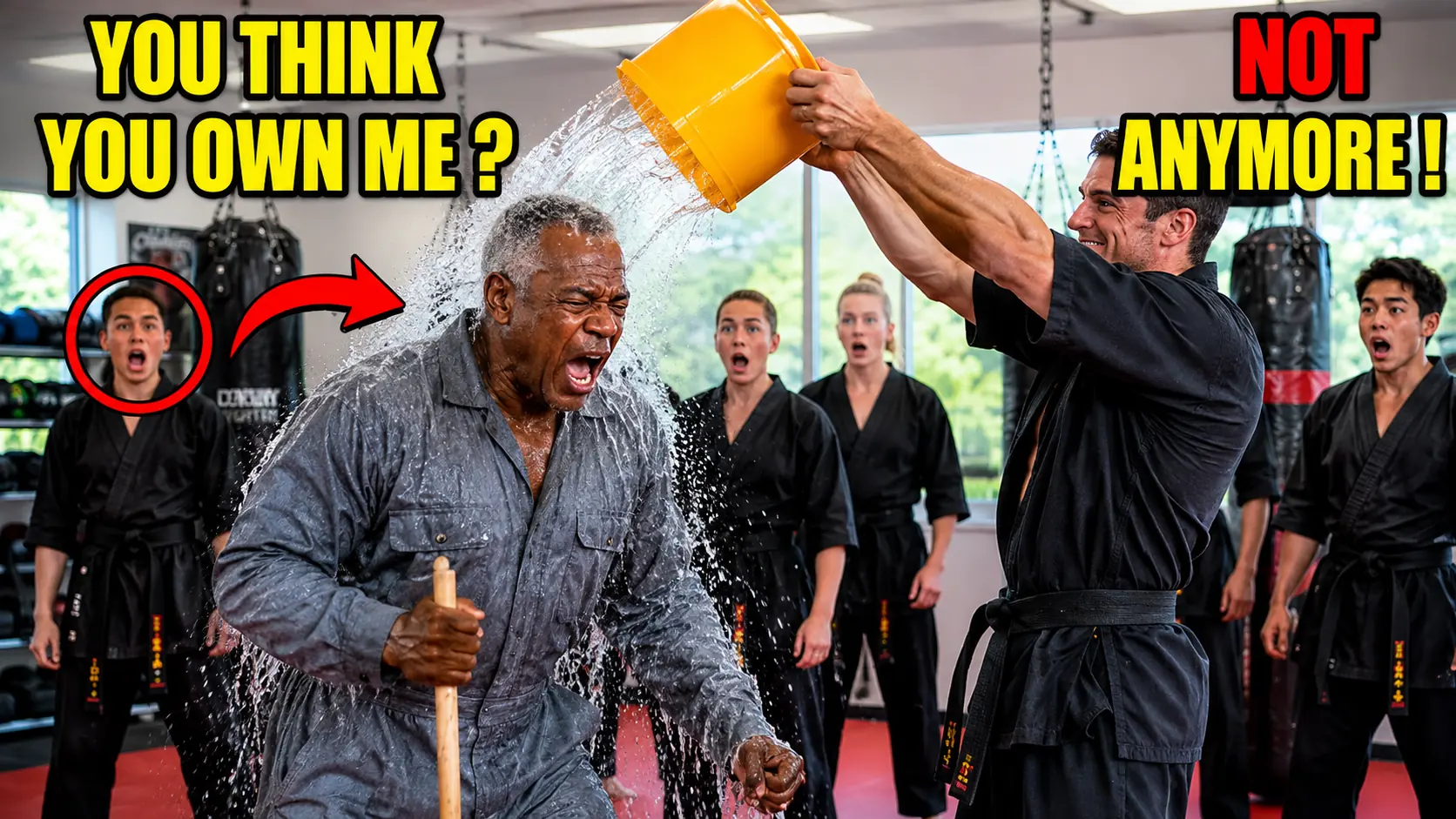
Bowman’s Martial Arts Academy occupied a dying strip mall sandwiched between a failing laundromat and a discount auto-parts store. The neon sign buzzed with a rhythmic irritating hum, casting a sickly red glow over the cracked asphalt parking lot. Inside, the air was thick. It tasted of vinyl, damp cotton, and the sharp metallic tang of adrenaline. This was not a dojo of quiet meditation and cherry blossoms. It was a factory for local competitors, a place where egos were inflated and bruised in equal measure. Bradley Hayes thrived in this swamp. He was twenty-two years old, built like a brick wrapped in steel wire, and possessed a natural explosive athleticism that made him dangerous. He had earned his black belt three months ago. Since that day, he wore it not as a symbol of mastery, but as a crown. He walked with a swagger that ate up the space in the room. When he sparred, he didn’t just want to win—he wanted to humiliate. He threw spinning hook kicks with a vicious snap, targeting the heads of nervous blue belts, stopping only an inch from their noses just to watch them flinch. He fed on their wide-eyed fear. It was a cheap kind of power, but to Bradley, power was power.
Bradley despised him. Not consciously at first—it was a subconscious irritation. Bradley lived for the spotlight, for the loud smacks of shins against Thai pads, for the applause of the junior students. Leon’s utter indifference to Bradley’s displays of dominance felt like a silent insult. Leon never clapped. He never winced when Bradley landed a brutal body shot on a sparring partner. He just watched, his dark eyes entirely unreadable, leaning against the handle of his mop. “Look at him,” Bradley muttered to a sycophantic purple belt named Jared one Tuesday night, untaping his wrists. “Guy watches us every single night. Probably goes home and shadowboxes in the mirror thinking he’s Bruce Lee.” Jared snickered, adjusting his groin guard. “He looks like he’d shatter a hip if he threw a jab.” “It’s pathetic,” Bradley said, loud enough for his voice to carry over the ambient noise of the gym. He wanted Leon to hear. He wanted a reaction. “Living your whole life in the background, cleaning up other people’s sweat.” Leon was less than fifteen feet away, wiping down the full-length mirrors with a blue microfiber cloth. His hand moved in slow methodical circles. Wipe, step, wipe, step. If he heard Bradley, he didn’t show it. His breathing remained deep and even. He didn’t tighten his grip on the cloth. He just kept working.
That lack of reaction knotted Bradley. It was a small petty thing. But for a young man whose entire identity was built on forcing people to acknowledge his superiority, Leon’s apathy was intolerable. Over the next few weeks, Bradley’s microaggressions escalated. He started leaving his empty water bottles directly in the middle of the freshly mopped mats. He would “accidentally” kick a heavy bag right as Leon was walking behind it, forcing the older man to stop and wait for the swinging vinyl to settle. Leon never complained. He picked up the bottles. He waited for the bag. He went about his work with a blue-collar stoicism that Bradley found utterly infuriating. Bradley mistook the old man’s silence for cowardice. He mistook his slow movements for weakness. He didn’t know how to look closely. If Bradley had known anything about true martial arts beyond scoring points and causing concussions, he might have noticed the way Leon walked. A cynic sees an old man dragging his feet. An expert sees a man whose center of gravity never shifts, a man who steps heel-to-toe with perfect unconscious balance. Bradley didn’t notice how Leon’s hands, though calloused and thick-knuckled, gripped the mop handle with a relaxed supple tension. Bradley only saw a target, and targets in Bradley’s world existed to be hit.
Friday nights at the academy were reserved for open mat—no formal instruction, just two hours of unstructured sparring, drilling, and grappling. It was a chaotic, high-energy environment. On this particular Friday, the atmosphere was looser than usual. Bowman had left an hour early to attend a regional promoters’ meeting, leaving Bradley to lock up. Giving a twenty-two-year-old narcissist the keys to the castle was a predictable disaster. By 9:30, the casual students had filtered out. Only Bradley and a half-dozen of his hardcore training partners remained. The air conditioning had struggled all night, and the gym felt like a sauna. Hip-hop blared from the Bluetooth speaker in the corner, shaking the cheap ceiling tiles. Bradley was high on his own supply. He had just spent twenty minutes dissecting Jared in a grappling exchange, submitting him repeatedly and loudly analyzing his mistakes for the rest of the room. “You’re telegraphing the armbar, man,” Bradley barked, standing over a panting Jared. He wiped sweat from his forehead with the back of his hand. “You got to set it up. You’re moving like you’re underwater.”
From the back hallway, the familiar squeak of rubber wheels announced Leon’s arrival. The janitor pushed his yellow mop bucket onto the edge of the mats. He was wearing his usual gray coveralls. He stopped, looking at the half-dozen young men loitering on the training floor. “Excuse me,” Leon said. His voice barely carried over the heavy bass of the music. “Mats need to be cleaned. Gym closes at ten.” Bradley turned, dropping his hands to his hips. He smiled. It was a thin, predatory smile. He looked at the wall clock. It was 9:40. “We got twenty minutes, Leon,” Bradley said, not moving from the center of the mat. “We’re not done.” “I need twenty minutes to mop and sanitize,” Leon replied calmly. He dipped the string mop into the murky, chemical-smelling water and wrung it out with the lever. “If I don’t start now, the chemicals won’t dry before lockup.” “Then I guess you’ll just have to wait and stay late,” Bradley said, taking a step toward the edge of the mat. The other young men sensed the shift in the room. The music pounded, but the social dynamic had suddenly narrowed down to a single tense line connecting the young black belt and the old janitor. Some of the guys smirked. Others shifted uncomfortably, recognizing that Bradley was pushing a boundary that didn’t need to be pushed.
“I get off at ten,” Leon said. He didn’t sound angry. He sounded tired. He lifted the mop and placed it on the extreme outer edge of the red vinyl boundary. “I’ll start over here. You boys stay in the middle.” “Nah,” Bradley said. He walked directly over to where Leon was working. He intentionally stepped off the mat, placing his bare, sweaty foot squarely on the freshly mopped floor, leaving a damp footprint. “See, we need the whole floor. We’re doing cage-walk drills.” Leon paused. He looked down at the footprint, then up at Bradley’s face. “Please move.” “Make me.” The words slipped out of Bradley’s mouth before he even thought about them. It was a playground taunt—juvenile and pathetic—but the moment it was spoken, Bradley felt committed. He couldn’t back down in front of his crew. Jared let out a nervous laugh from the center of the room. “Come on, Brad. Leave him alone. Let’s just drill.” “No, no, hold on,” Bradley said, holding up a hand while keeping his eyes locked on Leon. “Leon’s been watching us for two years. Two years of free lessons. I bet he’s picked up a few things, right, old man? You probably know the secrets—the deadly ancient techniques.” Leon sighed. It was a heavy sound, a deflation of the chest that spoke of decades of dealing with arrogant young men. “I’m a janitor. I clean the floors. Move your foot, please.” “I’ll move it if you can make me move it,” Bradley challenged. He bounced lightly on the balls of his feet, slipping into a loose fighting stance. He kept his hands low, mockingly exposed. “Come on. Just a joke. Throw a jab. Show me what you got.” “I don’t fight,” Leon said. He reached for the mop handle.
Before Leon’s fingers could close around the wood, Bradley snapped his lead foot forward in a lightning-fast front kick. He didn’t aim for Leon’s body—he aimed for the mop bucket. The strike connected with the heavy plastic. The bucket lurched violently, spilling two gallons of soapy gray water across the floor and over the toes of Leon’s work boots. The heavy metal wringer crashed onto the linoleum with a loud ringing clatter that temporarily drowned out the hip-hop. The gym went dead silent. Even the music seemed to recede into the background. Jared and the others froze. This wasn’t a joke anymore. This was destruction of property. This was bullying in its rawest, most undeniable form. Bradley stood there, his legs slowly returning to the mat. For a split second, a flash of regret hit him. He had a mess to clean up now. But his ego instantly built a defensive wall over the guilt. He puffed out his chest. “Oops,” Bradley said, his voice flat. “Guess my reflexes slipped. Should have blocked that, Leon.”
Leon looked down at his soaked boots. The soapy water pooled around him, reflecting the harsh fluorescent lights above. Slowly, he looked up. There was a profound shift in the air. The cynical detachment of the old man was gone. In its place was an absolute, terrifying stillness. Leon did not clench his fists. He did not square his shoulders or assume a fighting stance. He simply stood perfectly upright, letting his arms hang naturally by his sides. But the way he looked at Bradley changed. He was no longer looking at an annoying kid. He was looking through him. “You have made a mess,” Leon said softly. The gravel in his voice had smoothed out into cold steel. Bradley felt a strange, cold prickle run down the back of his neck. His primal instincts, honed by hundreds of fights, were screaming at him that something was terribly wrong. The man in front of him wasn’t radiating fear. He wasn’t radiating anger either. He was radiating zero output—a total vacuum. But Bradley was twenty-two, and pride is a loud, stupid voice. He shoved his apprehension down. He smirked, raising his hands into a traditional Muay Thai guard. “Yeah? You’re going to make me clean it up?” Bradley mocked, taking a deliberate step closer, encroaching on Leon’s physical space. “Come on. I’m giving you a free shot. Let’s see it.”
The other students were completely silent. One of them, a younger green belt, quietly pulled out his phone, holding it against his chest, the camera lens peeking out. Bradley threw a fake jab, snapping his glove an inch from Leon’s nose. Leon didn’t blink. He didn’t flinch. His eyelids didn’t even flutter. He just watched Bradley’s fist with the detached interest of a man watching a leaf fall from a tree. “Oh, he’s got ice in his veins,” Bradley laughed, looking back at his friends, seeking validation. The laughter was brittle. No one joined in. Bradley turned back, his face flushing with a mix of embarrassment and rising rage. “Fine. You want to play statues?” Bradley decided to end the joke with a flourish. He wanted to scare the old man so badly he’d quit on the spot. He wanted a reaction, and he was willing to use violence to extract it. Bradley shifted his weight, pivoting hard on his lead foot. He engaged his hips, whipping his rear leg around in a high sweeping roundhouse kick. It was a beautiful, devastating technique executed with the speed and power that had won him state championships. He aimed the instep of his foot directly for the side of Leon’s head, intending to pull the strike at the very last microsecond—a classic gym-bully tactic meant to generate a massive rush of wind and force the victim to cower. The kick sliced through the heavy humid air. The fabric of Bradley’s gi pants snapped like a bullwhip.
What happened next defied Bradley’s comprehension. It happened too fast for his brain to process the mechanics. Leon did not duck. He did not block. He simply shifted his weight. It was a movement so minute, so perfectly calibrated, that it barely registered to the naked eye. He pivoted backward on his heel, perhaps two inches. Bradley’s foot tore through the empty space where Leon’s head had been a fraction of a second before. The wind from the kick ruffled the collar of Leon’s coveralls. Bradley, having committed all his momentum to a target he expected to be stationary or retreating clumsily, over-rotated. His foot met zero resistance. His balance shattered. He scrambled, his arms windmilling awkwardly as he hopped on his planted foot, desperately trying to stop himself from falling face-first into the puddle of dirty mop water. He managed to stay upright, stumbling heavily onto the mat, his face burning bright red. He spun around, furious, humiliated, ready to charge. Leon was standing exactly where he had been, his posture entirely unchanged. His breathing was still deep and slow. “You got lucky, old man,” Bradley snarled, abandoning all pretense of a joke. He stepped forward, raising his fists, his intent now genuinely malicious. He was going to hit him. He was going to drop the janitor right there.
Ding. The small brass bell above the front glass door chimed, sharp and clear. The sound froze Bradley in his tracks. Everyone turned. Richard Bowman stepped through the doorway. He was still wearing his suit trousers and a button-down shirt from his meeting, carrying a heavy leather briefcase. He looked exhausted. He’d forgotten his ledger and had to turn back. Bowman paused on the threshold, taking in the scene. He saw the spilled mop bucket. He saw the gray water pooling on the linoleum. He saw a half-dozen of his students standing like statues, a green belt trying to hide a phone, and then he saw Bradley—his prized black belt, fists raised, face contorted in rage, standing aggressively close to Leon Carter. Bradley immediately dropped his hands. The arrogant sneer vanished, replaced by the panicked look of a teenager caught keying a car. “Sensei,” Bradley stammered, stepping back, suddenly intensely aware of how this looked. “It’s not what it looks like. We were just—I was just messing around. He got in the way of a drill.”
Bowman didn’t look at Bradley. He didn’t look at the mess on the floor. Bowman dropped his heavy leather briefcase. It hit the floor with a dull thud. The color completely drained from Bowman’s weathered face. The tough, hardened ex-military instructor—the man who regularly screamed at heavyweights and broke baseball bats with his shins—suddenly looked like a terrified child. His eyes were wide, fixed entirely on the old man in the gray coveralls. Bowman walked forward. His steps were quick, almost frantic. He didn’t stop until he was standing a few feet from the edge of the puddle. He didn’t look at Bradley, who was practically shrinking into the mat. Bowman brought his heels together with a sharp clack. He placed his hands flat against the sides of his thighs, and then he bowed. It wasn’t the casual nod he gave to his students. It wasn’t the polite bend he offered at tournaments. It was a deep, formal ninety-degree bow, holding his torso perfectly parallel to the floor. He held it there. Five seconds. Ten seconds. The silence in the gym was absolute. The hip-hop music had automatically paused when the speaker’s connection dropped. The only sound was the faint hum of the neon sign outside and the ragged breathing of Bradley Hayes. When Bowman finally straightened up, his voice was trembling. “Master Carter,” Bowman said. The title echoed in the quiet room. “I… I do not have the words to express my profound shame.”
Bradley felt the floor drop out from under him. His brain stuttered. “Master Carter?” Leon looked at Bowman. The intense, cold vacuum in his eyes softened, returning to the tired, gravelly patience of the janitor. He reached down and slowly righted the yellow mop bucket. “Your floor is wet, Richard,” Leon said softly. “I will clean it immediately, Master,” Bowman said, his voice stripped of all authority, reduced to pure deference. Bradley stepped forward, his mouth opening and closing like a fish on a dock. “Sensei—Bowman—what is this? He’s the janitor.” Bowman turned his head slowly. The look he gave Bradley contained no anger. It contained pity. It was the look a man gives a dog that has just run out onto a busy highway. “Bradley,” Bowman said, his voice dangerously low, “the man you are attempting to intimidate is Leon Carter. Thirty years ago, he was the head instructor of the Kyokushin branch in Okinawa. He is the man who taught me how to walk, how to breathe, and how to strike. He’s forgotten more about combat than you will learn in a dozen lifetimes.” Bowman turned back to Leon, keeping his eyes respectfully lowered. “He retired to find peace. He asked me for a quiet job—a place to simply be near the training without the burden of teaching.”
Bradley stared at the old man in faded coveralls. He thought about the perfectly balanced gait, the supple tension in the hands holding the mop, the way he hadn’t blinked when a fist stopped an inch from his face, the microscopic pivot that had effortlessly neutralized a knockout kick. Suddenly the smell of sweat and Pine-Sol was overwhelming. Bradley felt sick to his stomach. He wasn’t a wolf terrorizing a sheep. He was a loud, obnoxious child throwing rocks at a sleeping lion, and the lion hadn’t even bothered to roar. It had just let the child trip over his own feet. Leon picked up the wringer and placed it back into the bucket. He looked at Bradley one last time. There was no malice in his eyes, no triumph—just the quiet, heavy reality of a man who knew exactly who he was looking at: a boy who had no idea. “The floor,” Leon said, handing the mop handle toward Bradley, “is yours to clean.”
Adrenaline is a liar. It floods the system, expands the chest, and whispers that you are invincible, untouchable, the center of the universe. But when it finally drains away, it takes all the heat with it, leaving you hollowed out, shivering, and acutely aware of your own pathetic reality. Bradley reached forward, his fingers still wrapped in white athletic tape that suddenly looked childish and absurd, and closed around the wooden handle of the mop. The wood was cold, smooth from years of friction, with a deep groove worn near the top where a thumb naturally rested. Leon released his grip. He did not shove the handle toward Bradley, nor did he pull it away. He simply let go, transferring the weight of the tool and the weight of the room entirely onto the young man’s shoulders. The transaction was silent. Jared and the other students stood frozen on the far side of the mat, their eyes darting between Bowman, Leon, and Bradley. The social hierarchy of the gym—a structure they had navigated and relied upon for years—had just been vaporized in the span of ninety seconds. Bradley, the apex predator of their small, sweaty ecosystem, was standing with his head bowed, holding a dirty mop.
“Everyone out,” Bowman commanded. His voice was not the booming bark he used to count out push-ups. It was flat, quiet, and scraped raw with lingering shock. It was the voice of a man barely containing a terrifying anger. The students did not hesitate. There was no casual banter, no fist-bumping on the way to the locker rooms. They grabbed their gym bags and hurried toward the exit, their heads down, eager to escape the suffocating pressure of the room. Jared cast one final, fleeting glance over his shoulder at Bradley before pushing through the glass door, the small brass bell chiming a sad, lonely note into the night air. Then it was just the three of them. “Clean it up, Bradley,” Bowman said. He walked slowly toward his office, a cramped glass-walled cube in the corner of the facility. He didn’t look back. He just stepped inside, left the door wide open, and stood by his desk watching. Leon walked over to a gray metal folding chair set against the cinder-block wall. He sat down heavily, resting his forearms on his knees, staring at the floor. He looked incredibly old in that moment. The terrifying, utterly still martial artist who had evaded Bradley’s kick had vanished, replaced once again by a tired man who just wanted to go home and soak his joints.
Bradley stood before the puddle of gray soapy water. He had never mopped a floor in his life. At home, his mother did it. Here, Leon did it. The mechanics of the bucket were completely alien to him. He placed the heavy string mop into the water, watching the dirty suds soak into the thick cotton fibers. When he pulled it out, it was dripping heavily, splashing more water onto the linoleum. He tried to drop it into the wringer, clumsy and frustrated. “You have to press the lever,” Leon said. His voice echoed slightly in the empty gym. It wasn’t an order. It was just a factual statement. Bradley gripped the metal lever and pushed down. The wringer squeezed the mop, the dirty water cascading back down into the bucket with a hollow echoing splash. He lifted the mop and placed it on the floor. He began to push. It was excruciatingly slow work. The water had spread further than he realized, seeping into the microscopic cracks of the worn linoleum, pooling dangerously close to the expensive red vinyl of the sparring mats. Bradley pushed the heavy wet cotton back and forth. His shoulders, usually loose and primed for throwing punches, felt tight and rigid. The chemical smell of the Pine-Sol burned his nostrils, sharp and unforgiving. He moved over his own footprint—the damp sweaty mark he had intentionally placed on the clean floor just to prove a point. He stared at it. Ten minutes ago that footprint had been a declaration of dominance. Now it just looked like a stain, a childish arrogant smear on someone else’s hard work. He pressed the mop down hard, scrubbing the mark away until the floor was blank again.
Every squeak of his bare feet against the floorboards felt like an announcement of his failure. He was sweating, but not the clean honest sweat of a grueling training session. This was a cold clammy sweat born of profound humiliation. He wanted to throw the mop down. He wanted to scream, to storm out into the humid night air, get into his car, and peel out of the parking lot. His ego screamed at him to leave, to preserve whatever shred of dignity he had left by rejecting the punishment. But he couldn’t. He looked toward the glass-walled office. Bowman was standing there, entirely motionless, his arms crossed over his chest. The disappointment radiating from the head instructor was palpable. Bowman hadn’t just watched his star pupil act like a bully. He had watched him dishonor a master. In the world of traditional martial arts, disrespect flowed upward, staining the teacher as much as the student. Bradley realized with a sickening drop in his stomach that he hadn’t just humiliated himself. He had humiliated Bowman. Bradley kept mopping. He dipped, wrung, and pushed over and over. The repetition, usually something he craved in drills and heavy-bag work, was maddening here. It forced him to think. It forced him to occupy the empty space in his own head. He thought about the roundhouse kick. The mechanics of it played on a loop behind his eyes. He had thrown it with everything he had—speed, torque, malice—and Leon hadn’t even bothered to raise a hand. The old man had simply not been there. It was a level of spatial awareness and timing that Bradley couldn’t even fathom. Bradley fought with anger, relying on youth and aggression to overwhelm his opponents. Leon didn’t fight at all. He existed in a state of complete absence, letting his opponent’s aggression destroy itself. The realization stripped away the illusion of Bradley’s black belt. The heavy cotton fabric tied around his waist suddenly felt fraudulent. He was a child playing dress-up in a dangerous man’s world.
Thirty minutes passed. The gym was quiet, save for the rhythmic sloshing of the water and the distant hum of the traffic on the wet asphalt outside. The air conditioning finally kicked into a higher gear, blowing cold dry air across the mats. Bradley squeezed the mop out one final time, leaving the cotton damp but not dripping. He wiped down the last section of the linoleum, backing his way toward the janitor’s closet in the rear hallway. The floor was clean. It gleamed faintly under the harsh fluorescent tubes. He stood holding the handle, his chest heaving slightly, though his heart rate was entirely steady. The physical labor was nothing. The emotional labor had completely exhausted him. He walked back into the main gym area. Bowman had stepped out of his office and was standing next to Leon, speaking in low, hushed tones. They stopped as Bradley approached. Bradley stopped ten feet away. He didn’t know what to do with his hands. He didn’t know where to look. He stared at a crack in the drywall just to the left of Leon’s head. “The floor is finished,” Bradley said. His voice cracked slightly. He cleared his throat and tried again, forcing the words out past the lump of shame in his throat. “It’s clean.” Bowman looked at the floor, then at Bradley. The severe, rigid lines of the instructor’s face were set in stone. “Leave your belt on the desk, Bradley. And your keys.” Bradley flinched. The words hit harder than any liver shot he had ever taken. Giving up the keys meant giving up his status. Giving up the belt meant giving up his identity. “Sensei,” Bradley started, the desperation bleeding into his tone, “I—” “Do not speak.” Bowman cut him off, his voice cracking like a whip. “You do not have the right to speak in this room right now. You are a danger to yourself, and worse, you are a danger to the integrity of this academy. I gave you power before you had the maturity to carry it. That is my failure.” Bowman bowed his head briefly toward Leon. “A failure I intend to correct. Belt. Keys. Now.”
Bradley slowly reached down to his waist. His fingers fumbled with the tight knot of his black belt. It took him three tries to loosen the fabric. He pulled it free. The sudden absence of the heavy cotton around his hips made him feel incredibly exposed, naked in the middle of the room. He walked over to the glass office, placed the folded black belt squarely on the center of Bowman’s desk, and dropped his set of brass keys next to it. They landed with a sharp, final clatter. He walked back out. He had nothing left. He was just a guy in sweaty white pants standing in a strip-mall gym. “Sit down, boy,” Leon said. It was the first time the old man had addressed him directly since handing over the mop. Bradley froze. He looked at Bowman, silently asking for permission—a reflex he hadn’t realized he possessed until this exact moment. Bowman gave a barely perceptible nod. Bradley walked over and sat down heavily on the edge of the red sparring mat, just a few feet from where Leon sat on his metal folding chair. The physical proximity made Bradley deeply uncomfortable. He was hyper-aware of the space between them—a space he had so violently violated an hour earlier. Leon leaned forward, resting his calloused hands on his knees. He looked at Bradley, really looked at him, for a long time. His eyes were dark, incredibly sharp, and utterly devoid of anger. “You hit very hard,” Leon said quietly. The gravel in his voice was thick. Bradley swallowed hard. He kept his eyes on his own bare knees. “I missed.” “You did not miss. You hit exactly what you aimed for. You aimed for fear,” Leon said. “You wanted me to flinch. You wanted to feel large by making me feel small. That is not martial arts, Bradley. That is bullying. It is the behavior of a frightened animal.”
The word “frightened” sparked a brief dying ember of defensive anger in Bradley’s chest. “I’m not— I’m not afraid of anyone in this gym.” “You are terrified,” Leon corrected him, his tone perfectly flat, stating a fact like he was reading the weather report. “You are terrified of being ordinary. You are terrified that if you are not the loudest, the strongest, the most violent man in the room, you will cease to exist. You wear your aggression like armor, but armor is heavy, boy, and it makes you slow.” Bradley looked up. He expected a lecture. He expected a dramatic speech about honor and ancient traditions. Instead, he got a clinical dissection of his own crippling insecurities. It was devastating because it was entirely true. “I wanted to prove—” Bradley trailed off, unable to finish the sentence because he didn’t actually know what he had been trying to prove. “You proved that you have a fast leg and an empty heart,” Leon said. He sighed, rubbing a hand over his close-cropped gray hair. “Richard tells me you win tournaments. You collect plastic trophies. You beat other boys who are also fighting their own shadows. But tonight you fought the mop bucket, and the mop bucket won.” A heavy silence stretched between them. The neon sign outside buzzed its relentless irritating hum. “Why didn’t you hit me?” Bradley asked. The question had been burning a hole in his mind since the moment his foot hit empty air. “You could have dropped me. You could have embarrassed me in front of everyone. Why did you just move?” Leon smiled. It was a small, sad smile that barely touched the corners of his mouth. “Because hitting you would have been a failure of my own discipline,” Leon explained. “Violence is a tool of absolute last resort, meant only to preserve life. You were not a threat to my life, Bradley. You were only a threat to my patience. If I strike a child throwing a temper tantrum, I become the child. I chose to step away. I let your own imbalance defeat you.”
The old man pushed himself up from the metal chair. His joints popped audibly in the quiet room. He reached down and picked up the yellow bucket by the wire handle. “When a cup is full of muddy water, you cannot pour clean water into it,” Leon said, turning toward the back hallway. “You must empty it first. Tonight you spilled your muddy water all over my floor. Good. Now the cup is empty.” He paused at the edge of the hallway, looking back at the young man sitting on the mat. “Tomorrow is Saturday,” Leon said, his voice returning to the tired, gravelly cadence of the night janitor. “The junior classes leave a terrible mess in the bathrooms. The toilets will need to be scrubbed. I expect you here at seven sharp. Wear clothes you do not mind ruining.” Bradley stared at him. He wasn’t being offered a secret apprenticeship. He wasn’t being taught the lethal techniques of Okinawa. He was being offered a toilet brush. He looked at the glass office, at the folded black belt sitting uselessly on the desk. He looked back at the old man in the gray coveralls holding the dirty mop bucket. For the first time in years, the arrogant burning noise in Bradley’s head fell completely silent. The heavy suffocating armor of his ego cracked just a fraction of an inch, letting in a single breath of cold sobering air. “Yes, sir,” Bradley whispered to the empty room. He stood up from the mat. He didn’t walk with a swagger. He didn’t take up the space in the room. He walked quietly to the door, pushed it open, and stepped out into the muggy neon-lit night carrying nothing but the profound crushing weight of how much he still had to learn.