The first thing Harlan Whitaker noticed was the horn.
Not the police lights. Not the engine. Not even the cruiser stopping only a few feet behind his wheelchair in the middle of the crosswalk.
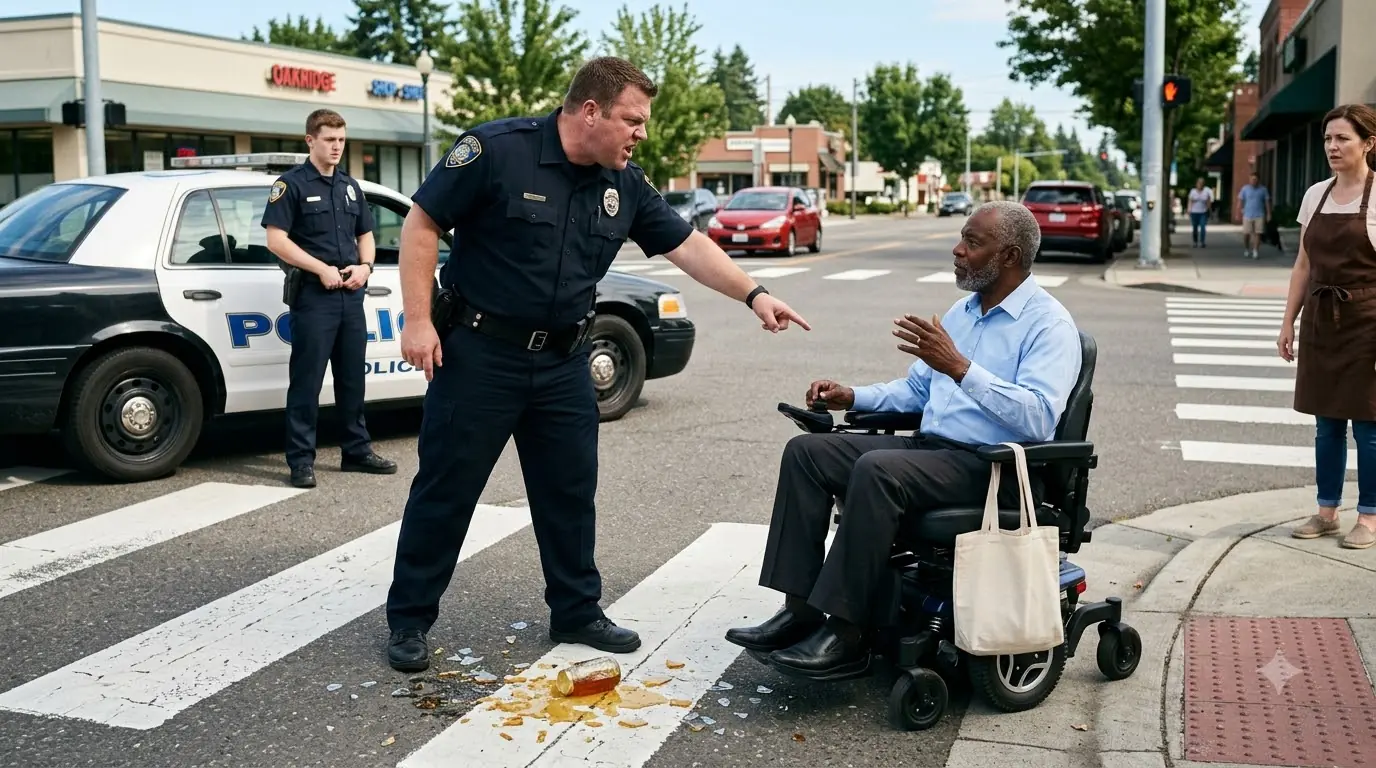
The horn.
It came as one long, furious blast, loud enough to startle a flock of birds from the maple trees lining Fourth Avenue and send two pedestrians turning toward the intersection.
Harlan lifted his head slowly.
A broken jar of honey lay on the pavement beside his right wheel, golden syrup spreading across the white paint of the crosswalk while several thick pieces of glass glittered in the afternoon sun.
He had been reaching for a cloth in the side compartment of his wheelchair when the patrol car appeared.
The pedestrian signal was still white.
He had entered the crosswalk legally.
His wheelchair had stopped only because the canvas grocery bag on his lap had shifted and the jar had fallen.
A reasonable person could have understood the situation in seconds.
Officer Derek Langford was not interested in understanding it.
“What is this idiot doing?”
Derek slammed his palm against the steering wheel again.
Beside him, twenty-four-year-old Officer Caleb Voss looked through the windshield at the elderly Black man in the motorized wheelchair.
“He dropped something,” Caleb said. “Looks like glass.”
Derek turned toward him.
“I can see that.”
Caleb shifted uncomfortably.
He had been assigned to Derek for less than three weeks.
Three weeks had already been long enough to understand that his field-training officer treated questions as challenges and caution as weakness.
Derek was forty-one, thick through the shoulders and neck, with a habit of clenching his jaw even when no one was arguing with him. He wore mirrored sunglasses despite the fact that the afternoon sun was beginning to soften.
His uniform was always immaculate.
His reports were always detailed.
His complaints file was not.
Caleb had heard rumors before his assignment.
Everybody in Oakridge Police Department had.
Excessive-force complaints.
Aggressive traffic stops.
A teenager shoved against a patrol car hard enough to split his lip.
A delivery driver handcuffed for twenty minutes because he questioned a parking order.
A Black contractor stopped three times in two months while driving through one of Oakridge’s wealthier neighborhoods.
Nothing had ever stuck.
There were always explanations.
No usable video.
Conflicting witnesses.
A complainant with an old record.
A report written so carefully that every burst of aggression became “officer safety” and every frightened reaction became “noncompliance.”
Derek had survived them all.
Chief Victor Thorpe had tried twice to place him on extended disciplinary leave.
The police union fought both actions.
One case died because a witness stopped cooperating.
Another ended in a settlement without an admission of wrongdoing.
Derek returned to patrol each time more convinced than before that he was untouchable.
That afternoon, he had spent half the shift explaining his philosophy to Caleb.
“People read hesitation,” he had said while cruising through Oakridge’s commercial district. “You let somebody question you once, everybody starts questioning you.”
Caleb had stared through the passenger window.
“Isn’t asking questions allowed?”
Derek had laughed.
“Academy answer.”
“What’s the real answer?”
“The real answer is people respect certainty.”
Caleb had not replied.
Derek continued anyway.
“These neighborhoods stay quiet because people know we’re here.”
A few minutes later, he pointed toward a young man wearing a hooded sweatshirt and walking beside a bike.
“See him?”
Caleb nodded.
“Baseline.”
“What about him?”
“Doesn’t fit.”
“Fit what?”
Derek had looked over.
“Don’t play stupid with me.”
That was when Caleb understood something he did not want to understand.
Derek did not simply believe in aggressive policing.
He believed certain people needed to be controlled before they did anything wrong.
Now, as Harlan Whitaker sat halfway across Fourth Avenue trying to keep cars from rolling over broken glass, Derek apparently saw another opportunity to teach.
“Watch,” he said.
He threw open the cruiser door.
Harlan watched him approach through the small rearview mirror attached to his wheelchair.
Even after retirement, Harlan noticed details automatically.
Stride too fast.
Right hand near belt.
Jaw tight.
Eyes locked on the subject rather than the hazard.
No attempt to assess traffic.
No immediate concern for whether the wheelchair user needed assistance.
Harlan had spent thirty-two years in federal law enforcement after serving in the United States Army.
Observation had become less a skill than a permanent condition.
He noticed exits when he entered restaurants.
Registered unusual vehicles without trying.
Remembered faces.
Tracked hands.
Measured tone.
His wife, Denise, had once told him retirement would be easier if he could stop treating grocery stores like unsecured crime scenes.
Harlan had told her he was trying.
He had been trying for six years.
Some habits never left.
The wheelchair had been part of his life for almost nine.
A spinal injury sustained during an overseas counterterrorism assignment had ended his ability to walk independently and eventually accelerated his retirement.
For the first year, he hated the chair.
Then he hated himself for hating the thing that gave him mobility.
Eventually, it became what it was now.
A machine.
Useful.
Reliable.
Unremarkable.
He did not consider himself helpless.